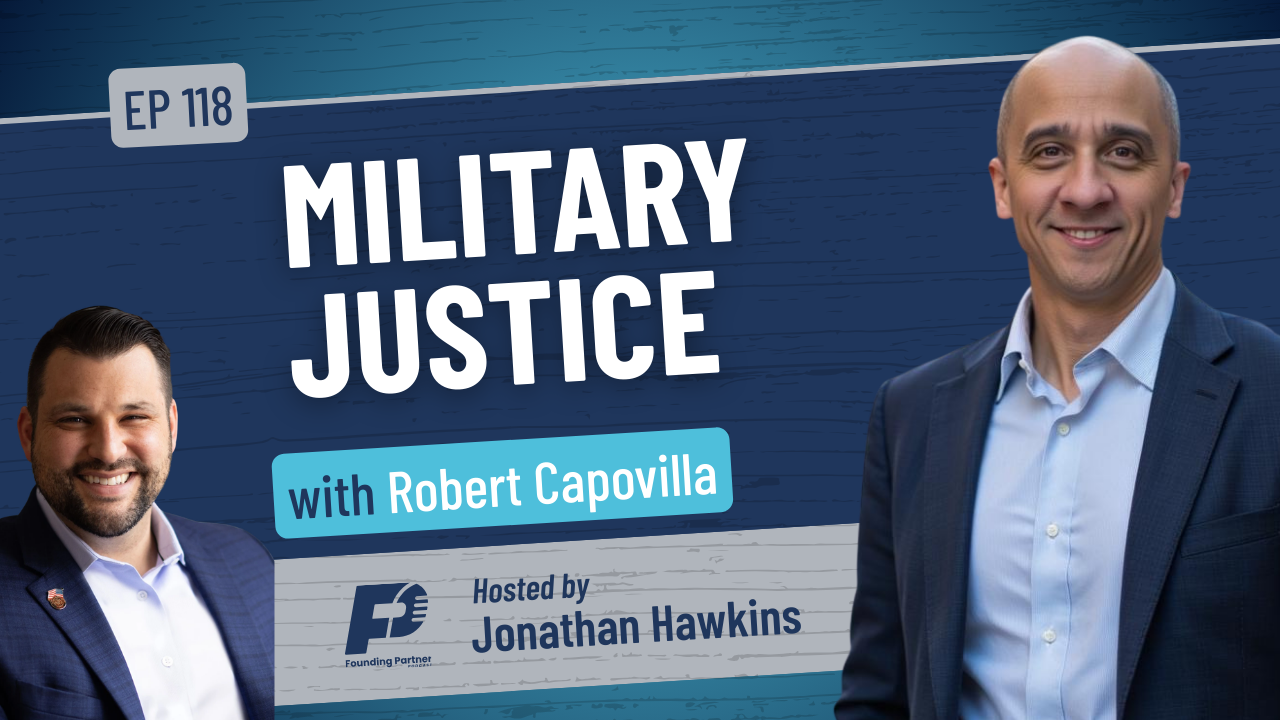
Military Justice with Robert Capovilla
From Army JAG to Entrepreneur
When Robert Capovilla and his partner Mickey Williams launched their firm in July 2020, it wasn’t a polished boardroom moment.
It was two former Army JAG officers, sitting in a kitchen, writing their mission statement while kids ran through the house.
No guarantees.
No certainty.
Just vision.
Today, Capovilla & Williams has grown to roughly 40 employees and 18 lawyers, serving clients nationwide in military law, veterans disability, federal employment, and education law.
That kind of growth doesn’t happen by accident.
It happens by design.
And discipline.
The Foundation: Vision and Core Values
Before they chased clients, Robert and Mickey built something else first — clarity.
A mission statement.
Core values.
A vision for what the firm would become.
Robert believes growth without clarity is chaos. And clarity requires commitment.
“If you want to take the island, you gotta burn the boats.”
For him, that commitment is daily. He reads his vision every morning at 4:30 a.m. It is not symbolic. It is operational. Because when overhead grows from $30,000 a month to hundreds of thousands, belief is not optional.
It is survival.
Marketing: Start with What Makes the Phone Ring
Robert does not romanticize marketing.
He simplifies it.
Start with direct lead generation.
“I don’t think you should start with SEO or social media or even billboards. I think that Google is still king… You gotta start with what makes the phone ring.”
Direct response first.
Branding later.
Google Ads. Paid search. Strategic investment. Even when it feels uncomfortable.
Then, once revenue stabilizes, layer in branding.
That’s when the billboards came.
Fifty of them.
Across federal installations nationwide.
And for six months? Nothing.
“I remember being six months in and thinking to myself, did I really just cut a six-plus-figure check for this crap? And then all of a sudden… it took off.”
Branding, like fitness, compounds. Not immediately. But consistently.
Authority Wins: Podcast, Book, and Visibility
Robert also built authority.
- A podcast, Military Justice Today
- A trial strategy book
- YouTube content
- Speaking at military bases
- Strategic visibility within veteran communities
The podcast started small.
“Ten listeners… probably six of them were my mom.”
But over time, some episodes reached tens of thousands of views. One surpassed 27,000 listens.
The goal was never fame. It was accessibility.
Make it easier for people who need you to find you.
And when they do, give them confidence.
That is branding done right.
Leadership Without Micromanagement
Nearly 90 percent of the firm’s lawyers are prior military officers.
Robert learned early in his military career the difference between strong leadership and suffocating leadership.
The best leaders trusted him.
The worst ones micromanaged every motion and every witness interview.
He built his firm accordingly.
“If I have to micromanage you, you’re not going to make it here.”
Trust strong people.
Hold the line on standards.
Act early on red flags.
And remember that culture scales only if discipline scales with it.
The Hard Truth About Growth
Growth is uncomfortable.
Robert does not sugarcoat that.
Overhead increases.
Sleep decreases.
Pressure rises.
But he refuses to be distracted by “shiny things.”
“I live in the same home that I bought when I was making $65,000 a year. I drive the same pickup truck I bought when I was a captain in the Army.”
Because you cannot build a national firm and live like you already sold it.
That is the tradeoff.
You can drive the Porsche.
Or you can build the empire.
But rarely both at the same time.
The Vision: A National Veterans Disability Powerhouse
Robert’s next chapter is clear.
He wants to build the most recognized veterans disability law firm in the country.
No upfront fees.
No claim sharks.
No exploitation.
Just disciplined operations, strong branding, and relentless commitment.
“We want to be the most well-branded disability firm in the country.”
That clarity is what fuels the sleepless nights.
And the 4:30 a.m. wake-ups.
Closing Reflection
Building a firm is not about ego.
It is about endurance.
It is about choosing discomfort over complacency.
It is about putting the chips on the table and letting them fall where they may.
Robert’s journey reminds us that growth is rarely glamorous in the moment. It is gritty. It is uncertain. It requires belief before proof.
But when vision meets courage, momentum follows.
Burn the boats.
Connect with Robert Capovilla
Thank you for joining us for this episode of The Founding Partner Podcast. Stay tuned for more conversations with founders who are building firms with intention, discipline, and vision.
AND MORE TOPICS COVERED IN THE FULL INTERVIEW!!! You can check that out and subscribe to YouTube.
If you want to know more about Robert Capovilla, you may reach out to him at:
- Website: https://www.military-defenseattorney.com/
- Podcast: Military Justice Today
- YouTube: https://www.youtube.com/@capovillawilliams
- LinkedIn: https://www.linkedin.com/in/robertcapovilla
Connect with Jonathan Hawkins:
- Website: https://www.lawfirmgc.com/
- LinkedIn: https://www.linkedin.com/in/jonathan-hawkins-135147/
- Podcast: https://www.lawfirmgc.com/podcast
Jonathan Hawkins: [00:00:00] So let’s dive in to the extent you’re willing to share some of the things that you guys do for your firm to market. And again, I talk about this a lot and lots of things people can do, lots of things that work. Where have you been focused on last few years? What kind of stuff do you guys do.
Robert Capovilla: I think you have to start with direct lead generation. I don’t think you should start with SEO or social media or even billboards. I think that Google is still king, in my opinion. That might be changing with Ai. I don’t know. You gotta start with direct lead generation. You gotta start with what makes the phone ring.
And to me that’s always been Google. Now can’t be silly when you mass market. You’re gonna get bad leads. You’ve gotta poke through the bad ones and you gotta get to the good ones. That’s the nature of running a practice. Then from there, I think once you start getting a steady flow of leads and you’re, okay, I have figured it out.
I’m paying my [00:01:00] bills, we’re making a little money, whatever, then I think that’s where you really start to talk about branding. You know, I think direct lead generation is different than branding. You’re not building a brand by paying to be at the top of Google, right? You’re paying for calls there. Then I think it’s branding and after we invested in Google and did some other things, we decided we were gonna do billboards. And so we’ve got about 50 billboards across different federal installations in the country.
That’s made a big difference. It’s sort of like, you know, it’s like a workout routine. You’re not gonna see with billboards, you’re not gonna see immediate gratification, but if you stick with it, you know, I remember being six months in and thinking to myself, did I really just cut a six plus figure check for this crap? And then all of a sudden. It took off.
Welcome to the Founding Partner Podcast. Join your host, Jonathan Hawkins, as we explore the fascinating stories of successful law firm founders. We’ll uncover their beginnings, triumph over challenges, and practice growth. Whether you aspire to launch [00:02:00] your own firm, have an entrepreneurial spirit, or are just curious about the legal business, you’re in the right place.
Let’s dive in.
Jonathan Hawkins: Welcome to Founding Partner podcast. I’m your host, Jonathan Hawkins. This is a podcast where I get to interview cool founders that are doing really cool things with their firms and hear about their journeys, and hopefully get some advice from them and learn from maybe some of the mistakes they’ve made along the way.
Not that today’s guest has made many mistakes. We’ll see. We’ll see what he says. But
Robert Capovilla: I’ve made my fair share.
Jonathan Hawkins: yeah, so, so I wanna welcome Robert Capovilla of Capovilla & Williams. He is a I’ll call him a military lawyer and I’ll let him explain what that is here in a minute. But Robert, thanks for coming on the show.
Why don’t you give a little bit of a high level about you and your firm, how many people you have, what sort of practice series you do.
Robert Capovilla: Yeah, I [00:03:00] appreciate that. It’s a pleasure to be here. I enjoy talking about the business side of law and I enjoy talking about you know, sort of the maturation of our business. So, thanks for having me. Yeah. So, our law firm started off with me and my partner, my co-founder Mickey Williams.
We served in the United States Army Jag Corps together got out together had some other ventures that led us to Capovilla & Williams. And we’ve now grown to a law firm of about 40 total employees. We’ve got 18 lawyers on staff right now. And we primarily handle four different areas of law.
So, you’re right. We, we do military law, so we do. We represent service members in, in all sorts of matters all over the country and all over the world. Really. That’s how we got started too. That’s litigation heavy. And then we’ve got our veterans disability practice. And we’ve got our federal employment practice where we help federal employees across the country that are dealing with investigations or are the victims of, you know, things like harassment in the workplace.
And then we’ve got our educational law [00:04:00] department. So we help college students and professors and faculty and staff that are, under investigation, under Title IX or some sort of applicable code of student conduct or for a faculty and staff member of you know the the faculty and staff code of conduct.
Jonathan Hawkins: You know, I did not know you did education law. There’s, there was a time where I I sort of fell into that a little bit. I won’t go into all that, but I did it for a very short period of time, maybe 10 or 11 years ago. And, very interesting. And then I got out real quick. But
Robert Capovilla: I understand.
Jonathan Hawkins: but my, what I have found, what I found then and I don’t know if you personally do it, but the schools, they have these I guess process of justice they’ll call it, but there really was not due process and nobody knew what they were doing.
And so, you know, the, you have these untrained college staff trying to make their way through this thing, and they were just stepping online, man landmines all over the place. [00:05:00] I don’t know if that’s been your experience, but.
Robert Capovilla: Yeah. It’s a unique I call it like a quasi-judicial experience because it’s on the university side, it’s typically a bunch of folks that are not lawyers that try to behave like lawyers, and so. Every Title IX case or student Code of conduct case that we have is, entirely new on its own, so to speak.
Right? Now we’ve been fortunate enough to do ’em, you know, at some consistent university, so we kind of have a feel for how that works, but we do that nationally. So it’s a wild world, and I think part of that is why we were attracted to it. My our first ever Title IX case came out of Emory University, and we had kind of grown up as litigators defending folks who were accused of, you know, major level felony crimes and sex crimes.
And so when we took this case, I remember thinking to myself, this is going to be a an easy win. Nobody’s gonna take this allegation seriously. And what I came to find out is no. Sometimes in the Title [00:06:00] IX world common sense gets thrown to the side. We start discussing really kind of crazy things.
And so we kind of decided after that instead of, you know, pulling back from that and saying, this is a too different of a world. I kind of came to the conclusion that these primarily young men, right, they needed a voice because what was happening, the Title IX process was not fair or right.
And so that kind of became a motivation for us with that. So we kind of used our experiences as prosecutors and defense lawyers and litigators to help those college kids and, and a lot of professors do you know, deal with this really strange world that they call education law.
Jonathan Hawkins: Yeah, I agree with you there for sure. There’s a huge need for these folks. I remember one of the ones I did is real quick, we did a whole call it trial with the student body or whoever it was. The students got to decide, you know, they’re judge and jury, they were judge and jury. And at the end they [00:07:00] said, yeah there really was no evidence for the allegations, but we’re still gonna find against you anyway ’cause we just feel like it.
And I was just like, this is crazy.
Robert Capovilla: Yeah, it’s a, it’s a wild world, man. It’s a, it’s a very strange world. And, and that sort of thing happens, right? But we’ve, we’ve kind of perfected it over the years, you know, to the extent that it can be. And, and we’ve we have a group of lawyers here that, that do really good job with their, with their Title IX and their education law cases.
And but it is still strange. I mean, some of the terminology is lawyers is strange, right? I mean, there’s things that people get accused of that, you know, nobody with any degree of common sense would think that could violate any policy anywhere, ever. And yet. These, these primarily young men and students face expulsion and, you know, their lives being derailed over stuff that is really quite crazy in my humble opinion.
Jonathan Hawkins: Yeah, totally agree with that. So, so back to your firm. So when, when did you start it? How many years ago?[00:08:00]
Robert Capovilla: Yeah. So, Mickey and I had the bright idea to start this firm, right smack dab in the middle of COVID. So I think our LLC that we started, I think is dated around July 10th or so of 2020. So we’re not a particularly old firm in that sense. Now, of course, we, we’ve been practicing law a lot longer than that and between the Jag Corps and some other stops along the way.
But, Capovilla & Williams officially started in July of, of 2020.
Jonathan Hawkins: So that’s, yeah. So you’ve been around, let’s call it five and a half years-ish. That’s 18 lawyers, man, that’s tremendous growth. That’s, that’s awesome. So congrats number one. Number two, that’s a lot of growth to manage and oversee. How’d you do it?
Robert Capovilla: Well, think it’s more like present tense, right? Like, how am I doing it? And I, think the, the answer there is I think in its most simple, basic manner, we created a mission statement and core [00:09:00] values really our first few days in practice. And those, that mission statement and core values have been tweaked a little bit over the years, but not really.
And they’ve sort of served as the benchmark, the bedrock, right? Of what we’ve done and what we’ve built from. And so I, I think it starts with that. And then there’s just a lot of you know, I, feel like there’s a lot of two steps forward, one step back, sometimes two steps forward, and five steps back.
And I think that you just have to be resilient. And I think you have to be courageous and you have to get used to living a life that is uncomfortable. And so that’s what I think when, when you ask the question about how we manage it solid mission, solid core values organizational structure, building it from the top down, making sure we have the right people in the right seats, making sure we have operation procedures and SOPs for the business.
And then of course making [00:10:00] sure that we, you know, that we’re aggressive on the marketing front and that we’re doing things that are creative and, and that we’re persistent about that.
Jonathan Hawkins: So we will get into some of the marketing stuff later. I’m curious also one, well, I’ll say this, one of the things we’ve had discussions before today that, that I find that, you know, that I like about your approach is you invest, you have a thesis on maybe a, an area you want to grow, and then you invest to do it, and then it, you know, hopefully it turns out.
So I want to get into that a little bit later too. But, but before we get to all that, so when you started in the middle of COVID crazy times, it was just, was it just the two of you?
Robert Capovilla: that’s right. Yeah, that’s right. And we we wrote the mission statement and the core values in Mickey’s kitchen with his little, at that time his little five and 6-year-old boys running around. And it’s just the two of us. That’s, that’s how we started.
Jonathan Hawkins: Before you started, where, where were you? Were you at another firm? Were you straight out of military?[00:11:00]
Robert Capovilla: Yeah. So we I start, Mick and I both started our, our legal career careers as JAG officers. Right. And people ask me, when did you commission? And I, I, to be honest with you, it’s like, it’s kind of hard to remember now, but I think I commissioned somewhere around 2012. So I, I served about 10 years to an active and reserve time.
I got out of active duty, I think in January of 18. Mickey and I joined up with another attorney who was doing primarily military law. After about a year, we decided that we wanted to change some things and tweaked some things, and we weren’t exactly bought and sold with the future outlook of, of that endeavor.
So we joined a, a firm here in Atlanta that primarily does divorce work but they also do some they do a lot of military divorces. They had a, a military nexus in connection, and so we spent some time there. Which was valuable in some ways. You know, you learn what you wanna be and what you don’t want be when you see how other people run at that time, what I consider to be a fairly sizable practice. And then that led us to starting our own, our own [00:12:00] practice in 2000. And like I said, July of 2020. And it’s been an adventure ever since. It’s been certainly challenging and rewarding and all the things that come with entrepreneurship, I think.
Jonathan Hawkins: Did you have clients and cases when you started or did you start from scratch?
Robert Capovilla: We started, you know, so we, when we left our prior firm and to start Capovilla & Williams, we brought with us a small caseload. But it was pretty much from scratch. I mean, there was not a lot of assurances that any of this was going to work. And so we just started with relatively small number of clients that kind of stayed with us and we grew from there.
Jonathan Hawkins: So, so we’ll get into again, and I said sort of the marketing piece, how you get clients, but before we get there you know, I was talking to an attorney yesterday and their problem is not getting more clients, it’s finding the legal. The lawyers to do the work.
Robert Capovilla: Oh, sure.
Jonathan Hawkins: so I’m curious, you know, growing a firm from two to 18 lawyers, that that’s no small feat, [00:13:00] especially over five years.
How do you find your lawyers? How, how, how do you go about recruiting folks?
Robert Capovilla: You know, my business coach and my marketer told me very early on that finding the right people in the niche work that I do would be my hardest challenge. And start, he was right. You know, we used to advertise. I remember the, the first couple hires we did were people that we had known.
Somewhere along the way, maybe we served with them in the Jag Corps. But then as we really started to grow you know, we, we had to kind of diversify that and we used LinkedIn that was sort of our primary method for hiring especially during the early days. And I found that to be pretty effective.
You gotta spend some money on it. But if you do that, I found it to be an effective way to do it. And then I remember early on, Jonathan, you know, we would put an ad up and we’d get a resume a week. You know, we just hired two or three new lawyers around the new Year, and in that batch, you know, we were getting about [00:14:00] 75 a week of resumes.
So I think once we started to establish ourselves within the niche practices that we have, you know, that is, I think one benefit of, of owning a firm that does, you know, more niche work is you can find good quality people because they might not have a ton of options to do what they love elsewhere.
So that part has turned out to be one of the most rewarding parts of my job. But also one of kind of the surprising, I’ve been surprised last couple years just about how. The, the quality of applicants that we’ve, we’ve, we’ve received and the quality of people we’ve been able to bring on.
Jonathan Hawkins: And I imagine too, the more established you are, the more relationships you have out there and people that know you and your firm, you’re probably getting people sent to you on a regular basis which is always makes it a little bit easier too, I would imagine.
Robert Capovilla: Yeah. It, it happens that way, you know, especially like on the military side, right? Where, you know, we’ll, [00:15:00] we’ll come across a talented judge advocate that’s either working as a prosecutor or defense attorney on a case we have. And, you know, the, that can sometimes lead to conversations like, Hey, you know, I’m thinking about getting out in six months.
And it’s like, oh, okay, well let’s chat about that. Right? So that part of it you know, as we’ve gotten bigger and our reputation has grown that part of it has been a little easier.
Jonathan Hawkins: And so your, your attorneys and your staff, are they all local coming in the office or are they dispersed hybrid or a mix of both?
Robert Capovilla: Yeah, so it’s a mix of both. We’re a national law firm, so we have attorneys in Colorado Springs Florida, Texas some, some up in the Northeast. And then we’ve got a group of of attorneys and staff that work here at our two locations in, you know, in, in Woodstock, Georgia, and north of Atlanta.
So it’s sort of a mix of, of both which is nice. I’d like eventually to have everybody under one roof, but I don’t think that would ever happen. But I would like to at least have my Georgia team all under [00:16:00] one roof.
Jonathan Hawkins: So I, I really don’t know much about military law and I’m curious we can, you can talk about a little bit about it as well, but does it make sense for you and I, I just throwing this out of the dark ’cause I really don’t know, but to set up near in proximity to bases and, and military establishments.
Is that sort of a, a strategy potentially for you? I mean.
Robert Capovilla: It is it’s a strategy that we haven’t taken full advantage of. I decided relatively early on that I wanted to be in a region where there was a lot of military and veterans. And so Georgia kind of fit that, that mold for me. But I also, you know, I didn’t wanna live like right outside of a base, because if you go to those bases, you’ll, you’ll, you’ll see that they’re not always the, the best places to live and to to have a family and all that kind of stuff.
Right. So, we picked. Atlanta, the Atlanta area for a couple reasons. One was [00:17:00] there’s a lot of travel for our litigators in, in the military side, so you’ve got the airport here. And two, we were sort of strategically located, kind of in the middle of, you know, a number of the largest installations.
Now we’re gonna be opening an office in Texas, outside of joint Base, San Antonio in July. I’d like to get an office in Colorado Springs. So we’re gonna be doing more of the local model stuff, but for us to start, you know, it, it, we were just hoping to make it right to, to make a living. And so we decided we wanted to pick a place where we wanted to live and, and we would build around that.
Jonathan Hawkins: Yeah. You mentioned Colorado Springs. My, my nephew’s about to graduate from the Air Force Academy, so I was like, okay, you must, you must be targeting
Robert Capovilla: Yeah, I’ve been there, I’ve been there.
Jonathan Hawkins: I have not, he tells me it’s, it’s gigantic, the base, just huge.
Robert Capovilla: it’s a, it’s a fascinating place. I had a jury trial there. I represented a cadet [00:18:00] and we won. And I remember that case because it was probably one or two in the morning when we got the verdict. And they deliberated for probably seven hours or eight hours. And for my line of work, that’s a long time.
And I remember thinking that’s not good. ‘Cause I felt that it was sort of a all in or not. And I do remember going back out into the courtroom they have there. And I remember standing up next to my client, who I truly felt was an innocent, an innocent man. And I remember this full bird colonel who was a pilot who just had, you know, metals on, metals on metals on metals stood up and. One by one each charge, you know, not guilty, not guilty, not guilty. And that was a really cool a cool day. My client was a first generation American from the Philippines who came to this country to go to the Air Force Academy, and it was the biggest thing his family could ever imagine him doing. So, it really was a, a special day and [00:19:00] a special a special case for me that I still remember.
And it was one of the earliest trials that I had, and I also remember it because I only thought it was gonna last a couple days. So I only brought two suits and it ended up lasting. I learned a lesson that it ended up lasting like seven or eight days. And, and by the end of the trial, I mean as embarrassing, this is a say on our podcast.
I mean, my suits had sweat stains on ’em. It was sort of embarrassing being in front of a bunch of highly, you know, highly decorated military officers. And I remember I made a little joke about it ’cause you couldn’t hide it. There was nothing I could do. I mean, I was dry cleaning that stuff. I bought a little steamer, you know, so I remember that.
That’s my story about the Air Force Academy.
Jonathan Hawkins: Nice. So you mentioned the trial. So, the other thing, you know, I imagine as your firm has grown, your role in the firm and your sort of responsibilities has probably evolved and changed. So maybe, you know, compared to the early days where you’re trying the cases and doing all [00:20:00] this stuff, what kind of stuff do you do nowadays in the firm? Are you trying cases?
Robert Capovilla: A, it’s a lot different. You know, it’s a lot different. I still take trial work. Now I do it with a team. But to me, my competitive nature my belief system, I still think that there’s value and, and not, not that I think I’m, I’m certain that there’s still value with me stepping into the arena of the courtroom for the folks who need it.
But the majority of my time now is spent, you know, running the practice. We recently named me CEO, we named my, Mickey managing partner. And we do executive, we do what executives do now, most of my day, I mean, I, I love I love content. I love to write. I like to speak. I still enjoy sales and marketing a lot, so a lot of my time.
You know, I, I think that a lot of my time is spent on my people and then on our profitability, right? [00:21:00] That’s sort of my role now, and that leads to a lot of stress. Sometimes when you run a, a law firm that’s grown like ours has and some days are great, and some days like today when you’re waiting for your per first payment to come in, it’s not so great.
Jonathan Hawkins: Yeah, so, I’m curious what your experience has been mentally psychologically, whatever you wanna call it, from, you know, a lot of lawyers that identify as lawyers and as trial lawyers when they move into this business role, they don’t like it. They don’t wanna do that. What’s been your experience?
Has it been easy, or which do you prefer?
Robert Capovilla: I love running my business. I love the I, I love being an entrepreneur. I, I wake up, you know, I wake up every day. I, it feels like, and I have a hundred ideas. And, and Mickey or our marketer or our team will literally tell me, like, you know, stop with this. Let’s execute the plans we have. So for me, it’s been a way to sort of, an outlet for whatever creativity I [00:22:00] have.
I think that I do miss the courtroom. I, I’m not in the courtroom as much as I used to be, but the cases I do take now tend to be our higher. You know, our, our our, whether it’s higher publicity or something that I just fundamentally believe in. So I, I still get to, I still get to do that, but it’s been a transition.
I’ve enjoyed it. You know, I one time heard John Morgan on a podcast and he was talking about how much he loves being a CEO compared to being a lawyer. And he, he talked about he knew that he was gonna be an entrepreneur when he, when he was delivering papers as a kid. And most of us are not ever gonna be as successful as John Morgan is.
And, and we’re not gonna build what he’s built. It. It’s astonishing what he’s done. But I, that made me think, I remember after that podcast thinking, well, were there any early signs for me for being an entrepreneur? And the answer is really no. Except. My buddy from high school brought this up [00:23:00] when I was at a wedding last year and they said, you know, how big is your firm now?
I said, oh, I think we got about 35 or 40 people. Oh my gosh. You know, like, wow. And he said you know, Rob, I, I always knew that because whenever we would play sports games, whether it video games, whether it was Madden or MLB, ’cause we were big sports guys, he goes, you never would play the game. You would just, you would just build your teams and draft and do the banking, and do the marketing and, and then simulate the seasons.
And we always thought you were, you were super crazy to do that ’cause you know, you were the only guy we needed to do that. So maybe that was a, and he precursor to what I do now. So I enjoy I enjoy the development and the organization and everything that sort of goes into that.
Jonathan Hawkins: So I’m curious, your experience in the military, do you, do you think some of the training there and some of the operational system, whatever they teach you there, do you think that translates well or not? I’m guessing it does, but I don’t know.
Robert Capovilla: it’s funny when you tell somebody you’re in the army, they [00:24:00] automatically, you just think like, you know, you, you fight in wars. The Jag Corps obviously didn’t fight in any wars. We’re advisors only, and so, you know, I’m not, I didn’t go through Ranger school or anything like Mickey did, or, or one of our partners, Dan did.
I’m not a combat veteran, so I can’t speak to. Some of the harsher realities of military service. My military service was was primarily done in offices and in courtrooms. And I got to do some incredible things. You know, I got to go to air assault school and rappel outta helicopters, and I got to do some things that kept me physically fit, and I’m grateful for that.
But I think the biggest thing for me was the discipline. You know, prior to the military, getting up at four 30 or five in the morning would’ve been like going to Mars. You know, it’d be like, what? Then in the military, you know, you’re just expected to do it. And you’re expected to do it day in and day out, and if you don’t do it, you’re, you’re held accountable for that. Now, not everybody’s getting up at four [00:25:00] 30 in the morning, but, but you get my point is, you know, you had to be at physical training even as a Jag by 6:30 AM in the right uniform, in formation. And as an officer you sometimes lead people. So. I think it taught me discipline. I, I think it sort of, you know, I, I don’t know if I would say, you know, like the old adage, like, it made a man out of me.
I, I’m not sure that I would go that far, but what I would say is certainly there was me before the military and me after, and who I was after was distinctly more disciplined than who I was before.
Jonathan Hawkins: So you brought up a word, you said you were held accountable. I imagine as well that you had to hold pe other people accountable at certain points of your military career. And I, you know, I’ve seen this a lot in firms that I’ve been in. I just, I just, the nature of a lot of lawyers, they could be bulldogs in the courtroom, but they’re like pussycats in the office with the, the receptionist.
They want to, you know, they don’t hold anybody accountable ’cause they’re scared. [00:26:00] Do you think. The military training, has that, has that helped you be able to hold others accountable in your firm?
Robert Capovilla: Well, I think one of the greatest benefits that I got from my military experience was I got to work with some really incredible leaders and I got to work with some really bad leaders. And I’ve tried to take what I learned from the good ones and, and discard what I’ve learned from the not so good ones and what I learned from the good ones.
And this is something that I’ve just, I’ve held on to it Jonathan, because I just think it’s, it’s important is the best leaders I had in the military were not micromanagers. They, they were folks that would call me in and say, you know, captain Capovilla or Major Capovilla, we have a new case that you’re gonna prosecute and it’s your case and I’m your boss and you answer to me, but it’s your case.
We’ll meet every couple weeks. I wanna hear your progress, but I’m not going to be involved in every single aspect. We trust [00:27:00] you, we think you’re good. And that always caused me to do my best work. And, and those kind of bosses would let me make sure I, I had to do what I had to do personally to be prepared for high stakes, you know, felony litigation, where guys could go to jail for their lives.
I despised the leader that would every motion I filed, they wanted to see it. Every witness I interviewed, they wanted to hear a copy of the interview. You know, they, they, and so I really didn’t like that very much, and I didn’t know anybody that liked that very much. Now, when you’re brand new, you need that.
So I’m not, I’m talking more when I was experienced. And so I, I’ve sort of taken that. Model with me. And I, I tell my team all the time, you know, 90% of my firm is veterans and almost all of our lawyers are prior military officers. Probably 90% of our lawyers are prior military officers. I tell ’em all the time, I said, if I have to micromanage you, you’re not gonna make it here.
You know, your prior military officers, some of you have seen combat, you know, some of you’ve been deployed and into places most of us are afraid to go. So if I’ve gotta micromanage, [00:28:00] then they just won’t make it. So there’s not a lot of accountability to be held with their work product because they’re good, they’re good, they’re, they’re, they’re self-motivated.
Where I have to hold people accountable is the sales side of the business, because that’s the part where you don’t get training coming outta the military to be, to close business or how important a lead is. Right? And so that’s the part where I, I do have to manage a little bit. And I do tend to be a little bit more overbearing when it comes to that side.
But, you know, I’ve, I’ve learned if you have the right people, you, you don’t need to be, you don’t need to do a a lot of holding accountable. And and I think when you find, I’ve learned over the years too, when you see red flags, it’s important to act early and it’s best sometime to let those folks go early because it, it almost never works out.
Jonathan Hawkins: So you mentioned sales, so maybe that’s a good segue into marketing and I want to talk about ways you market your practice. But let’s start with your podcast. So you have a podcast, I think it’s, it’s [00:29:00] called Military Justice, right? Is that right?
Robert Capovilla: Yeah. Military justice today. Yeah.
Jonathan Hawkins: great name, love the name.
Robert Capovilla: Yeah,
Jonathan Hawkins: So tell, tell me about the podcast and sort of how you got started, how long you’ve been doing it.
Robert Capovilla: yeah. So podcast is four years old now. We’ve hit a bit of Hi, hi. A hiatus. The last three months we. Sort of switched studios and then the holidays crept up on us and we dealt with a government shutdown. And we’re back in the studio next week, which I’m excited about. But, but I started the podcast early on. We had no money to start it. We had no money. But I wanted to get, I wanted our service members that time. We were only doing military law, and I wanted our service members to hear Mickey and I talk and communicate and, and I wanted them to, you know, not all of ’em can afford a lawyer, and I wanted them to be able to click on a podcast and learn a thing or two about their situation and try to entertain ’em a little bit.
And it sort of took off from there. I mean, I remember the first couple days, you know, the first year it’d be like, we had 10 people listen, and probably six of ’em [00:30:00] were my mom. Then by the time, by the time. I remember we did a podcast on the Trump assassination attempt because Dan Higgins is a junior partner here.
He was a prior army sniper, so he did like his whole breakdown, which is really cool. And, and, and that podcast got 27,000 hits. And then, you know, some of our stuff on YouTube’s gotten more than a million views, which is really wild to me.
Jonathan Hawkins: So, lemme just pause for a moment. 27,000 hits on a podcast. That’s, I mean, that’s amazing that, that really, that is impressive.
Robert Capovilla: yeah. I mean, that’s what they look, that’s what my marketer told me across all the different platforms. Not all of it’s organic, right. We throw a little money into to, to marketing, but yeah, I mean, it cool
Jonathan Hawkins: I don’t care. That’s impressive, man.
Robert Capovilla: Yeah. It was cool
Real quick, if you haven’t gotten a copy yet, please check out my book, the Law Firm Lifecycle. It’s written for law firm owners and those who plan to be owners. In the book, I discuss various issues that come up as a law firm progresses through the stages of its growth from just before [00:31:00] starting a firm to when it comes to an end.
The law firm lifecycle is available on Amazon. Now, back to the show.
Jonathan Hawkins: So, so tell me about sort of the format of the podcast. Is it you and Mickey Spitballing? Do you have interviews? Is it, do you pick a topic and you dive deep? Is it educational? Tell me the format.
Robert Capovilla: That’s part of the reason we took a hiatus because we weren’t sure four year, well, three and a half years in exactly where we wanted to go with it because we, we started off just making eyes spitballing you know, let’s just talk about an issue that turned into that kind of developed. And then we started to have some, and we’ve had some bestselling authors on, we invited some very well-known people in military law to come on.
And then from there we’ve, we, we decided that. We wanted to get some of the other folks in the firm involved that come from a little bit different backgrounds than we do, you know, whether they’re Navy Jags or Marine Corps or Air Force. And so we’re gonna be kind of recalibrating it now. When we come back on, we’re gonna have more contributors from the firm on it.
We’re gonna also discuss a lot of veterans disability types of issues. And so it’ll be not [00:32:00] just military justice centric, but I’m hoping a bit more veteran relatable as well. So it just started off just me and Mick talking about, you know, military law related issues. I mean, that, that was it. And it, it was kind of cool because now and when we travel to a base or, or we go speak at a military event, people always bring up the podcast and it’s not that popular.
The average, the average episode was getting about 5,500, you know, listens or something. But still, for, for guys that just started it and didn’t really do much with it it, it’s a cool thing and it’s turned into a blessing for us.
Jonathan Hawkins: So I gotta ask have you seen, have you gotten clients out of it that you can loosely attribute or maybe directly attribute to?
Robert Capovilla: Yes. What I think about podcasts from a marketing perspective is it makes it easier for the people who are trying to find you, to find you. You know, if a podcast is your only source of marketing, you’re going to fail unless you’re, you know, Joe Rogan or [00:33:00] you know, something like that, right. Sean Ryan or whatever, whoever those guys are these days, right?
But it certainly has made it easier for people to find us.
Jonathan Hawkins: And one benefit, you know, for anybody out there thinking about it, it is a lot of work. You know, a lot goes into it, you never really know, but it does create a lot of content that you can repackage, leverage, et cetera, in all sorts of different ways. I’m sure you do that. I mean, you mentioned the YouTube channel, but I’m sure you do other things with it.
Robert Capovilla: Yeah. So, you know, my marketer does a really nice job of getting those episodes out. We’ve, we’ve spliced them up into little YouTube clips, you know, we’re on Apple and Spotify and all that kind of stuff. Right. I have plans to do more of that as time goes on, because you’re right there’s a lot you can do with a podcast episode.
And I get, you know, it’s kind of odd even though I’m not particularly old for what I do whenever I go to these lawyer conferences. I’m always one of the younger business owners [00:34:00] in the room. But what’s odd is people will come up now and ask me, you know, you know, how, how did you build your firm?
And it makes me laugh ’cause it’s like, if they could see inside the walls, they would know that this is not perfect and it’s not even close to perfect. But I, I always tell ’em like, you know, find a platform and get your voice out there. It can’t be all you do. You know, the lawyers that come up to me and are like, well, I, I have a great idea for TikTok.
Well, that’s great as a supplemental marketing approach, but you’re not gonna, I mean, I, I know some lawyers have done really, really well with social media, but I’ve always kind of believed in a comprehensive approach to marketing. And so I do think a podcast, if you’re, if you’re, you know, in a firm and you’re wanting to grow, it’s a good way to do it.
And it won’t break. You can do it like we’re doing it now in our offices. You don’t have to break the bang to do a podcast.
Jonathan Hawkins: Yeah, I do agree with you. It’s, it’s one piece of a bigger series of things you do. I definitely agree with that. So you mentioned a second that your marketer, is that somebody on [00:35:00] staff or is this sort of an outsourced person? Tell me about that.
Robert Capovilla: It’s sort of both. We I like to say that he’s our full-time marketer, but we, he certainly we’ve had discussions over the years and there are certain clients that he has worked with for a long time that he continues to work with. And so it’s, we also have some in-house people that support him. So we’ve kind of massaged that over the years. But I think that, you know, finding, finding a good marketer early was one of the best things we ever did. And I remember our first office was, was an awful little space. And we had, we, we, my business partner’s wife had put this plant in there and these bugs started flying around our office.
This, this is the kind of way we started. And the first time I met my mar, my now marketer, he was in that office and we were sitting there swatting bugs. And I’ll never forget when he quoted me as fee. And I remember thinking like, oh my God, there’s no way. But, you [00:36:00] know, Mick and I just decided that if at that time things were looking tough, we had maybe three months of survival left before it was gonna be closing doors time.
And we kind of just decided, I guess as army buddies, you know, that if we were gonna go down, let’s just freaking go down swinging. And lo and behold, I mean, within a relatively short period of time, the investment pulled off, you know, the investment worth it. And so it all kind of started after we got ourselves squared away on our mission and our values and then the marketing.
We’ve always been good lawyers. I mean, the world’s filled with good lawyers in my opinion. There’s a lot of really good lawyers. That are not making the kind of money they wanna make because they haven’t figured out the marketing side or they don’t wanna figure it out, or they, they don’t have the patience to let an investment work.
Jonathan Hawkins: And two points there. You gotta be willing to take a risk. Now don’t, don’t be too crazy, but you gotta be willing to take a risk and [00:37:00] you gotta take action. And you did both there. So you also mentioned you had a, you, he’s a good marketer. So any advice out there for somebody that says, Hey, I wanna go find a good marketer.
Robert Capovilla: yeah.
Jonathan Hawkins: do I find these people?
Robert Capovilla: man, I love talking about this stuff ’cause I don’t get to talk about it all that often. Right. Most of the time I get to go on podcasts, I probably do a couple a month. A lot of ’em are veteran related. You know, I get to talk about disability. I was on a podcast a couple weeks ago.
I got to talk about Georgia House Bill 1 0 8 and why I, why I think that’s terrible legislation and all this kind of stuff, but this is so much fun to me because it’s like. It’s all consuming, right? It’s my life at this point. So I’m, I’m really grateful that we’re talking about this. It is really, really, really hard to not be distracted when you’re a lawyer by all the marketing stuff that’s out there. It’s really hard. You have people that tell you, ai, you gotta spend a hundred grand a month on ai. You gotta do this, you gotta do TikTok, you gotta do [00:38:00] YouTube, you gotta do all these things. And, and then you’ve got your people, your, your marketers out there that are just trying to make a living. I, I get it.
But, you know, they’ll, we all get the videos, the advertisements, hire us, and we’ll triple your revenue in a month, and you’ll get a million views on, you know, on YouTube and all this kind of stuff. Or, you know, the, in the olden days, oh, you know, we’ll, we’ll hire us as your SEO guy and in, and in a month you’ll be the number one in the month.
In one month, John Morgan will be wishing he’s you. And, you know, you gotta get through and I, I, I hope you don’t mind my language here, but you gotta get through all the bullshit there. And you gotta find somebody who’s a straight shooter. And if you do that and they’re knowledgeable and they’re gonna care about your business and they spend time with you, they take your phone call at six o’clock at night or whatever, the guy to go with.
Because you just can’t be led astray unless you are made of money, which I was not. You, you [00:39:00] have to figure out what the real big hitters are to generate leads. And that’s the key man. I mean, that’s the key. Then you can grow from there. And then you can try stuff. You can have fun with stuff. I mean, I’ve done some marketing stuff that I’ve lost some money on, but it was sort of fun.
But man, it’s tough, you know, it’s tough to be a lawyer that’s new to the industry and you get all these people telling you, pay me and you’ll make all this money.
Jonathan Hawkins: Well, you, you hit the nail on the head there, so it is, I don’t know what it is, but it’s like lawyers are walking around with this big sign that says, I’m a sucker. And you’ve got all these people, these snake oil salesman, basically promising you that, I mean, you, you exactly like, gimme your money. I can do this, that, and the other.
And it’s, it’s hard to sort of figure it out. You know, it’s almost like a full-time job to try to figure it out. And so, you know, maybe you got lucky or, or maybe you had a system. But that’s why I asked, you know, for people that are out there trying to find, you know, maybe, you know, how can they begin to sort of figure out where to [00:40:00] go?
Do you have any advice on that?
Robert Capovilla: Yeah. You know, man, that’s a tough question, and I don’t know if I have the perfectly right answer. What I would say is very seldom when you’re shopping for a home, do you walk into the home and buy it site on scene. You don’t do that very often, and I don’t know anybody that does that, right?
When you buy a home, what do you gotta do, Jonathan? You, you, you go see a bunch of ’em, your realtor takes you around, then you gotta ha have people come in to check it out and make sure all the pipes and everything are working and, and all this sort of stuff, right? I think it’s like that when you purchase a marketer, ’cause you can make mistakes in business.
You can hire the wrong person. Every once in a while you might lose a case that you thought you were gonna win. There’s not a lot of forgiveness if you hire the wrong marketer, especially when you’re getting started. And so what I would suggest to people is interview the big guys out there, interview the guys that you have a hard time finding on Google.
Ask your friends [00:41:00] that are lawyers, how they did it. That’s where probably I would start. If you have a successful friend that, or a colleague that’s built it, ask him. And sometimes they’ll lie to you. So be prepared for that too. And then find the one that makes you feel comfortable. And then the other thing I, I guess I would say is I do think that one thing I’ve looked at is how do they market their own business? Right? That’s a tricky street. ’cause you got a lot of big, big marketing companies out there that make a lot of money off lawyers. And I’m not big into that world. I like to find the guy that I can call at eight o’clock at night. And so you gotta just, I don’t, that’s a long answer to an easy question, man.
But I, to me, you’ve got to explore the field. You, you’ve got to, don’t hire the first guy you talk to.
Jonathan Hawkins: Well, I do like the house analogy that that is such a good one. You don’t buy the first house you visit, you gotta look at a bunch of ’em to know.
Robert Capovilla: Right. And, and not to interrupt you and I, and I almost did, the other thing I would say is find [00:42:00] a lawyer specific marketer. Find a lawyer specific marketer. Don’t hire the guy who also has restaurants and, you know, amusement parks and whatever, hire sort of like you, right? Like if you wanna, if you wanna have a lawyer draft a fee agreement or do a partnership agreement for lawyers, you’re the guy to call because that’s what you do.
You know what I mean? I think it’s the same for marketers. I, I, I, my life changed when I went and found a legal specific marketer.
Jonathan Hawkins: So let’s dive in to the extent you’re willing to share some of the things that you guys do for your firm to market. And again, I talk about this a lot and lots of things people can do, lots of things that work. Where, where have you been focused on last few years? What kind of stuff do you guys do?
Robert Capovilla: I think you have to start with direct lead generation. I don’t think you should start with SEO or social media or even billboards. I think that [00:43:00] Google is still king, in my opinion. That might be changing with ai. I don’t know. You gotta start with direct lead generation. You gotta start with what makes the phone ring.
And, and to me that’s always been Google. Now can’t be silly when you mass market. You’re gonna get bad leads. You’ve gotta poke through the bad ones and you gotta get to the good ones. That’s the nature of running a practice. Yeah. Then from there, I, think once you start getting a steady flow of, of leads and, and you’re, okay, I, I have figured it out.
I’m paying my bills, we’re making a little money, whatever, then I think that’s where you really start to talk about branding. You know, I, I think direct lead generation is different than branding. You’re not building a brand by paying to be at the top of Google. Right. You’re, you’re paying for calls there. Then I think it’s branding and, and the, after we invested in Google and did some other things, we decided we were gonna do billboards. And so we’ve got about 50 billboards across [00:44:00] different federal installations in the country. That’s made a big difference. It’s sort of like, you know, it’s like a workout routine.
You’re not gonna see with billboards, you’re not gonna see immediate gratification, but if you stick with it, you know, I remember being six months in and thinking to myself, did I really just cut a six plus figure check for this crap? And then all of a sudden. It took off. And then I think, you know, figure out other ways to build your brand.
A podcast, I think is a great way to do it. If you’re a writer and you want to, I know a lot of people kind of poo p the idea of blogs today. It’s like old school now, right? I, I still write. I love to write. I think writing makes a difference. So you’ve gotta be comprehensive in your lead strategies.
And then there’s all your marketing strategies and there’s a whole bunch of other stuff. You know, you’ve got your super lawyer stuff, you’ve got your, your Martindale, you know, Hubble or whatever they are stuff. You’ve got your Justia stuff, your AVO stuff. I mean, that’s all to me. Supplement, you know, supplementary, that, that’s all to me.
Stuff you do when you have the money to do it. If you’re a new lawyer, new firm, [00:45:00] whatever, not even a new lawyer. If you’re new in a firm, focus on direct lead generation. Don’t focus on social media, don’t focus on all this other focus on direct lead generation, in my opinion.
Jonathan Hawkins: And so you touched on it a little bit, but one of my questions was gonna be because you have this national practice, national firm, you can’t spend money everywhere, all at once. So you, you bleed, you dry. John Morgan’s the only one that can do that. Right. So, so I was, I was gonna So you got the billboards.
That’s interesting. And you put ’em in the right places. I mean, that’s the other thing. You don’t wanna put billboards just anywhere. Just like for my practice, billboards would be the dumbest thing in the world for me to spend money on. But if I put an ad, which I’m about to do in a legal journal that only lawyers read, that’s like my form of a billboard.
Right.
Robert Capovilla: Yep.
Jonathan Hawkins: I’m gonna experiment. We’re trying it, we’ll see what
Robert Capovilla: yep.
Jonathan Hawkins: So other than the billboards, how do you, how are you sort of really, and I guess branding the podcast, what other ways do you get your name out? ’cause you can’t, the other [00:46:00] thing about. Google and SEO, you can’t do that all over the country all at once. how do you work through some of the thought process of where to focus at any given time?
Robert Capovilla: You know, you gotta have your, you’ve got to master the direct lead generation park first, in my opinion. Whether that’s you want to go network and get referrals, which I think I’ve never done a very good job of that. I, I’m a bit of an introvert despite the fact that I like to speak, I prefer to be keynote speakers than the guy shaking hands, if that makes sense.
So I’ve never been great at that. My old managing partner at my old firm, he was really good at that and they brought in good leads that way. I still think referrals are probably the best leads you get, but if you’re not somebody that loves that, or if you’re just got, if you’ve got cases and you just can’t get out there, right, like, that’s part of the problem.
To me, you know, I, I, I invested in directly generation, then I invested in branding the billboards, the podcast, the written content. And [00:47:00] then once we kind of got that underway, you know, I, ventured out into, you know, your, your, lawyer specific fields, like, you know, your super lawyers, your Georgia elites, that kind of stuff.
And then I, I kind of hit the road and I would go to the different like VFWs and American Legions and, and go talk and meet with folks. And then video. You know, video has been a central piece of what we’ve done. It’s expensive. Nobody likes it. Nobody likes cutting a big check for videos.
But to me, having a really high quality video that you market well, I think that’s helped too. And then, you know, you have your other things, like we wrote a book I got a royalty check, Jonathan. $396, which means 80 something people bought my book. And that’s a small number, but it was kind of cool.
It was kind of cool. So you gotta put yourself out there. And, and you’ve got to try and see what works in your, your line of work. You’re correct and your line of work. A [00:48:00] billboard would be silly, but targeting the people that could be your clients, which is what we’ve done with our billboards. We broke deals with bases, military installations, they go to the gym, they get to see my face.
I was at a base recently and this like very jacked built army ranger came up to me and he’s Mr. Capovilla. I look into your eyes every Monday and Wednesday when I do my squats. So now does that mean I’m a good lawyer? No, it doesn’t. But does that mean if that particular Army ranger runs into some problems or he has a buddy run into some problems, who do you think the first person in their brain is gonna be? Right.
Jonathan Hawkins: It worked.
Robert Capovilla: It works. I mean, and you know what’s funny about billboards is lawyers look down at other lawyers for billboards, right? But the public doesn’t do that unless you’re a silly lawyer and you’ve got like silly billboards. Like some of these [00:49:00] I see with like, you know, I don’t know these people that make fools themselves, but you people with the general public, when you have billboards, they think you’re a big deal.
They don’t know.
Jonathan Hawkins: It is funny you say that. I was in Athens I, six months ago with with, we were at dinner, a lot of us at dinner, and one of the people at dinner was sort of a local pi and he has, he has some billboards and they’re sort of funny and they’re interesting. Whatever. But all the wait staff, were coming up.
Are you so and so? Can we get a picture? it was. It was
Robert Capovilla: Yeah, there’s a local guy here whose operation is one fifth the size of mine, but he’s got billboards all over town. Good lawyer, good dude, great guy. And he’s like a, he’s like a local celebrity, kind of cool, but I guarantee you he gets business from that. I guarantee you people remember him. So us lawyers might see a slogan and go, I would never do that, but the general public remembers it.
You know, so I always [00:50:00] think when it comes to marketing, look, I know John Morgan is a, a character in, in the legal world. Either admire him or you hate his guts. But I always said from a marketing perspective. Look at what that guy is doing and if you can afford to do some of it, do it. ’cause he’s not a dumb guy.
And so I’ve kind of looked at those mega PI firms and I’ve thought to myself, okay, well how can I incorporate that into my business? And that has worked well for me. That’s worked well for me. And people, you know, people make fun of our billboard sometimes and other our competitors don’t like ’em. But, you know, to me, I don’t care.
It gets our name out there to the people who need us.
Jonathan Hawkins: I hear you. So, so you mentioned the book. Tell me about the book. What’s it called? What’s it about? How do you, how do you use it?
Robert Capovilla: Yeah, it’s a book. You know, I wrote this book over winter break three years ago in two weeks. We weren’t very busy at the time. It was winter. Everything kind of shuts down in the federal government. I wrote this book called Defense Strategies and How to Win Court Marshals. [00:51:00] And I, I put everything I had into, it’s really a litigation book.
It’s a trial strategy book. How, how to build a case from scratch. We’re gonna update it next year, not this year, but next year we’re gonna update it. It’s for Salem, Barnes and Noble and Amazon and all that stuff. And you know, we’re proud of it. It, it’s, it was sort of meant to be a pocket guide. It’s only about 150 pages.
It’s meant to little be, kind of be a pocket guide for the folks out there that might wanna hire a lawyer, but, but couldn’t necessarily afford it. And my thought process was at least they can have something to, to serve as a benchmark for them, you know? So yeah, it’s a, it is a trial strategy book.
Jonathan Hawkins: So do you hand that to leads or when you speak, how, how? How do you distribute it? Or is it just If they buy it, they buy it?
Robert Capovilla: When I travel to the bases, we give it to the JAG officers that are in, in, at the base because that’s, they put it in their bookshelf and client that comes in to see the free legal help that the military officer sees our book. That’s the first thing I do. The second [00:52:00] thing I do is it’s on the website and then the third thing I do is I include a link in, in our reach out emails when we’re done with talking to a lead, we send an email that breaks down the agreement, has some information about the firm.
I include our, our, the book link in that email. For no other reason than it gives us some authority. The other thing that I would say too about marketing is this your, one of your best marketing approaches is your success. And so you gotta have a good team and you gotta have good lawyers, and that’ll lead to good reviews.
I always find it shocking to me how many lawyers don’t care about their Google profile. It’s wild to me. You know, I, I look at these good lawyers like guys that you would say that’s a smart lawyer and they’ve got a 4.2 with 18 reviews. You know, I mean, to me. That shows a lack of attention to detail.
And if I’m a lead, if I’m, if I’m gonna hire a lawyer, I want somebody that cares a lot about detail. So it’s kind of those [00:53:00] little things, Jonathan, that, that the, that lawyers, us lawyers, we tend to put our nose in the air. I’m a lawyer. I have a really fancy degree, and I’m really smart. I know transactions better than anybody in America.
Nobody cares if you don’t market. Nobody cares. Nobody cares. And you’re not helping people.
Jonathan Hawkins: That is a mindset shift that a lot of lawyers need to hear. It’s marketing allows you to go help the people that need you, so you, you need to do it. So,
Robert Capovilla: That’s right.
Jonathan Hawkins: so,
Robert Capovilla: that’s a motivating factor for us.
Jonathan Hawkins: so we’re, we’re, we’re getting close on time here. I I do have two more questions I wanna
Robert Capovilla: Yeah. It’s great, man. I got all, I’m happy to do it. Yeah.
Jonathan Hawkins: again, we’ve got lots of things we we’re not gonna be able to cover, but so for somebody out there that’s starting a firm, starting to grow a firm, they look at you, you, you, they see, you started, just two of you now.
You got 18 lawyers. Any pieces of advice you might give them for the folks that are trying to get where you are?
Robert Capovilla: I don’t know. I, I think [00:54:00] we’re halfway done with our journey here. I think in the next five, five to seven years, I, I would be surprised if we don’t hit a hundred total employees and 30 to 40 total lawyers. So I always feel kind of self-conscious answering that because I don’t really view myself as all that successful.
I just don’t I know some people would look at a firm of 18, 19, 20 lawyers, which is where we’ve kind of been, and they think that’s big. And I think if you would’ve asked me five years ago, my, my jaw would’ve dropped out of my face if you would’ve said, you’re gonna have 20 lawyers by 2026. But if you’re asking me to provide some advice. What I think has to be at the top of the list is a commitment to the vision. And I’m not talking about a mild mannered commitment. I’m not talking about going to the gym for a month and being like, it’s not for me, man. When you grow as fast as we have and you go from 30 grand a month of overhead to a hundred [00:55:00] to half a million dollars a month or whatever it might be, if you’re not committed to the vision, you’re not going to make it.
It is a hard thing to do. I don’t sleep at times. I am uncomfortable a lot but I’ve always believed this is maybe the military or the historian in me. If you want to take the island, you gotta burn the boats. Nobody likes being uncomfortable, Jonathan, least of all me. Do you think I enjoyed increasing the overhead, another 40, 50, 60, 70 grand or whatever it is?
No, not really. I didn’t, but I also know what the vision is and we remain committed to that. So a commitment to the vision, I think is, is first and foremost. And I think you gotta be honest, you gotta be true to yourself too. If you’re the kind of guy you want a nice small practice, there’s nothing wrong with that.
Be true to yourself, man. Know yourself. Me, I’ve always wanted something big, you know, I’ve always, I’ve always wanted something big. I think the second thing is, is you gotta have guts. [00:56:00] And I tell myself, you know, I, if you don’t program your mind, your mind will program itself. And that’s not always good for people.
It. Every morning I wake up, I have the same routine that I stick to brother except for Saturdays. And, and sometimes Sundays, but four 30 in the morning, I am reading my vision statement every morning just to be tough, just to remind myself about why am I having sleepless nights? You know, why am I on the phone nine hours a day? So I think number one, you gotta have a vision. Number two, you, you’ve got to commit to the vision. And to me, that’s always been reading it, reminding myself about it, you know, meditating on it. And then the third thing is, man, you gotta accept failure. I mean, you, you gotta accept failure. I don’t care if you’re John Morgan or if you’re President Donald Trump, or if you’re an athlete doesn’t make a difference to me.
You’ve gotta be willing to accept failure. I, I honestly think we fail as much as we succeed here. But. We put ourselves in [00:57:00] the arena, that’s all you can do. The chips will fall where they may after that. My father, when he was alive, God bless his soul, always used to say, you worry too much, Rob. Let you know.
Do your best. Put the chips on the table and they will fall where they will. And, and I’ve tried to do that in my business life. And, and if you’re gonna have a business partner, which I do, and there’s ups and downs, that’s almost like a second marriage. There’s been times where both of us have wanted to be at each other’s throats. But I guess the last thing I would say, I know this is a long answer, I apologize. I know we’re like an hour into this thing already, and I’m very long-winded. I you have to have a business partner like who you guys aren’t gonna have a hundred percent the same vision. It’s just not reality. But one thing Mickey and I have done exceptionally well.
I live in the same home that I bought when I was making $65,000 a year. I drive the same pickup truck I bought. When I was a captain in the army, I read in a book somewhere, you cannot be distracted by the shiny things. We make the kind of money now, Jonathan, where if we wanted to, we could do it, and there’s gonna come a day where our [00:58:00] families deserve it. But to build a law firm, you know, and you want to take out six figure distributions for yourself, unless you’re a big time PI lawyer and you hit some big windfall PI’s, a little different. Most of us guys that are litigators that are doing niche stuff that live off of retainer fees, and you gotta make your mind up what you want to be.
You wanna drive the Porsche, or do you want to have a firm of a hundred people someday because you can’t, can’t do both always.
Jonathan Hawkins: So great answer. And you didn’t know this, but it’s actually the perfect segue to what I was gonna ask you last, and that is to the extent you’re willing to share it, what is your vision for the firm and for your life? Maybe it’s the same thing, maybe it’s different. So what’s the vision?
Robert Capovilla: So I want to you know, our next phase of development is going to be on the VA disability side, and I want to build an empire from coast to coast and help veterans with their disability claims. I am sick and tired [00:59:00] of the claim sharks. I’m sick and tired of getting calls from veterans about they had to pay $15,000 upfront or some nonsense to have some weirdo file their claim for them.
I, I want to build a a big well run disability practice for our veterans where they only pay if we win. And I want to be the most branded firm in the country in that. So if a VA disability attorney hears this I suppose they should put themselves on notice to some extent. But that’s what we want, you know, and we wanna continue to cultivate our litigation practice.
We want to be, I don’t know if I want to grow that much more, because I think great litigators are hard to find. So you, you gotta be careful there, you know? But to me I want to be the most well-branded disability firm in the country.
Jonathan Hawkins: I love it. We’re gonna end it with that Robert Capovilla. Thanks for coming on. For people out there that. When I find you, what’s the best way?
Robert Capovilla: Yeah, so, [01:00:00] obviously you can look up the name you can look up the name Capovilla & Williams. You can look up our podcast Military Justice today. You can look us up, Capovilla & Williams on YouTube. And if I could too, Jonathan, just give you a shout out, man, like if you’re a lure that’s listening to this and you’re interested in growing your firm, Jonathan can help you do that.
I know personally that he can help you do that. And so, part of growth is having your own lawyers. Okay? That’s part of growth. That’s part of it. Guys. Don’t be writing your own contracts, folks. ’cause unless you’re a contract lawyer, even then you might not wanna do it. So you can find me all kinds of places, but I at least wanted to say that ’cause you’ve got a cool niche, man, and I think you’re in a cool area of law yourself.
Jonathan Hawkins: Well, I appreciate that, and you didn’t have to do that, but I, I do appreciate that. It’s, it’s been fun getting to know you and seeing what you’re building over there and, and I can’t wait to see. Five years from now, you know, another five years. So that’d be your 10 year anniversary. May maybe you’re double the size or more.
So it’ll be fun
Robert Capovilla: I don’t know. We’ll see. I’m just trying to get through [01:01:00] today right now, to be honest with you.
Jonathan Hawkins: Yeah. You may not be getting much sleep but you
Robert Capovilla: not so much these days, but that’s okay. That’s okay. It’s all part of it.
Jonathan Hawkins: that’s right. Well, cool. Well again, thanks for coming on man.
Robert Capovilla: Of course. Brother. Thank you so much.
OutroUpdatedWebsite-1: Thanks for listening to this episode of the founding partner podcast. Be sure to subscribe on Apple podcasts, Spotify, or wherever you get your podcasts to stay up to date on the latest episodes. You can also connect with Jonathan on LinkedIn and check out the show notes. With links to resources mentioned throughout our discussion by visiting www.lawfirmgc.com. We’ll see you next time for more origin stories and insights from successful law firm founders.