Lawyer on the Beach with Regina Edwards
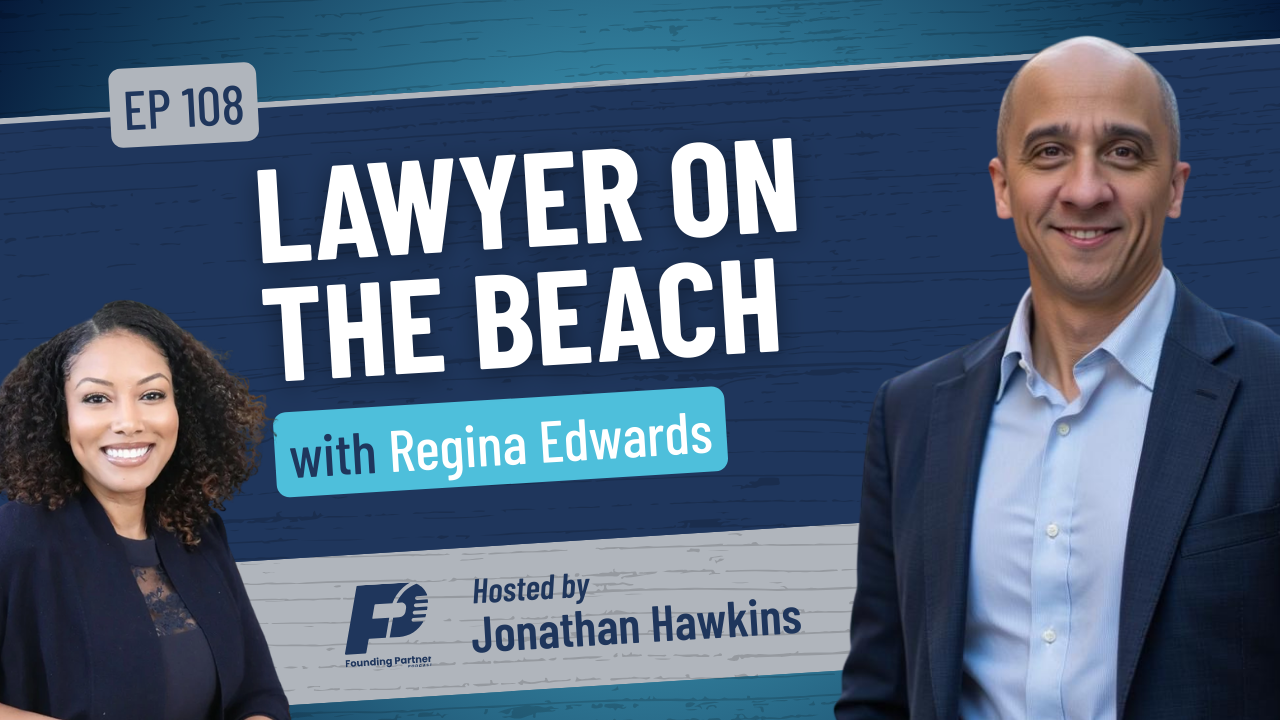
When I sat down with Regina Edwards, one thing stood out immediately.
She was calm.
Not disengaged. Not detached. Just steady. At ease. And as we talked, it became clear that this wasn’t a personality trait so much as the result of very intentional design. Regina has built her practice, her systems, and her boundaries on purpose, and that design shows up everywhere.
It shows up in how she prices cases.
It shows up in how she communicates with clients.
It shows up in the hours she keeps, the technology she uses, and the clients she chooses not to take.
And it shows up in one of the first things she said that really stuck with me:
If you don’t have a communication policy, your clients will write one for you.
Why Regina Left the Model She Started In
Regina didn’t spend decades inside another firm before opening her own. She worked for a family law firm for about six months, and she knew she couldn’t function in that environment.
She had always planned to start her own firm eventually. She just didn’t expect to do it that soon.
What pushed her was the way billing and client relationships were handled. The firm used a very low retainer, $1,800, billed every two weeks, and that retainer was often gone before the client even left the consultation. When the money ran out, the client was dropped, sometimes right before an important hearing.
Whether meaningful progress was made for the client felt secondary.
She didn’t like the feeling that billing was the goal and helping the client was a bonus. She also didn’t like billing itself. Tracking time, recording every increment, constantly watching the clock. It didn’t align with how she wanted to practice law.
So she committed to flat fees.
She’s very honest that she made mistakes early on. But she committed to learning from them.
Trial, Error, and Learning Where Things Break
One of those early mistakes was taking a contested custody modification for $2,500 and getting stuck in it for two years.
She laughed about it, but she was clear: she would not recommend that.
What she learned was that flat fees only work when scope is clearly defined. Over time, she developed a stage-based approach, structured around Georgia’s limited entry rules under the Uniform Superior Court Rules.
Limited entry allows an attorney to define exactly what they are handling and when that representation ends. When the scope is complete, the attorney can exit the case without needing permission from the court. If the client wants to move forward, a new limited entry is filed.
That scope might be time-based. It might be tied to a specific stage, like through the first temporary hearing or through mediation. What matters is that it is clearly defined and clearly ends.
Regina prices by stage. Her first stage typically runs between $10,000 and $15,000 and includes initial pleadings, responding to counterclaims, sending discovery, responding to discovery, and pushing the case toward mediation.
In her experience, discovery is where family law cases get bogged down. She even mentioned that she’s working on modifying the Uniform Superior Court Rules to better define discovery requirements, because otherwise firms can spend months arguing about what should have been produced.
Her goal isn’t to rush cases. It’s to move them efficiently.
She pointed out that in many middle-income cases, where both parties have identifiable jobs, standard retirement accounts, a house, and a couple of cars, it shouldn’t take $50,000 just to reach mediation.
Her firm’s focus is getting organized early, exchanging discovery efficiently, and working toward a resolution the client can live with.
Designing a Firm Around Real Life
That same intentionality shows up in how Regina structures her time.
Her firm is virtual in practice. She has an office, but clients don’t come there. Meetings happen on Zoom.
Fridays end at noon.
No weekends.
No holidays.
Thanksgiving week is closed.
Over the holidays, she follows the school schedule and closes from roughly December 19 through January 6.
She explains this to clients directly.
She told me she’s not an emergency room doctor. If someone’s child’s other parent forgets soccer cleats, that’s unfortunate, but it’s not a Friday night emergency.
What struck me was how transparent she is about this. These boundaries aren’t hidden. They’re in the fee agreement, the client guide, the website, email signatures, auto-responses, and the consultation itself.
She’s also very clear that this won’t work for everyone.
If someone wants a lawyer who answers the phone on weekends, there are thousands of excellent divorce attorneys in Georgia. They’re free to hire one of them. It just won’t be her.
Choosing Clients on Purpose
One of the things I admire most about Regina is how unapologetic she is about turning clients away.
She told me it took time to get past the scarcity mindset. She doesn’t have a trust fund. She understands the fear of turning down a fee when you don’t know when the next one is coming.
But she also learned something very clearly.
Every time her gut told her not to take a case and she ignored it, she regretted it. She has never regretted turning a case away.
The turning point came when a client emailed her and said he didn’t feel his case was getting the attention it deserved because he was quiet. He didn’t complain. He didn’t demand. And he was right.
She realized she was spending most of her time dealing with a small percentage of problem clients, while good clients who followed the rules were getting less attention.
So she created a system.
She built an Excel spreadsheet and ranked her clients based on criteria that mattered to her practice, things like whether the parties were amicable, whether opposing counsel was reasonable, how the judge was, and whether the client had reasonable expectations.
Anyone below a 3.0 was fired.
She did it carefully, at appropriate transition points, and provided referrals. About 25% of her clients were terminated.
She’s never had to do a mass purge since.
Now, the filtering happens before clients ever sign.
Intake Without Chaos
Regina doesn’t answer the phone. There isn’t even a phone in her office.
Calls go to an answering service that gathers basic information and feeds it into her system. The service isn’t there to vet clients, just to collect information accurately and trigger the next steps.
She asks open-ended questions like “How can we help you?” because people often reveal disqualifying information on their own.
Sometimes she declines cases immediately, politely, with an email and referrals. She mentioned that she used to get negative reviews just for declining cases, but that stopped once the process became more structured and professional.
If a lead continues, her staff follows up and gathers more detail, including noting temperament. Do they answer questions? Do they let staff speak? Do they avoid answers or become hostile?
In some divorce cases, Regina skips the consultation entirely.
She explained why. People want answers too early. Will I get custody? Will I get alimony? And she can’t responsibly answer those questions at that stage. Clients are telling one side of the story, and discovery can change everything. She gave the example of discovering photos of a client topless and mud wrestling while a child was home alone, information that completely changes a custody analysis.
She doesn’t want clients holding onto something she said before the facts were known.
So her divorce qualifiers are simple:
Have you lived in Georgia for six months?
Are you married?
Would you like to no longer be?
If yes, she can help. The rest will be determined later.
Talking About Money Up Front
Regina is very direct about finances early in the process. She asks about budget, whether clients have spoken with other attorneys, and how they intend to pay.
She explained that many people don’t understand how expensive litigation is, or they’re hoping someone will handle a fully contested case for very little money.
One of her biggest frustrations with hourly billing is what she sees as hiding the ball. If a lawyer knows a case will be expensive but asks for a small retainer anyway, that sets the client up for failure.
Clients should be told the truth so they can make informed decisions.
She estimates that the average divorce costs at least $20,000 to $30,000. Many clients are never told that. They pay a retainer, then another, then another, until they run out of money before mediation.
She compared it to wanting a Ferrari without being able to afford one. You might want it, but you can’t walk in with $500 and expect to drive away with it.
She’s not opposed to pro bono work. But she draws a clear distinction between intentionally chosen pro bono and accidentally doing unpaid work because a client can’t pay.
The second one hurts everyone.
Training Clients Through Policy
Regina came back again and again to communication policy.
If you don’t set one, your clients will.
Her firm uses a client portal as the primary communication channel. Messages there are visible to the entire firm, which makes responses faster and reduces confusion.
She doesn’t take unscheduled phone calls because they interrupt focused work. When the firm is preparing cases, they want concentration.
Clients aren’t ignored. Messages are typically answered within 24 hours. But it’s not instant messaging or texting.
She explained that most clients respect these boundaries when expectations are clear and information is shared proactively. Clients receive pleadings and correspondence immediately, and the client guide explains the process step by step.
When clients know what’s happening, they ask fewer questions. That leaves room to respond quickly when something truly urgent does come up.
Technology That Serves the Model
Because Regina works on flat fees, efficiency matters.
She’s always been interested in technology and has tested many systems over the years. Her view is that tools only work if they fit how you think and how your firm actually operates.
She also warned against constantly chasing new software. No system does everything well. Sometimes a tool that does most of what you need is better than switching and scattering data across platforms.
Her current stack includes Ignite for long-term storage, Google Drive for active files, HelloSign for fee agreements, Matics for intake, Front App for collaborative email, Motion.io as a client portal, Google Calendar for scheduling, and Airtable as the backbone of her practice management.
Discovery is where she sees some of the biggest efficiency gains, especially using Pipefile. Each discovery request has its own folder, clients drag and drop documents into the right place, files can be rejected if they’re unreadable, and reminders go out automatically.
When the firm downloads the files, everything is already organized.
AI, With Boundaries
Regina uses AI for summarizing and reviewing information, always with redaction. For example, she may use it to analyze large volumes of text messages or bank statements.
She was very clear about one thing.
She does not use AI for legal research.
And frankly, I don’t blame her.
Lawyer on the Beach
Regina started the Lawyer on the Beach Facebook group in 2019 after people questioned how she could run a Georgia litigation practice while living in Arizona. She had moved there in 2015 during what she described as a quarter-life crisis and continued running her firm remotely.
When COVID hit, others needed answers fast. For her firm, nothing changed.
The group grew quickly and now focuses on technology, life-work balance, and practice design.
She explained that the “beach” is a metaphor. She doesn’t even like the beach. She joked about hot dirt and sharks. The point is identifying your own happy place and building a practice that supports it.
Scaling Back on Purpose
At one point, Regina ran a much larger firm with associates and staff. She described it as being on a treadmill.
Over time, associates left for different reasons, and the timing allowed her to scale down. She briefly operated completely solo, which she does not recommend, then hired an office manager and returned to a small, stable team.
Today, she enjoys the work again. Clients hire her and get her.
Scaling is not mandatory.
Final Thoughts
Regina’s advice to lawyers is practical.
Don’t chase money blindly.
Plan for slow periods.
Build reserves if you can.
Assume rainy days will come.
Because they will.
And it’s a lot easier to weather them when your firm, your systems, and your boundaries were designed on purpose instead of written for you by default.
AND MORE TOPICS COVERED IN THE FULL INTERVIEW!!! You can check that out and subscribe to YouTube.
If you want to know more about Regina Edwards, you may reach out to her at:
- Website: https://georgiafamilymatterslaw.com/
- Facebook Group: www.LawyerOnTheBeach.com
- Facebook: Regina Irene
Connect with Jonathan Hawkins:
- Website: https://www.lawfirmgc.com/
- LinkedIn: https://www.linkedin.com/in/jonathan-hawkins-135147/
- Podcast: https://www.lawfirmgc.com/podcast
Jonathan Hawkins: [00:00:00] So, okay, so you’re really good at picking your client and filtering and really sticking with the ones you want and I can tell you just seem chill and, you know, at ease. And I think that’s probably a reflection partly in your designing your practice the way you wanna do it. So you’ve got the clients in another thing you do well as you have you mentioned I think your communication policy, but maybe you have a client policy as well.
So tell me about that. How do you train once you get the clients, how do you train ’em? How do you train ’em
Regina Edwards: So we have all kinds of policies. And so what I like to say about a communication policy is you, first of all, you need to get one. You need to get a communication policy, otherwise your clients will write it for you. And that’s not what you want. And it doesn’t matter to me what that is, you just need to have one.
If you’re okay with a client having your cell phone number, that’s fine. I will never do that. But if you’re fine with that, cool. But at least put some parameters around it. You can use this number in between the, these hours and on particular days. And so we put our communication policy, it’s on our website, [00:01:00] it’s in the client guide, it’s in the fee agreement, it’s everywhere.
And we explain it to them. We give them a portal. We explain to them if you put messages on the portal, that’s the easiest way to contact us because I’m getting 8 million emails a day and I’m always gonna go to the portal first, and everybody in the firm can view the portal.
So it makes it easier
Welcome to the Founding Partner Podcast. Join your host, Jonathan Hawkins, as we explore the fascinating stories of successful law firm founders. We’ll uncover their beginnings, triumph over challenges, and practice growth. Whether you aspire to launch your own firm, have an entrepreneurial spirit, or are just curious about the legal business, you’re in the right place.
Let’s dive in.
Jonathan Hawkins: Welcome to Founding Partner podcast. I’m your host, Jonathan Hawkins. This is a podcast where I get to interview law firm founders and hear about their journey, lesson learned, and some of the cool things that they’re doing. And today’s guest I’ve known [00:02:00] about for years at this point. But I actually had never met her until very recently.
I, I saw her give a talk at a conference and really good talk and really excited to meet her there and excited to have her on here to talk about some of those things. So, today we’ve got Regina Edwards of Edwards Family Law, and we’re both here in the Atlanta area, but again I had never met her until very recently, and it was in another city.
So, Regina, welcome to the podcast. Why don’t you tell us a little bit about your firm and, and sort of what you do.
Regina Edwards: Thanks for so much for having me. Yeah, I get that a lot. There’s a lot of attorneys in Atlanta that I don’t meet until I go out of, out of Georgia for conferences. So my firm is Edwards Family Law. We’ve been around since 2005 and we do exclusively family law and I am exclusively flat fee and I have been flat fee since 2010. Wow. [00:03:00] And that’s just kind of an unusual thing in family law and people have lots of questions about it. But it is something that, sets me apart and I really like delivering, you know, value to the client. So it really incentivizes me to kind of, you know, figure out how to get the client through the case as quickly and efficiently as possible.
And that’s not always people’s primary focus. If you’re not flat fee, if you’re billing by the hour, you may not have that sort of laser focus on how do we get through this case quickly and efficiently. So that’s kind of what we’re known for. We we’re pretty niche. You know, we get a lot of referrals based on our flat fees and based on the reputation of the quality of work that I do.
So I’m able to be pretty selective in my client, so I’m happy about that.
Jonathan Hawkins: Well, that’s definitely something I wanna talk about. Your selectivity of clients I think is really cool. And brave would seem brave to many people, but I, I love how you do that. So I wanna get into that later. But first, let’s talk about the flat fee stuff. So, I imagine you did not start out in flat fee, and so why don’t you tell [00:04:00] me how you.
Came upon it and how you discovered it and how you, you know, made the switch.
Regina Edwards: So I worked for a family law firm for only about six months before I started my own firm. And I did not like it. I had planned on starting my own firm at some point. I did not expect to do it six year or six months into into working with a firm. And I was fairly young at the time because I was 22 when I finished law school.
So even though I was, at the time, I wanna say four years out of law school, I was still pretty young to be starting my own practice. I was in my mid twenties, but I just could not function with what they were doing. Just the overbilling, they had a very low retainer, $1,800, they’d bill every two weeks. So we’d get the $1,800 and that would be gone before the person left the consultation.
So, and they would just dump a client when they ran out of money. It didn’t matter if it was right before an important hearing. And I, I just really didn’t like that vibe. I just didn’t, it just seemed like it was, let’s get the client in Bill as much as possible. And if we get something done for ’em, [00:05:00] great.
But that was a bonus, not a goal. So, it just kind of popped in my head too. I also don’t like billing. I really did not like the billing process and tracking all of my time. And I just felt like there had to be a better way to bill. So I committed to going flat fee. I definitely did some things wrong in the beginning ’cause you’re gonna, but I learned from those mistakes and, and I’ve been doing it, I guess it’s 15 years now, so it’s, it’s worked out. Okay,
Jonathan Hawkins: Yeah, you get, you’re gonna make mistakes. I’ll say that for sure. But you should not. Let that prevent you from trying. I mean, I, I think anything subscription, flat fee phase billing, whatever it is, you, you gotta start somewhere and you’re not gonna learn, you’re not gonna do the mistakes till you try it.
So let’s talk about, so I mean, how did you figure it out? You know, you said you made mistakes. How, how did you figure it out and how did you iterate?
Regina Edwards: it was almost exclusively trial and error, which I don’t recommend. So there’s tons of resource. No one needs to go through what I [00:06:00] went through, which is the good news. There’s books, a lot of, a lot of people have converted to flat fees. Brita Long is an attorney that does estate planning. She’s written a book that I would recommend called the Happier Attorney.
There’s Ron Baker is a professional, I think he’s an accountant, but he’s written a lot of books on value pricing, so there’s a lot more resources now than there were then. So I was just winging it. That’s, you know, when you’re 25 and you don’t have a family and anybody else to feed but yourself.
It’s a little easier to do, but I just, I just committed to the process and some mistakes I made where I took a contested custody modification for $2,500 for the whole case, and I got stuck in that thing for two years. Yeah, would recommend that. So I eventually figured out that I need to price per stage. This is largely dependent on your state. So Georgia allows limited entry, which is fantastic. They allowed it before, but now they’ve tightened up the rule, which is very specific and it is very good. So our limited entry [00:07:00] rule allows us to enter the case for a limited scope as long as you define the scope.
And as long as you define the scope and it’s clear and that scope has ended, you’re out of the case. Otherwise, a judge has to allow you off a case, and sometimes they do not. They don’t seem to, some judges who do not let you off the case don’t seem to understand that indentured servitude is not okay, but with a limited entry, you don’t have to worry about that.
So. You can be creative in what the scope is. Sometimes the scope is time. I’m entering this case for three months. I’m entering this case for six months. Sometimes it’s per stage. I will represent the client through the first temporary hearing. I’ll represent the client during mediation. Whatever it is, you just have to make sure that it is easily definable.
So it is very clear when that stage ends. And if you want to, you can just withdraw because it’s a lot easier to just get back in a case if you want to than to ask permission to try to get out. So if you file limited entry and that stage ends and then you want to go to the [00:08:00] next step, you just file another limited entry at that point.
So we price per stage and we just kind of, we kind of looked at how long it was taking us to get from one stage to the next. The kind of manpower it took to kind of get to that point. And we kind of came up with, with about, we charge about 10,000. 10 to 15,000 for the first stage of the case, which is the initial pleadings responding to any, any counterclaims discovery, sending discovery, responding to discovery.
And in my experience, that’s really what bogs down family law is, the discovery. So I’m working on trying to modify the Uniform Superior Court rules to tell people what they have to turn over in discovery. ’cause otherwise we spend five months arguing about it. you know, that fee structure has pretty much worked for us.
We have found that the other parties on the other side of our case are usually spending three to four times more to get to [00:09:00] mediation to get the same result. And for most cases, it’s just not necessary. With the middle income cases, if you’ve got two people with easily identifiable jobs and assets and you’ve got 4 0 1 Ks and IRAs and a house and two cars, it shouldn’t take $50,000 to get to mediation it, it should not.
So that’s kind of our sweet spot in terms of, you know, getting in, getting our discovery, getting it from the other side, getting our documents together and hammering out an, an agreement that the client can live with.
Jonathan Hawkins: So that limited entry rule in Georgia, where is that? Like
Regina Edwards: It’s in the uniform Superior court rules. I don’t know it off the top of my
Jonathan Hawkins: You don’t have to give, you don’t have to gimme the number, but you don’t have to gimme the number. I was just curious. So it’s in the, in the superior court
Regina Edwards: Yes, it’s in, it’s new, so it has a 0.1 or 0.2 or something after it. So the original rule was just the entry rule and then they added the limited entry rule and then they improved it.
I wanna say last year.
Jonathan Hawkins: Nice. So, okay, so shifting. So another thing that really has struck me about [00:10:00] you and your practice is you have designed it for you. In a lot, in a lot of ways. In a lot of ways. And we’re, we’re gonna get into that. So the first thing, I mean, it’s, it’s is a, it’s a virtual firm, right? You can sort of do it from wherever,
Regina Edwards: Yes, I have an office. I’m in it right now, but my clients don’t come to my office. I, we just, we just use Zoom.
Jonathan Hawkins: and then you have I guess limited or reduced office hours. Is that right? So you’re closed on Fridays or Fridays at noon or something like
Regina Edwards: Fridays at noon? Yes. Fridays at noon. We don’t work weekends or holidays. The Thanksgiving week we’re closed the whole week. Over the holidays we close from, basically I follow the school schedule. So when schools are closed, I’m closed. So pretty much from December 19th till January 6th we’re closed.
So yeah, we, it is a reduced schedule and we tell people that we do our best work when we are rested and refreshed and we’re not playing whack-a-mole. You know, I’m not an [00:11:00] emergency room doctor. I mean, I’m really sad if your, you know, your kid’s dad didn’t bring the cleats to soccer practice, but I’m not gonna worry about it on a Friday.
It’s at 7:00 PM I’m just not.
Jonathan Hawkins: So do you, do you put away your email? Do you just put away your phone or whatever on the weekend or after hours?
Regina Edwards: Y Yeah. Yes. I don’t, I don’t have to check it. So, you know, and we give plenty of warnings. So it’s in the fee agreement, which I don’t know if people read, but that’s fine. It’s in the client guide. I also don’t know if they read that, but it’s also in my email signature. They probably read that, or in my auto responses.
So people get plenty of warning. I am not gonna check my email afternoon on Fridays. There’s probably some rare exceptions. If I’m trying to settle a case for Monday, I’m going to, but you know, so they have plenty of warning and we discuss it during the consultation and it doesn’t, that does not work for everybody.
And if it doesn’t work for that client, they don’t have to hire me. There’s literally thousands of good divorce attorneys in Georgia. They are more than welcome to hire one of those people. But if they want someone to, you know, [00:12:00] answer the phone on the weekend, it’s, it’s just not gonna be me. I don’t have the, the bandwidth for that.
Jonathan Hawkins: so let’s talk about that. That I really like. It’s and I’ll, I’ll call it, you know, you, you have really honed in on your ideal client and both who you’re, who is and who is not your ideal client. And there’s lots of ways you go about doing that. And I want to get into that, but you just sort of mentioned it.
You are not scared to tell somebody, I’m not right for you, go somewhere else. A lot of lawyers out there are very scared to turn people away. They’re like, ah, it’s, you know, whatever, and you are not, which I think is incredible and awesome. How so, how long did it take you to get to that place where you felt secure enough, brave enough to turn clients away?
Regina Edwards: it took a while. You can’t help but be sometimes in the scarcity mindset, unless you just have a trust fund, which I don’t. Then, you know, you wanna make sure that you can pay all of your bills and you’re afraid of turning down a fee because you [00:13:00] don’t know when the next one is, is coming along. But I have definitely found when my gut has told me not to take a case, and I do it anyway, I regret it.
So it’s never been the other way. I’ve never sat there and said, oh wow, I, I really should have taken that case that I was, you know, on the fence about. And so I kind of look at the 80 20 Pareto principle, and I’m gonna get this kind of wrong, but you can Google it. But essentially, I think it had to do with a philosopher that realized in Italy that, I don’t know, maybe.
80% of the people were contributing to 20% of the profits and 20% of the people were doing 80% of the work, something like that. But that basically the 80 20 rule can apply in almost every area of your life. And if you start getting problem clients, you’re gonna spend 80% of your time dealing with those 20% problem clients and it will drain the soul out of you. And I realized it was an issue when I had a client email me, and he was very nice about it, but he said he didn’t feel [00:14:00] like he was getting, his case was getting the attention it deserved because he was just kind of quiet. He didn’t bother us. And he said, you know, I understand that the squeaky wheel gets the grease, and he was a hundred percent correct.
And I was spending so much time putting out fires that the clients themselves had started that I really wasn’t able to give as much attention as I should have to the good paying clients that were doing what they were supposed to do. So I actually created this, this chart, and I, I can, you can put it in the notes and I’ll send you the link for it.
It’s an Excel spreadsheet and I basically ranked all of my clients and everybody below a 3.0 got fired. So you can decide what your categories are. So some of the categories I had were, are they amicable with the other side? Is the opposing counsel amicable? How is the judge? Does the client have reasonable expectations?
So things that are important to you in your practice. You can just, you know, apply that to your clients. So now I don’t really [00:15:00] use the system anymore, I just kind of know it in my head and the people doing my intake sort of know the kind of clients that I want and we just sort of weed out based on that.
But at the time it was very helpful to sort of empirically and mathematically see where we were. And it really was about the 80 20 rule. It was about 25% of the clients fell below the 3.0, and I just immediately terminated them. I was as nice as possible. I just said, I’m unable to continue representing you.
Here’s a list of attorneys who may be able to help you. I made sure I was, their cases were at a good transition point. This didn’t happen a week before trial, but and I have never looked back. And since then, my practice has been much more stable. My staff has been happier. I’ve been happier when we get the core clients that, that really want our help and are willing to work with us to make sure they get good results without driving everybody crazy.
Jonathan Hawkins: That exercise. That’s incredible. First of all and people have said. Those sorts of things, but very few people do it. In my experience, you know, I’ve heard stories where people say [00:16:00] every year I, I, I make a list and I fire my bottom 20% or bottom 10% which is great in theory, but I’ve never really talked to anybody who’s actually done it except you, so
Regina Edwards: I only had to do it once. That’s the funny part. So once I did it that one time, there’s occasionally a client will pop up and we’ll part ways, but I’ve never had to do a mass purge since then because we’re, we just have a laser focus when they’re coming in on who to take where. We just don’t have a mass influx of, of clients like that anymore.
Jonathan Hawkins: Yeah. So let’s talk about that because you, you’ve really sort of developed, I think, a, a very sophisticated and specific system on how to filter out these clients early in the process and, and you’re not scared, say boom, boom, boom, get rid of ’em. So maybe talk us through. How it begins and how you do it.
I’ve seen some of your intake forms, which I think are great, but why don’t you take us through from the call or intake to the, to the time it maybe gets to you.
Regina Edwards: yeah, so I don’t ever answer the phone. People [00:17:00] think that’s odd, but I mean, I could pan this camera around. You’re not gonna see a phone in this office, so I have an answering service, and the answering service takes the calls from potential clients and gets really basic information. If people are using answering services, you really kind of have to lower your expectations.
They are not there to vet the client. They’re there to get information, feed them into your CRM and kick off your workflow. So it’s. It’s not hard. They get their name, they make sure they spell it correctly. I ask what county they live in, what county the other party lives in. I like to ask an open-ended question, like, how can we help you?
Because people will give you information in that answer that honestly can disqualify them. Like, you know, I found out my husband was cheating with my cousin and I want him to die and I want to have a hundred percent custody of the kids. And every dollar he ever makes until he dropped dead the second time, I mean, I can’t help that person.
So they, they get the information, I sort of skim it and I sometimes I’ll disqualify them and we do it nicely, but we send it with a nice email. I’m so [00:18:00] sorry, we’re not able to help. Here’s a list of resources, other attorneys, Atlanta bar, anybody but us who may be able to help you. And that helped. ’cause honestly, we were getting negative reviews just from declining people, which was insane.
But since we’ve instituted this, we really haven’t gotten that. Or if I. Want them to go further down the track. Then I assign it to my staff to call back and they will call back and they’ll get a whole bunch of more detailed information. And they’re also screening for temperament and things like that.
So I will see things in the notes. Like, this person wouldn’t let me get a word in edgewise. They wouldn’t answer my questions. They kept, you know, avoiding the answer. You know, they screamed at me, whatever it is. There are some things that can happen in that call that, again, disqualify them. So if they get past that, then I either do a discovery call with them, or if it’s a divorce case and they meet all the parameters, I honestly skip the consultation and we just send ’em the fee agreement.
So the reason why I skip consultations sometimes in divorces is [00:19:00] people always wanna know kind of what’s going to happen. And I, and I really can’t tell them at that stage. I can tell them generally how divorce works. I have a client guy that they can review that, that does the same thing, but. I’ve found myself being asked questions of, am I gonna get alimony?
Am I going to get custody? And I can’t answer that. And no attorney should be able to to try to answer that on the first call because your client’s telling you their side of the story, and you may think in your mind, whoa, based on what you’re telling me, yes you do. It does look like that. You may be able to get custody, or you’re a good candidate for alimony, and then you get discovery.
And then I’m looking at pictures of you. True story naked, topless mud wrestling in the neighbor’s house while your kid is at home alone. That might change my opinion. So, but you know, the client stuck on what you told me during the consultation. I would get custody. It’s like, well, there’s some things that you left out
So you know, my qualifiers for divorce or have you lived in Georgia for six months?
’cause that’s the jurisdictional [00:20:00] requirement. And are you married? And would you no longer like to be? So the answers to those questions are, yes, I can help and everything else, we’re gonna figure it out down the road. Trust me.
Jonathan Hawkins: well, some of the other qualifying questions that I’ve seen are really cool. So you’re, you are a very tech forward, tech based practice, and one of the questions you ask is sort of basically gets at how comfortable they are with technology, and then you also ask, you know, how you’re gonna pay you know, questions that maybe other lawyers don’t ask at the beginning.
And, and so maybe take me through how you discovered to ask those questions and how early in the process and, you know, is it a hard disqualifier or no?
Regina Edwards: Well, we. We get a decent amount of calls where people are looking for, you know, free attorney pro bono services, or I’m not sure if they’re just unaware of how expensive litigation is, or they’re kind of expecting someone to handle their fully contested divorce case for $500 or something like that. So, I mean, we kind of ask, what’s your budget?
What, you know, have you talked with other attorneys and formulated a a litigation [00:21:00] budget? How do you intend to pay? You know, and what we mean by that is do you have resources? Are you intending to use your retirement friends, family, et cetera, to at least get them thinking about it. That this is, and, you know, litigation is expensive.
And one of my pet peeves honestly, with hourly and I, I feel like a lot of hourly attorneys are hiding the ball and I don’t like it. So to me it’s a disservice if you hear a client say, I have a 30 year marriage, my. Spouse is self-employed and has been for 20 years. I’ve never seen a bank statement. He’s gotten 12 DUIs.
You know that this is a tough case. And then you tell them I need a $2,500 retainer. You’re setting them up for failure. You, you know that that is a very expensive case and they need to know that from the beginning because if they don’t have any money and they’re going to someone and saying, Hey, I need to buy 20, I need to borrow $2,500 from an attorney. And then they have to keep asking. It’s a little [00:22:00] more difficult than if you tell them upfront, this is an expensive case. We may be able to get some back from back for you, from the assets or from the other party, et cetera. But this is going to be an expensive process. You know, the average divorce case, I wanna say, is at least 20 to $30,000.
And clients are not being told that. So they’re just handing over $2,500 and then they’re getting a bill for another $2,500 and then two months later they’ve run out of money and they haven’t even been to mediation and. I think there’s nothing wrong with intrinsically, with doing hourly, but I really do think there needs to be a better conversation upfront with what they’re going to spend because it, I just do because I, I think the client needs to make a fully informed choice as to whether or not they can afford it or whether or not they should look for someone that’s a flat fee or they should try mediation first, or just they can have, if they have all the information, maybe they can make a a different choice, because I’ve seen lots of people spend a whole bunch of money.
The attorney drops, then they end up having to do the case, [00:23:00] pro se, and it does not go very well, and I think that’s unfortunate
Jonathan Hawkins: great points and, and some of this, I think every lawyer has to learn the hard way, at least once, at least on their end, is you, you sign up a client and you have that gut feel, and, and then it ends up they can’t pay you. You probably do a lot of work for free. You’re writing it off your bills, you’re not getting paid.
Eventually, hopefully you get out. Then the client’s pissed off. They may file a bar complaint. They’re definitely giving you a bad Google review, and it’s just like all that could have been avoided if you just have this conversation at the beginning, and if they can’t afford it, turn ’em away.
Regina Edwards: and people are afraid to have that conversation because they are afraid of, you know, someone going somewhere else. But that’s just life. You know, there’s some things in life that I can’t afford. I mean, I might want a Ferrari, but I don’t know how much Ferraris are these days. But if I don’t have the money, I, I, I can’t get a Ferrari and I can’t come in there with $500 down and expect to get one.
And that’s okay. You may not need a Ferrari for your case. You may just need a Camry, [00:24:00] but I do think it’s important to be transparent because I think that’s clients can get a negative view of attorneys when. They hear, well, I thought the case was only gonna cost 5,000 and ended up costing me $40,000 and I ended up with nothing and they dropped me right before trial.
Now usually that’s not exactly how it went, but perception is reality. And they’re gonna write a Google review that says that. And since we’re attorneys and we have attorney-client privilege, we can’t say, Nope, that’s not true. This is what happened. So you can’t even defend yourself. So the best way is to avoid those types of situations by just not everybody can afford you.
And that that’s, that’s okay. And you know, we’ll just, we’ll wait for the next person that can, or we’ll do pro bono stuff that is referred to us by reputable agencies. But you can’t get sucked into doing a whole bunch of work for people that can’t afford it because it’s not gonna be great for your practice.
It’s going to. [00:25:00] Impact your quality of your work. And a lot of times those people aren’t super grateful either, even if you’re writing off a whole bunch of money. So, you know, it may sound callous, but at the end of the day, we are running a business. We have our own bills to pay and there has to be that expectation of we will provide excellent legal service as, but we do need to be paid for those services.
Jonathan Hawkins: You know, I, I think pro bono work is commendable, but you need to firmly decide to do it and as opposed to accidentally doing it. So. Absolutely. So, okay, so you, you’re really good at, at picking your client and filtering and really sticking with the ones you want and I can tell you just seem chill and, you know, at ease.
And I, I think that’s probably a reflection partly in your designing your practice the way you wanna do it. So you’ve got the clients in another thing. You’re, you do well as you have your, you mentioned I think your communication policy, but maybe you have a client policy as well. So tell me about that.
How do you train once you get the clients, how do you train ’em? How do you train ’em
Regina Edwards: So we have all [00:26:00] kinds of policies. And so what I like to say about a communication policy is you, first of all, you need to get one. You need to get a communication policy, otherwise your clients will write it for you. And that’s not what you want. And it doesn’t matter to me what that is. You just need to have one.
If you’re okay with a client having your cell phone number, that’s fine. I will never do that. But if you’re fine with that, cool. But at least put some parameters around it. You can use this number in between the, these hours and on these particular days. And so we put our communication policy, it’s on our website, it’s in the client guide, it’s in the fee agreement, it’s everywhere.
And we explain it to them. We give them a portal. We explain to them if you put messages on the portal, that’s the easiest way to contact us because I’m getting 8 million emails a day and I’m always gonna go to the portal first, and everybody in the firm can view the portal. So it makes it easier for us to respond quicker when.
You send one message, you don’t have to worry about copying everybody. Everybody can see it, and you’ll get a response right away. We also explain that the reason [00:27:00] why we don’t take unscheduled phone calls is if we’re working on your case. We’re preparing your case for trial, and I’m really trying to concentrate.
You don’t want me to be bothered by somebody else calling or me looking at other emails or everything else. We like to do focused work when it’s time to work on our cases. So the best way to do that is to kind of eliminate interruptions. So it doesn’t mean that we’re ignoring you, because if you put a message in your portal, we will respond and we will respond usually within 24 hours every single time.
It just means it’s not instant messaging, it’s not texting. We’re not gonna respond right away unless there is a true emergency, which is almost never,
Jonathan Hawkins: So the other lesson, I think get the communication policy, but you also have to stick with it. It’s
Regina Edwards: oh, you have
Jonathan Hawkins: a little kid, like a little kid that
Regina Edwards: Mm-hmm.
Jonathan Hawkins: you say no three times. And if I ask one more time, they’re gonna get it. You know, you gotta stick with the policy or else it’s out the window.
Right.
Regina Edwards: exactly. And, and that’s why we really try to, you know, pick the clients that are going to be respectful of [00:28:00] our policies. And it, for the most part, it really hasn’t been an issue. And in my experience, most clients, as long as they’re within kind of normal balance of social behavior, as long as you are giving them information on a regular basis, you are responding that to them as promised on a regular basis in the manner that you said that you were going to.
They’re not peppering you with questions and that’s because you’ve been proactive about that. So they’re getting a constant stream of information from my firm. Anytime a pleading comes in, correspondence gets, it’s coming in, they’re getting that immediately in their inbox and they’ve got a portal they can go back and look at it at any time.
So we also, in our client guide, it explains the process like. Like when you go to an amusement park, you are here and you can see where you need to go. It’s the, the same thing. So I think the more questions you, you answer upfront and they’re getting a constant stream of information, it’s gonna lessen the amount that they need to sort of reach out to you.
So of course there’s gonna be things that [00:29:00] come up, like, I came home and my husband cleaned out the house and we have no furniture. Like we don’t have that in the client guide, so we’re gonna have to talk about that. But for a lot of things there, you can anticipate what the questions are gonna be and what the responses are gonna be, and you can sort of deal with it that way.
And then it just frees up time. So when a true emergency does come up, you, you have the time to respond because you’re not answering, you know, 80 million emails a day.
Real quick, if you haven’t gotten a copy yet, please check out my book, the Law Firm Lifecycle. It’s written for law firm owners and those who plan to be owners. In the book, I discuss various issues that come up as a law firm progresses through the stages of its growth from just before starting a firm to when it comes to an end.
The law firm lifecycle is available on Amazon. Now, back to the show.
Jonathan Hawkins: So let’s, let’s shift to a technology discussion. You know, the other thing about working in flat fees is you, you as the service provider, have incentive to make it efficient and run [00:30:00] smoothly on your end, and technology’s a huge help for that. So, I guess first question is, have you always been a tech person or is this something you learned after you sort of started this flat fee process?
Regina Edwards: I have always been a tech nerd, like I was the kid that would just take stuff apart just to see how it worked. And sometimes it would get put back together and sometimes it wouldn’t and I would bear it in the backyard and hope my parents didn’t notice. But I’ve just always kind of been into tech. So I, when I went to college, I actually thought I was gonna major in computer science, and then I ended up switching because I decided to finish in three years.
And I couldn’t do that with computer science, but that part of it always fascinated me. I got my first computer when I was eight, and this is gonna date me, but I promise you that was a big deal, like in 1985 for me to have my own computer. So I just, I’ve just really always been into tech. I actually like coding and developing and, and all that stuff.
So even when I was. [00:31:00] Hourly. I was constantly, constantly looking at things at ways to make things more efficient, which kind of put me at odds when I was working for a firm because they wanted me to take longer to do things, and I would say, I don’t want to take longer. I want to get the client to the next phase of their case quickly.
So that’s always been something in the back of my mind in terms of efficiency, and that’s why the flat fee model ended up really working, because that was always my goal anyway, because I don’t think that I should be paid for the amount of time that it takes me to do something. I think I should be paid for the amount of expertise and knowledge that I bring to a case.
And it might mean that it takes a lot less time because I’m involved. And that’s what you’re, that’s what you’re paying for. You shouldn’t pay for time for me to just read my Kindle while we’re in court or something.
Jonathan Hawkins: Okay, so another tech question. This is really a broader question, so I get a lot of questions myself. I ask questions. You go to a a message board, we will talk about your Facebook group in a minute, but people come in [00:32:00] and they say, what should I get this or that, or what do you think of this? What do you think of that?
Which I think are probably the wrong questions because if it, it may work for someone else, but it may not work for you. So I
Regina Edwards: right?
Jonathan Hawkins: You know, just asking people what they use is not necessarily the right approach. So what advice or, or how do you approach making decisions about which technology or software you’re gonna add to your tech stack?
Regina Edwards: I have to test everything out. I’m a visual person. I know my brain is weird. So not every system is gonna resonate with me. So when I decided to kind of abandon the traditional practice management systems and use my own, I looked at Trello Monday. I didn’t know about Airtable at the time, but that’s what I’m using now, Clickup.
But there’s plenty of software in the project management space to use, and some people will swear that Clickup is the best things in sliced bread. I just didn’t like it for me. I didn’t like Trello for me. So at the time, I started using Monday and I liked the way it was laid out, and [00:33:00] then Airtable kind of took it to another level.
So I have to get in and play with it and kind of experience it to see if it fits my needs. Not everybody has the time to do that, so they may have to rely on someone else to kind of give them advice, but to me, the system is only gonna work if I’m willing to use it. So if it’s not fun to use, if it’s not easy to use, it doesn’t matter how great it is, you’re not gonna use it.
So I always recommend that people get in there and start playing with it. Or the very least, watch demo videos on YouTube for any system you wanna use. Somebody has used it and done a video on it, so that might give you some insight on how it looks like visually, how you could use it. But I, I’m just kind of, I’ve gotta play with it before I start using anything.
Jonathan Hawkins: And I’ll say to another. A common occurrence, myself included, is you have a technology or a software and you’re not even using it to its full capability and you’re already out there looking for something else and somebody comes in and says, well, what you have already does that,[00:34:00]
Regina Edwards: yep. People get trapped into that a lot. Like, and I’m honestly guilty of that too, like, oh look, something shiny and, but at some point you kind of got to stick with what you’ve got as long as it’s capable of doing what it is that you want to do. And then sometimes I kind of take the stand.
Sometimes good enough is good enough. So if you’re using a system and you’ve invested a lot in it and you’ve got a whole staff and they’re all invested in it and it does 90% of what you want it to do, sometimes you’re gonna have to be okay with that because there’s no, there’s not a system and not a law practice management system. That does everything very well. It just does not exist. So that’s why I moved away from the space and I basically frankensteined my own thing together with different, with different programs. So, you know, sometimes it helps. I mean, there’s people that can coach you on using your system better or sometimes you, you may need an additional tool, but you know, at some point you’re just gonna end up playing Whack-a-mole and then your data’s gonna be all over the [00:35:00] place, but at some point you kind of, kind of need to stick with what you got.
Jonathan Hawkins: And one of the tools you use that you, you talked through on your presentation I thought was really, really cool and it’s pipe file.
Regina Edwards: I’ve got a lot. So I actually share my tech stack online. It’s if you use TinyURL slash r ie. Tech Stack it has everything. So it’s actually a lot and I don’t remember all of it, so I’m looking it up now. So I use a couple cloud storage systems. I use Ignite. I used to exclusively use Ignite, and I switched from my current files to Google Drive, and I’ll tell you why in a minute.
Ignite has been fantastic, though I’ve ne I don’t know that they’ve ever been down, and I’ve used them for 12 years and I pay $80 a month, I think. I don’t even know how many terabytes of data, but I have every file, every intake I’ve ever done since 2005 stored on Ignite, and I’m not even 25% full. So I highly recommend [00:36:00] Recon, recommend Ignite, and it’s spelled E-G-N-Y-T-E.
I use Google Space for active folders, and that’s because it syncs With Airtable. I use Hello Sign for fee agreements. I use Matics for intake. I use Front App for email and email delegation. So Front App is a really cool tool. Miss Missive does the same thing, so it basically turns your email into a collaborative email box.
You can put your settings however you want, but how I, I have my setup is everyone in my firm can read my email and vice versa. So that just makes it easier for me because they can go through and read my emails when I’m in court, they can respond to it. A lot of times they’ll start drafts of emails and they can tag me in it and I can just look at the email and just hit send or just make comments under the email.
So I like having a collaboration email tool. I use motion.io, which is a portal for clients. And this sounds like a lot, but it, honestly, it’s not a lot of work once you get it going. [00:37:00] So that actually, I wouldn’t say it Syns with Airtable Motion, you can think of as sort of a window and it’s showing you whatever you tell it to show.
So with Airtable you can share different views. You just put the view into to motion and the client can just see it. But Motion is very inexpensive. It also has tasks and some other things. It’s fantastic. I use, I use a Google calendar for all of my calendaring. So since I really started getting into this tech stuff, I’ve probably used 10 different practice management systems.
So having my firm events in Clio not helpful ’cause I’ll switch. So I just use Google Calendar for everything and then I sync with that instead of trying to do it in reverse. And I use Airtable and yeah, those are the main things.
Jonathan Hawkins: So pipe file you, you talked about that, which I thought was really cool. The way you use that to force, again, you’re sort of forcing your clients into your system and into your efficiency to,[00:38:00]
Regina Edwards: It is idiot proof, which is why I absolutely love it. So
Jonathan Hawkins: talk through that real quick. Just, you know, high level how you use it with your clients.
Regina Edwards: Yeah, I think I was the first client pretty much. I’m pretty sure I was in the first 10. I discovered it really, really early. It’s literally just one guy named Steve Riccio. He just developed a really clean and streamlined way to gather documents from your clients. So we have found that the discovery part is the part where the case sort of bogs down a little bit.
’cause if you do it the old fashioned way, you’re just sending them their requests and most firms are at least sending some detailed instructions. But that’s about it. You’re kind of leaving your client to flounder on their own and it’s, it’s a lot. And they’re like, I don’t know what to do. I have to create a whole Word document for it.
I have to gather all these documents. And even if they do everything correctly, a lot of times they just gather all their documents. They don’t rename them anything helpful. So you about. 50,000 files named 1, 2, 3 document, [00:39:00] and they just vomited on you and your staff has to spend a whole bunch of time and the client’s money renaming, organizing it, putting in different, different folders.
And personally, I think Discovery is a big money maker for hourly firms. There’s no real incentive for them to do it faster. But I’m not hourly, so there is an incentive. So with pipe file, you can either send them pre-programmed requests, which is helpful in a county like Fulton, which has pre-programmed discovery requests, or if you get tailored requests in, in other counties, you just put in the request and each request has its own folder.
So all the client has to do is drag and drop into that specific folder. And when you’re done, you download the zip file, everything is already. Organized in the correct folder online, you can rename the folders if you want to. So then when they’re downloaded, they have the correct names and it gives reminders, it sends them texts and emails every single T day until they’re done it.[00:40:00]
You can see when the client logged on and viewed it, you can reject files. If you ask for a PDF of a tax return and they took a picture of it from, you know, across the, the table and you can’t see it, you can reject JPEG or any other types of files. It just makes it a lot easier than a, a lot of back and forth you’re gonna do otherwise.
’cause the client will email you something and you say, no, I don’t need this. Versus you just hit the button X and they’re automatically gonna get a message saying, Hey, you need to resubmit it. So it’s really sort of sped up and made that process a lot easier for the clients and they really like it.
Jonathan Hawkins: And like you said, it just eliminate that back and forth. You get bogged down on flat fee. That’s huge. Okay, so gotta ask ai, are you, what are you doing there? Anything?
Regina Edwards: I’m not doing a ton with ai. I refuse to use it for research. Like I’m not even messing with that. I use it for other things I redact before I throw it in there, but it’s really good for reviewing and summarizing things I [00:41:00] think. So, a lot of times I get a whole bunch of text messages and I don’t wanna read 800 pages of text messages.
You can throw it in there and tell it what to look for and you know, it’ll point you in the right direction. Or sometimes with bank statements, and again, you redact ’em before you throw it in there. It’ll give you a chart of these are the deposits, these are the extraneous expenses. So we’re using it a lot for that, which is sort of analyzing sort of the discovery that we have, which is things that we are doing anyway.
It’s just a lot faster, but I’m definitely not using it for research. Nope, nope, nope, nope, nope, nope, nope.
Jonathan Hawkins: Yeah, it’s gonna hallucinate. It’s,
Regina Edwards: Yeah. Yeah. It’s not worth it.
Jonathan Hawkins: okay, so let’s talk about Lawyer on the Beach. That’s another. Cool thing that you started. Tell me what is it and, and when did you start it? Why’d you start it?
Regina Edwards: So I started the group in 2019. I was, I’m part of another Facebook group called Boss Lady, which is for a female law firm owners. And at the time I was living in Arizona, I moved to Arizona in [00:42:00] 2015. I was having quarter life crisis and I was still running my practice in Georgia. So people just thought that was the oddest thing in the world, like, how can you do it?
How can you run a litigation practice when you don’t even live in the state? So I just started a group. So I said, I’ll just share whatever secrets I have and just start posting things about it. And I had a robust following of 300 people or so in 2019 who really wanted to know about virtual lawyering.
And then COVID hit and people were like, oh crap, I need to figure this out yesterday. And for us it was, it was another Tuesday. We did nothing different when COVID hit absolutely nothing. And so the group kind of exploded. We’re at 16,000 members now, so our focus is on, you know, technology life work balance.
We’re real big about life work balance. I do talk about flat fee sometimes, but how you can design a practice and what tools you can use in your practice to help design the life that you love. So this should be obvious, but I don’t know that it is. The beach is a metaphor. I don’t even really like the beach ’cause I don’t, I to this day do [00:43:00] not understand why people wanna sit on hot dirt. But and there’s no. And I’m a really good swimmer, but one thing, if I die being eaten by a shark, just know that I was murdered because I did not willingly put myself in their playpen. So it’s just a metaphor, like what is your happy place? Your happy place might be you want to stop work at 2:00 PM every day because you wanna take your daughter to dance class.
That’s great. You don’t have to be on a catamaran, you know, hanging off the of cans in order to be successful. So it’s just what’s your happy place? What gives you joy? And how can you design a practice to allow you to do that? So,
Jonathan Hawkins: So for any lawyer out there, if they wanna join it, how, how do they get in?
Regina Edwards: oh yeah, that’s fun. So I, if you go to lawyer on the beach.com, it’s gonna redirect to the, to the Facebook group. And I ask very simple questions is, are you a lawyer? Can you post a link? Like I can click on to [00:44:00] verify that you’re a lawyer. If you don’t answer all the questions, you’re just gonna stuck in purgatory until I purge everybody.
But so I do have to review them to let people in. So I’m probably a little bit behind on doing that. So sometimes it takes a while for people to get in, but I’m trying to keep it in a safe space. I really don’t want people coming in just to sell tech products or anything else. I do ask if someone wants to kind of promote.
Tech product, they have to contact me first. I have to kind of review it. I just don’t do a lot of that. I occasionally will give webinars on things that I personally have used and have familiarity with. ’cause they’re gonna, people are gonna blame me if something ends up being a terrible product. So where I’m trying to keep it a safe space where it’s mostly about attorneys exchanging ideas and us helping each other.
I learned about Airtable from someone in the group, and Airtable is like my favorite thing ever. So it’s definitely given back to me as much as I’ve given out. Hopefully.
Jonathan Hawkins: So you, you do a lot of speaking and a lot of, I mean, these webinars and, and I would say you, you give a lot out there. [00:45:00] Are you, do you, do you have some, do you have a consulting business as well? Do you help me? Is that a side hustle?
Regina Edwards: Not really. I mean, I do, but I just don’t, I don’t do it a lot. So people have, people ask a lot at this time, I just don’t have. The time to really focus on that. It, it would take a lot of time where I would have to take time off of my litigation practice, write all of the tools, write out everything, you know, I’m, that is something that I’m thinking about doing in the future.
Sometimes people come to me with small projects, like, help me include, help me improve my communication policy, help me write my employee manual and I can do that, but like, soup to nuts, fix my whole practice. Yeah. I’m not, I’m not doing that right now. I might at some point in the future, I would love to pivot ’cause being in family law litigation for 25 years, I’m about burnout, so I’d love to pivot to something else, but not right now.
Jonathan Hawkins: Well, I think he’d be good at it. So, and there, and there’s definitely demand in the market. So
Regina Edwards: Yeah, there is, lawyers are stubborn though, so sometimes it’s hard to [00:46:00] get them like. I had someone using Word Perfect and they just did not wanna give up word. Perfect. So
Jonathan Hawkins: is that, do they
Regina Edwards: yeah, it’s, I don’t know that they make it anymore, but if you have it on your computer, you can keep using it.
Jonathan Hawkins: Well, you could have a really good intake form just to, to filter out the people that aren’t gonna listen to you. One of the questions could be, do you use the word perfect? That’s funny. So, so do you still travel a lot? Is that part of why you set it up this way? I know
Regina Edwards: I do. I tr I travel a fair bit. Gosh, yeah, this year I’ve probably been on 10, 12 trips. Sometimes it’s just I go up to the mountains in North Georgia. Usually during the summer I go to Arizona and people think it’s insane that I go to Arizona during the summer, but I’m always cold and the heat doesn’t bother me.
And I’m also a morning person, so I’ll get up at four o’clock in the morning and hike for four hours before the sun comes up. I don’t care. So, and. You can rent a furnished place for next to nothing. ’cause I’m the only moron that wants to be there during the summer. So I go to Arizona a lot. I [00:47:00] travel internationally maybe two, three times a year.
It just depends on what I have going on in my personal life too. Sometimes.
Jonathan Hawkins: And again, you know, for everybody out there, I mean, you have designed your li well, you’ve designed your firm to for you to be able to live the life you wanna live, right? As opposed to letting the firm dictate everything, which is what most people do.
Regina Edwards: Right. I read a book called The Four Hour Work Week by Tim Ferriss. Some people are familiar with it. It’s, it’s funny, it’s one of those books where like 70% of it is just really eyeopening. The other 30% is insane. But the parts that resonate are really about. Life design, delegation and not saving everything up for the end.
And that’s where I got the idea to do a sabbatical in 2015. You know, I, what’s the point of working nonstop for 40 years, retiring at 65 and then you dropped dead, which is literally what happened to my law professor. He was dead within two years of retiring, [00:48:00] didn’t get to enjoy any of it. So you can take many sabbaticals, many retirements, you know, throughout your practice and or design a practice that doesn’t feel like you’re working yourself to death.
So you don’t, so you don’t have that intense desire to just, I need to take a vacation or I’m going to to die, type of thing. So, the book is good for that. And, you know, he was way ahead of his time, I think, in terms of delegation and outsourcing and using VAs to help even with your personal tasks. So I highly recommend it.
Jonathan Hawkins: So I want to talk about your firm some more. So it’s you tell us about sort of the setup. Do you have other attorneys, other staff? How do you, how do you, is it VAs?
Regina Edwards: I don’t have other attorneys. I, I just have an office manager and I have a litigation paralegal and that’s it. So it’s just the three of us. So I, I have a relatively small caseload, so I have about 50 active litigation cases and then five guardian ad litem cases, so that’s very manageable with the team that I have.
I used to have a [00:49:00] much larger firm. I used to have 10 employees. I had an associate, and I just felt like I was on a treadmill. I was going a little too fast, and it doesn’t really allow me to take time off because I have to make money to feed all of these mouths, and it just wasn’t for me. It also could be that I just.
Didn’t really have the skillset in place to manage all those people. I’m fully willing to admit that, and I also do not care. So I am perfectly happy with my small firm and you know, my clients are happy because I’m the only one working on their case. They’re hiring my firm. They want me. That’s not sustainable for everybody, for forever, but for now, I actually really like doing legal work, so I’m happy to do it for them and with them.
Jonathan Hawkins: And I think that’s really powerful insight. So you look out there in this, the legal space and everybody’s talking about, let’s grow, let’s grow, scale, scale, get the blah, blah, blah. Every everywhere you look, that’s what it’s about. And so people sort of, I believe, chase these dreams that others are pushing, not necessarily
Regina Edwards: [00:50:00] Right. I did too. Yeah.
Jonathan Hawkins: so you you tried it and you’re like, this isn’t for me. I, I think that’s, I think that’s really cool that you said not doing it. How was it restructuring your firm? So you, you’ve grown and then you’re like, that’s not for me. How did you un scale
Regina Edwards: actually was pretty easy. I had one associate for five years, and I had the next one for five years. She, she wanted to go to a larger firm, so I thought this is kind of a good pause then. And then I had another one that I think went on maternity leave, so she, she wasn’t really looking to work anymore.
And another one we just kind of parted away. So it just kind of happened at the right moment where everybody was kind of going their own directions anyway, so I just said, well, let me just burn everything to the ground. So I was a solo for two months. I highly don’t, I do not recommend that. I don’t think anybody should be a complete, true solo.
That was insane. And I, I just can’t do that. So I immediately hired an office manager and my former paralegal trained her, but it just was so much easier [00:51:00] in terms of. You know, me being able to take care of the clients. And so at this point, we’ve been working together for 10 years, so she knows how I like to do things, how I like things set up.
So she’s able to kind of almost read my mind and have everything prepared ahead of time. And I’m mostly just reviewing and pushing things out the door, but I’m not doing, you know, super hard drafting or anything like that.
Jonathan Hawkins: So you’ve designed your firm the way you like it. You’ve really honed in on your ideal client. You know, what, what, who you want, who you don’t want. Tell me about your, sort of how you market because you know, you, you don’t want too many clients, but you want the right ones. So how do you market your firm to get clients?
Regina Edwards: I don’t, so I don’t have an advertising budget or I don’t do anything. I don’t use LSA or Google AdWords or anything. I honestly don’t know how these people are finding me. But we get, I get a lot of calls. I get at least 10 to 15 new client calls a day. I don’t know where they’re coming from. Some of them are not.
Great calls, but they’re just there. So I think it might be just people googling flat fee [00:52:00] attorney and there’s really only three or four of us in the Atlanta metro area that are doing it. So if you add Gwinnett, which is the county that I specialize in, you’re down to me. So I think that might have a lot to do with it.
And just in general, I guess, I mean, I’ve been around a while. I’ve had my website in domain for 20 years. So ’cause because I’m a nerd, I designed my own website and that doesn’t sound like a big deal now, but in 2005 a lot of smaller firms didn’t have websites, so I did. So I was kind of able to kind of get a little ahead on the SEO game.
I don’t mess with SEO anymore, but at the time it was super helpful and it helped sort of establish a presence online. So I think it’s maybe a residual of that. I honestly haven’t investigated it that much, but. You know, the messaging that I put out there is that we are flat fee. I’m experienced, I know what I’m doing.
My goal is to get you through this case, as you know, efficiently and economically as possible. And I’ll always be brutally honest with [00:53:00] you. So that’s my messaging. I’m not exactly sure how people are getting it and why so many people are getting the message and finding me. But, you know, I’d rather have this problem than the opposite.
Jonathan Hawkins: There’s a lot of envious people out there right now after hearing that, but that’s cool. I mean
Regina Edwards: mean, I honestly, if I had a secret I would tell them, I dunno what
Jonathan Hawkins: Well, I think really part of the secret, well, number one, you’ve been around for a while, you, your, your, your website’s o old in terms of SEO or Google Juice. But I think really probably it’s the differentiation. I mean, I think that’s, that’s probably the secret. If you don’t sound like everybody else, you do it differently.
That’s,
Regina Edwards: I’m the second attorney on a lot of cases and I’ll, and a lot of times it’s. People that, and the, their first returns are perfectly fine. They just couldn’t keep up with the billing. So it’s a lot easier to sell those people on flat fee because sometimes it’s difficult ’cause people don’t wanna pay $10,000 a month upfront.
I don’t wanna pay $10,000 [00:54:00] upfront for anything. So I get it, but they don’t get it until they’ve been through hourly billing and they realize, well, if I had gone with you, I would’ve been through mediation for my 10,000 versus I’ve now already spent 40. I’m still at mediation and now I gotta pay you another 10.
So those cases are honestly very easy to close ’cause people sort of have, you know, been through the hourly billing process. But and I wish it weren’t like that, but yeah, maybe that’s why.
Jonathan Hawkins: Yeah, so as you sit here today, you’ve been doing this for a while. You’ve designed it the way you want it as you look forward. Yeah. Next 10, 20 years, what? Where do you see this going? What do you wanna do?
Regina Edwards: I think I’ll continue to do litigation for a little bit. I, I mean at some point I’ve thought about becoming a magistrate judge at least. ’cause here we can do part-time judge work where you can be a part-time magistrate judge and you can practice in counties other than the one that you’re a judge in.
So that’s something I’ve thought about doing. I have thought about doing some consulting stuff later on. But for now I’m pretty happy with what I’m doing. So I, I [00:55:00] tend to be pretty shortsighted in terms of my focus. I kind of look at what am I planning on doing for the next year or so, and then I’ll figure out the rest later as it comes up because I also might change my mind.
Jonathan Hawkins: So this is a question I like to ask. So if you were not a lawyer,
Regina Edwards: What would I be
Jonathan Hawkins: what would you be doing? Would you be in computers or would you.
Regina Edwards: That is so hard to say because I’ve wanted to be a lawyer since I was five, so I was very narrow-minded in that way. I think maybe I thought about politics and then me working at the White House in 1995, this definitely cured me of that.
Jonathan Hawkins: Yeah, run. Run far from that nowadays. Yeah.
Regina Edwards: I realized that I was only what, 18, 19? I was like, mm-hmm. Mm-hmm.
Jonathan Hawkins: Yeah. I thought about that a number of years ago too, and I sort of dabbled in. Yeah. Yeah.
Regina Edwards: Yeah. I thought about being a lobbyist. So initially I was, I, because I, I was really into politics. Like I was a, like a, an election watching nerd at the age of 10. I remember sitting at watching the [00:56:00] 19 98, 19 88 election, which was a complete blowout. So I don’t know why I was watching it. My, that my cat is like, he won four hours ago.
Why are you watching this? But I was really obsessed with politics from a young age, and I really thought being a lobbyist, but. Once I got to Washington and worked in the White House for a little bit, I was like, nobody’s trying to solve anything. And I, I really, I’m a result or oriented person. Like, I like to see immediate results and you don’t get that a lot in politics.
It takes a long time for something good to happen and then someone can come around the next year and just, you know, destroy it. So I definitely decided that was not the way to go. So I don’t know what else I would do now. Like somehow my law license evaporated. I don’t know what I would do, to be honest.
Jonathan Hawkins: So last question. So for lawyers out there maybe that are thinking about starting a firm or maybe early stage, what advice would you give them?
Regina Edwards: There’s lots of good resources out there, which, you know, I’m glad those [00:57:00] resources were there, but we didn’t have a lot when we were trying to figure this out, you know, 20 years ago. I would say don’t just chase money. It works for some people. Some people it does not works Some people get in a lot of trouble when you’re chasing money, and also you kind of have to be prepared to ride out the difficult times a lot of times, and I am a hundred percent guilty of, of doing this too.
Back in 2007 I was just making a killing and when you make a lot, you tend to spend a lot and your expenses increase and that’s fine as long as the money is coming in. But if you experience a low period it gets a little bit tight. So you really kind of have to plan your firm and your life to weather out any storms that might come and because it’s just gonna make your life a whole lot stressful.
So less stressful if you do it that way. You know, have some reserves on hand if possible. But, you know, always assume a rainy day is coming because more often than not, it will.
Jonathan Hawkins: That is [00:58:00] such great, great advice and it gives you more options. When you have money in the
Regina Edwards: definitely more
Jonathan Hawkins: you have options, and options are usually good. So Regina if anybody out there wants to get in touch with you, what’s the best way?
Regina Edwards: Well, it’s, it’s pretty easy to find me on Facebook. I don’t, I don’t put my last name on there. It’s just Regina Irene. I’m trying to avoid my clients. So just my first and, and middle name. That’s usually the easiest way. I’m pretty responsive. I’m on there quite a bit, mostly because I’m the admin of a, of a group and it’s like herding cats and managing third graders sometimes.
But, so I’m on Facebook quite a bit so you can message me or, or post in the group if you have a question that’s relevant to tech and life work balance, so,
Jonathan Hawkins: Well, Regina, this has, this has been fun. Thank you for coming on again. I like what you’re doing. It’s, it’s the other thing I’ll say, it’s a little overwhelming. You, you did this presentation and I saw all the tech and how it all ran. I was like, oh my God, this is so [00:59:00] cool. How am I ever gonna get there? But you know, I would say just start somewhere.
That’d be my advice. Start somewhere small and just keep going at it. So thanks again for coming on and I will see you. Hopefully I’ll see you around town.
Regina Edwards: Alright. Thanks so much.
OutroUpdatedWebsite-1: Thanks for listening to this episode of the founding partner podcast. Be sure to subscribe on Apple podcasts, Spotify, or wherever you get your podcasts to stay up to date on the latest episodes. You can also connect with Jonathan on LinkedIn and check out the show notes. With links to resources mentioned throughout our discussion by visiting www.lawfirmgc.com. We’ll see you next time for more origin stories and insights from successful law firm founders.