Lawyer Marketing Tactics with Brian Glass
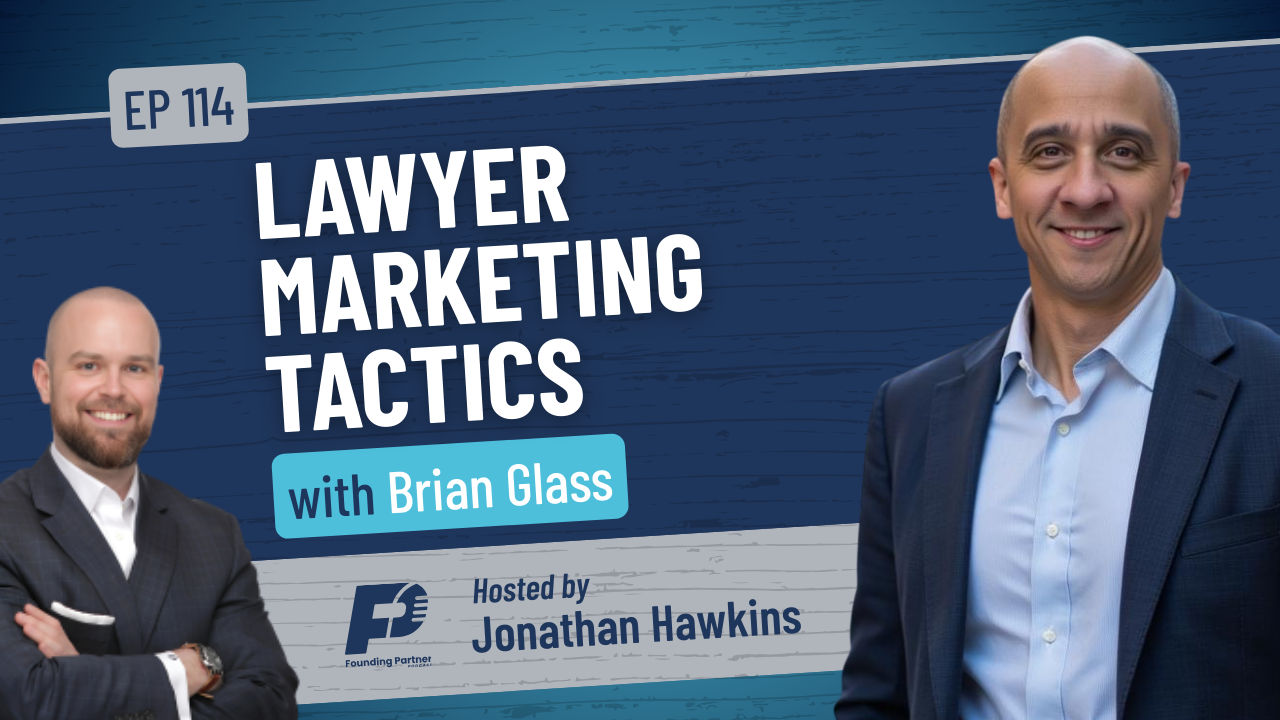
I brought Brian Glass back on the Founding Partner Podcast to skip origin stories and talk tactics. Brian is a personal injury lawyer in Virginia and co-owner of Ben Glass Law and Great Legal Marketing. His firm sits at 20–21 people stateside with five virtual assistants in the Philippines. Great Legal Marketing has been around roughly twenty years. It started by teaching personal injury lawyers how to run better Yellow Pages ads. Despite the word “marketing” in the name, they do not sell services. The work is helping solo and small firm owners define the next problem to solve and decide the best use of their next dollar and hour. I called GLM one of the originals in this space, with PILMMA as the other longstanding name I see often. The real value comes from the lawyers in the room who share openly.
“Everything works. The question is what works for you right now.”
That was Brian’s first point. Billboards work or they would not be everywhere. LSAs work when they are part of a real plan. Even those cringey lead-gen ads must pencil out for someone if they keep running. The job is not finding magic. It is being brutally honest about your stage, your budget, and the next constraint you need to remove.
If I were starting today, I would echo Brian’s advice. Do not begin with digital spend. Spend money on time with people. Coffees. Lunches. Meet the professionals who already serve your clients. In personal injury that means doctors, chiropractors, and physical therapists in smaller practices. It can also mean the larger advertising firms. Offshore staffing has changed the mix. Some big advertisers now keep more small cases. They still are not trying cases, which leaves a lane to become a litigation partner.
Then document the analog. Take a photo. Tag the person. Celebrate them. It is not either or. It is analog first, digitized. Brian pointed to examples I like a lot: Brad Scott and David Ner doing New Orleans pizza reviews, a Miami lawyer doing chicken parm reviews, and Josh Hodges interviewing local figures across small towns in Ohio. Those pieces work because the relationships are real.
“More than half of our cases, and probably 60 to 70 percent of our money, comes from referrals from actual human beings.”
One more reality check. I recorded with a law firm owner who had grown non-law businesses before opening her firm. Her take was simple. Legal moves slower. The sales cycle is longer. Set expectations accordingly.
The $500 plan: time with people, then a physical reminder
Brian’s starter playbook is straightforward. Use your dollars to get face-to-face with referrers. Follow with a simple newsletter. He prefers a printed, mailed piece over email, something that keeps relationships warm and reminds people you are alive and practicing.
Social is distribution and proof, not a miracle
Personally, Brian spends most of his time on LinkedIn, with lighter use of Instagram and TikTok. Writing is easier for him than filming, so he has aimed for a short daily post for about three years. He does not grind in the DMs. When someone sends a connection request, his EA accepts it and sends a value-first reply. Vendors get information about the GLM Partners Program. Practicing lawyers receive the GLM summit notes, a 122-page resource. Law students get a podcast episode designed for them.
For Virginia-bound personal injury, LinkedIn is not a major case engine. It has produced speaking invitations, podcast appearances, and easier hiring. It can be powerful for national, niche practices like ERISA or FTCA where jurisdiction is broader and most lawyers prefer to refer. Locally, the quiet amplification is real. I see it too. People who never comment will stop you at a courthouse or a kids’ game and say they read everything.
Podcasting: start as a guest, or skip it
I love the medium. Brian does too. Neither of us recommends it as a first marketing move. Discoverability is slow, especially early. Shorts of two lawyers talking do not move the needle. If you enjoy the conversations, a podcast gives you one-hour access to smart people and deeper talks with friends. That is relationship capital more than lead flow. You will usually see more discovery by being a guest on shows that already have audiences. If you do that, have a useful give-away and a simple page to capture a slice of the audience.
“If you are doing any piece of marketing and you do not like it, you will not create it consistently.”
Fix intake before you buy more leads
For small firms, intake is the highest-leverage improvement. Brian’s team started by defining a wanted-case box for car crashes. Clear liability in Virginia. A prompt medical visit to the ER, urgent care, or a primary care doctor. An established period of care. They exclude the situation where someone calls a lawyer first within forty-eight hours and has not seen a doctor. Then they measured, thirty days at a time, how many wanted callers actually signed.
Scripts and drips help. The breakthrough was a single in-house intake professional who takes it personally when a right-fit caller does not retain and who can literally run down the hall to get a lawyer on the phone to close.
SEO: what changed, what did not
Brian has been writing SEO content since law school. His firm built an in-house system that found content gaps, improved existing pages, and used AI for drafts that a human would polish. It worked. They later hired an outside team after realizing that paying for expert execution was cheaper than stacking the leadership time to keep running the coaching loop. His caution is one I share. Results rise and fall with the specific account manager you get. Channels also shift. They saw Google Business Profile calls drop in their locality when the click-to-call button changed. The durable work has not changed. Publish authority content. Get other people talking about you. Do excellent work so more work comes.
The ethics minefield
I mentioned an ad aimed at personal injury lawyers that promised “you only pay for signed cases.” That structure is unethical in many jurisdictions. Brian sees plenty of similar ads. Click one and the competitors follow you around.
Community, identity, and the firm you want to work in
The thread through all of this is people. Hire helpful staff your clients like dealing with. Create a service experience worth recommending. If you want more five-star reviews, be worthy of five stars. Build a firm where you and your people like showing up. That is how you perform at an above-average rate for a longer-than-average time.
“Create the firm where your people and you actually like showing up. That is happiness, and it is how you win long term.”
A concrete analog play
I loved this example. Brian’s father is a longtime referee, so they launched a youth referee scholarship. It fits who they are and contributes to a real community. The response was immediate. They received 207 applications for a $2,500 award. That is what it looks like to meet a community you already belong to.
Mentioned in this episode
- Great Legal Marketing, a long-running community focused on helping solo and small firm owners choose their next best move.
- Analog Marketing Bootcamp. During the recording Brian corrected the date from January to February 11 and noted it sits alongside a GLM mastermind meeting.
If you enjoyed this conversation, you can always find future episodes on your podcast app of choice. Show notes and links live at LawFirmGC.com.
AND MORE TOPICS COVERED IN THE FULL INTERVIEW!!! You can check that out and subscribe to YouTube.
If you want to know more about Brian Glass, you may reach out to him at:
- Website: https://www.benglasslaw.com/
- Website: https://www.glmbootcamp.com/
- LinkedIn: https://www.linkedin.com/in/fairfaxpersonalinjury/
- Instagram: https://www.instagram.com/thebrianglass
Connect with Jonathan Hawkins:
- Website: https://www.lawfirmgc.com/
- LinkedIn: https://www.linkedin.com/in/jonathan-hawkins-135147/
- Podcast: https://www.lawfirmgc.com/podcast
Brian Glass: [00:00:00] I think it’s, again, it’s back to like relationship building, right? I think it’s good for analog, actual one-to-one connection and for developing one to many afar connections. People who think they know you ’cause they’ve consumed a whole bunch of your content, but it’s not where I would start.
Jonathan Hawkins: I was a lover of the platform or the sort of the channel and I just wanted to do it. I always wanted to do it. But it’s a lot of work and it’s, you know, it’s a lot of time. It’s light energy.
You gotta find all the stuff. There’s, I get a lot out of it and I really like it. But there are easier ways in higher ROI. Things you can do If you’re gonna do it for marketing, I would not start with that. And I’m with you too. I’ve gotten more work out of being a guest on a podcast than I have on via my podcast.
Brian Glass: Well, because that’s the way to get introduced to other people’s audiences, right? Like how many people out there are scrolling lawyer podcasts and decide that’s the one I’m gonna listen to. No, like, people start listening to your podcast or my [00:01:00] podcast because one of their friends was a guest, shared the episode with them and then they decided, they liked the way that we interviewed people enough that they would listen to the next episode, right?
Welcome to the Founding Partner Podcast. Join your host, Jonathan Hawkins, as we explore the fascinating stories of successful law firm founders. We’ll uncover their beginnings, triumph over challenges, and practice growth. Whether you aspire to launch your own firm, have an entrepreneurial spirit, or are just curious about the legal business, you’re in the right place.
Let’s dive in.
Jonathan Hawkins: Welcome to Founding Partner podcast. I’m your host, Jonathan Hawkins. And we’re gonna do this one a little differently than we usually do. Definitely we’ve got an interview style, but we’re gonna be talking tactics and diving into the topic of marketing for law firms versus sort of taking [00:02:00] our guests through the journey of their firm.
And the reason why we’re not doing that is because this is a repeat guest. Today. We’ve got Brian Glass on for the second time. If you want to hear about his journey and all that. Gotta go back to episode 27. It’s a good one. So go back and listen to that. But a brief introduction and then I’ll hand it over to Brian to really fill out the introduction, but he is the co-owner of Ben Glass Law and great legal marketing. He’s a personal injury lawyer up in Virginia. So Brian, thanks for coming on again. And why don’t you fill out the introduction. Tell us a little bit more about what you do and really great legal marketing, which might be of interest to our lawyer audience here.
Brian Glass: Yeah. I mean this is perfect ’cause you’ve grown an audience of lawyers and, and I market to lawyers, right? So, you know, I’m a personal injury lawyer by trade. That’s where we make the vast, vast majority of our money. I have a firm that we are now at 20, 21 or so people stateside and five virtual assistants in the [00:03:00] Philippines.
And we do personal injury. And my dad has a long-term disability appeals practice. For fun, we run great legal marketing which is an organization dedicated to helping solo and small law firm owners run better practices. The marketing piece is a little bit of a misnomer. You know, it really started 20 some odd years ago.
As a, as a company that was intent on teaching personal injury lawyers how to run better Yellow Pages ads. And we don’t, the, the thing about the marketing word being in the name is that many of the solicitations that I get on LinkedIn are about like, let me help you grow your marketing practice. And we don’t provide any services.
You know, our niche, Jonathan, is as you know, is, is talking with lawyers like you and trying to help you figure out like what’s the problem, the next problem to be solved in the law firm, and what’s the best use of your next dollar and hour?
Jonathan Hawkins: And I’ll say, you know, great legal marketing, there are lots of masterminds and coaches and all these things out there, but [00:04:00] great legal marketing is like maybe the og. I mean, it’s been around, it’s one of the originals in space. You guys have been going strong and I’ve been a member, you know, for three years or so now.
And it’s really cool. The thing that I like about it is you get in there with the other lawyers and everybody’s sharing. They’re sort of opening the kimono, so to speak. And I’ll say you and Ben really open up and talk about what you guys are doing in your firm, which is really always very enlightening and educational.
And you know, you guys have been experimenting doing lots of things over the last three years since I’ve been in there and I’m sure predate me as well. So I want to dive into some of those things and get your perspective because you do talk to a lot of lawyers, you coach lawyers. I use that in air quotes.
And you guys. Talk to a lot of marketing vendors, so you sort of have a pulse of what’s out there in the legal space, and so.
Brian Glass: Yeah. I mean we’re, we’re one of the OGs and I I’ve to be. To be accurate, I’ve only been [00:05:00] involved in great legal marketing in a formal capacity in the last two or three years. The company’s 20 years old. PILMMA is the other kind of OG in space now. There’s tons and tons of masterminds. You know, the Mastermind really is, it rises and falls on, on the level of who’s in the room with you.
And, and by that I don’t mean the leaders, right? You know, good leaders are, are facilitators and can help you. out really what is the problem and maintain and hold in, check all of the lawyer egos and law firm owner egos that can be in the room. But really the value of any Mastermind is on the 12 or the 15 other law firms that are in the room with you.
And so credit to you and to the rest of the members of our hero and our icon groups for showing up and for caring about helping other law firm owners get better at what we do.
Jonathan Hawkins: So I wanna dive into marketing. You know, every law firm owner out there wants to grow. They want more cases, they want bigger cases, they want more money, et cetera, et. There are exceptions that I’m sure of, but everybody wants to know how do you get more [00:06:00] stuff in the door? And there’s a lot of people out there selling magic pills.
They’re like, come to us. We’ll get, we will do this magic thing, and you’ll get all these cases and all this stuff and it can be overwhelming. All the things you can do, all the vendors trying to sell you stuff. And so hopefully today we can cut through some of that and, and sort of figure out what, what.
What people should look at. And so the first thing I’ll say is, you know that lots of things work. I mean, maybe everything works to some
Brian Glass: Everything works.
Jonathan Hawkins: So let’s focus, I wanna focus on, in your opinion, and let me one other sort of background. There are brand new lawyers, there are established firms, there are really big firms and you can sort of pinpoint.
Who this works for. As we talk through things, not everything’s gonna work for everybody along that spectrum. So, where do you wanna start?
Brian Glass: What a question. So there’s a spectrum of lawyers from brand [00:07:00] new to establish to big, and how should they market?
Jonathan Hawkins: Yeah, so maybe.
Brian Glass: Well, no, I’ll tell you. You know, I think your point about maybe everything works to a certain extent is absolutely valid. Everything works right? You know, for small law firm owners, you come out and you go, billboards don’t work ’cause there’s no way to track whether anybody called my 888 number that’s on the billboard. Like, if billboards didn’t work, lawyers wouldn’t have ’em everywhere. So that branding works. It’s a part of a larger. The rest of your broader marketing strategy LSAs don’t work ’cause they’re too expensive.
Well, again, it’s part of a broader marketing strategy. Even those stupid lead gen ads that I see more than my fair share of You know, the new 2025 compensation program that’s gonna get you paid even if you weren’t actually hurt in a car crash. Like it must work when you go back in the Facebook Ad library and you just look at the length of time [00:08:00] that those things have been running. There is no way that they don’t work. And the hard part about being the law firm owner or the marketing director is figuring out. Which works best for me in the stage that I’m in right now.
And you know, anywhere from just opening my law firm on January 2nd to I have 40 lawyers practicing in metropolitan Atlanta.
Right. And the answers are gonna be incredibly different based on your budget and based on what you already have in place and based on what the next thing that you wanna implement is. And I, I think that is maybe the biggest challenge for lawyers picking their marketing strategy is being really, really honest with yourself and self-aware about where I am right now?
What am I trying to build? And then, you know, all of the marketing sales guys think that their widget or website or [00:09:00] whatever is, is the thing that’s gonna save you. And they, you know, most of them don’t have any experience in legal except for the 13 months that they’ve been in this job. Which, and, and to a certain extent, like they’re, they’re right, right.
Their thing might save somebody out there. But the challenge really is figuring out what is the thing that’s gonna be the best for me.
Jonathan Hawkins: So I, I was talking to a law firm owner yesterday recorded a podcast. It’ll be coming out some weeks and before starting her law firm, she had been involved in, in a couple of businesses, non-law businesses, and really grew those pretty successfully and really had the marketing down on those two businesses.
And then she got into the law firm and she said, marketing law firm. It’s just a lot slower than her, the things you can do in some of these non-law businesses. It’s quick, quick hits, but the sale of a lot of the law legal services, it’s just a longer sort of sales cycle. But let’s, let’s step back.
You had a, you had a podcast episode a while back [00:10:00] for young lawyers. I think it is. Like their $500 marketing plan, which I thought was really good. We don’t have to go through all of that, but you know, a lot of lawyers that come to me and they’re like, where do I start? And I always tell ’em, you know, relationships, relationships, relationships, take people to lunch, breakfast, dinner, drinks, whatever it is, coffee.
And at least do that. ’cause you know, as you’ve, I think I’ve heard you say when you got, when you don’t have money, you have time. So use that.
Brian Glass: You don’t have cases you.
Jonathan Hawkins: So, so why don’t you so high level, if, if I’m a new lawyer, starting a firm, maybe take me through some of the, the, the, the big. Pillars of that $500 marketing plan.
Brian Glass: Well, that, that is the really the, you know, the big pillar is spending money on time with people, right? Whether it’s coffees or lunches. That’s, I think the, the place that almost everybody that doesn’t have any business and doesn’t have any clients and doesn’t have a very large budget, should be starting.
[00:11:00] Right. And I, the mistake that I see some lawyers make is they, you come out and you put the money into digital, right? You put it into LSAs or Pay Per Click, or God forbid, SEO, brand new trying to SEOA brand new website, like good luck. But what I know in my firm. Is that more than half of our cases and more than probably 60% of our money, 60, 70% of our money comes from referrals from actual human beings, right?
Whether that’s the first touchpoint or the last touchpoint before they get to us, most of our clients and I, in my personal interview practice, have had my name mentioned to them. By somebody else in the universe before they Googled me or looked up my LinkedIn or looked at my Instagram profile, and then maybe they came through that channel, but most of them my name come outta somebody’s mouth.
And it’s, and it’s not always that they’re only hearing my name. Right. And so you have to have those digital properties that distinguish you from, if I get three names. Now the, the end consumer can [00:12:00] go and look at those three names. But really the relationship building is, is the crucial part of it. And so the way that I like to think about this, if I were just starting out. Is thinking about who else has my clients already, who else is already talking to the group of people that I wanna serve? And the easiest thing for me to do is, is a personal injury practice. ’cause I know that, right? I could, I could guess what it might be in your, in your law firm general counsel practice, but I don’t actually know.
In a personal injury practice, the people that already have your clients are doctors, you know, chiropractors, physical therapists who are in smaller practices, who aren’t in institutional practices. There may be larger law firm owners. They are, you know, the, the big advertising firms. That I, until five years ago, didn’t have the capacity to handle the smaller cases.
Right. That’s kind of changed now because with offshore you know, quote lawyers and case managers and people in the, in the Philippines or Central [00:13:00] America, you working on US-based cases. I, I think that dynamic has shifted and it probably is harder to get small case referrals from large firms.
Than it is, than it was five years ago, but those offshore people aren’t trying cases. And so you could go become the litigation arm of a big advertising firm. And so the doctors lawyers and then like, who else in the community should I be speaking to that that has an audience that naturally fits for me.
So if you go to church. The other church, the, the, the heads at your church, the pastor, the, the youth ministers, whoever. Right. It’s like, it’s, it, it’s the things that naturally fit for you. So for my dad, he’s a referee. The referee organization, Jonathan, we just ran youth Referee Scholarship. I think we’re giving away 2,500 bucks for youth sports umpire or referee to go to college. We have 207 applications. So, but, but all of those is like, what is the thing, the, the [00:14:00] person that naturally fits with who I am who I can have some kind of affinity with, that’s like, do they know I’m a lawyer? Yes, but am I hanging out with them because they want to hang out with lawyers?
No. Right. So for him it’s referees that know it. He is a lawyer for me, some of these people at the gym that know I’m a lawyer, finding these other communities where you can become the hub, not only necessarily for what you do, but for referrals out to other lawyers in your community. And so if I had no money and I had time and I had no clients, I would spend. All of my time and whatever, whatever marketing budget I had doing that, doing referral lunches, going to meet people in their office, and then I would have some kind of newsletter or, or maybe an e-newsletter, but I’d prefer it be a physical hard copy thing that I could mail to them afterwards that reminds them that I’m still alive and still practicing law.
So that’s where I would start.
Jonathan Hawkins: let’s talk about that a little bit in the sense that I’ll, I’ll call it digital versus analog. And [00:15:00] so part of what you mentioned, you know, meeting people where they are all of a sudden, you know, all that is definitely analog. I call that the physical newsletter, which is a bit, you know, I call that a cornerstone piece of the GLM community.
I did one after joining you guys. I have one now. I’ve heard your dad, Ben, talk about it. You know, everybody thinks digital, digital, and that’s what most people are selling out there. But really what you’ve just described is an analog. So how do you, again, going back to your podcast about the $500 marketing plan, you talk, you also talk digital, and you have a interesting approach to that about establishing a digital presence.
So how do you,
Brian Glass: Well, you could.
Jonathan Hawkins: how do you approach the balance of the digital analog?
Brian Glass: So it’s not either or. Right. And in fact, the, the one of the things that I would be trying to balance if I were doing all these in-network in, in-person meetings with other lawyers and law firm owners and business owners is I would be documenting it, right?
I’d be [00:16:00] taking pictures and tagging them on Instagram or LinkedIn or wherever else, and celebritizing them. There’s a couple of lawyers in GLM who do this exceptionally well. And, and even outside of GLM, I mean, if you think of Brad Scott and David Ner down in New Orleans, have they, they go out and they eat pizza.
And they do a pizza, new Orleans pizza review. There’s a guy in Miami who does chicken parm reviews, right? And then of course, Josh Hodges goes to every small town in Ohio and interviews all of the lo local quasi celebrities, right? And so that’s all, that’s all analog stuff that he has, that they have just documented digitally and now they’ve.
Now they’ve scaled the analog relationship building that they’ve done by broadcasting it somewhere. But all of those things at their cores are analog relationship building tactics.
Jonathan Hawkins: So let’s pivot to social media, which is I think a bl my personal view, it’s, it’s definitely digital. It’s, it’s basically free. [00:17:00] I mean, you pay a little in time and all that, but it is a scaling of those analog relationships as well. I’ve, I’ve noticed that. So I know you’re active on some social media. I guess first, you know, what, what is your view on social media?
What platforms do you personally use and, and your firm use?
Brian Glass: I, well, I’m primarily active personally on LinkedIn and a little bit less on Instagram and TikTok. But I get into. Into these cycles where I make, make more video content and put it out. None of the video content, almost none of the video content is about being a lawyer, right? It’s just trying to be an interesting or do things that I think are interesting.
LinkedIn is my, my most popular mind is the one I use the most often. Because it comes the most naturally for me. It’s easier for me to sit down and write something than it is sometimes it feels awkward to hold up the camera and shoot a video into the camera, and could I get over that? Probably. But just LinkedIn comes a little bit more naturally for me.
And I have tried [00:18:00] to say something on LinkedIn about. Once a day for about the last three years and it’s just kind of organically grown. I developed a, a little bit of a backend strategy, so I don’t, I am not good at LinkedIn dms ’cause there’s just too much to go back and forth. And so I don’t really, I don’t do any outbound LinkedIn DMing.
I probably could get better at that. The only strategy that I have for that is if somebody sends me a connection request, I have my ea accept all of them. And if it’s a if it’s a law firm vendor, but somebody selling into the law firm space. We have an autoresponder that says, Hey, that’s not something that I need in my law firm right now, but I run this company called Greatly Marketing.
And we have a partners program, right, where you either you can supply content for us or maybe if you do something that’s interesting enough, like we’ll have you on one of our stages either on the Zoom call or, or at our summit. And so here’s how you sign up for that, right? So now I capture you my email address.
Email list. If you’re a practicing lawyer, the [00:19:00] response that you get back is with a. Link to our summit notes that we produce every year. It’s 122 pages of transcribed notes along the slides from all of the speakers at the event. And then if you’re a, a law student then you get pushed a podcast episode that’s designed for law students.
So it’s, that’s, it’s digital, but it’s not any, I don’t think it’s offensive, outbound. It’s, it’s not the, Hey, let’s hop on a Zoom call and talk for 15 minutes, kind of thing. It’s trying to provide value to you first, and if you’re not interested in the value, then. You know, you just don’t click on the thing.
Jonathan Hawkins: So let’s talk about LinkedIn. Yeah. I’m very active there too. I’ve talked about it a lot. I, I bump into attorneys and they’re like, especially you, you’re a personal injury attorney. People say, well, Jonathan, you’re a, you’re a a B2B course. It works for you. It’s not gonna work for me. You’re a B2C.
What’s been your experience in terms of generating referrals or work or whatever.
Brian Glass: Yeah, it’s not a lot of work. I don’t get a lot of work out of [00:20:00] it. And, and again, maybe it’s ’cause I haven’t done a great job of developing a DM referral network. Or maybe it’s because, you know, it’s like, it’s the, it’s the. Random chance that somebody in Texas is gonna get a call about a Virginia car crash and refer them to me.
I, I have said if you have a practice like yours where it’s nationwide, B2C, or if you have an e an what I call alphabet soup practices like my dad’s ERISA practice or Brewster raws, FTCA practice where you can, you know, it’s a niche, true niche, it’s federally based and you can practice anywhere, then those are great for LinkedIn because most lawyers don’t know how to or don’t want to do cases like that, and you can do it anywhere. So I, it, it has not been great for me in terms of case generation. That’s not why I do it. I really do it because. I just, I, I enjoy creating content about how to run a better practice, live a better life as a lawyer.
And I think it’s helpful to people that are three to 10 years [00:21:00] behind me on the growth curve or the legal career path here. That’s why I produce that stuff. Jacob Molina says that he tells clients he’s a ghost writer, tells clients of his, that LinkedIn is like a box of chocolates. Like you never know what you’re gonna get.
And for me, it hasn’t been cases, although for some people it’s cases, but for me it’s been broader distribution of my podcast invitations to speak on stages and an easier access to like good employees, right? Because it’s in the same way that your clients can go and binge some of your content.
If you have a YouTube channel or a a social media channel, my employees can come, future employees can come and click and say like, what are these guys about? And I’m talking about running a better business, living a better life. Like I think most people want to work there. So that’s really why I produce that content.
I think, you know, every year. I get somewhere between three and five cases that get referred through LinkedIn. So it’s not that it [00:22:00] generates nothing, it’s just that’s not why I do it.
Jonathan Hawkins: You know, I, that’s been a similar experience to me. I have gotten actual cases out of it direct that say I’ve been following on LinkedIn and I don’t know who they are, so that way, but the other thing that I’ve, I’ve. Definitely noticed. I’m curious if you’ve noticed it. There’s all these local attorneys that never comment.
Never. Like they, they’re like ghosts, lurkers on LinkedIn. But then I’ll go to some bar van or somewhere and I see them and they’re like, oh my God, I love what you’re doing. I’m like, well, why don’t you comment man? So it, it, it almost like amplifies the local networking scene as well. I dunno if you’ve experienced that up there in Northern Virginia.
Brian Glass: I was. I was at my 7-year-old soccer game, and this guy comes up, my wife hates it when this happens. This guy comes up to me and he says, are you Brian Glass? I see you all over my LinkedIn. And I, I looked at her and I said, see, I’m famous. And but I had the same, I said, you could like drop me a like [00:23:00] every once in a while.
But yeah, I do think that there’s. As much engagement as you can get, there probably is three to 10 x. That number of people who read all of your stuff and never comment on it, you know, until they see you at at the courthouse.
Real quick, if you haven’t gotten a copy yet, please check out my book, the Law Firm Lifecycle. It’s written for law firm owners and those who plan to be owners. In the book, I discuss various issues that come up as a law firm progresses through the stages of its growth from just before starting a firm to when it comes to an end.
The law firm lifecycle is available on Amazon. Now, back to the show.
Jonathan Hawkins: So the other thing you mentioned, you, you’ve got a podcast, obviously you’re, you’re a guest on this podcast, but you have your own I’ll let you pitch it here if you, if like, but it’s it’s life beyond the briefs. You can tell us, my interpretation is it’s really for somebody that’s 2, 3, 5 years behind where you are now, sort of, you help bring up people.
So let’s talk about [00:24:00] podcasting. I love it. I’ve always been a consumer for many over a decade. It’s easier to produce now than it was five, eight years ago. But it’s still a lot of work. And for those out there that are thinking about, should I start a podcast? What’s your advice on that or what’s your experience?
Brian Glass: Don’t do it. Don’t do it. No pod po you, you have to figure out why you’re doing it. I, it gives me access to smart people who I can interview for an hour. And it gives me access to friends of mine who I can have discussions with that I probably wouldn’t otherwise have had about building their business.
’cause I don’t know, for whatever reason, we don’t, outside of, you know, mastermind groups and podcasts, like we don’t really ask our friends. Like tell me about the first couple of years that you were out in practice and what worked and what didn’t work. Right. So, I get those [00:25:00] gifts out of it. It is terrible for discoverability.
You know it, I think it’s, if I get a couple hundred downloads on an episode, that’s amazing. And so with, and then people will binge listen to it, right? Same thing as as LinkedIn in some regards. ’cause you’ll have people who call, oh, I’ve been listening to your podcast forever. I, I’ll miss an episode.
And you have no idea who they’re, so that’s kind of cool. But I think it’s, it’s terrible for like. New people tripping onto you and discovering you, especially in the first three months, six months, even a year. You have to be willing to, and I’ve heard you say this, if you’re gonna go into a new channel, be willing to stick with that channel for three years on a regular basis.
And, and not see any results. Hormozi says something similar, right? Like I, I think Hormoz claims he created a weekly podcast for seven years before it really got any traction at all. And so if you were thinking about starting a podcast, [00:26:00] I think the first thing that you should do is try to get on everybody else’s podcast and see if you actually like the format. And then, you know, the. People who are selling like podcast production services will tell you, Hey, we’re gonna chop up your video, we’re gonna post the shorts. Nobody watches the shorts of two lawyers talking about it. Right. So, so I, I had my EA doing that for a while. We kind of stopped doing that.
I think it’s, again, it’s back to like relationship building, right? I think it’s good for analog, actual one-to-one connection and for developing one to many afar connection. People who think they know you ’cause they’ve consumed a whole bunch of your content, but it’s not where I would start
Jonathan Hawkins: A hundred percent. A hundred percent. The people that do it know this. But you know, I went into mine again, I was a lover of the platform sort of the channel and I just wanted to do it. I always wanted to do it. But it’s a lot of work and it’s, you know, it’s a lot of time. It’s light energy.
You gotta find all the stuff. There’s, I get a lot out of [00:27:00] it and I really like it. But there are easier ways in higher ROI. Things you can do If you’re gonna do it for marketing, I would not start with that. And I’m with you too. I’ve gotten more work out of being a guest on a podcast than I have via my podcast.
Brian Glass: Well, that’s the way to get introduced to other people’s audiences, right? Like how many people out there are scrolling lawyer podcasts and decide that’s the one I’m gonna listen to. No, like, people start listening to your podcast or my podcast because one of their friends was a guest, shared the episode with them and they decided, they liked the way that we interviewed people enough that they would listen to the next episode, right?
But you get far more. Discoverability by being a guest on somebody else’s show who already has an audience. And if you’re gonna do that, you should do like you’ve done, right? Which is have a book that you can give away and have a page where you can capture and scrape off some of that audience into your own channel.
But I think the thing that you said [00:28:00] is important was like, you do it because you like doing it. And I do it because I like doing it. And if you’re doing any piece of marketing and you don’t like it, you won’t create it consistently. It’s just a truism.
So I think if you enjoy it it shows and people will listen. And if you don’t, it’s a waste of your time and effort.
Jonathan Hawkins: So true, and maybe that’s a good segue in a topic that really, I guess. Goes across all the different marketing things you can do. And you mentioned it a minute ago, but you know, in my view, it’s pick something that, that you’re gonna do and you gotta do it consistently. And then you’ve gotta do it for I think, a pretty long time before you give up on it.
That’s the other, you know, that, that’s that meme or whatever where the guy’s mining and he’s about to hit the, the diamonds, but he gives up. And then the last part is at least for me. I sort of try not to have expectations just
Brian Glass: Hmm.
Jonathan Hawkins: do it consistently for a long time without expectations, because if I expect it to do really [00:29:00] well and it doesn’t, I’m not gonna feel good about it and I may want to quit.
And so that, that goes back to you mentioned the thing about the three years. I just like to pick a date way far out. I figure that’s long enough that. If it’s gonna work, it should work by then hopefully. But as you approach maybe a new marketing channel or project or whatever, how are you looking at it and how do you gauge whether you’re gonna do it or not, versus another one?
Brian Glass: Yeah that’s a good question. We don’t give it three years, you know, especially if it’s digital. So this year we spent some money in LSAs. We spent some money on lead gen. We spent some money on a referral marketing campaign. And, and I’ve kind of moved around like, all right, I’m gonna give this thing 90 days and see what happens.
And there are different cha like SEO takes a little bit longer to ramp up. But if I. I spend money on LSAs for three months, I’m [00:30:00] gonna know the result at the end of those three months. So the thing that I’ve tried to, to do with our marketing director is we go into a new channel, is be really intentional about. When we look back in 90 days, what do we think success looks like? So you said go in without expectations. I I don’t like going in without ex. I, I understand what you’re
Jonathan Hawkins: Well, I guess,
Brian Glass: but
Jonathan Hawkins: let me, let me give a caveat on that. It’s, it’s if I’m spending money, buying ads or whatever, absolutely. There’s gotta be a quick, but in terms of the content game, that’s what I meant by that. So.
Brian Glass: You know, because it’s so easy to look back and go, oh, it’s working, or it’s starting to work, or what. But if you don’t have some objective measure that you’ve already agreed upon before you go into the channel, it’s like, you know, it’s like, oh, I, I don’t feel good today, so I’m gonna stop doing that thing. So we try to be fairly intentional and we’re not always great at it [00:31:00] about if we’re gonna start this thing, we, we gotta write down why are we doing it? What result do we expect it to yield, and in 90 days, how will we know whether we should continue it or not?
Jonathan Hawkins: Yeah, so you know, another example is you mentioned the book, it just came out. That’s another cornerstone piece of the GLM community. Get a book out there and you spend all this time and energy and money getting, getting it sort of created. And then you just gotta go out there and put it in the world. But you never really see a direct return on that book that you can say, all right, here’s the line from the book to this client.
Maybe it happens every now and then, but you know, that’s when you just gotta sort of have some faith and just keep putting it out there.
Brian Glass: Yeah, I mean it’s, it’s like, it’s like anything else though. It’s like shooting YouTube videos or creating podcasts. You, you kind of softly begin to hear that, oh, I read your book, or I, and it’s probably not a discovered, you threw your book. Right? It’s like I did a cons. You, you maybe did a consultation with somebody and you sent ’em, you shock an awe package and it had the book in it and [00:32:00] then they took some time and read the book or, or they read the first three chapters.
Which is what most people do. And, and so that, that you write that you never really see the direct line of attribution through the book, but I don’t think you really see the direct line of attribution through almost anything that anybody does in the lawyer marketing space. Except, except non-branded lead gen.
Right? Because e everything else is. You know, the multi-touch attribution is so hard that you’re really just giving your best guess at is anything working or is it a waste of money?
Jonathan Hawkins: Yeah, it reminds me, I saw an ad this morning. I’m gonna, I’m gonna post about it tomorrow, so I know you do this a good bit. And it’s for, it’s, it’s a legion company aimed at PI attorneys and, and they say, you don’t pay us for leads. You only pay us for signed cases.
Brian Glass: How, how
Jonathan Hawkins: which is completely unethical. There’s like 30 ethics opinions around the country.
But yeah, they’re [00:33:00] out there promoting that. So I’m gonna have a little post on that.
Brian Glass: Well, and, and so. I see more than my fair share of those. ’cause I watch all the videos. Just like, and so now you’re gonna see a bunch of the interesting thing, they must all share some digital cookie somewhere, because once you click on one, you’re gonna see seven of the competitors ads. So you, yeah, you’ll have a whole portfolio of things to post about by tomorrow morning.
Jonathan Hawkins: I’ll be looking for that. That’s interesting. So we’ve been talking a lot about marketing and different approaches and channels and. This, that and the other. But another thing that you, you showed the GLM Mastermind a while back was I’ll call it fixing your intake. And so, and a lot of people say, I wanna spend all this money, I need more leads, I need more leads, I need more.
But they have a leaky bucket. And so I don’t know if you have the stats in front of you, but you you did some work to, to fix the leaky bucket. I’ll call at your firm and, and take me through that, and what results did you see?
Brian Glass: Yeah. So this is, this is [00:34:00] the highest point of leverage for any small law firm is closing the gap in. The number of cases who call you that you want to serve, and the number of cases who actually sign your retainer. And so the, the first step with this though is very clearly defining what is our wanted case criteria.
And so for us in the the car crash space, it’s clear liability in Virginia. Less than two years ago where you went to an emergency room or you went to an urgent care, or you saw your primary care doctor in a quick period of time and you had some established. Period of care, right? I’m not interested in talking to somebody who, know, was in a crash 48 hours ago and hasn’t been to a doctor yet, and, and is calling a lawyer first, right?
So that, that’d be somebody who’s outside of our box. But you have to have this clearly defined box so that you’re not just looking back and guessing what percentage of cases that we [00:35:00] wanted did we actually sign? Because it’s the same thing. It’s like, how did I feel today? You know, and on and on a slow week. You know, those, those bad cases become cases that you want. So as you’re keeping these statistics, you have to very clearly define and pass off to your team, what do we want and what do we not want? And, and then you have to, before you try to fix anything, like you should get on a scale and measure yourself today and find out in the next 30 days how many of those cases are.
Our calling that we’re missing some way or another. Right. And then you can start to fix, and I wish I had the silver bullet for you. ’cause it’s not a script, it’s not, you know, a follow-up sequence. It’s not a drip campaign. It really is hiring somebody who gets. Personally offended like our intake person does.
Now Krista gets personally offended if somebody calls us and is a right fit for us and doesn’t hire us like it ruins her day. And that is the biggest leverage point that you can have in your law firm. And so we’ve, we’ve kind of moved [00:36:00] up the scale and the evolution that most small firms go through is the lawyer does all the intake.
To, you know, a, somebody at the front desk does a little bit of a screen and then the lawyer closes the sale to maybe there’s a paralegal involved, and then we hear about overseas stuff. And so, okay, we hire a VA offshore to do the intake and we train that person and, and at every stage is like. This is what I can afford.
This is what I can afford. And you, you kind of move up. The biggest change for us happened when we found the right person and she was in-house in Fairfax, Virginia. And as I like to say, if a, a good case is on the phone, she could run screaming down the hallway like her hair is on fire and find a lawyer to get on the phone and close that deal.
So, you know, I don’t, I don’t begrudge people that, that don’t have the financial capacity to hire somebody like that ’cause it’s way more expensive than hiring a VA offshore. But understand that if you look at like your average case value and you only signed three more cases, you probably [00:37:00] could afford that person.
In 12 months, right? If you just invest in having the, the real life person in-house, you probably could close that, that gap pretty quickly because most lawyers will tell you, we sign a hundred percent of the cases that, that we want, and it’s just not true.
Jonathan Hawkins: You know, you just, I, I love the evolution of how you guys sort of tested and experimented and sort of grew along the way, and you sort of found where you are now. We’ll see where you are in, you know, three, four years from now. The other thing that you, that I’ve heard you talk about and this is going back to SEO.
As a marketing approach that I thought was interesting. You, your evolution to the SEO sort of experience where you guys did a lot of that in-house, you did a presentation to us and it was extremely sophisticated the way you guys did all that. It was incredible, really. And you guys,
Brian Glass: we’re very proud of
Jonathan Hawkins: was great, but then you decided we’re scrapping that we’re hiring somebody out of outside vendors.
So maybe take me through that thought process.
Brian Glass: Yeah. Well, I mean, my, my evolution with SEO I went to law school. 2005 to 2008, and I [00:38:00] worked while I was in school for Tom Foster, writing content for foster web marketing. So I have a, a fairly deep background and it is way more complicated. Now than it was back then. And that was the lesson that we learned.
You know, after we showed you guys the presentation of here’s all the things that we’re doing in-house with these AI tools to, number one, select what’s the gap in our content right now? Whatever our competitors have that we don’t have, how can we take our current content and make a little bit better?
And then how can we utilize. AI ethically or not right to, to write most of the article. We’ll come back and give it some human tweaks and put it up there. But really, Jonathan, the, the change for us from going from that in-house. System, which was, which was working fairly well to, to Jason Hennessy’s company is, you know, Jason was offering coaching for a while and I, I don’t know if he still is, where for $2,000 he would get on a 90 minute call with you and go [00:39:00] through him personally, your website and what.
Changes needed to be made. And, and then we would go and execute. He, he liked working with us ’cause we would take all the things that he said, and then by the next call, 30 days later, we had done all the things. But finally I looked around and I was like, Shep, we’re spending $2,000 on Jonathan. It’s my time.
It’s Ben’s time. Ben’s time. It’s Lauren’s time for this 90 minutes. We’re doing prep work before we get on the call. And then when we get after the call. It’s Lauren is fixing the things on our website and we have a VA in the Philippines who’s helping her. Like we. We should at least quote, what would it cost to just have you do this for us? And, and when we did, I was like that we, it’s definitely cheaper to just have the professional do it for us. So that’s how, how we got there. I, I think the challenge with SEO is that your results are only as good as the account manager who’s working on your account. And so you can have the greatest company and the worst account manager, and you’re, you’re [00:40:00] not gonna have good results.
And you never know during the sales process, and you never, and, and there’s always somebody in the space looking over your shoulder, you know, willing to get on a call and tell you the three things that your firm is doing wrong. And it’s very hard to figure out, and especially if you were starting brand new in 2025 or 2026, like, good luck.
I’ve at least got a 18 year, you know. Novice background in this stuff, and I understand the terminology. If you were coming out brand new and you were hearing about schema markup and H one tags and No way.
Jonathan Hawkins: It is a lot. It is a lot. And you mentioned the other, you know, you mentioned ai, but that’s the other piece at the summit, you know, Hennessy talked about. AI people are moving away from the traditional Google search. We don’t have to go down that rabbit hole, but now it’s, it’s a AI search and people aren’t necessarily even clicking on your website anymore.
So whole different ballgame
Brian Glass: well, our, [00:41:00] our Google, our Google business profile calls are dramatically down because there’s no more Click the call button. least in our locality, right? And so we put all this work and effort into it and then, and then it changes. But I, what I took away from the presentations at the summit was the stuff that we’ve all been doing for years is the stuff that you need to continue doing, right?
Produce content that holds you up as the authority in the space. Get that content into the hands of other people who can talk about how you’re the authority in the space and. Do do and do good work and more work will come. Right. And so there are there AI specific tactics. Can you have a bot go and recommend you on Reddit 150 times?
Sure. Right. And that works until the AI script begins to ignore Reddit. And so the stuff that has always worked is the stuff that will continue to work, which is be, be a good, ethical, honest lawyer, create interesting content [00:42:00] become the authority in your field, and get people to talk about you.
Jonathan Hawkins: We might have to end it with that. I mean, that is basically it, right? And how.
Brian Glass: What’s, what’s old is new,
Jonathan Hawkins: I know. That’s it. You know that that might be what we end on. But I’ll ask one last question. Is there any, anything we haven’t talked about? If I’m a lawyer out there and maybe we not focus on the behemoth type, really big sophisticated firms, like the similar ross out there that really have his machine going what advice would you give to somebody out there that’s trying to build their firm and trying to build their marketing channels?
Brian Glass: And so if you’re a small firm and you’re trying to build the firm, I think it’s all people, man. You know, having good people and being, having good people in your firm who are helpful to your clients, who your clients like dealing with. And creating a good customer service experience that is worth recommending, right? Everybody wants to know what’s the tactic that’ll get me more. Five star Google [00:43:00] reviews. Turns out it’s like being worthy of being left, the Five star Google review. I think at the end of the day, that’s the most important part.
And you know, I think maybe the thing to end with is this like. If you can create the firm where you’re people and you actually like showing up. It’s a whole lot easier to work in that firm long term. You don’t have to sell it to private equity. You don’t have to have your exit ’cause you’re tired of it. And that really is the path to wealth is to be able to do the thing at an above average rate for a longer than average period of time.
And that’s happiness too, right? ’cause you actually enjoy showing up and putting in your 40, 50, 60 whatever it is hours that you’re calling. So I don’t think it’s anything fancy. It’s just like doing work that’s interesting to you with people that you like.
Jonathan Hawkins: Well, Brian, we’re gonna end it with that. I appreciate you coming on. For people out there that want to get in touch with you or learn more about your firm or great legal marketing, what’s the best way to find you?
Brian Glass: Yeah. So, LinkedIn is where I’m most active. If [00:44:00] this is you getting this out sometime in January.
Jonathan Hawkins: yeah, I think it’s ish.
Brian Glass: Okay, so we’re, we’re doing a bootcamp at analog Marketing Bootcamp. You can check out the details at GLMBootCamp.com. We’ll probably do a couple more of those throughout the year. People seem, seem interested in that.
So one day event talking about all the things that are not digital that you can do in your law firm.
Jonathan Hawkins: When in January. Is that
Brian Glass: I think it’s, oh, I’m sorry. It said January. It’s February, February. Screwed up. The date. February
Jonathan Hawkins: okay? Yeah. This will be out by then for sure. I was, I was gonna move it up.
Brian Glass: I should know the date of my own event. It’s a, what, what we did? No, it’s the 11th. February 11th. What we did this year is we’ve started tacking on to the beginning of our mastermind meetings, and in particular, The HERO meeting a one day event where you can come and meet some of the members, and then there’s an upsell opportunity from that bootcamp to, to come and see what Mastermind is all about.
If you’re gonna get on a plane and stay in a hotel, you may as well hang out for another day, so February 11th.
Jonathan Hawkins: Cool. Well, I’ll be there, the week before [00:45:00] for the, the Icon group, so looking forward to that. But again man, thanks for coming on and we’ll catch up soon. Have a good holiday get all the stuff done you need to get done. Running outta time.
Brian Glass: Yeah.
Jonathan Hawkins: Alright
Brian Glass: too.
Jonathan Hawkins: Thanks.
OutroUpdatedWebsite-1: Thanks for listening to this episode of the founding partner podcast. Be sure to subscribe on Apple podcasts, Spotify, or wherever you get your podcasts to stay up to date on the latest episodes. You can also connect with Jonathan on LinkedIn and check out the show notes. With links to resources mentioned throughout our discussion by visiting www.lawfirmgc.com. We’ll see you next time for more origin stories and insights from successful law firm founders.