How to Grow a Law Firm From 1 Attorney to 12 in 3 Years with Bart Denham
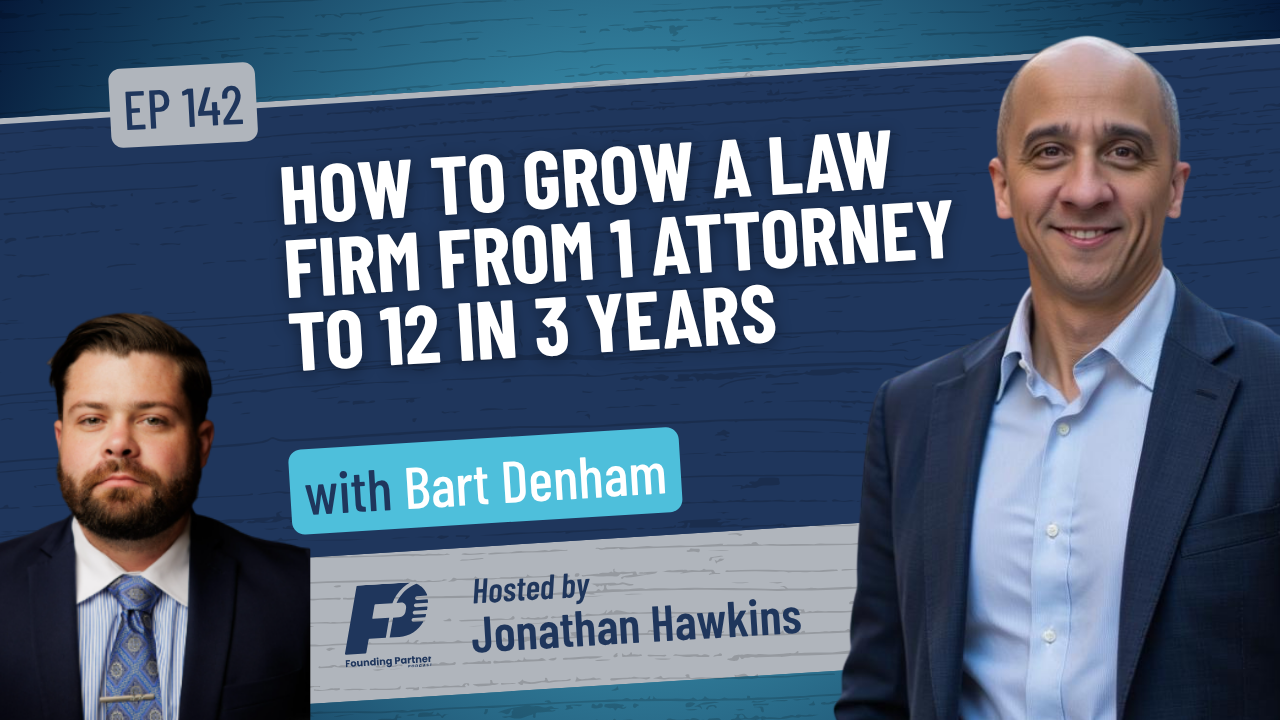
When I first met Bart Denham a couple of years ago, we were talking about him hiring his first attorney.
Today, his firm has twelve attorneys, six offices, and licenses across roughly fourteen states.
That kind of growth gets your attention.
But what interested me most about Bart’s story was not simply how quickly the firm grew. It was how willing he has been to rethink almost everything along the way, from hiring and business development to technology and even the software his team uses every day.
Bart is the founder and principal attorney of Denham Property and Injury Law Firm, a firm focused primarily on plaintiffs’ first-party property claims. His goal is ambitious. He wants to build the biggest property insurance firm in the country.
And he is not waiting around to see if it happens.
Finding an Opportunity He Never Planned For
Bart did not go to law school dreaming about first-party property insurance.
In fact, he did not even know the practice area existed.
His first job after law school was doing regulatory work for a medical device company. He quickly discovered it was not the career he wanted. Eventually, he moved to Florida and took a position with a boutique plaintiffs’ property law firm.
That decision introduced him to an industry that would ultimately shape his career.
After helping that firm expand into Kentucky and later working with a personal injury attorney, Bart began to see an opportunity. Kentucky did not have the same concentration of specialized property insurance firms that existed in Florida.
So he built one.
Bart explained that property claims can arise from severe weather, hail, fires, water losses, and other events covered by a homeowner’s or business owner’s insurance policy. His firm represents policyholders when claims are denied, delayed, or underpaid, and increasingly gets involved earlier in the claims process as well.
What began as an opportunity in Kentucky quickly became something much larger.
From One Attorney to Twelve
Bart started his firm less than three years before this conversation.
Today, he has twelve attorneys.
When I asked him what drove that growth, he credited a combination of timing, industry trends, hard work, and bringing a competitive litigation strategy into markets where specialized representation was harder to find.
But relationships have been one of the biggest factors.
The property insurance world is highly referral driven. Bart’s firm works closely with public adjusters, contractors, and other professionals who encounter policyholders dealing with difficult claims.
Do good work for someone, take care of the client, keep the referral source informed, and people talk.
As Bart put it, those relationships can spread “like wildfire.”
That lesson also changed how he thinks about marketing.
Bart originally thought paid advertising would be the primary lever for scaling the firm. Instead, he discovered that some of the strongest returns came from B2B relationships, keeping referral partners informed, answering questions, and creating opportunities for people in the industry to connect.
One example is the Claims Champions Conference his firm hosts in Nashville. What started with roughly 25 to 30 attendees grew to around 75 the following year.
The event is another example of something Bart seems to understand instinctively: sometimes growth comes from becoming a connector, not simply becoming a louder advertiser.
Hiring for Traits Instead of Experience
Rapid growth also meant Bart had to learn how to hire.
And like most founders, he learned some of those lessons through mistakes.
One of the biggest shifts was moving away from hiring primarily for experience.
“Don’t go for experience,” Bart said. “If somebody has the experience, it’s great, but you need to hire for the traits and the skills or the, you know, the behavior and the traits.”
His firm now uses a much more structured applicant process, including cognitive, behavioral, and role-specific testing, along with written and video responses.
Bart said that process has helped reduce turnover and improve culture.
He has also seen another advantage that comes with growth.
Once an organization reaches a certain level of credibility and starts attracting strong leaders, those people can become magnets for more talent. Bart described it as reaching “critical mass.”
A great hire does not simply fill a position. Sometimes that person changes who else is willing to join you.
Growing Through Relationships
Bart’s expansion beyond Kentucky has been a combination of strategy and opportunity.
His first major move came after a referral source told him policyholders in Montana were struggling to find attorneys who specialized in this type of work. Bart responded by getting licensed and opening an office there.
From there, the firm continued expanding geographically and into markets where Bart saw opportunity.
Sometimes that meant moving naturally into neighboring states. Other times, it meant pursuing markets such as Texas or Colorado because they made sense for the firm’s practice.
And sometimes the signal was much simpler.
People kept asking, “Are you in this state?”
Bart paid attention.
That willingness to listen to the market has helped turn a Kentucky practice into a firm with a much broader footprint.
Building Technology Around the Firm
One of the most interesting parts of our conversation was Bart’s approach to technology.
After using established case management platforms, Bart decided his firm’s specialized practice needed something different.
So he built it.
Bart is quick to point out that he is not a coder. Instead, he began experimenting with AI-assisted development tools to create a case management system customized around the firm’s processes.
Eventually, he hired a professional freelance developer to review the system and make sure it was secure. The firm then moved completely onto its own platform.
Now, when the team wants a new feature, Bart does not have to wait for a software vendor’s roadmap. They can build and test it themselves.
The system also incorporates AI into parts of the firm’s workflow, including document review and demand preparation.
For Bart, technology is not something separate from the firm’s strategy. It is part of how he wants the organization to compete.
That same philosophy showed up when I asked what advice he would give other attorneys considering entrepreneurship.
“You definitely wanna leverage technology,” he said. “You wanna use AI. I mean, that’s, that’s key.”
The Reality Behind Rapid Growth
From the outside, explosive growth can look exciting.
From the inside, it can be exhausting.
Bart was candid about that.
He still has his hand in almost everything, even as he works to reduce his personal caseload and concentrate on the firm’s largest and most complex matters.
His days can include reviewing applicants, interviewing attorneys, meeting with marketing and intake teams, working on business development, opening offices, attending conferences, and handling client matters.
That creates plenty of stress.
“I work an insane amount of hours and have a smile on my face doing it most of the time,” he said.
Growth has also brought turnover and difficult feedback from former employees. Bart acknowledged that an organization can change quickly, and the people who were right for one stage may not always fit the next.
His challenge now is learning how to keep moving without allowing the inevitable frustrations of a growing organization to overshadow the progress.
Sometimes that means getting out of the office and going to the gym.
Sometimes it means remembering how far the firm has already come.
And sometimes it means hugging Skirt, his poodle and the firm’s unofficial mascot.
Building Something Bigger
Near the end of our conversation, I asked Bart what advice he would give someone earlier in the journey.
His answer came back to entrepreneurship.
“If you want to, go out and build something.”
Bart pointed out that even if the attempt fails, there is value in trying. When he sees candidates who have started businesses or firms that did not work out, he does not automatically view those experiences negatively. He respects the willingness to take the risk.
For lawyers starting small, he believes preparation can become a competitive advantage.
When you do not have the resources or size of a larger firm, you can still be the most prepared person in the room. You can dig deeper into cases. You can adopt technology faster. You can build relationships others overlook.
That is essentially what Bart has done.
He found a niche he did not know existed when he entered law school. He recognized underserved markets. He built relationships. He experimented with hiring. He expanded geographically. He created his own technology.
And he kept building.
Closing Reflection
Bart’s story is a reminder that growth rarely comes from having the entire roadmap figured out at the beginning.
Sometimes the opportunity appears first, and the strategy follows.
What matters is being willing to recognize the opportunity, do the work, build the relationships, and keep adjusting as the organization becomes something bigger than what you started with.
Three years ago, Bart was building a firm largely on his own.
Now he is thinking nationally.
And he is still building.
AND MORE TOPICS COVERED IN THE FULL INTERVIEW!!! You can check that out and subscribe to YouTube.
If you want to know more about Bart Denham, you may reach out to him at:
- Website: https://denham.law/
- Facebook: https://www.facebook.com/DenhamLaw/
- Instagram: http://instagram.com/denhamlawfirm
- LinkedIn: https://www.linkedin.com/in/bartdenhamlaw
- Email: Bart@Denham.law
Connect with Jonathan Hawkins:
- Website: https://www.lawfirmgc.com/
- LinkedIn: https://www.linkedin.com/in/jonathan-hawkins-135147/
- Podcast: https://www.lawfirmgc.com/podcast
Jonathan Hawkins: [00:00:00] So, when you started out three years ago, it was just you, and in three years you’re now 12 attorneys. That’s a lot of growth in a short period of time. What do you attribute all that growth to? How’d you do it?
Bart Denham: Yeah, so I definitely got lucky with the industry that I’ve stumbled into and kind of like our strategy of taking the litigation style that I learned in Florida, which is super competitive and laser focused on, you know, firms that do this type of litigation, taking it to Kentucky and, you know, some other markets like in Montana where they’ve never even heard of an appraisal, which is like a big part of it.
Industry trends a lot of hard work. When I started out, didn’t have a lot of work and was kind of looking for things to do, but pretty quickly I had no shortage of things to work on ever.
Welcome to the Founding Partner Podcast. Join your host, Jonathan Hawkins, as we explore the fascinating stories of [00:01:00] successful law firm founders. We’ll uncover their beginnings, triumph over challenges, and practice growth. Whether you aspire to launch your own firm, have an entrepreneurial spirit, or are just curious about the legal business, you’re in the right place.
Let’s dive in.
Jonathan Hawkins: Welcome to Founding Partner Podcast. I’m your host, Jonathan Hawkins. This is a podcast where I get to interview founding partners and attorneys and hear about all the cool stuff they’re doing. And today’s guest is a good one. We met, I think, two years, two and a half years ago or so at a conference, and have stayed in touch ever since.
And his firm has just experienced, I would call it explosive, massive growth. it’s been cool to see, and I wanna dive in and talk about it. So welcome to the show, Bart Denham. He is a attorney based in Lexington, Kentucky. His firm is Denham Law. Bart, [00:02:00] thanks for coming on the show, man. Why don’t you tell us a little bit about your firm, what you guys do, and, and sort of where all you practice now.
It’s not just Kentucky, right?
Bart Denham: Yeah. Well, thanks, Jonathan. I was thinking before we came on here about when I met you. You know, you meet so many people at these conferences. Met you, such an unassuming, nice guy, but the effect that you had on the trajectory of where our firm’s gone has not been unsubstantial. It’s crazy to think about.
So, yeah. Bart Denham, born and raised in Lexington, Kentucky. Double University of Kentucky grad. Founded Denham Property Injury Law Firm a little less than three years ago. And we specialize in first party property claims. Makes up about 90% of our total case volume. We have six offices and about 14 licenses in-house pretty much nationwide you know, for the right case, and 12 [00:03:00] attorneys, staff.
You know, we’re proud of being a, a young tech forward and aggressive law firm
Jonathan Hawkins: We’re gonna dive into all of that, especially the tech part too. But so what is property, you know, what is it, what, what does that mean? What do you, what do you do? First, first party property damage, what, what is this?
Bart Denham: Yeah, I get that question a lot, even from other attorneys. If you’re in the industry, you’re in it, but if you’re outside of it, like, you don’t even know it exists. But basically, like, think about, like, the hurricanes in Florida first party insurance claims people have against their own home or business from, for insurance that you purchase.
So, Florida was like the cottage industry. It, it was a big industry there, so lawyers in Florida do know about that. But we’ve brought it over to a lot of underserved markets where, you know, we might be one of, or one of the few [00:04:00] firms that, that specializes in that practice area. Gotten a lot… There’s been a lot more cases coming around because the insurance companies are becoming quicker and quicker to deny and underpay these claims. Like, a Wall Street article just did a Wall Street Journal just did an article about the big five insurance companies are denying 45% of claims without any payment, and that’s up, like, almost double from, like, five years ago or something like that
Jonathan Hawkins: Wow. So th- this is I, I buy home insurance and then something happens to my house, I make a claim and they deny it, and you come in and you fight on behalf of me. Is that basically it?
Bart Denham: that’s a, a really common occurrence, you know. So we do underpaid, denied, delayed, and then there’s a new part of our business we’re doing a lot more of, which is kind of like, adjusting in a way. Like, somebody will bring us in on the very beginning of a claim just to, like, handle it for a reduced rate and [00:05:00] make sure it goes smoothly, and then if we have to litigate it, we’re, we’re already there.
But that’s becoming a bigger portion of our business the way the industry’s going is just like people getting us in like you would, like a car accident. Like before, you know, you even try and negotiate it with the insurance company, you’re hiring an attorney. It, it’s starting to be done that way, too
Jonathan Hawkins: Okay, so take me back. You decide you wanna become a lawyer because you said, “I wanna go do first party property cases.” How, how did you get into this? I
Bart Denham: not even close. So I mean, I didn’t even know, I didn’t even think about law school till, like, my junior year of college. And then through, th- there through law school, I always thought I wanted to do in-house work. And that was actually the first job I took. I did regulatory work for a medical device company for about a year, year and a half after I graduated, and I freaking hated that job, dude.
I was just staring at the clock till 5:00 every day, like, counting [00:06:00] down the minutes till I could leave and go home. And at some point, you know, COVID hit, and we were all working from home, and that was great because I wasn’t actually working. I was playing video games. And when they said it was time to come back to the office, I was like, “I’m not going back.”
That, and this was in Kentucky, like, you know, in Lexington after I graduated. So I decided I was gonna move to Florida, so I took the Florida Bar Exam. And before I even got my results back, you know, I was applying for jobs, and I ended up taking the first job I got offered at a law firm in St. Pete a boutique plaintiffs property law firm.
So they did first-party construction defect and, you know, third-party property loss. And I think I accepted the job in the first interview. Didn’t even really think too much about it, but that’s how I got in- into first party
Jonathan Hawkins: And so you were down in Florida for a while. I guess you said that’s sort of where it sort of s- this practice area really started, I guess. And so y- you were there for a while, and then [00:07:00] somehow y- or some way you made it back to Kentucky. So tell me about sort of how you ended up back there.
Bart Denham: Yeah, so that firm actually had some Kentucky connections. Like they… It’s a husband and wife that owned it. The husband was from Kentucky, so they wanted to open a Kentucky office. So me working there, my first job at a law firm, I pretty quickly helped them open their Kentucky office and was doing everything from acquiring the clients to resolving the cases.
So I kind of outgrew that role pretty quickly. Technically, I got fired from the job, but decided to partner with a personal injury lawyer in Kentucky and did that for about a year while I was still living in Florida. Same thing, outgrew that role, was kind of paying a percentage of the profit to a partner who’s doing something completely different, didn’t make any sense.
So, when it was time to open my firm, I really saw the [00:08:00] opportunity in Kentucky. I had the connections here. There was nobody else doing it. The Florida market was super saturated. They just got rid of the attorney fee statute. There was a, a law in Kentucky that if you recovered anything from an insurance company they had to pay your fees in Florida.
They got rid of that in 2022 or ’23, so the market’s like collapsed there. But moved back to Kentucky when I opened the firm. It’s gonna be three years ago in a few weeks
Jonathan Hawkins: So, I think I understand in Florida, I mean, you, you get a big hurricane that comes through, there’s just claims everywhere, and, and the insurance company’s like, “We can’t pay all these claims. They’re denying.” Like, how did, how did you know, or what led you to believe that there’s actually a market for this in Kentucky where ma- what do you guys have?
Like, tornadoes, earthquakes? I mean, what, what kind of, you know, is this… You know, what are the, what are the claims? How are they, they coming, come… How are the claims arising?
Bart Denham: Yeah, I mean, so severe weather is [00:09:00] probably the biggest portion of the claims. But, like, after I left at my first firm, there was a straight line wind event, just, like, a really, really strong wind. It wasn’t a tornado or anything like that. And it was so bad that it was declared a, like, federal national national disaster.
And so it pretty much, you know, destroyed every roof in, in Kentucky that it touched. So I mean, that, that’s a big part of it. Hailstorms fires. Insurance companies will do anything not to pay for a fire loss. They’ll say, you know, you’ve lied on your application, make up some mystery about how the fire got started by, you know, one of the policyholders.
Losses, they’ll say this was long-term seepage and leakage, which is excluded. It has to be a sudden accidental loss to be covered or, you know, failure to maintain heat to the property. The reason I knew, it’s like if you’ve read From Good Hands to Boxing Gloves, which talks about the McKinsey documents in [00:10:00] Allstate, when they realized, hey, we’re gonna make a lot more money if we just don’t pay our claims.
That theory has spread throughout the industry. So there’s I think like 60,000 claims a year in Kentucky or something like that, and insurance company’s gonna pay maybe half of them or whatever. So you do the math there. Well, there’s not a lot of other firms doing it. There’s plenty, plenty of work for us to go around.
And when, when they deny the claims or, you know, underpay them, whatever, nine out of 10, eight out of 10 people aren’t gonna do anything about that. They’re just gonna accept it and move on
Jonathan Hawkins: So that was my next question. Do most people just walk away? And if that’s sort of what most people do, how do you… Do they know about somebody like you that can help them get the rest? And if not, how do you spread the word, educate, get the word out?
Bart Denham: It’s a good question. So a big part of, you know, when we used to advertise was just like letting people know they [00:11:00] have an option. We have kind of gotten away from advertising. You know, we’ve– about to get back into it, but, you know, we’re having no shortage of work. Haven’t really taken that burden upon ourselves to try and educate people about, you know, their rights and their options.
Public adjusters and, and contractors are somebody that we work really closely with in the industry, so a public adjuster kind of does the same thing. They try and get these claims paid. They’re just– they’re a licensed professional. They’re just not a lawyer. And you know, roofing contractors, some people hate them, especially because they go knock on people’s doors after storms, but they’re serving a real purpose.
Like, no regular homeowner is gonna get on their roof after a storm and go check if they have damage. But you may have damage, and you might not notice it until six months or a year after when your claim’s already time barred, and you can’t even make it. So, you know, a lot of the education falls on the other people in the industry, not really the law firms.
But, you know, it’s, it’s definitely something we want to get back into [00:12:00] doing
Jonathan Hawkins: Okay. So you, you, you were at a couple other firms before you started your firm. So what, what was the impetus of you starting your firm? Was it whatever, whoever you were working with ended, or, or you left to start your firm? What, what… And then what inside you said, “Hey, I’m just gonna do it myself,” versus going with someone else?
Bart Denham: Yeah, I got really lucky. So The way I say it is like I didn’t really have a choice. It was like I could stay where I’m at right now and be doing all the work and giving away some of the profit to somebody else that’s not really providing much value, if any, in return, or I could go out on my own and take 100% of the profit.
So, you know, I didn’t really ever, I think, really have a, a goal to own my own firm. I think at either of the two law firms I worked at before, if, if… I don’t wanna say if I was treated better, but, you know, if I if it was a better fit, I probably would’ve stayed there. But [00:13:00] the, the way the, the dominoes fell, it was like I really didn’t have a choice.
It was just like, “Let’s go start our own firm.”
Jonathan Hawkins: Maybe it was destiny.
Bart Denham: Yeah.
Jonathan Hawkins: So, all right. So how many attorneys do you have now, other than you?
Bart Denham: We have 12
Jonathan Hawkins: Okay. That’s a, that’s a lot, man, for, in three years. I remember when we first met, I think it was just you. I think it was just you.
Bart Denham: I remember we were talking about me hiring my first attorney
Jonathan Hawkins: And I mean, we’ll talk about… Well, well, let’s dive in now, just hiring ’cause I know like everybody, when you start to hire your first people, I’ve had this experience, everybody has it, I think. Maybe you get lucky, but usually you, you, you don’t hire well. It’s like you don’t really know what you need or maybe you don’t interview right.
I, I don’t know what it is, but you gotta sort of learn a few times, make a number of mistakes before you figure it out. What have you learned over the years about hiring?
Bart Denham: Yeah. So one of the first lessons I learned was don’t [00:14:00] go for experience. Like, if somebody has the experience, it’s great, but you need to hire for the traits and the skills or the, you know, the behavior and the traits. Once I figured that out, that cut down on turnover a lot. So we have a really cool applicant system.
We use TestGorilla. We run ads on Indeed and LinkedIn, and then TestGorilla we do. I mean, it’s a really cool program. You can do a ton of different kind of tests. Right now we’re doing cognitive, behavioral, and some role-specific skill tests. So like multiple choice question tests, and we’ll do, like, some custom essay questions, resume scoring, and video questions.
So between all that, like, it gives them a numbered score and, you know, I usually go through and, like, pick out somebody. I’ll tell my operations manager like, “You, interview these people.” He records them, I watch them. Sometimes I do a [00:15:00] second interview, and that works really good for non-attorneys, like support staff and, like, associates.
When you start to go for, like the leadership roles or, like management, that system doesn’t really work. Those people sometimes don’t wanna spend their, like, two hours applying for a job or an hour and a half applying for a job or whatever. So for those roles, which is really cool, this year I think we kinda got.
Finally got enough of a reputation and hit, like, critical mass as a firm where we started, like, getting these A-level hires. Like, I hired Asher Malul. He’s our National Director of Business Development. I think he’s one of the best people in the country in doing this, and, once you start bringing people like that, other people wanna come too.
So we hired like two 10-year vets. One was a managing partner at a firm in Florida. W- the other one worked at another major firm and then had his own shop for like eight years before he came and joined here. And all three of them have just been like, “This is amazing. We love it here.” So [00:16:00] already had some other people reach out that I’m like mind-blown that they would even be considering leaving their current position to come join here.
But, so I would say like the momentum, you know, you gotta get like enough of mass as an organization and enough credibility to be able to land top-tier talent, and then testing, being selective on the hires for the support staff. And then also one thing we’re getting into now is direct hire for VAs.
Had some agencies in the past, terrible experiences. They’re taking like two-thirds of the money and really just getting in the way, especially in the hiring process when they pick like two or three applicants. They’re like, “Here, pick one of these, or we’ll get you some more if you want.” You know, we have like posting on latamjobs.org and onlinejobs.ph for Philippines and South America, and we’ll get hundreds of applicants that have taken this test, and you can, you know, pick the best of the best to interview. It’s really [00:17:00] been a world of difference than like the agency route
Jonathan Hawkins: You know, the, what you said about the critical mass that’s so true. Early on, it’s hard, it’s hard to hire because people don’t know who you are, but then once you hit a critical mass, it, it, it’s, it’s, it’s like you have a center of gravity, so you can pull more people towards you. But even bigger than that, a great point I think you made, if you can make a major splash of a hire that other people know in the industry, that hire can then attract lots of other good hires, especially, you know, people they have worked with in other places.
That is so insightful. So I got, I gotta, I gotta find one of those for my firm. And then they all just start coming, right?
Bart Denham: Yeah
Jonathan Hawkins: The other thing, yeah, I think with all these tests, as, as you’re telling me about it, I’m thinking a lot of applicants are gonna be like, “Hell no, I’m not taking that test.” So [00:18:00] just, just you weed out a huge chunk of the people that would’ve pushed the button and submitted.
So it just probably makes the whole process on your side in terms of weeding down the initial applicant pool a lot easier as well
Bart Denham: Yeah. And I mean, again, sometimes we’ll interview somebody that maybe hasn’t taken the assessment, and then if we’re like borderline, we’re like, “Go take the assessment.” And if it’s good, we’ll hire them. If it’s bad, it’s not. But you know, it definitely Streamlines the process and makes, you know, it’s def- it’s cut down on our turnover a ton.
We used to have a terrible turnover problem. It’s helped with our culture. I mean, it’s, it’s been a game changer
Jonathan Hawkins: Okay. So, when you started out three years ago, it was just you, and in three years you’re now 12 attorneys. That’s a lot of growth in a short period of time. What do you attribute all that growth to? How’d you do it?
Bart Denham: Yeah, so I definitely got lucky with the industry that I’ve stumbled into [00:19:00] and kind of like our strategy of taking the litigation style that I learned in Florida, which is super competitive and laser focused on, you know, firms that do this type of litigation, taking it to Kentucky and, you know, some other markets like in Montana where they’ve never even heard of an appraisal, which is like a big part of it.
Industry trends a lot of hard work. When I started out, didn’t have a lot of work and was kind of looking for things to do, but pretty quickly I had no shortage of things to work on ever. And so, you know, the industry is highly referral based or relationship based. So, you know, you do a good job for some public adjusters, some contractors, they tell their friends, they all want to use you, and it kind of just spreads like wildfire.
So taking care of the referral sources, providing a good client experience you know, that’s key. It’s it can be tough ’cause when you think about, you know, we’re 100% contingency based billing and if somebody [00:20:00] needs $100,000 to put their house back together and insurance company only paid them 20, we get them 80, well, we’re still gonna take 30 or 40% of that 80, and they might not have enough.
So, you know, trying, fighting really hard to make sure every client gets made whole, A lot… It, it’s just been a lot of things, you know. Like, the stars kind of aligned, you know, I have a goal and wanna be, like, the biggest property insurance firm in the country. So doing everything we need to do to make that happen
Jonathan Hawkins: I love that goal, man. That’s awesome. So that’s the next question. So you decide you wanna grow, you’re in Kentucky. You- obviously you’re more, you’re more than Kentucky now. So how did you decide how to expand outside Kentucky? Was it organic or strategic? So organic, just opportunity rose, arose. You’re like, “Yeah, let’s go there.”
Or was it strategic? I wanna go to this state next. Or was it both?
Bart Denham: Yeah, so initially, you know, I had Kentucky and [00:21:00] Florida licenses. I had to take bars for both of them. One of my first big referral sources was like, “Hey there’s nobody to help us in Montana. There’s tons of claims. People are just getting screwed over for no reason just because the insurance companies know they can’t find an attorney to help them up there.” So I was like, “I’ll go … I’ll take another bar.” So I got the UBE, and I actually took it in Tennessee and transferred it to Montana and opened a Montana office. And so at that point we had Kentucky, Tennessee, Florida, and Montana. And it’s, it’s been a couple of different reasons why we expand where we do.
There’s, like, the geographical expansion around Kentucky that’s kind of like the natural path. So far we’ve added North Carolina, South Carolina, and Indiana. Would add Ohio, but I just hate the laws in Ohio and hate litigating there, so probably not gonna go there. The other part is, like, the, the major markets.
So, like, Florida used to be the golden market. Louisiana, still [00:22:00] really good, but kind of on its own island ’cause of the way they have the laws there. But now, like, the good markets like Texas and Colorado, so had to get into those two. And then kind of, like, again, we started reaching that critical mass.
Like, people all over the country are reaching out to us like, “Hey, are you in this state? Are you in this state? Are you in this state?” So kind of just by, like, the vibes, I could tell where people need attorneys, so,
Jonathan Hawkins: So
Bart Denham: just doing it that way.
Jonathan Hawkins: you’re pretty active on LinkedIn. Are you active on any other social? And, and I, I assume that’s helped get the word out. What, what’s been your experience there?
Bart Denham: Yeah. This year I got a lot more active on LinkedIn. Love it. I check it multiple times a day, always trying to come up with clever things to post. Instagram, @denimlaw. We love posting videos of Skirt and funny memes and of our events and [00:23:00] stuff on there. And my, my personal Instagram’s @bartdenim.
But those would be the big two. The, the industry though is, like all the public adjusters and contractors are on Facebook. So like there’s several groups that have tens of thousands of people in them. Like Level the Playing Field is a big one. L- you know, Public Adjuster Forum. They’re these huge groups that we get a lot, a lot of referrals on there.
Like other people will say, they’ll be like, “I needed an attorney in Missouri.” People would be like, ” Bart Denim
Jonathan Hawkins: Good place to be. It’s a, it’s a good place to
Bart Denham: there. Yeah. I need to get back on Facebook. See, I’m on there, but I need to get on there more
Jonathan Hawkins: There’s only so much time in the day. There’s only so many things you can do personally, so hopefully you’ve got a team to help you there. But s- so that’s, you know, it’s a good point. You, you’ve done a good job of really branding yourself and making relationships and, you know, you’re seeing that you’re getting sort of the, the benefits of all that work and sort of building the relationships.
And I, [00:24:00] and I imagine when you started, you weren’t sure what was gonna work and what wasn’t. Did you experiment a lot, or how did you go about trying to build these relationships?
Bart Denham: Yeah. Well You know, some of the relationships I, I’ve taken, taken with me over the years like You know, the, one of the public adjusters that I owe a lot of my early success to, I met at my first firm and I’ve kind of still keep up with him all the time. Mainly I think on maybe the paid ads, I thought that I would be able to just like really scale it with that, like just calculate my cost per case, return on investment, just keep throwing more money at it, and then boom. But where we’ve really gotten the biggest return on our investment is B B2B, like hosting events.
We host a conference in Nashville every year called Claims Champions Conference. And just building relationships with public adjusters, and a lot of that is … doesn’t cost anything. It’s just [00:25:00] like keeping them updated on the cases they referred to us, being there to answer their questions you know, doing whatever you can do to help our mutual client be successful. So I would say that’s been the biggest key
Jonathan Hawkins: let’s talk about that conference. That’s b- that was on my list, something I wanted to ask you about ’cause I, I, I noticed, I don’t know, the last time you did it, I saw some posts on it and I thought that was great. So how many years have you done it? What led you to do it? And I just imagine it, it is a shit ton of work to put on a conference.
But so tell me what, what gave you the idea to, to do it?
Bart Denham: Yeah. Thankfully it hasn’t been a shit ton of work for me. But the, my staff that plans it, they’ve done a great job. Maybe a shit ton of money that I’ve sunk into the first two. But so the first… I’m a, I’m a huge UK fan. I’m like diehard UK fan. That also means I love the SEC. So when we were opening our Nashville office back in, when was that?
2020 [00:26:00] Four beginning of 2024. We were like, “Let’s host a, you know, an event for it.” And we were like, ” When’s a good time to do that?” We looked, the SEC Men’s Basketball Championship Conference is in Nashville, so we’re like, “Well, let’s just do a conference with it.” So that was Clayton Champions Conference.
Year one, I think we maybe had, like, 25 or 30 people over two days. Next year we did it again. We had, like, 75 people, and we literally packed out this conference room at this country… called the Countrypolitan Hotel. We couldn’t even fit everybody in there ’cause we had oversold capacity. It was, like, meant for, like, 50 people.
And squeezed as many of them in there. But yeah, that, that, that was a really great event. Doing it again this year. Got a bigger space. I think we’re doing it at the Nashville Convention Center, so hopefully we’ll be able to fit everybody in there. But yeah, that, that was great. You know, again, critical mass.
[00:27:00] Got a few, like, really popular people in the industry to go, and then I, you know, reached out to other people I knew in the industry. Was like, “Hey, this conference. Got these people. Would love if you would also speak.” And then it kind of snowballed from there. We did some fun events, too. Like, last year we had a tractor ride at the t- around Broadway.
It’s like this giant tractor with, like, you know, bars at each end, and, like, just drove around. We got billboards, and I tried to get the tractor to drive by the billboards, but apparently the street I got the billboards on wasn’t big enough for the tractor to go down. So they wouldn’t drive us by the billboards.
I was pretty mad about that.
Jonathan Hawkins: So are there any competitor conferences or is yours the only game in town?
Bart Denham: You know, I try not to look at other people in the industry as competitors. We’re all uni- we’re all unified, unified by our, our hate of the big insurance companies. But I’m, I’m kind of small potatoes compared to the, the conferences of the property insurance space. So there’s like [00:28:00] Windstorm that’s in Texas.
It’s got, you know, maybe 50,000 people or something. I don’t know, some crazy amount of people that go. ‘Cause, like, the roofing industry in Texas is massive, so that Windstorm, it’s aimed at roofers, but we’re tangentially on the side of that industry. Wind Insurance Conference, it’s just called Wind. I mean, that’s been going on forever.
That’s a really big one. Th- those are, like, the, the two main ones that I think come to mind. There’s the, the International Roofing Expo is insanely big, but that’s, like, they include pretty much everything about the roofing industry, whereas the other two are… Those are aimed at, like, the insurance side of, of the industry
Jonathan Hawkins: Well, I think that’s an interesting idea for others out there maybe that, that have these niche sort of practice areas. Th- there may be room for creating your own sort of [00:29:00] event and becoming the center point of that, and it might be something that people can do. You know, obviously like in the legal space there’s hundreds of conferences of all types and different people doing them, so, but you know, something like that, I mean, I could think of some others maybe, but you know, maybe an idea out there for some people to think about. I like it.
Real quick, if you haven’t gotten a copy yet, please check out my book, the Law Firm Lifecycle. It’s written for law firm owners and those who plan to be owners. In the book, I discuss various issues that come up as a law firm progresses through the stages of its growth from just before starting a firm to when it comes to an end.
The law firm lifecycle is available on Amazon. Now, back to the show.
Jonathan Hawkins: So moving on, man. So, for people who are not watching this, behind you there is this glass wall and all these colors and things going on back there, and before we went on I said, “What is that?” And it’s a computer that you built [00:30:00] yourself. So that leads me to believe you are a builder of many things, and one of the things you’ve built other than that computer is that you mentioned you built your own case management system for your firm to operate on.
So tell me about that. How did you do that, and are you a coder or is this a, an AI assisted thing? Tell me about that.
Bart Denham: Definitely not a coder, but I mean, going back to like two years ago, three years ago, when, you know, ChatGPT was on the rise, it was like ’03, I was like, I spent days trying to get ChatGPT to like hooked up to our case files. It was ultimately unsuccessful, but then like at the turn of this year, like December, January, when OpenClaw came out, it really changed the game on what non-technical people can do. lot of people call it vibe coding, but you know, you can tell the AI to build you a case management system. It’s not necessarily exactly that [00:31:00] simple, but basically we started out on Clio, and then we outgrew that. We were on Filevine. I absolutely hated Filevine and everybody that worked there and all their business practices, and thought we were able to build something better.
So I started off on my own for the first couple months using OpenClaw. You can do the same thing on CloudCode, but you know, there’s programs out there. I’ll get nerdy for a second. We have a Supabase database, which is Postgres where everything’s stored. Then there’s a Next.js framework on top of it, which is like the interface.
It’s hosted on Vercel. And so anything we wanna do, I can log into CloudCode and be like, “Add this feature.” We test it. If it works, we can push it over to the live version. If it doesn’t work, you know, just troubleshoot it with with Claude. So I use Claude Code now. It’s really cool, and I’ve started using that for way more than just working on the case management system.
Like, I [00:32:00] had an appellate brief that I used it to review an insane amount of documents. But yeah, so I hi- hired a professional freelance developer to help us with for a few months, and he kind of gave it an audit and made sure that everything was secure. And then a couple months ago, we pushed it out live to the firm.
We’re completely off Filevine. The staff loves it, especially like if they want a new feature, we could add it in like a week maybe even less. But you know, especially with a niche practice area, it’s so great to be able to customize some software to exactly how we want it to work and not have to change our processes around, you know, how some case management system that’s geared at personal injury works or something like that.
Jonathan Hawkins: What’s… I’m just curious, you know, when you have Filevine or Clio or whatever, you gotta buy seat licenses, right? You know, a license for every seat, everybody that uses it. So it just, your cost just continually goes up as you grow. What’s it like when you build your own? I mean, [00:33:00] obviously you’re not paying licenses for people, but
Bart Denham: Mm-hmm.
Jonathan Hawkins: obviously y- you know, it, it’s, you’ve done it, so it’s does exactly the way you want it.
It does what you want it to do. But what’s the cost? Is there any cost savings or is it just spread in a different way ’cause you have to maintain it?
Bart Denham: No, the cost savings is, I mean, it’s nominal. Well, I mean, once… Like, you know, I paid, I think I paid $20,000 to the developer over the course of like four months to kind of… And I, you know, we probably didn’t even really need him. We probably would’ve been fine without that. But no, the cost is nominal. I mean, we pay for tokens through the AI vendors, through Claude.
We have it hooked up to OpenRouter, so you could actually select whatever model you’d like to use when you’re using the various AI features on there. But I mean, yeah, the tokens are the biggest cost. Like, I mean, we have a demand writer that goes through probably 10 to [00:34:00] 12 passes, you know, through the documents and iterating the letter, and I think that’s like an extreme overkill number of passes on it.
And we’re using Fable 5, which is the most expensive model, and I think it’s like 15 bucks to do, to do that, to do the demand letter. And then, you know, we have… There’s not, none of it’s per seat licenses, so we have a Gi- we have like a GitHub, a Vercel, and a Superbase subscription. I think all that is less than $500 a month, and we get unlimited seats
Jonathan Hawkins: So, so you’re coming out ahead. I mean, number one, it does exactly what you want it and you’re coming out ahead cost-wise. That’s awesome
Bart Denham: Yeah. Yeah. And then I’ve showed it to some other people in the industry, they’re very impressed with it. I kinda wanna I don’t, I don’t wanna say sell it, ’cause I don’t wanna go you know, do all that. But I’d, I’d like to give it to some other people to use too
Jonathan Hawkins: Your MSO can license it out to other
Bart Denham: Oh, good idea. Yeah
Jonathan Hawkins: That’s a topic for another day. Ah. So yeah, so getting back to your [00:35:00] firm, man. So again, you’ve had all this massive growth. From the outside it looks great. People are like, “Wow, he’s just killing it, doing awesome.” But, you know, anybody who’s done it knows on the inside it’s, it’s, it’s an up and hill, up and down, and, you know, two steps forward, three steps back kind of process.
Especially if you grow very, very fast, which you’ve done. So what are your thoughts on that? How have you managed it?
Bart Denham: Yeah. So I mean, first of all, I wanna, I wouldn’t have it any other way. Let’s go ahead and say that. Very happy about, you know, what I’m doing. I work an insane amount of hours and have a smile on my face doing it most of the time. But if I had to think about the, the drawbacks, I mean, when you are doing so much stuff, like there’s so many different moving parts and you, you know, maybe have a large caseload, do so many different things in a day, there’s gonna be at least one or two or three [00:36:00] things that just piss you off, like major.
And so it’s hard to not focus in on those things. You know, you’re leaving work, it’s like, ” Today was so stressful. This felt like a crazy day.” But it gets to the point where it’s like, that’s every single day. And you know, you gotta take a step back and, and think about the wins and, and how far you’ve come. The other thing is when you’ve grown this much, you’re bound to have disgruntled employees and, Definitely have had a few of those that have had some not nice things to say on their way out that usually it’s something along the lines of like, we have too many cases and we don’t care about our clients ’cause, you know, we, too many attorney- or too many clients per attorney or something like that.
But, you know, I just think like, well, we gotta take an altruistic view about helping these people. If they didn’t come with us, would they go to some other firm down the street that doesn’t specialize in this? And would that firm do a better job than [00:37:00] us? Maybe if they, you know, have a higher caseload and don’t get the same attention maybe that they would at another firm.
But those would be the main things I think
Jonathan Hawkins: Well, it’s very true. As you grow, the people that were there at one stage, you, you, you tend sometimes to outgrow them just naturally, their talents, their abilities, all that. But also the… It just, it’s a different atmosphere. It’s a bigger firm, and maybe they don’t like the change. Pe- change is hard for a lot of people, and not everybody can really handle it.
So I think it’s inevitable really. So I, you know, you just gotta, gotta roll with it, which I’m sure you are. But you said you’re, you’re working your butt off, man. You’re doing all sorts of things. What, what’s a typical week like for you now in terms of, you know, what, what do you, what do you focus your time on?
Client work, growing the firm, building their case management system, recruiting, all the things. What, what’s a typical week like for you nowadays?
Bart Denham: Yeah. So I still have [00:38:00] my hand in, you know, pretty much everything. So I thankfully have gotten down to about 84 cases, which is the lowest I’ve been at since I can remember in a long time for my personal caseload. And I’m– have two attorneys that have higher caseloads than me. I think I had like 150, maybe almost 200 at one point when– after some attorneys left.
So I’m trying to get out of, you know, working the cases, and I just wanna focus on our biggest and most complex cases. So been a nice transition, spending less of my time having to litigate at least some of the smaller cases. But spending several hours a week either reviewing applications or interviewing people.
My operations manager is doing a lot of that too. But kind of like second rounds with attorneys or, or some just [00:39:00] reviewing the applicants, doing a lot of that. I’m trying to look at my calendar and think. I mean, the days, the days fly by. But yeah, meeting with marketing meeting with intake, business development, opening new offices.
I mean, we’ve all opened like three new offices this year. So that, that’s a big part of the time, like helping set that up, finding the attorney to be in charge of it, the location referral sources, that sort of thing. Beginning to go to a lot of conferences. I like that. Så ja
Jonathan Hawkins: So tell me about opening a new office. Okay, let’s talk about this ’cause I’ve, I’ve talked to other firms and lawyers that have done this, and I’m always really interested in, in the process of doing that. And just inevitably, I think you’re gonna get better at it every time. Your, your next open is gonna be better than the last one, and it’s certainly better than the first one.
So let’s say you’re go- you decide to open a new office in [00:40:00] Colorado. What, what’s, what’s the process? Do you have a go team? Do you have a… You, you fly out there, you find the space. Sort of take me through, you know, the process of doing it
Bart Denham: Well It depends. So We’ve, we’ve changed how we’re doing it recently. So And we still do it the old way sometimes, but the old way was we post it for an attorney in the market we want to enter into, and we hire a local attorney. I mean, we just hired for North Carolina like that recently, and it, it worked out great.
But now what we’re doing is we’re hiring people in Kentucky, usually in Lexington, that are willing and able to get those licenses in those other states. And then they’re working from our headquarters in Lexington. So trying to keep, you know, this be the, the mothership, the headquarters where all the work gets done, and then have you know, a satellite office in Denver.
And then for the, you know, [00:41:00] opening the … When we actually open the office, you know, we gotta make sure we comply with the bar rules, whatever you know, you need to be able to advertise or, or hold yourself out as having that office there. But we usually like to go for, like, as close to the city center as possible.
Like, if you look on Google Maps, the name Denver, we would wanna be, like, right on the N or the second E or whatever to maximize SEO for our Google My Business profile. So those are the two main things. But you know, some of the other offices, they’ve kind of turned into their own hubs. Like Nashville, we have three attorneys and two support staff in our Nashville office, and it’s, it’s growing.
We just got them kind of like a, I call it an ivory tower office. They moved out of this like really ugly first floor Nashville rock wall office into like the 18th floor of the Regions building in this like super nice building. It has like a [00:42:00] fitness center and like all this, you know, all these nice features, so really happy for them for that.
Jonathan Hawkins: Very nice. All right, man, another question. Again, massive growth. You’re busy, you’re working all the time. What do you do to sort of manage the stress? I know from some of your LinkedIn posts, you used to be a runner. I don’t know if you still do that. I mean, what, what, what do you do to manage the stress?
Bart Denham: Yeah. That’s, that’s tough. So, oh You got, you gotta exercise. I mean, that’s, that’s the biggest one. So, finding time to go to the gym. We actually get all of our employees gym memberships that there’s a gym that’s, like, connected over here. So if I get, like, to the point where I’m yelling at people at the office or about to yell at somebody at the office, I’m like, “I’m just gonna go to the gym for a little bit and I’m gonna come back.” I also have a sauna at my house. I love that thing. I’ll be in there every day. Like to hit [00:43:00] it, like, a few hours before bed, and then I have, like, the Sleep Eight bed, and it gets, like, really cold. It’s, it’s a very nice way to transition into bedtime. That’s a big one. This guy right here, if you, if you pet him, give him a nice big hug, it like re- relieves some stress.
Jonathan Hawkins: Dogs are great. Dogs are great. I did notice
Bart Denham: watching, it’s my poodle mascot Skirt
Jonathan Hawkins: I love it. All your, your marketing pieces, you’ve got sort of a, I’ll call it a cartoon version maybe.
Bart Denham: Yeah.
Jonathan Hawkins: I love that
Bart Denham: we’ve transitioned into that. Funny story real quick. Whenever we were transitioning to this logo, we still used the, like our s- our scales of justice logo in most of the places. And I had a motion in this case I actually filed a motion for sanctions and I messed it up. But on the safe harbor letter, I put the logo of our skirt logo, our dog logo on it instead of the scales of justice one. [00:44:00] And I got sanctioned by a judge ’cause he thought the logo was a joke. He thought I was trying to make fun of him and it was a joke logo. And I got sanctioned $7,000 I messed something else up, honest mistake. But he also looked at our website and was like, “They’ve rec- they say they’ve recovered over 20 million, so we must make a significant penalty to make it, you know, fit the crime.”
Jonathan Hawkins: You need to s- you need to add that, that judge to your mailing list with, with your logo, your new logo on it so he gets something every month
Bart Denham: my gosh. Well, he totally screwed us on this case. Filed most for summary judgment, or granted most for summary judgment against our client. It was a construction defect case. A month later he retires from the bench, and then I get admitted to the Sixth Circuit of appeal, of Appeals on the day he retires.
So that case is gonna be going for a while. But he, he’s a local legend
Jonathan Hawkins: So I love that you g- you get everybody a gym membership. I love [00:45:00] that. That’s something I’m thinking about. Do you, How do you encourage them to actually use it? Do, do they get bonuses if they go a certain amount of time or a certain number of days in the month, or is it just it’s there if they want it or not?
Bart Denham: You know, I don’t know if we’ve done that yet, like encouraging people to use the gym membership. There’s been a few times we’ve gone to some group classes or, you know, a few of us have like gotten together and been like, “Let’s go. Let’s go pump some iron.” But, you know, it’s just there if, you know, you wanna use it.
I don’t think we’re gonna try and force anybody to use it, but
Jonathan Hawkins: Well, another cool thing you did recently is I saw it on LinkedIn. You, you, you brought a, a custom suit maker to your office, and I think everybody got fitted or, or h- Tell me about that. I thought that was really cool
Bart Denham: Yeah, so there’s this guy on Instagram, Gunner Churchwell. He does these, like, viral videos where he gets, like, millions of views, or he’ll be, like, walking around the streets of New York City, like, he calls it [00:46:00] hustling people to buy suits. But he’s like, you know, a clothier. And I hit him up on LinkedIn, actually. I was like, “Hey, man, I wanna get some suits.” And then got on the phone with him, and he was talking about sending, like, somebody else from his company down there. I was like, “No, man, I, I really want you to come.” Like, “What if I got all my attorneys suits?” He was like okay, I guess that’d be enough. Will you buy my plane ticket?” I was like, “Yeah, I’ll buy your plane ticket.”
So I was like, “All right, guys, we’re getting new suits.” So I got all management and all the attorneys new suits. I mean, it was, like, 13 new suits at the time. And we got them all with… And so he, he flew down here. We made a video about it. Got like 500,000 views ’cause we collabed with him. It’s a great experience.
Super cool guy. But we got all the suits, like, custom, handmade, hand-stitched. You know, the guys got to pick out whatever color and styles they wanted. Dress shirts with their, you know, cuff links, buttons, embroidered everything. And the insides of [00:47:00] the liners have our skirt dog logo on each side for all of them.
Yeah
Jonathan Hawkins: Well, that was not an expensive perk there. I, I’m
Bart Denham: Yeah, it was very expensive, yeah
Jonathan Hawkins: Yeah. Well, that’s cool, man. I like that. That’s, that’s cool also. All right, man. Let’s, let’s bring it home here. So you’ve been at this, you’ve been to some firms, y- you know, you’ve been at your firm now for three years, ups and downs, massive growth.
You know, what, what, what advice would you give to others out there that are behind you in their journey?
Bart Denham: Well, you know, I think You and I, we have that je ne sais quoi, that X factor, that level of panache, you know, where we can kind of tell we have that entrepreneurial speak- streak A-level type player vibe. And I would say anybody that thinks they have that should definitely go out and, you know, if you, if you want to, go out and [00:48:00] build something.
It’s great. If you, you know, if it crashes and burns, it doesn’t work out, that’s fine. You can go back and get another job. But I can’t tell you how many resumes I look at where I’m like, there’s somebody that’s currently, you know, doing their own thing, or they have, like, two or three times they went and did their own thing on their resume.
And I don’t really look- hold it against anybody ’cause it, ’cause it didn’t work out. You know, if anything, I respect it. But, you know, I think with the way the industry’s trending, it’s gonna be… You’re gonna be small or you’re gonna be big. At least that’s what a lot of people are saying, and it makes sense.
So, you know, go do it. And when, when you are either first starting out or, or a solo, I think, you know, your superpower is being the most prepared person in the room, being able to, you know, really dig into your cases that other people might kind of look over. And I would say, you know, you definitely wanna leverage technology.
You wanna use AI. I mean, that’s, that’s key
Jonathan Hawkins: Well, Bart, I appreciate you coming on, man. And, and [00:49:00] again, it’s been real fun watching what you’re doing over there. And I, you know, I think back to when we met, and you, you know, it’s just you. And man, you’ve come a long way. I mean, it’s, it’s really impressive. So keep doing it, man. It’s awesome. And build that national firm.
I know you’re, you’re halfway there, so congrats on everything you’re doing
Bart Denham: Thanks, man. Well, man, I’ve, I’ve said to people before, you’re almost like a, a mentor to me. I don’t know if I’m allowed to call you that, but, like, you’ve … You’re, you’re awesome. You’ve given me great advice over the years. Your book, absolutely amazing, a- and your advice a- as outside general counsel, priceless.
Jonathan Hawkins: So people out there that wanna find you, maybe they wanna join your team, maybe they wanna send you a case, what’s the best way?
Bart Denham: All right, I’m gonna give out my email address. if you’re a recruiter or you’re trying to sell me something, you better not email me. I will be pissed and I’ll never buy from you again. But you can email me, [00:50:00] bart@denham.law. You can find us on Instagram @denhamlaw or my personal Instagram @bartdenham.
So yeah. Thanks, John
Jonathan Hawkins: Yeah. Thanks for coming on
OutroUpdatedWebsite-1: Thanks for listening to this episode of the founding partner podcast. Be sure to subscribe on Apple podcasts, Spotify, or wherever you get your podcasts to stay up to date on the latest episodes. You can also connect with Jonathan on LinkedIn and check out the show notes. With links to resources mentioned throughout our discussion by visiting www.lawfirmgc.com. We’ll see you next time for more origin stories and insights from successful law firm founders.