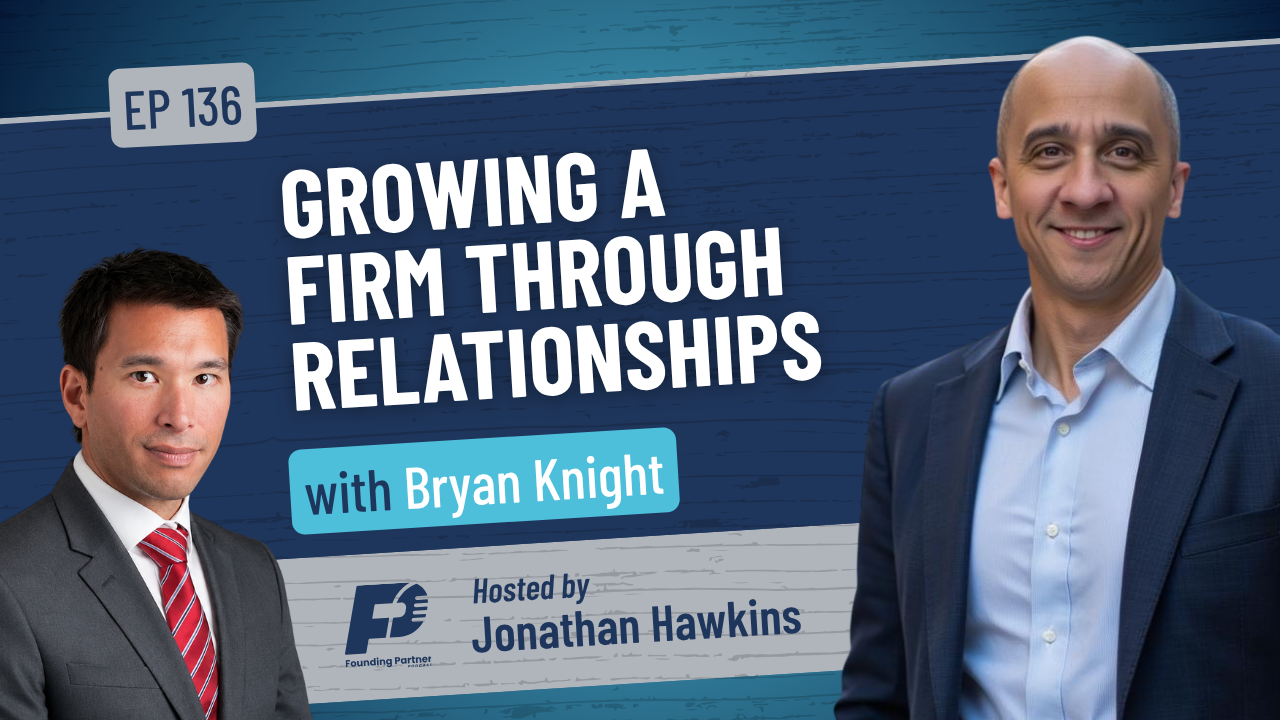
Growing a Firm Through Relationships with Bryan Knight
When people talk about starting a law firm, they often focus on the risks.
The uncertainty. The overhead. The fear that clients might stop calling.
But after talking with Bryan Knight, I was reminded of something I hear over and over again from successful founders: most of the things we worry about never happen.
Bryan is the founder of Knight Palmer, a commercial litigation boutique in Atlanta that focuses on business litigation, construction disputes, real estate litigation, class actions, and insurance coverage matters. Over the years, he has built a respected trial practice while growing a firm that now includes ten attorneys and continues to expand.
What stood out most in our conversation was not just Bryan’s success. It was his willingness to bet on himself long before he had certainty.
From Young Trial Lawyer to Firm Founder
Bryan started his legal career at Streeter, Wheeler & Flint after graduating from Wake Forest Law School.
Unlike many larger firms, he was put into depositions, hearings, and even jury trials almost immediately. Within his first year and a half, he was serving as lead counsel in a jury trial.
That experience changed everything.
Once he got in front of a jury and won, he knew trial work was where he belonged.
As his career progressed, he built a substantial book of business and discovered that he enjoyed business development just as much as litigation. Eventually, he reached a point where he realized the traditional law firm model was limiting his ability to pursue both.
With no children, limited personal risk, and a strong client base, he decided it was time to take the leap.
In 2011, he and his original partner launched their own firm from a single-office Regus space in Midtown Atlanta.
The Reality of Starting Small
Like many founders, Bryan laughs now when he looks back at the early days.
The firm started with one office, one copier, and two lawyers doing everything themselves.
They handled marketing, invoicing, technology, administration, and legal work.
There was no roadmap.
There was no operations department.
There was no IT support.
There was simply a willingness to figure things out one problem at a time.
Within six months they hired their first paralegal, who remains with the firm today. Looking back, Bryan credits much of the firm’s stability and growth to finding the right people early and creating a culture where everyone contributes.
Building a Firm Through Relationships
One of the most valuable lessons Bryan shared is that business development is not about titles.
It is about relationships.
Young lawyers often assume that generating business becomes easier once they make partner. Bryan disagrees.
In his experience, developing a book of business starts long before partnership.
He spent years attending lunches, networking events, bar association functions, and informal gatherings with other lawyers. He focused on building genuine relationships and becoming known for a specific type of work.
For commercial litigators, he believes referrals from other attorneys remain one of the strongest sources of business.
The key is positioning yourself as someone who can solve problems confidently and consistently.
As Bryan explained, people do not refer work to a title. They refer work to someone they trust.
Why Trial Skills Still Matter
Although many commercial litigators spend most of their careers handling motions and discovery, Bryan has always maintained a strong trial practice.
In fact, he recently completed a week-long jury trial involving construction defects and a defective generator system.
For Bryan, trial work remains one of the most rewarding parts of practicing law.
It also creates opportunities to stand out in a marketplace where many lawyers rarely enter a courtroom.
His approach is straightforward: know the facts better than anyone else, keep the jury engaged, and never forget that every case is ultimately about people.
Even highly technical business disputes can become compelling when attorneys tell the story effectively.
That ability to simplify complexity continues to be one of the most valuable skills any trial lawyer can develop.
Expanding Beyond Hourly Work
One of the most significant developments in Knight Palmer’s growth came when Bryan partnered with Jonathan Palmer.
Palmer brought expertise in consumer class actions and whistleblower litigation, creating opportunities for the firm to pursue larger contingency-based matters.
That expansion has led to several major cases, including a nationwide antitrust class action involving real estate commission practices.
The case originated from a conversation with a longtime friend who worked as a real estate agent. What began as a simple discussion eventually led Bryan to investigate industry practices and identify what he believed was a significant antitrust issue.
The result was a nationwide class action that ultimately received approval for a $55 million settlement.
For Bryan, it was a reminder that some of the best opportunities emerge from paying attention to problems people encounter every day.
Growth Without Losing Identity
Today, Knight Palmer has reached an important stage of growth.
The firm recently hired its tenth attorney and continues to evaluate what comes next.
Like many founders, Bryan wrestles with questions about scale.
How big should the firm become?
How much growth is enough?
How do you expand without losing the culture that made the firm successful in the first place?
Rather than chasing growth for growth’s sake, Bryan focuses on intentional growth.
His goal is to continue building a respected trial boutique while creating opportunities for the next generation of lawyers to step into leadership roles.
That means hiring carefully, maintaining high standards, and ensuring the firm’s values remain intact as it grows.
The Advice Every Future Founder Needs to Hear
Toward the end of our conversation, I asked Bryan what advice he would give to lawyers considering starting their own firms.
His answer was simple.
Do it.
According to Bryan, fear stops more lawyers than anything else.
Fear of running out of work.
Fear of not paying the bills.
Fear of leaving behind a comfortable salary.
Yet after nearly fifteen years of firm ownership, he has found that most of those fears never materialized.
Instead, every challenge created new opportunities.
Every obstacle led to growth.
And every step forward reinforced the same lesson.
You do not need all the answers before you begin.
You simply need the willingness to start.
Closing Reflection
One theme kept resurfacing throughout this conversation: confidence comes from action.
Bryan did not wait until everything was perfect before starting his firm.
He did not wait until he had every system figured out.
He did not wait until all uncertainty disappeared.
Instead, he trusted his abilities, invested in relationships, and committed to learning along the way.
For founders and future founders alike, that may be the most important lesson of all.
The path becomes clearer once you start walking it.
Thank you for joining us for this episode of The Founding Partner Podcast. Stay tuned for more conversations that inspire connection and growth.
AND MORE TOPICS COVERED IN THE FULL INTERVIEW!!! You can check that out and subscribe to YouTube.
If you want to know more about Bryan Knight, you may reach out to him at:
- Website: https://www.knightpalmerlaw.com
- LinkedIn: https://www.knightpalmerlaw.com/bryan-m-knight-esq
Connect with Jonathan Hawkins:
- Website: https://www.lawfirmgc.com/
- LinkedIn: https://www.linkedin.com/in/jonathan-hawkins-135147/
- Podcast: https://www.lawfirmgc.com/podcast
Jonathan Hawkins: [00:00:00] And you mentioned the one, this new one with the real estate agents, and with your real estate background, how did you guys discover it?
Bryan Knight: So it was sitting, you know, with one of my buddies from high school who was a Keller Williams agent, and him complaining about this. He’s just like, “You know, man, there, you know, I’ve got a seller, you know, who wants to sell a home, and he doesn’t wanna pay the buyer side commission.” And I had to tell him, I was like, “Look, this is just the way it is.”
And he said, “Well, listen, if you go over to Century 21 or RE/MAX, they’re gonna tell you the same thing. It’s just the way it is.” And so that’s when I went and kind of researched it, why it was that way, and realized the National Association of Realtors who control the MLS systems in every state, in order to be a part of the MLS, these real estate agent brokerages have to join the National Association of Realtors.
And that’s one of their written stipulations, is for the seller to pay buyer side commissions, which is antitrust. And [00:01:00] so immediately when I found that out, I said, “All right. This is an antitrust case. We’re equipped to do it. We vetoed some experience doing it.” And we filed the suit and settled it, and got a settlement approval for $55 million.
Jonathan Hawkins: Very nice, man.
Bryan Knight: It’s up on appeal, 11th Circuit, but hopefully we’re not really too worried about the appeal.
Welcome to the Founding Partner Podcast. Join your host, Jonathan Hawkins, as we explore the fascinating stories of successful law firm founders. We’ll uncover their beginnings, triumph over challenges, and practice growth. Whether you aspire to launch your own firm, have an entrepreneurial spirit, or are just curious about the legal business, you’re in the right place.
Let’s dive in.
Jonathan Hawkins: Welcome to Founding Partner Podcast. I’m your host, Jonathan Hawkins. This is a podcast where I get to talk to law firm founders and hear about all the cool stuff they’ve done, lessons learned along the way, [00:02:00] and maybe some advice to me and others as we continue trying to grow our firms. So today’s guest is a old friend of mine.
I can’t remember how long ago we met, but we’ve been on the same side of litigation, the opposite side of litigation, and just hung out in the same circles for a long time. So today’s guest is Bryan Knight. He is a commercial litigator here in Atlanta at Knight Palmer. I think he’ll tell me, he’ll, he’ll give a little more detail, but he focuses on real estate litigation, construction litigation, and business litigation. So Bryan, welcome to the show, man
Bryan Knight: Yeah, Jonathan, thanks for having me. You know, I actually remember it’s been about twenty years. It was you at Folsom Martin and then Kreindler & Horst, and we’ve had a bunch of cases with each other and against each other. So thanks for having me on your podcast. But like Jonathan said, my firm, Knight Palmer, I specialize in commercial litigation construction and real estate litigation.
My law partner does a lot of class [00:03:00] action, consumer class actions, and also insurance coverage disputes. So right now we’re– we just hired our tenth lawyer, and like you, Jonathan, we’re, we’re, we’re trying to figure things out and trying to grow right now
Jonathan Hawkins: We’re gonna dive into all that. But one thing I’ll note is you, you know, a lot of commercial litigators are paper pushers. You’re an actual trial lawyer. You just came off of a, a trial, I guess, last week, I think you said?
Bryan Knight: I did out in Gwinnett Superior Court, and I had a, had a week-long jury trial with one of my associates Lawton Jordan, and it involved… We represented a medical practice that had some construction defects. And the big thing was a Generac generator would never, never work properly. And we ended up suing, got a judgment for about two hundred thousand and a bad faith attorney fee award of a hundred and eighty.
So we’re pretty happy.
Jonathan Hawkins: Not a bad day, man.
Bryan Knight: Not a bad day
Jonathan Hawkins: All right, so let’s, take me back to the beginning. I, I’m not sure I know this part of your story, but if I, [00:04:00] maybe I just don’t remember. But where did you start out after law school? What,
Bryan Knight: All right.
Jonathan Hawkins: kind of practice did you have?
Bryan Knight: Went to Wake Forest for law school. Did, did summer associate stuff or summer programs at King & Spalding, big firm, and Streeter, Wheeler and Flint, which was more like a, I guess a medium-sized firm, about 30 lawyers. And ended up really liking Streeter, Wheeler and Flint because they got their lawyers into the courtroom, got them in depositions.
Took a job offer with Streeter, Wheeler and Flint, worked exclusively with David Flint and John Christi over there. And within the f- within my first year and a half, they had me doing my first jury trial lead counsel, and we won on a small case. And after that, I was hooked
Jonathan Hawkins: I tell you, man, it’s, it’s the good thing of those smaller firms, they just throw you in the fire fast
Bryan Knight: They do. And, you know, you know, interviewing, you know, recently we’ve hired a, an associate from Wake Forest last year. This associate’s coming from UGA Law, and they, they always ask me, “What kind of, you know, you know, mentoring [00:05:00] program do you have? What is, what, you know, what, you know, what am I, what am I doing to get prepared?”
I said, “Look, you’re gonna get on-the-job experience, and do not come here if you need a, a mentor to, to hold your hand.” And it kind of scares them at first, but I need, you know, to work at my firm because I’m so busy. I need, I need those kind of people that wanna jump into it and aren’t afraid to. So that’s who we’re looking for.
Jonathan Hawkins: Let’s talk about that. So, I mean, over the year, you’ve been, you’ve been doing your own thing. We’ll get into that too, but for a long time. You’ve had your own firm for a long time. You’ve hired a lot of people over the years. What’s your philosophy now in terms of straight out of law school or have some seasoning under their belt?
What, what are you looking for nowadays?
Bryan Knight: You know, looking for a little of both. I go back to two hires ago. We got John Sugg, who came in when Davis, Matthews, and Quigley kind of fell apart. Ron Quigley had some medical issues. John Sugg came over as a non-equity partner who was, who is probably a couple years younger than me [00:06:00] and was a perfect fit.
But at the same time, you know, I’m looking for younger, younger people to kind of, me, for me to develop them the way I want to. So in my form, I’m looking at if, if you have a lot of experience, you know, it’d be a good fit, or I’d rather just take someone out of law school. The, the third year, it’s gotta be a really good fit because with really good training, you have to come from a firm like, you know, where, where you went, you know, where you started, you know, a Folts Martin or a Trevillian Horst or a Schueller & Flint, these kind of medium-sized firms that train their, their lawyers really well.
Gotta be a good writer. You gotta be not afraid to go into court and do your thing
Jonathan Hawkins: So take me back. I think you started your, the first iteration of your firm back in 2011. Is that right?
Bryan Knight: That’s correct
Jonathan Hawkins: Okay. So what pushed you over and said, “All right, it’s time to go”? And I ask this question to a lot of folks. Some people it’s sort of the accidental starting, and other people are like, “I always knew it, it was just, just a matter of when.”
What, what was it like [00:07:00] for you?
Bryan Knight: You know, for me, it, it got to the point where I had a, a large book of clients. I wasn’t getting the return from the law firms that I was at, and really, I really enjoyed the business development side. But because I had so many billable hour requirements, it was very hard to do both. But really, at the time, I had a wife that worked, and I had no kids.
I had no risk. And so for me, it was more about this is the time to do it, and if I don’t do it, I can always come back and work for somebody. And so for me, it was kind of an easy decision because I enjoyed, I enjoyed the business development side of it, and I enjoyed, you know, working with clients directly.
So on that side, that’s what, that was the motivator for me
Jonathan Hawkins: And so you, y- I think you j- you formed it with a partner, right?
Bryan Knight: I did. James Johnston. He was formerly with Morris Manning and, you know, we were both, we had cases with each other going back to the associate days [00:08:00] and we were emailing each other at midnight and, and then, and then we, then we, you know, we, so we formed a friendship and he was kind of at the same point in his career as well.
I think we were at the same year out of law school. Maybe he was a year ahead of me, but we were kind of the same place in life. He, he had a wife, he was married and, you know, it worked and no kids, and we just enjoyed each other. So enjoyed hanging out with each other, had the same philosophies of the practice of law, loved trial work.
And so we, so we gave it a go. We started out at a Regis space over at at Promenade Two in Midtown. And we, we started out with one office. We were licking stamps, writing envelopes, had a copier in there with us in one office, and it was, it was actually, it was actually kind of fun back then. You know, the overhead was super low and we were doing our thing.
Jonathan Hawkins: You know, I had this conversation with somebody recently, sort of after a firm has grown for a while, you know, you’re in your spot, just like the old days. They were so nice, low stakes. You know, you didn’t have all [00:09:00] this overhead. You didn’t have all this responsibility. You’re like, “Man, maybe we should go back to that.”
Do you have those thoughts ever?
Bryan Knight: You know, I, I like having staff now. I like having associates. But no, there, there was a part of it, it was like, you know, “Oh, oh, this, you know, this client paid this big bill this month,” you know, and it was really exciting for us. But now I don’t even know what comes in, what goes out, you know? I got to get my staff taking care of that.
So there’s a part of me that would love to go back to that, but there’s a part of me that’s gotten used to having the help, which is nice
Jonathan Hawkins: Yeah. So tell me about the early days. So it’s you two, did you have any help with you? Just, just the two of you? Did you have staff at all?
Bryan Knight: was just us two. I was doing more of the business, kind of the management, sending out invoices kinda handling the IT. Within six months, we hired our first paralegal, who was luckily loved the IT stuff, loved the softwares and all that kind of stuff. And she kinda came in. She’s still with us today after, you know, tw- you know, almost 15 years.
And so she’s, she’s invaluable for us. [00:10:00] But that, that was the beginning. I mean, really, we didn’t know what we were doing, I mean, to be really honest with you. You know, if I’d known that you were around back then, I would’ve, you know, hired you and had you come in to help us out a little bit.
Jonathan Hawkins: Well, I wasn’t, I wasn’t, I wasn’t there yet, man.
Bryan Knight: I know. I know.
Jonathan Hawkins: know, it’s weird a- and I, I’m curious as to, you know, your, your, your thoughts on it, if you’ve thought about it in a while. But when you’re at an established firm that’s already gone through the startup phase, it’s, it’s way different. You know, if you need something, it just sort of appears, you ask for it, whatever.
But when you have to build it for that first time, you know, after you’ve sort of done some of the things, you never have to do them again. But, you know, the first IT setup, the first setting up the firm, you know, all those things you have to do to begin just suck up a lot of time, and you don’t know what you’re doing, you’re fumbling around
Bryan Knight: It’s, I mean, you’re right. It takes up a ton of time and, you know, and, and you, and you learn stuff, right? And so we’ve gone through a couple iterations, you know, and I wish I had, I had [00:11:00] started out with the same, you know, invoicing system as before, ’cause we lost a lot of information by changing over, you know.
But the only thing that’s, that stood true is we started out as Apple and we’re still Apple computers. That’s about the only thing that, that, that’s actually stayed. We’ve changed IT companies, we’ve cha- we’ve grown into some different things. But you live and learn.
Jonathan Hawkins: 2011, man, that’s early days for Apple law firm Apple implementation
Bryan Knight: It was, it was early, but I will tell you that these Apples for, at least for our, our firm, they’ll– they last a lot longer than the your, your typical computer off, off the shelf. And so we– I, I’ve, I’ve run the numbers, and we think that that has definitely helped. And then the integration with phones now and everything else and, and laptops, it makes it easy
Jonathan Hawkins: You know, the other thing that I, I’ve, you know, just learned over the years, I’m sure you have too, after hiring a lot of people of all types, attorneys, non-attorneys, all, all the stuff, you realize how early [00:12:00] on you’re not very good at hiring. And part of it is you don’t know what you need. It’s part of it is you learn what you need so then you can hire better.
Part of it is you figure out what not to hire or who not to hire. H- what have you learned in that regard over the years?
Bryan Knight: Man, you know, I’ve we’ve learned a lot. we’ve, we’ve hired some gems and had a couple misses here and there. But I think what, what, what stands across the board, at least for me, is I’m looking for kinda hard workers. And I like people who have had jobs, you know, before or worked during college or it’s this kind of this work ethic ’cause you’re gonna find smart, smart people.
I mean, but it’s, for me, it’s that kind of that next step or people who actually like really kind of enjoy the law. Coming outta law school, maybe you don’t know what you know or, or not, but I’m looking for people to actually enjoy the law. But then it’s gotta be, in a small firm, it’s gotta be a good personality fit, you know.
Because if you’ve got one that’s not gonna be [00:13:00] a team player or one a little bit off, it affects everybody else. And so I’m looking for a good personality fit. I usually like to take people out to lunch rather than just do the normal stuff, and try to really get into their personal lives. What are you doing, you know, outside of work?
What do you, you know, what are your interests, you know? And try to, try to, try to see it from, from the whole kind of person aspect rather than just, what are your grades, you know, you know, are, are you okay working weekends and, and that kind of stuff. I actually have respect for people that say, “Listen, I don’t wanna work weekends,” you know?
And for me, I’m like, “Okay, well, why?” You know, because I’ve, you know, I’m into mountain biking, or I’ve got these interests, you know, or I just like to travel. And I said, “All right. Well, that’s kinda why I went on my own.” You know, these guys all laugh, but s- this last, one of the last big wins we had, you know, I said, “Rather than giving you guys bonuses, I’m gonna give you trips anywhere in the world that you wanna go with this X amount of, of, of dollars that you can [00:14:00] spend but I gotta approve the trip.
It’s not to Mexico. It’s not to the Caribbean. It’s gotta be a cool trip. And, and I, and I, and I’ll give you the time off, and I’ll take off the billable requirements for that, so you don’t have to ever worry about that.” And, and that I think means more, it means more to me than having just a bonus
Jonathan Hawkins: That’s cool, man. I bet that helps with recruiting.
Bryan Knight: It does. You know, and these, and, and my lawyers will, will tell those stories, you know, is that, you know, that, that… And the people that we get and that we hire, you know, put that into perspective where it’s like work hard, play hard, you know? You know if you put the time in that, you know, we’re gonna get rewarded.
We’re gonna, you know, I’m gonna take, you know, if you’re into golf or if you’re into other stuff, you know, you know, we’re gonna do dinners. We’re gonna do our bourbon tasting every year, you know? And we try to at least make this a little bit of fun, you know, ’cause I’ve been, been, well, I’ve worked at firms that hasn’t been as fun, and it, it, it just, it makes working hard a lot [00:15:00] harder
Jonathan Hawkins: Yeah, I do wanna talk about that bourbon tasting in, in a minute, so a pin in that. I missed it this year. I’ve missed it the last couple years. But so back to James. So James started the firm with you. He’s moved on. At what time, I, I have this vague memory. Did he move to California and he was
Bryan Knight: He did. You know, he went to UCLA Law. He was barred out in California. He actually was doing some work out in Ca- California. He loved it out there. He met his wife out there, brought her to Atlanta, and they always wanted to go back. And so they, they moved– he moved to San Diego. He wanted to try to do a bicoastal thing.
I just was really worried about that and thought it might be better that he kind of do his own thing over there and, and, and I’ll go solo. And the plan was for me to go solo here. And then Michael, Michael Caplan over at Caplan Cobb connected one of his buddies James, I mean, old J- Jonathan Palmer with me because his firm, Dr.
Miles Shields was all of the partners were retiring. And so he was, he was in a [00:16:00] spot similar to mine, kind of in flux. And so we had some common, you know, co-commonalities with with work in terms of his commercial litigation practice. But then he brought on class action and insurance coverage, which is always great to have those extra practices.
But then he also liked golf, liked bourbon, and you know, the rest is history.
Jonathan Hawkins: I can’t remember, when did you start the bourbon tastings? Was it
Bryan Knight: Bourbon Casey was with James. It was one year out. So 2012, first one was Druid Hills Golf Club and you know, we’ve been doing it ever since
Jonathan Hawkins: Damn. So you’ve been doing it, what? Almost 15 years
Bryan Knight: Almost. Almost, yeah.
Jonathan Hawkins: We’re about to be the 15– Is next year
Bryan Knight: Coming up, yeah
Jonathan Hawkins: You gotta blow it out. It’s gotta be a
Bryan Knight: I know, I said that. You know, we’ve got that class action settlement. Hopefully that comes through. It’ll be, it’ll be a, it’ll be a straight Pappy line of bourbons.
Jonathan Hawkins: You’ll get them to make one for you, custom for the, for the tasting. So yeah. So Jonathan came [00:17:00] on in 2019. He brings class action. So how was that bringing in… I mean, that’s a completely different practice area than what you were doing. I mean,
Bryan Knight: Correct. And so I
Jonathan Hawkins: action
Bryan Knight: I always tell people like, you know, I’m getting, I’m getting base hits. I’m, I’m an hourly guy, you know? I’m just, I’m just plugging away. Palmer brings in both the whistleblower stuff and the class actions, pure contingency. Us paying, paying the expenses, taking a lot of risk.
Palmer’s hit on two here that did not involve me. But this last one where we sued you know, all the real estate agents, you know, I was involved in that. But, you know, that was a big risk, but I kind of liked it because I kind of had my practice set with the hourly stuff, taking care of most of the expenses and all that.
And, you know, having a couple kind of home runs lingering out there was, was, was a lot of fun for me
Jonathan Hawkins: So how did, how did you and Jonathan integrate the two style of practices? I, I’ve seen a lot of firms where they have an hourly piece and a contingency [00:18:00] piece, and it, it, it can get a little challenging of how you integrate, especially with how you use, I mean, obviously you advance expenses, but using other resources, people and whatnot around the firm, and when it hits and when it doesn’t, and the, you know, peaks and valleys.
How have you guys managed it?
Bryan Knight: You know, the way, way that, way that we manage it, we started it out, and because we were unsure kind of how things were gonna work out, we really started as expense sharing partners. And so really it was just kind of, you know, each one kind of pay their, their expenses. You know, I have certain lawyers that work for me.
I take care of their expenses. We have some shared overhead expenses with staff and rent and that sort of thing. And, and then, and then when these, these cases came in, what we kind of agreed on was, “Look, I’ll come in with my hours. I’ll bring in, you know, an associate or two, and, and then we’ll kind of split whatever comes in.”
And so, and, and so it’s, it’s kind of worked out, you know? It’s… But it’s also kind of just [00:19:00] trusting your partner. I hate to say it, you know, everyone wants everything in writing, but at the end of the day, if one gets a little out of whack, then, then we’ll make adjustments. And we’ve kind of done that through throughout the course of our partnership
Jonathan Hawkins: And class actions are a little weird too in terms of contingency ’cause you gotta get approved and then maybe there’s a committee and then how do you, is this political there? You get in on the committee and then you have to have the judge approve the, the fee and all this stuff. How’s that part been?
Bryan Knight: Well, luckily we opposed the… You know, there was a, there was a motion to have all of these cases consolidated into the mul- MDLs, the multi-district litigation cases. Luckily, we’ve avoided those, and so we have not had to deal with that. And so we have, we have been our own committee. We were able to negotiate all these individually.
We had to go move for class you know, class settlement approval from the Northern District, and you’ve got all sorts of parties coming in and fighting that. But o- other [00:20:00] than that, we haven’t had to deal with the committees yet. That happens more usually on the product side or personal injury side.
We’re only doing consumer class actions.
Jonathan Hawkins: Cool thing, I, I’m curious, you know, don’t give your secrets, but finding the, the, the claim,
Bryan Knight: Yeah
Jonathan Hawkins: the claim. And you mentioned the one, this new one with the real estate agents, and with your real estate background, h- how did you guys discover it?
Bryan Knight: So it was sitting, you know, with one of my buddies from high school who was a Keller Williams agent, and him complaining about this. He’s just like, “You know, man, there, you know, I’ve got a seller, you know, who wants to sell a home, and he doesn’t wanna pay the buyer side commission.” And I had to tell him, I was like, “Look, this is just the way it is.”
And he said, “Well, listen, if you go over to Century 21 or RE/MAX, they’re gonna tell you the same thing. It’s just the way it is.” And so that’s when I went and kind of researched it, why it was that way, and realized the National Association of Realtors who control the [00:21:00] MLS systems in every state, in order to be a part of the MLS, these real estate agent brokerages have to join the National Association of Realtors.
And that’s one of their written stipulations, is for the seller to pay buyer side commissions, which is antitrust. And so immediately when I found that out, I said, “All right. This is an antitrust case. We’re equipped to do it. We vetoed some experience doing it.” And we filed the suit and settled it, and got a settlement approval for $55 million.
Jonathan Hawkins: Very nice, man.
Bryan Knight: It’s up on appeal, 11th Circuit, but hopefully we’re not really too worried about the appeal.
Jonathan Hawkins: Whittle that down a little bit on you. But so is this national or just in the state of Georgia?
Bryan Knight: It was a national class action
Jonathan Hawkins: But filed in, in Northern District
Bryan Knight: Correct. Judge, Judge Kellam approved the settlement
Jonathan Hawkins: Very nice, man. You got any others in the, in the, in the
Bryan Knight: We do. We do. We’ve got– we’ve gotten into these these tax appeal cases. And so we’ve got one in Fulton County against the Fulton County [00:22:00] tax assessor where back in kind of around COVID time, they got lazy or couldn’t have– didn’t have appraisers that could go to properties and appraise. So they just used the previous sales price for the house as the appraisal value, and that’s, that’s called sales chasing, and it’s, it’s unconstitutional.
Constitution of Georgia requires each property to be separately appraised. And so your firm is on the other side. Crowell & Moryes is representing the City of Atlanta.
Jonathan Hawkins: My, my old firm.
Bryan Knight: old firm. Your old firm. Your old firm is representing the City of Atlanta. And and so we’re– we’ve, we’ve gotten class, class certification on that case, and now we’re kind of moving forward with fact discovery.
Then we’ve got another case in DeKalb County under a different kind of tax, tax issue. But it’s it’s based on the two-year freeze period that commercial properties get. So like Stonecrest Mall is a– one of the big class representatives, and they appealed their taxes, supposed to get two years of freeze.
They didn’t get [00:23:00] it. They were sent a tax bill, paid it on accident, not knowing. And there’s– And almost every– A ton of commercial properties in DeKalb County had the same thing happen to them. So, so that, that one alone is probably a hundred and fifty million dollars class action. The Fulton County one’s about a hundred million.
Jonathan Hawkins: Wow.
Bryan Knight: So
Jonathan Hawkins: Well, let me ask this. If you start to, if these class actions start get- gaining traction, are you gonna give up, give up the hourly practice? You gonna
Bryan Knight: the hourly practice, you know, I, you know, I still enjoy going to trial, but I think we might get a little pickier and choosier on some of the hourly stuff.
Jonathan Hawkins: So let me ask you this. I’m curious as somebody who tries complex business cases, they’re very different and I’ve asked some folks this, but you know, the I’ll just call it like a car wreck or a typical plaintiff kind of case. They’re pretty short. You’ve got witnesses and you can do it in a day and a half, maybe three days tops.
With these business cases, [00:24:00] they’re more complex. There’s usually a buttload of documents. The jury’s over there probably falling asleep. How do you, Bryan, keep them entertained and keep them interested when you’re having to put these documents and take them through these sometimes boring and methodical, you know, spreadsheets or whatever?
Bryan Knight: Well, let’s take this last trial. So last trial were power systems, a generator company. They sell these million-dollar generators that power, you know, whole hospitals and that sort of thing. They brought their corporate representative down from headquarters in Wisconsin.
And to keep the jury kinda entertained, you know, I know the answers to a lot of the questions I’m gonna ask ’cause of depositions, but one of the big issues was here is that they said that the building was defective, not their generator. But for a year and a half, there was no writing in there.
They were sending people out, doing warranty work and trying to fix it. They just could never find a problem. It was a lemon. But I couldn’t say that from a motion of lemony standpoint, but it [00:25:00] was. And so for the jury, you know, I’d bring up these issues, and I was like I’d look at him and I’d say, “Let me guess. There’s nothing in writing, is there?” He says, “No.” “Let me guess. You had a phone call and then now let me guess. You didn’t know any, who was on the other line of that phone call?” He says, and he goes, “Yes, yes, yes.” Jury’s kinda chuckling. And for documents that are important, I’d walk up, put ’em up there, and kinda go through the document with him.
So I try to be a little more engaging, but one of the best ones was this guy tried to say that he’s on this elite team of resolution managers. They call it the escalation team and for Generac. And he said it was for rapid response. And so I said, “So you’re kinda like SEAL Team Six.” And he said, “Yeah, kinda like SEAL Team Six.”
And I was like, “So your rapid response, this claim starts in 2019. You don’t even send somebody out ’til 2021. If you were SEAL Team Six, people would die.” And no objection from their side. The jury’s laughing, you know. And [00:26:00] so I try to do stuff like that to keep them entertained because they are boring.
There’s a lot of documents. But, you know, if, if I can add a little, you know, humor or light to it without being condescending, I try to
Jonathan Hawkins: So did you, did you go to law school wanting to be a trial lawyer or is that something you s- discovered?
Bryan Knight: I went to, I went to law school not knowing what, what law is now that I look back on it. I thought it was something completely different. But it was, it was more of a trial aspect to it. It was this is embarrassing, but it was Tom Cruise from A Few Good Men. I was like, “I wanna be that guy.”
Like that, you know, but really, you know, I… Before law school I did two years of medical sales selling medical equipment, and I, I think that that experience today has, has probably helped me the most in business development and kinda my normal practice. Obviously the, the law stuff is different, but the business side, those two years of sales doing, [00:27:00] doing just, you know, cold calls or walking into businesses, you know, that kinda stuff is, has helped me out a lot with the business development side
Jonathan Hawkins: So what are your go-to? What’s, what, how did you build your practice? I mean, if, if you, if if I’m a young lawyer starting out, I say, “Brian, you’ve built this great firm, this great practice,” and it, and it sounds like from a pretty early age or in terms of law school or lawyer, you developed a book of business pretty young.
So what would you tell people?
Bryan Knight: I would tell people it’s, it’s, if you’re, if you’re in business litigation, it’s all law- it’s mostly all lawyer referrals. You know, it’s different for different practices. Family and personal injury kind of have their, have their own, but for business litigation, decent referrals are gonna come from other lawyers.
So what I was doing early on was doing lunches. You know, the lunches have kind of, kind of gone by the wayside these days, but, like, the lunches were, were critical. Doing anywhere where I can meet other lawyers, so I was focusing on the young, the young [00:28:00] lawyers bar, bar stuff. I was taking other associates, like opposing counsels, you know, meeting them for drinks.
You know, that’s back when, you know, before you’re married and you have more time, you know, or just kind of hanging out with other lawyers. But I also did one of those business to business kind of networking groups where we met other people. But doing that as a young lawyer was important just to get your name out there.
But also, I think as a young lawyer, taking ownership and being like, “I’m the man,” even though you might not be. You know, it’s maybe a little smoke and mirrors, but saying, but let them think you are, rather than saying, “My firm and my law part- my, my partner can help.” But you know, no, say, “I can help. I’m, I’m gonna do it.”
And, and run with those clients and actually, you know, run with them, you know. That, I think that helped me out the most because it wasn’t like you were gonna get a referral and then I was gonna bring somebody else in to help or… And that might naturally happen, but I wanted to be the man.
Jonathan Hawkins: I’m with you. I agree. I, over [00:29:00] the years, and I went out there pretty young doing all the stuff, and, you know, the first thing is it’s, it’s hard to develop practice, business litigation practice, I think, ’cause you’ve got to reconstitute it every year. It’s a, it’s, it’s one-offs. It’s just a bunch of one-offs, so you just really gotta get out there.
The other thing that over the years I’ve heard a lot of associates say, “Well, if I was a partner, it’d be a lot easier.” And I just don’t agree with that at all. I mean, maybe it’s a little easier, maybe, but that’s not stopping you. What, what are your thoughts on that?
Bryan Knight: I, I, I totally agree. It’s, it’s, it’s not so much the title, it’s how you act. It’s, it’s how much, you know, confidence that, that you’re gonna bring to it, or instill confidence in people to give you a referral. To say, “Hey, listen, if I give a referral to this guy, is he gonna be able to handle it?” So when I meet people, just like you and I have had this conversation, you know, I’m gonna talk about stuff that I’ve done, you know, and, and cases that, that I work on, and so that people can start to start thinking about you [00:30:00] as, you know, as, you know, a good lawyer or an expert in a field.
And so that’s what I always typically try to do. It’s not just, “Hey, Jonathan. Hey, I’m Brian. I’m a lawyer here.” It’s, “Let me hear about your practice, you know, first. You know, you don’t want to start talking about yourself first. Let me hear about your practice. Oh, well, now let me tell you about my practice,” and go through and talk about things that I think you and I might have synergies on.
Because if you’re a corporate lawyer, I know that immediately, you know, find out what kind of operating agreements you’re, you’re drafting, and I try to figure out those synergies. Is it from a non- non-compete stand- standpoint, trade secrets? Where is it where I can figure that out? And guess what? I do a lot of that stuff, and I’m the best.
Jonathan Hawkins: You know, the other thing too that a lot of younger lawyers, I mean, I get it, they’re busy, they have billable hour requirements, et cetera, et cetera. But you gotta get up from behind your desk and get the hell out there. You gotta go out in the world, right?
Bryan Knight: Yeah, [00:31:00] 100%. I mean, and that’s, and there’s nothing stopping you from doing that. And, and I think that that’s where, where you learn that you have the most freedom, you know, when, when you become a producer, you know, and you’ve got your own clients. You know, you have freedom. You can, freedom from law firms. You can move law firms.
You can do your own thing. But that’s where you have your freedom. But if you’re just, you- you’re sitting there billing, billing away, that’s a whole nother model. But you’re gonna be tied to the desk
Real quick, if you haven’t gotten a copy yet, please check out my book, the Law Firm Lifecycle. It’s written for law firm owners and those who plan to be owners. In the book, I discuss various issues that come up as a law firm progresses through the stages of its growth from just before starting a firm to when it comes to an end.
The law firm lifecycle is available on Amazon. Now, back to the show.
Jonathan Hawkins: Now, we’ve talked about that bourbon tasting a little bit. So take me back. What, what led to the creation of that? I, I, I think it’s a great event. You know, it’s, you know, it’s, it’s probably gotten bigger every year. I guess you gotta limit how many people you invite, [00:32:00] but great event. What led to it, and how has it grown over the years, and how has it maybe helped solidify relationships or form new ones?
Bryan Knight: You know, you know, people like you, people, you know, coming back every year. You know, the list has gotten bigger. But it, we, we just wanted a, a, you know, a signature event that was ours, that was different that had a theme and that people knew that when they come back, you know, they would … it’d be a good time.
But, you know, it’s, it’s grown and we’ve got judges there now, and we’ve got you know, we, we like to invite opposing counsel after cases are over. That’s, that’s one of our things is we can fight hard but, you know, still, still be cordial and professional and even maybe even friends afterwards. And that’s always the highest compliment that, that I get when I get a referral from opposing counsel.
So we try to, we try to keep that as, as, as lighthearted as possible. And seeing clients, seeing opposing counsel outside of work I think is always fun to do. But we just wanted a signature event, and that’s kinda how it started
Jonathan Hawkins: Well, great event, man. That’s a good one. [00:33:00] So another thing you do a lot of, I see, I see you and your firm out there a lot of, and that’s sponsor these judicial campaign events. I mean, you do a ton of those. How did you get into that? Why did you… I mean, I think I know why, ’cause you’re trying cases, but tell me about that
Bryan Knight: I mean, really it, you know, it, it kinda started with, with, you know, I think it was … God, I think it was way back. I mean, I’m trying to think of who the first judge was, but I saw, you know, I saw David Flint do that. David Flint did that at Shearer Flint really well. And, and it was, and it just kinda stemmed from that is if I can help keep judges that I like, that I think do a good job, that’s more so more the reason, the, and things behind it rather than just getting to know the judge.
Obviously it doesn’t hurt. But the good judges, that shouldn’t really come into play. They should be calling balls and strikes. But you know, coming in, having that ability to help out. And what I liked was we’re not a big firm, but I’ve got 20 [00:34:00] other people, you know, that are in my situation that I know and I can bring, I can bring together for an event.
And we’ll get … We’ll … Each of my events usually turns out, we usually make 25, $30,000 for a judge. And their typical event they’re hoping to get 5 to 10, you know? And so it, it turns out to be, you know, ju- just from the numbers, you know, a pretty decent event. And we’ll have, we’ll have it at, at fun places, and it’s just another, another way to network but in a different way
Jonathan Hawkins: And I, you, you mentioned it, but, you know, good judges, which we all know you do this long enough, there’s some judges that frankly should not be on the bench
Bryan Knight: Yeah, I agree with you.
Jonathan Hawkins: of reasons
Bryan Knight: Yeah, I agree with you. And that’s, and that’s kind of the importance of it, is just kinda helping out good judges. You know, you’re– I’m not gonna, I’m not gonna put my name on a judge that I don’t think does a good job
Jonathan Hawkins: All right, let’s switch back to the firm. I wanna talk about the challenges you’ve in- you’ve faced over the [00:35:00] years growing your firm. I’m sure you’ve had some, you know, three steps forward, two steps back kind of things. As you look back now, what is it we’re looking at? 2011 to ’26. What is that? 15 years or so. What are some of the big challenges you’ve faced over the years?
Bryan Knight: You know, the biggest, biggest one is, is hiring, you know? It’s just, it’s, it’s been difficult. We, we don’t have a lot of turnover, but it’s more of just finding the right, the right kind of person. But then strategy, am I, am I gonna get laterals? Am I gonna go straight from law school? You know, do I go after a equity partner to kind of come in, you know?
And we’ve, we’ve talked to people, we’ve, we’ve talked to equity partners about coming in, but then it’s wor- we’re worried about losing, you know, our core values and losing, losing what we have. That’s been a struggle for us. It’s like, where are we going with this law firm, you know? Is it we’re, we’re on a trajectory, you know, to definitely we’ve got room to [00:36:00] grow, but how big is big enough, you know?
And how much money is enough money? And so that’s, that’s kinda, kinda where, where we’re at. And so we’ve started taking less cases, but bigger cases. That’s been a challenge. You never like … I don’t know about you, but when I first started, probably the first 10 years, I was always worried about running out of business, and it, and it scared me, and I think it prevented me from growing a little bit those first years.
But now it, it hasn’t been a problem. It’s almost like the Field of Dreams. If you build it, they will come. And that’s … And we’ve been lucky enough to have, have that opportunity. And so right now we’re in kind of a growth mode. Our, our office is, is full. We’ve got, we’ve got, you know, one lawyer working from home, which she lives in, she lives, you know, 40 minutes away, but, you know, it’s work- it’s a good, good, good fit.
But there’s this next, next big obstacle of where we want this to go, what kind of space do we need, and, you know, it’s, it’s all exciting, but a little [00:37:00] scary at the same time
Jonathan Hawkins: So you mentioned opportunities. The other thing that people will find, I found it, I’m sure you’ve seen it. When you own your own firm, especially when you go out early, all these new opportunities, you just get these opportunities, and not all of them are a good fit. And I’m sure, you know, right, you’ve always been a litigation boutique.
I’m sure you’ve had the opportunity to add some transactional component to your, to your firm.
Bryan Knight: One, 100, 100%. I, I thought that the only way to do it, you know, you were at Fullarton. I thought the only way to do it was Fried Hiller Flint. You know, they had, they had their corporate side, they had their real estate, you know, transactional side and they had litigation. And it, and it all… You, you did everything for all the companies.
And, and we just realized that we’re gonna– I wanted to do what we do well, and we just, we are not equipped to do that, and I’m not equipped to kind of oversee that. And it was just, I think we were spreading ourselves thin, losing our identity. So I wanted to really just kind of more for branding, [00:38:00] just stick with what we do well
Jonathan Hawkins: My experience too over the years, I was always, before I started my firm, was at, I’d call it a business boutique. We did litigation and real estate and corporate stuff at both firms. Great firms, good lawyers, but I always felt as a business litigator back in the old days, it was a little more challenging to get referrals.
You know, if there’s a corporate lawyer out there at a corporate boutique, even if I promise I won’t steal the client and even if I, you know, they believe me and they said yes, they would still think, “Well, if you get a corporate client, you’re gonna send it down the hall instead of bring it back to me.”
So it was… It– I felt it was challenging being at those firms to try to get work. I don’t know. I think when you’re in a boutique, it just seems like it might be a little easier. I don’t know. You got any thoughts on that?
Bryan Knight: I agree. I mean, in terms of that’s who I network. I, I network with corporate lawyers who are kinda on their own or don’t do litigation, real estate lawyers who don’t do [00:39:00] litigation. Those are my beft- best re-referral sources because it’s usually a two-way street. It’s doing something that the other doesn’t do.
So with that respect, then yes. But then also just, just from the specialization, you know, that everyone knows you to kind of specialize in these areas, and you’re not just a j– like a small town lawyer who does a little bit of everything. You know, it’s you got the specialization. So I, I would definitely agree with that
Jonathan Hawkins: So you’re at about 10 lawyers now, you said?
Bryan Knight: We just hire a 10th. He’ll be … He’s taking the bar in July and will start with us in September. Yeah
Jonathan Hawkins: So the other thing that I, I saw over the years at my two prior firms, when I, when I joined the, I think both of those firms, we were around 12 lawyers, and we would bump around 11 to 14, and we bumped around for a while, and then, and then this critical mass effect took hold, and then all of a sudden we jumped into the 20s pretty quickly.
So you’re bouncing around and then boom. I’m wondering if you’re around that [00:40:00] stage and then the question is, do you want that? And are you, you know, are you open to that? And what do you think? What’s, what’s, what’s gonna happen next?
Bryan Knight: You know, they– all the, all the m-mentors and people that I’ve talked to over the years have said, “Just wait, you know, 50 is when you really start to peak.” You know, you get, you get a little, get a little of the gray hair, you get a little street cred, you know. But I’m 48, so if that’s two years from now, maybe you’re right.
But if it’s… I’m not a numbers guy, but I, I want it to be, if w- if the growth is there and we can, we can continue to provide great service, continue to st- to still be a great trial boutique, then yes, let’s grow. But numbers m- numbers don’t really matter to me. It’s more the planning. It’s like, what size office do I need?
That’s, that’s kind of what, what I’m thinking about because you know, th-those are just the questions that I’m still working on right now. But I do know that a numbers, numbers that I like are, you know, somewhere between [00:41:00] 15 and 20. And the reason being is when I talk to general counsels they want you at those numbers, you know, to make sure that you can handle all of their work.
And so right now, kinda like what you said, a lot of my work is kinda one-off, but I’m try– I– We’ve got a couple, we’ve got a couple of larger clients that we’re doing continuous steady work for but they’re still worried of flooding us, you know. And so that’s always a concern once you start making that next leap which is kind of my next goal is to start getting some more reoccurring larger companies to that reoccurring business.
Jonathan Hawkins: So that’s a great point. There’s a lot of people out there that, you know, they ask the question, “Should I grow? Why should I grow?” And I think you just raised a really good str- strategic reason to grow. You know, there’s a lot of reasons, like don’t just grow just to grow. But if, if being a little bigger means you can get the bigger cases or bigger clients that, that you really wanna go after, then yeah, you gotta get, you gotta do it.
But if you’re just growing just to grow, you’re just gonna sort of [00:42:00] get whipped up on the, on the seas and not really know where you’re going
Bryan Knight: That’s a good point. And that’s, and that’s where, you know, we’re, you know, Jonathan and I are really trying to start talk strategy and, and think about that for sure. But that would be, that would be a great reason. But right now we’ve got, we’ve got, we’ve got cases that are, that, you know, ha- definitely have a lot of m- you know, room for movement.
And so we’ve definitely got that there. But this tenth floor, you know, we’re, we’ll bring on and we’re, we’re gonna do the summer program and actually start to start trying to do what you and I grew up doing. You know, we’re, we’re, we’re part of this go after these top, top level law students and start, start putting some more money into the recruiting side.
Jonathan Hawkins: Nice, man. You’re growing up. You’re,
Bryan Knight: I know.
Jonathan Hawkins: becoming a real firm.
Bryan Knight: I know. I know. I know.
Jonathan Hawkins: So yeah, so as you look forward, it sounds like, you know, you- you’ve thought strategy. I think you, you sort of know where you’re going. You’re not a numbers necessarily just for numbers sake [00:43:00] kind of guy. But as you look forward the next 10 years or so where would you like to take it? Stay in Atlanta, go other places,
Bryan Knight: Yeah, no, definitely s- definitely stay in Atlanta. Definitely stay in Atlanta. But would definitely like to be more, more class action work. Maybe some more … See, business litigation is so hard in the contingency side, but class action whistleblower, that makes more sense for us. But, you know, I’d like to be at that kind of 10 years from now at that 20, 20 law firm, you know, 20 attorney number.
I’d like to have a, a succession plan in place, you know, because I’m not one of these guys that are gonna die, die at my desk, you know, working. But I’d like to be able to still have my foot in there, but have some, have that, these guys that are working for me now ready to take, take the reins and kind of have that set up here in the next, you know, five years or so.
Jonathan Hawkins: Yeah, it’s a challenge, man. The [00:44:00] succession planning is just, it’s a challenge. And, and it’s good to be thinking about it now ’cause if you wait too late, you know, it’s, it’s, it’s, and b- it’s sort of too late.
Bryan Knight: Well, you know, you’re right, and I, I don’t wanna be too old where they say, “You’re just, you’re just bringing these guys in because, you know, you have to.” But I, I wanna bring them in early with some of these, some of these bigger clients and get them g- you know, get them, get them used to this. But also show them, you know, kinda how to run a firm and, and also how to, how to bring in business.
That’s always, that’s the s- the, the, the unknown, you know, is, is the bringing in business side, you know, for a lot of these younger lawyers. But trying to teach them how to do that and hopefully, hopefully we’ll get that kinda worked out.
Jonathan Hawkins: So also as part of growth, and we’ve talked a little about it, you want sort of the seasoned lawyers or the brand new lawyers. Let’s talk about more of the seasoned lawyers.
Bryan Knight: Sure.
Jonathan Hawkins: H- wh- what do you do for recruiting? I think, you know, how do you find the, the lawyers you want, and then how do you recruit them and convince [00:45:00] them, “Hey, this is a place you should come”?
Bryan Knight: You know, we’ve, we, we are naturally very bad at recruiting. We understand that that’s one of our, our weaknesses. We’ve been, I’ve been lucky enough because of the attorney network that I have that’s kind of how I’m doing my recruiting, is really just kind of like reaching out to people, “Hey, we’re looking for this, looking for, looking for lawyers.”
But now I’m getting hit up with ev- everyone’s kind of looking for lawyers, I feel like. But it’s, you know, it’s not so much the new lawyers, but everyone wants that kind of someone older than, I mean, more than three years, but hasn’t been entrenched totally with, you know, wants to be partner. It’s kind of this, I think, I think everybody wants that right now.
But in terms of recruiting, you know, it’s really just kind of word of mouth, and that’s what I’ve, what I w- what I’ve, what’s made me successful and how I’ve gotten most of my business. But I need to be, I know I need to be open to, you know, more ideas with both marketing and, and recruiting. Those are two of our, our weaknesses for sure.
Jonathan Hawkins: Recruiting’s tough. I mean, it, it real- for me, it really is, [00:46:00] and it’s, it’s almost like business development it seems like. You just gotta be in front of people all the time and remind them, “Hey, I’m here,” but also, “Hey, we’re open.” If, if– Because if you– Let’s say an event happens wherever they are and they hadn’t seen you in a while, they may forget that, hey, this is an option.
So it’s like you just gotta be out there letting them know
Bryan Knight: Yeah. You know, in, in the recruiter side of it, you know, I’m, I’m open to it. I haven’t used a recruiter. I’ve gotten really lucky, I think, with some of our hires that most people have been here for a long time. We’ve gotten lucky, but I’m also scared of that, the, of the mercenaries that just kind of firm hop, you know?
Like I’m not looking for that
Jonathan Hawkins: Maybe it’s wrong, but that is a huge red flag for me. If it’s every two years,
Bryan Knight: Mm-hmm.
Jonathan Hawkins: b- you’re, you’re re- it’s, you’re renting a player. It’s like NIL. It’s like NIL nowadays, right?
Bryan Knight: Exactly. Exactly. Come and, come and go. Go, go, go to the next bidder
Jonathan Hawkins: Yeah. You’re, you’re a Clemson [00:47:00] fan, right?
Bryan Knight: I am. I am. Thanks again
Jonathan Hawkins: You know? And they had a good stretch there, but NIL- It’s harder, right?
Bryan Knight: I know. Well, you’re, you’re a UGA guy, right?
Jonathan Hawkins: Well, no, I’m a Georgia Tech guy,
Bryan Knight: UTech undergrad, but, well, at least UGA, you know, they, they, they didn’t win any… I mean, they got the AD championship, but they went, they had a drought until you could legalize cheating, and then they’re like two national championships. They’re like, “Oh, we can do this out in the open now?
Oh, this is great.”
Jonathan Hawkins: you’re, you’re out here. You’re, you’re, you’re at a, you’re drunk at a bar picking a fight, man. Everybody watch out.
Bryan Knight: I am.
Jonathan Hawkins: Oh, yeah. Football’s coming up, man. It’s gonna be fun. Gonna be
Bryan Knight: be
Jonathan Hawkins: So all right, man. What have we not touched on here? So yeah, what, what do you do for fun? I mean, we’ve talked about a lot of the stuff you do, you know, in terms of working. You work hard, you try cases. What kind of stuff do you do for fun, unwind?
Bryan Knight: I’d, I’d say for fun, you know, I’ve… I mean, my kids are really big into soccer, which I was too [00:48:00] growing up. And so I’ve got two girls that play on travel soccer. My son’s starting it up, so I think that’s fun going to that. And they, they also do AAU basketball, which I did, so that’s all fun for me.
But I play a lot of golf and so played, played Saturday for Father’s Day and play some golf here and there. And then travel. So we’re actually leaving for Italy for two weeks on Thursday with the kids, and we’ll go, we’ll, we’ll go take them and travel around and hopefully eat some good food and enjoy ourselves on the beach a little bit
Jonathan Hawkins: Very nice. Have you gone to any World Cup games?
Bryan Knight: Yeah, we went to the the Czechia South Africa game.
But I was actually in trial, so I couldn’t go. I had a friend from college going, but I sent my, I sent my family instead of me, without me, ’cause I was in trial on
Jonathan Hawkins: what’d they say? Incredible?
Bryan Knight: They said it was cool. They just liked seeing all, all the countries, you know, kind of being into it. The Fan Fest beforehand was pretty cool.
Have you, have you been to any games yet?
Jonathan Hawkins: I have not. I’m, I’m not g- [00:49:00] I’m not a huge soccer guy. I mean, I watch a little bit on TV, but, you know,
Bryan Knight: All right. Well, USA, man, we’re they’re gonna be going at it coming up. You know, I guess they don’t have to win this game, but it’s, it’s fun, it’s fun to watch them
Jonathan Hawkins: So, you mentioned earlier before law school, you, you, you were in sales. If, if you were not a lawyer, what would you be doing now?
Bryan Knight: Man, you know, it’s funny you asked me at, at this point, you know, after, after I’ve, I’ve, I’ve kind of put, put some money in, in the bank. But you know, I would, I would probably be… If I, if I wasn’t back… You talked to me and you asked this question back, you know, 20 years ago before law school or so, you know, I’d probably say I’d stay in medical device sales because I, I made pretty good money, you know, doing all that.
Actually paid for my first two years of law school at Wake. But now I think I would, I would be a builder. And because I’ve, I represent so many builders, I’ve represented Pulte Homes in the past, I feel like I know, at least from the, the risk [00:50:00] standpoint, I know where the problems go wrong, contracts, that kind of stuff.
And I think I would, I think I would enjoy kind of the general contracting aspect and having subs and doing that kind of work. But then the real estate dev- development side of it, you know, on the smaller end, I think I would actually enjoy that
Jonathan Hawkins: Have you dabbled?
Bryan Knight: I have. Very, very small amounts, but never on the building side. But I have bought some real estate here and there, which, which I’ve enjoyed
Jonathan Hawkins: Well, you know, I imagine just from some of your clients, you have opportunities to invest here and there, I’m sure
Bryan Knight: Oh yeah. Oh yeah. I’ve gotten involved in a fund and you know, done, done, done a lot of that stuff.
Jonathan Hawkins: All right. For the younger lawyers out there, that are thinking about starting a firm or maybe have started a firm, what advice would you give to them?
Bryan Knight: I would say do it, and I would say for everything that you’re worried about, focus on the upside. Because for some reason, all those things I worried about never came to fruition. [00:51:00] Worrying about not having enough cases, worrying about not being able to pay the bills that’s what keeps. That fear keeps most people from not making the jump.
And every lawyer I’ve talked to that’s gone on their own, I’ve never heard of one failing and going back and working at a big firm. I mean, you tell me. You work with them all the time. I mean, am I wrong? I feel like most all make it.
Jonathan Hawkins: Now, there’s some that get sick of the administrative stuff and they’re just like, “I don’t wanna do that anymore.” But they’re usually very busy and they just don’t wanna do, they just wanna actually just practice law. So, other than that, yeah, I mean, most people tell me, “I wish I’d done it earlier.”
Bryan Knight: Always. And that fear kind of paralyzes people. But especially when you get the golden handcuffs, when you got kids, you got them in private school, you do that. The earlier you do it like I did, you got no risk. You can always go back.
Jonathan Hawkins: So true. You wait too long, it’s too [00:52:00] risky, or at least feels too risky. You know, one thing you mentioned about the fear, you mentioned earlier too I sort of like to maintain a little bit of fear. If I’m too content, then I just start to get soft and lazy. I always need, and if I don’t have fear, I need to manufacture some.
I don’t know. It’s like to make me say, “All right, I gotta go do some more stuff.”
Bryan Knight: You know, that’s actually a good point ’cause you know where the fear comes from me every time? Hiring a new lawyer and be like, “All right, I gotta make sure they got 1,800 hours.” And so then it’s like, “All right, I need to get back out there.” So having that little bit of growth or actually just analyzing the financials a little closer, like, “Wow, there’s a lot of money going out,” gives me that little fear every once in a while and, and, and gets me back focused on, on bringing in some more business
Jonathan Hawkins: So you mentioned that about hire, hiring a new lawyer. I, I want, I’m curious your approach. Do you… Is it a build it and they will come, or do you wait till you’re super, super overloaded to hire the next lawyer?
Bryan Knight: You know, I [00:53:00] should build it, do, do what, do, do what you first said, you know, build it and they will come. I always end up doing the opposite and just overloaded and reactive rather than being proactive. And and it’s one of those things where if I were to tell a new lawyer, “Tell them to be proactive,” but I get how hard it is to do that without the work being there
Jonathan Hawkins: It’s tough, man. It is tough. And recently I had two attorneys leave basically back to back. And we’re, we’re not a huge firm. And it was, it was a big… I mean, we were, we’re, we’re slowly recovering. We’ve got people coming in. We’re filling the bench back up. But man, it’s, it just overloads. And then that’s another benefit of being a little bit bigger.
If, if one or two leave, you got a bigger bench to help fill in
Bryan Knight: Well, let me give you an example. We just had one of our associates she had to take medical leave from June 5th to July 20th. Not that long, right? I mean, but it’s, but it was, it was serious surgery and, but that means I couldn’t give her any new [00:54:00] cases coming in, and all of her current cases, I had to make sure that they were taken care of, which has now overloaded the firm.
Like, one person going down for six weeks has really created kind of havoc, which has kind of shown me that, you know, really we’re, we’re, we’re too stressed right now. We, we probably need another two, two, maybe three lawyers
Jonathan Hawkins: That’s the thing for those out there building, especially when, when you look at all these firms out there and it’s just like, “Oh, they got it made. They, they’ve got it figured out. They know exactly what’s going on.” There’s, It’s like that duck on t- on the water. You know, underneath there’s just so much shit going on, you just, you don’t know about until you’re in it.
And usually when you think it’s all great, that’s when the shit’s about to hit the fan, right?
Bryan Knight: Well, you’re exactly right. But there’s also no, no one way to do it, you know? And I know there’s models, people have used some and been more successful, but I mean, there’s, there, there’s no, I mean, there’s no [00:55:00] certain way to do it. And I think that it’s, that’s, that’s one thing that, that will help younger lawyers start this.
It’s okay to go into it and not know what the hell you’re doing. As long as you’re doing good law practice and getting the bills out and getting them paid, things, thing, things will work themselves out
Jonathan Hawkins: Well, Brian, let’s end on that, man. Things are gonna work themselves out. So, thanks for coming on. For people out there that wanna get in touch with you, maybe they got a case to refer you, class action idea, or maybe, maybe they’re looking to make a move. What’s the best way to find you?
Bryan Knight: Best way to find me probably our website www.knightpalmerlaw.com. Shoot me an email. My my email’s on there. Would, would, would love to talk
Jonathan Hawkins: Sweet. I’ll see you at the bourbon tasting. Well, I’ll see you before then, I’m sure. But thanks for coming on
Bryan Knight: Thanks for having me on
OutroUpdatedWebsite-1: Thanks for listening to this episode of the founding partner podcast. Be sure to subscribe on Apple podcasts, Spotify, or wherever you get your podcasts to stay up to date on the latest episodes. You can also [00:56:00] connect with Jonathan on LinkedIn and check out the show notes. With links to resources mentioned throughout our discussion by visiting www.lawfirmgc.com. We’ll see you next time for more origin stories and insights from successful law firm founders.