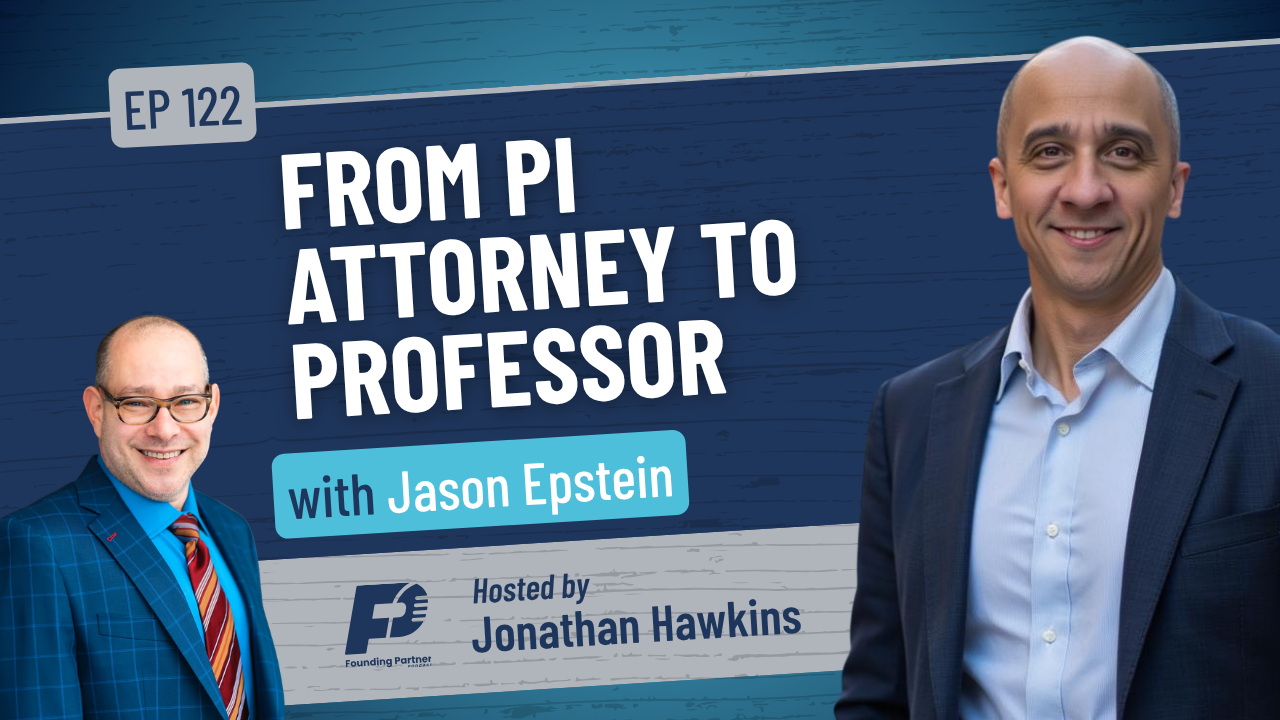
From PI Attorney to Professor with Jason Epstein
Start With Intention, Not Momentum
Jason didn’t stumble into personal injury law. He chose it early, after a car accident and a relationship with the attorney who helped him.
That clarity shaped everything that followed.
But like many founders, his early path wasn’t clean. He opened his own firm right out of law school, quickly realized what he didn’t know, and stepped into a role where he could learn. That willingness to adjust, without abandoning the vision, became a pattern.
And it’s a pattern many founders miss.
Too often, firms are built reactively. More cases come in, so more people are hired. More people create more problems, so more structure gets layered on. Before long, the founder is buried in something they never intended to create.
Jason’s perspective is simple, but powerful: build with intention from the beginning.
Turning Chaos Into a System
One of the most practical shifts in Jason’s journey came from applying business frameworks like EOS.
Not perfectly. Not by the book.
But intentionally.
Instead of chasing rigid implementation, his team focused on what mattered, clear roles, accountability, and visibility into performance. Weekly scorecards, leadership meetings, and problem-solving sessions became the backbone of how the firm operates.
That same thinking is what allowed him to step into his sister’s med spa business and transform it.
What started as a job became a system. And that system became a sellable asset.
It’s a reminder that structure isn’t about control. It’s about freedom.
A Different Way to Lead a Law Firm
Jason’s approach to leadership challenges a lot of traditional thinking.
Every client who calls the firm speaks directly to a lawyer. Most of the time, that lawyer is him.
Not because he has to. Because he wants to.
His goal is simple:
“Anybody who calls, I’m going to put them in a better spot than they were when they called.”
At the same time, he’s actively trying to work himself out of a job.
Half of his time is spent guiding his team and solving internal issues, not doing the work himself. The rest is split between client interaction and generating new business.
That balance didn’t happen by accident. It came from designing the role he wanted to play, then building the firm around it.
The Four-Day Workweek That Actually Works
One of the most interesting systems inside Jason’s firm is the four-day workweek.
Employees are paid for five days but work four.
The catch? Production doesn’t change.
If tasks fall behind, everyone loses the extra day off.
What happened next is what most leaders wouldn’t expect.
The team didn’t slow down. They stepped up.
When one person falls behind, others jump in to help. Accountability becomes shared. Efficiency increases naturally.
It’s not just a perk. It’s a system that reinforces ownership and teamwork.
And it highlights a deeper truth, people often expand or contract to fit the expectations placed on them.
Why Profitability Is About Impact
One of Jason’s strongest beliefs is that profitability isn’t optional. It’s responsibility.
If you’re good at what you do, then growing your firm means helping more people.
But growth requires resources.
Marketing, team development, systems, all of it depends on a healthy, profitable business.
Without that, you’re limited. Not just financially, but in the number of people you can serve.
It’s a mindset shift that reframes profit from something selfish into something necessary.
The Hard Lessons About People
Like every founder, Jason has learned the hard way when it comes to hiring and firing.
Keeping the wrong person too long is a mistake most leaders make. And one that almost always ends the same way.
The truth is, letting someone go is never easy.
Even when it’s clearly the right decision.
But every time he’s made that decision, the firm has improved.
Not just operationally, but culturally.
Because the right people don’t just do the work. They elevate everyone around them.
What Comes Next
At this stage, Jason isn’t just thinking about growth. He’s thinking about evolution.
He’s teaching law students how to build firms.
He’s starting to consult with other firm owners.
And he’s exploring what the next chapter might look like.
He also recognizes that the future of law is shifting.
Technology, private equity, and changing market dynamics are all reshaping what firms will look like in the next decade.
Rather than resist it, he’s preparing for it.
And possibly stepping into something new when the time is right.
Closing Reflection
There’s a quiet theme running through this entire conversation.
You don’t accidentally build a firm that gives you freedom.
You design it.
Every hire. Every system. Every decision.
It either moves you closer to the life you want, or further away from it.
Jason’s story is a reminder that success isn’t just about growth.
It’s about alignment.
Thank you for joining us for this episode of The Founding Partner Podcast. Stay tuned for more conversations that inspire connection and growth.
AND MORE TOPICS COVERED IN THE FULL INTERVIEW!!! You can check that out and subscribe to YouTube.
If you want to know more about Jason Epstein, you may reach out to him at:
- Website: http://www.premierlawgroup.com/
- LinkedIn: https://www.linkedin.com/in/jasongepstein/
Connect with Jonathan Hawkins:
- Website: https://www.lawfirmgc.com/
- LinkedIn: https://www.linkedin.com/in/jonathan-hawkins-135147/
- Podcast: https://www.lawfirmgc.com/podcast
Jonathan Hawkins: [00:00:00] So switch back to the firm. So let’s talk about sort of your role in the firm. We talked a little bit about marketing. You know, you could be running cases, you’re managing the firm, you maybe you’re doing intake.
What kind of functions do you have in the firm now and maybe how do you split up that time?
Jason Epstein: Yeah, one of the things that is one of our differentiators is that everybody who calls in, whether they’re a person we can help or not, so whether they’re qualified or not, they get to talk to an attorney on the first call. And, you know, most people in my niche. They don’t get to talk to lawyers, they talk to, you know, the intake person or maybe a paralegal.
And so that’s one of our differentiators is if you call, you’re gonna talk to a lawyer. And most of the time that’s me ’cause that’s something want to do and I like doing it and I like being able to help people that we can’t help. You know, my goal is that anybody who calls, I’m gonna put them in a better spot than they were when they called.
So, I do spend a fair amount of time talking to potential clients when they call. Most of my day though is spent I would say putting out the internal fires that are, you know, constantly [00:01:00] popping up in firms and trying to teach my people how to not have that fire happen again and how they can manage it themselves. I’m trying to work myself out of a job. But it’s a challenge and I don’t know that I’ll get there soon, but I’m always working on that. So, I would say it’s probably of my day and you know, I’m only in the office maybe 20/25 hours a week.
I would say that, you know, 50% of that time is dealing with my employees and helping them, you know, to make sure that all the wheels are turning still. And probably 25% of the time is dealing with new clients potential clients and working on some of the cases that I’m handling in the office, which is not very many anymore, but some of ’em that I’m handling.
And then the other 25% of the time is generating business. How am I gonna keep the lights on with new cases.
Welcome to the Founding Partner Podcast. Join your host, Jonathan Hawkins, as we explore the fascinating stories of successful law firm founders. We’ll uncover their beginnings, triumph over challenges, and practice growth. [00:02:00] Whether you aspire to launch your own firm, have an entrepreneurial spirit, or are just curious about the legal business, you’re in the right place.
Let’s dive in.
Jonathan Hawkins: Welcome to Founding Partner podcast. I’m your host, Jonathan Hawkins. This is a podcast where I get to talk to law firm owners and hear about all the cool shit they’re doing. And today I got a friend of mine, Jason Epstein, who is a personal injury lawyer up in Seattle area. And one of the things I like about Jason is he’s not afraid to speak his mind.
So this should be a pretty fun conversation. So, Jason, welcome to the show.
Jason Epstein: Yeah, it frequently gets me into lots of trouble especially at home, but yes, that is one of my weaknesses. I’m sure that you share it.
Jonathan Hawkins: Or strengths, depending on the situation.
Jason Epstein: Sure.
Jonathan Hawkins: so yeah, so tell us about your firm. So tell, you know, where are you? What, what do you guys do? I, I said personal injury, but is there, within that it could be lots of things and you know, how many people do you have? All [00:03:00] that?
Jason Epstein: Yeah. So, we are in the Pacific Northwest. So Seattle Bellevue is where our main office is, but I’ve got a Seattle location and I’ve got two satellite offices in some neighboring areas called Federal Way, and then one in Renton. We do personal injury, which is really you know, anytime someone’s hurt and there’s somebody that we can get on the hook for it, we’ll take those cases.
But it’s primarily car crashes. I am now at, we, we’ve got four attorneys total, and I think our total head count is like 12 or 13. That is, you know, on payroll. And then of course we’ve got a ton of other people we work with that are 10 99 vendors that do different stuff for us. So it’s, you know, I don’t know what that makes us if we’re small or mid.
I don’t, I don’t know what we are, but, but we’re here.
Jonathan Hawkins: And are you, is it in office? Virtual hybrid.
Jason Epstein: Yeah. Now we’re, we’re all in office. I know you and I have gone had a little LinkedIn fight about this. So, when we had when COVID hit, we [00:04:00] went to, you know, virtual like everybody did. And our metrics just took a total shit. And so, really quickly, the, the experiment only lasted like four, four or five, six weeks, and we were just like, Nope, everybody’s back in the office full time.
I recognize that in 2026, that’s an unpopular opinion to make everybody be in the office full time. I also recognize that I’m potentially missing out on certain talent bases that would be more would prefer either hybrid or remote. But for us, it just didn’t work. I found that we, the way we operate, I needed people in the office that I could yell down the hall and be like, what the fuck are you doing?
And, you know, that’s just how we, how it works for us.
Jonathan Hawkins: Well, I’m with you man. I, I in office. I think that’s the way to go. I really do, and I think it’s important, especially for younger lawyers to be in the office. And people, you know, people push back and they’re like, no, well you can just train. It’s ’cause you don’t know how to train virtually.
It’s, it’s not even about the training and that’s part of it. It’s definitely about the productivity. But you know, I still get referrals [00:05:00] from attorneys that I was in the office with 20 something years ago. And if we had been virtual, they wouldn’t be sending me anything. ’cause I barely know ’em.
Jason Epstein: Yeah. And I, I like, I’m. I love, you know, my, my door is always open and people will come in and, you know, either to ask questions or just to shoot the shit. And, and that’s kind of the environment that I, I prefer anyways. So, you know, for us in the office is the way to go.
Jonathan Hawkins: All right. So let’s go back. Did you always know you’re gonna be a personal injury lawyer? Is that the first thing you did outta law school or did you do something
Jason Epstein: It was, it was, yeah. No, so when I was in law school I went to law school at Pepperdine down in Southern California. And in between I graduated from USC, university of Southern California, not, not the USC that u Georgians talk about the real USC, Southern California. And when I was in between undergrad and law school, I got in a car accident in LA, hired a lawyer and wound up becoming friends with him and I was like, this is a hundred percent what I’m gonna do.
I always knew.
Jonathan Hawkins: So going into law school, you [00:06:00] knew?
Jason Epstein: Absolutely. Yeah.
Jonathan Hawkins: And I tell the story, I went to law school knowing I was gonna be a personal injury lawyer and then I never did it. So I’m glad you did, man. I’m glad you did. So when you got out, did you, so you were able to find a job straight out at a personal injury firm.
Jason Epstein: Not exactly. So when I got out, I had the entrepreneurial spasm that I was gonna open my own office when I, you know, literally fresh bar card. And I, I hung out my own shingle. I got really, really lucky that I happened to find an office share situation with a guy who was the incoming president of the Washington State Trial Lawyer Association at that point.
Now, now known as WSAJ, Washington State Association for Justice. But so he got me hooked up in the Trial Lawyer Association, like right away. And so, that was amazing because, you know, I had access to the LISTSERV and had access to people that knew what they were doing and, so I kind of muddled along for like, I don’t know, four or five, six months and, you know, picking up a couple cases, but, you know, still not really having any clue what I was doing.
And then I asked a [00:07:00] couple questions on the listserv on an issue I was dealing with and, and that, and a seasoned attorney reached out to me and I was like, Hey, it’s really cool that you opened up your own office. It’s clear that you don’t know what you’re doing. Do you want to come work for me? And I was like, yes, yes I do.
And so that’s where I really learned what I was doing was my, my first job with this with this other car accident lawyer.
Jonathan Hawkins: So it’s clear you had the entrepreneurial bug from the beginning. Did you do stuff as a kid? Were you involved in sort of selling candy or whatever? As a kid, I.
Jason Epstein: Yeah. Yeah. I mean, I had a couple of the, you know, like I did, I, I detailed cars and you know, like I did, I had some stuff that I was always trying to, to make a buck. My mom, I was a serial entrepreneur, she owned a bunch of different stores. And then my dad’s a surgeon and so ultimately my mom sold her her stores and started running my dad’s practice.
And so, you know, there was always an entrepreneurial spirit in my house for sure.
Jonathan Hawkins: So I don’t know where this fits in, in the journey, but I’m gonna go ahead and ask it because, and I don’t know the full [00:08:00] story, so you’re gonna have to explain it to me. But I do know that you were involved or have some involvement with like med spa type stuff on the business side, not, not as representing them or anything like that.
Tell me about that and when did that happen and what, what was that?
Jason Epstein: Yeah, so, I guess it’d be about 20 years ago. My oldest sister, I have two older sisters and it’s the oldest of those sisters was fresh off of a divorce and trying to figure out, you know, how she was gonna make ends meet. And so she started kind of doing stuff in that, aesthetician beauty world.
And so back then she was doing this one product that was like a cellulite remover that was called Synergy. I don’t, I dunno what happened to that company, but and so, you know, back then she just was like renting a station in somebody’s nail salon or something. And over time she was growing her business and like reiterating it for a while.
She was doing eyelash extensions and having employees do those. And then she started doing she was doing, like, she would just, like, she, she would find a product that, you know, beauty, you know, aesthetic product that, [00:09:00] that she, she liked for her and then she would kind of, you know, bring that into her business.
And so over time she, she grew her business and it, and it kept evolving. And she grew to the point where she had a couple of estheticians working for her. She had a couple of nurses doing injectables. And then she had a product that is still around but is has lost favor called CoolSculpting that she was doing a crazy amount of CoolSculpting business.
And and so she, you know, her business was grown and grown and grown and she would always complain to me about like, you know, the struggle she was having running the business. And and I think she was just at the end of her rope. And so, I said, look, let me come in and turn your business into a business instead of a job.
And so I came in on kind of like, you know, I guess you’d call it a consulting basis and just kind of crack the whip and turned it into a business and, you know, created an org chart and said, who’s in charge of what? And here’s everybody’s new roles and here’s what each person’s gonna do. And, you know, make made sure that.
People took [00:10:00] accountability for their rules and stopped bugging my sister with every, you know, small little question they had about, you know, what should we do here? And in the course of about, I don’t know, I’d say 18, 24 months turned it into a business where she wasn’t having to work as much. She was still working a little bit, but, but not, not very much.
And the business was running. And at about that time private equity started sniffing. And so since, you know, I had taken her to that point where she, she then had a sellable asset because it wasn’t it wasn’t just, you know, a cult of personality of her running everything. It, it was, it was a system, a business with systems.
We were able to sell to private equity for a huge multiplier. And she now lives. Halftime in Palm Springs and halftime here, and she’s completely retired and I think she sits around all day and counts her money. And and I was able to, you know, fortunately I got, I I got my beak wet a little bit in the exit, but not enough, but, you know, better than nothing.
And so I kind of drove that [00:11:00] process for her.
Jonathan Hawkins: So how did, how did you know how to do that? How did you know how to come in and turn it into a business?
Jason Epstein: Well, I applied all the same stuff that, you know, you and I talk about in, in the meetings we go to in the mastermind meeting. So, you know, a big, when you, when you’re on this kind of entrepreneurial journey, as, as a lawyer, you get to a point where you’re like, okay, I’ve gotta start running it like a business instead of, you know, like a job.
And and so for us, and I don’t know if you’ve done this, but for us, we implemented a hybrid version of EOS. And we didn’t hire an implementer. We just did it ourselves, you know, read the books and, and did it ourselves and figured out a way to make it work. And so I took all the same principles and, you know, from EOS that we used for us, and just applied it to her business and, and built out the framework.
Similarly I did all the same marketing stuff that, that we do for us and just kind of, you know, tweaked it and applied it to to the aesthetic industry. And it, you know, worked, it, grew her business. A lot of it, you know, to be honest, is that she was doing [00:12:00] the right stuff at the right time when private equity happened to be looking for these opportunities.
So it wasn’t, I don’t think that we developed like a, an amazing unicorn. I just think we, in some ways we got lucky that it was, you know, it was the right business at the right time with the right amount of revenue that peaked their interest. And actually, interestingly enough, we got I think we had three different groups.
That were, you know, interested in doing letters of intention at the same time. So that was helpful also.
Jonathan Hawkins: You know, there is an element of luck for sure. But you, you mentioned EOS, I wanna, I wanna explore that a little bit. I mean, I know what it is. Probably a lot of listeners know what it is. You know, you can, you can do the self implement implementation, which you talked and, or you can go hire somebody. I’m curious. What, what was it like and how did, how did you guys do it? Who led it? How did, how did you self implement? And I’m really asking personally, ’cause I, I wanna borrow some of your stuff if you, if you’re sharing it.
Jason Epstein: Well, so it’s an interesting story and you for everybody else, you know, a little bit about about our firm because when we brought on, me and my partner, Patrick brought on a, a third [00:13:00] partner, John, and John hired you to go over all our documents and make sure it was a good deal and stuff.
So, you know, kind of about our structure. But Patrick, my partner for the last 20 something years you know, it was, it was us 50 50. And Patrick is very, he’s an interesting guy in a lot of ways. And one of the things that, that he you know, says like clockwork is, you know, like, we’re lawyers and we’re smart, and so why would we hire other people when we can figure stuff out on our own?
And, you know, it’s like, yeah, okay, well, you know, because you hire experts to do expert stuff to save you time, but he doesn’t have that same mindset. And so there was a, I, I don’t know how, but I convinced him at one point to bring in an implementer because I said like, you know, here’s what we need to do, read the book.
And, you know, he read the book and we were, you know, we’re on the same page. And so, and I think part of the reason we brought in implementer was because and I’m sure you’ve heard their pitch is that, hey, it’s, you know, whatever, $5,000 for the day, and if you don’t like it at the end of the day, I’ll give you your money back.
Right? So he was like, okay, fine. So we brought in the [00:14:00] implementer and we did the one day session. And at the end of the one day session, Patrick was like, I think we can do this on our own. And so, you know, at that point we had to kind of figure it out on our own. ’cause, ’cause you know, the way our partnership works is when when there’s a big expense like that, it takes two yeses and, you know, one no.
And so, we didn’t have two yeses to spend the money on a professional implementer. So it’s like, okay, let’s take what we know and just kind of, you know, make it work for us. And so we, we did that. And so it’s, it’s sloppy and I don’t think it’s like, you know, it’s, we’re probably not as efficient with EOS as as people who have gone through the formal process and do continue to have an implementer.
Like we know people who’ve been doing it for years and still have their facilitator come in for the quarterlies or whatever. We don’t, we also don’t really run true level 10 meetings the way that pieces
Jonathan Hawkins: Yeah. You know, and I’ve talked to others, you know, I’ve read the book probably three times and I’ve taken [00:15:00] pieces. I’ve talked to others, both, and other professional services that, that, you know, they say really a true EOS doesn’t quite fit a law firm anyway if you really did it the way the book tells you to do it.
So, you know, you gotta take the pieces at work. Have you, so have you found it helpful?
Jason Epstein: Oh yeah, absolutely. So, we we use 90, which I think used to be affiliated with EOS officially, but I think they’ve split off. And so it’s, I think it’s ninety.io is the website. So that’s where we, we keep our scorecard. And, and so the leadership team jumps into 90, we update our numbers every week.
We have a leadership meeting where we go over our numbers we’ll talk about to-dos and issues. We don’t, you know, we do set like annual revenue goals and, and, you know, different goals and in the scorecard metrics, but we don’t really have like, you know, come up with quarterly rocks unless there’s something we feel like we need to work on, you know, so we’re not being, I would say religiously bound to the format.
We’re just, we’re just taking like, you [00:16:00] know, hey, right now we’ve got it. This issue, let’s IDs it and let’s, you know, work through the process and, and figure it out. And sometimes that’ll generate a to do and sometimes it’ll generate a rock. And so when those things happen, we’re able to follow up with each other using the, the 90 system.
But yeah, we didn’t think we needed kind of strict compliance to the system to make it work for
Jonathan Hawkins: Yeah. All right. So I’m gonna go back, we’ll go back to some of your journey. And so I don’t know the story. I want you to tell that when you were a younger lawyer, you were offered partnership.
Jason Epstein: Oh, yeah.
Jonathan Hawkins: So lets talk about that.
Jason Epstein: So I worked for that guy that we talked about for I think it was two or three years. And then got an offer and I went to work at another firm. And I was doing pretty well there, bringing in more revenue for them than they ever thought an associate was gonna be able to bring in. And so they offered me a partnership. And you know, I, I wouldn’t say I was super business savvy at that point, but my response, I knew enough to be dangerous and I knew people to ask the right questions to it, and so my response to their offer was, okay, open up the books. We’ll figure out what the firm is worth and, you know, I’ll buy in at my percentage that you’re [00:17:00] offering me.
And their response to that was, you’re fired, go fuck yourself. And they locked the doors and locked me outta my computer.
Jonathan Hawkins: God.
Jason Epstein: And and so, you know, I was fortunate that I had seen the writing on the wall, that that may happen.
And so I was able to send out even though at that point it was no longer neutral, I still sent out a neutral letter that said, Hey, I’m no longer there. You know, it’s your election, who to go with. While I was sending out that letter I found out that they were calling everybody and telling everybody that I was on drugs and that and that I was having an affair and that you, like, they were just throwing all the, all the darts at me.
But a fair number of my cases came with me. And so I was able to kind of transition. Land on my feet. And then that turned into what became my, my current partnership.
Jonathan Hawkins: For listeners out there, Jason did it the right way. His, his former employer, people did not, don’t, don’t do that.
Jason Epstein: And then the be, the best part is they [00:18:00] wound up taking on, I think they were having financial problems. So they took on a, a, you know, a big name partner after that who also was like really established, not a young, a young gun like I was. And about a year and a half later I was subpoenaed to testify in the trial of that firm, disillusion with the new partner.
And so, yeah, things got really ugly for them for a while.
Jonathan Hawkins: You dodged a bullet. You dodged a bullet there. Wow, man. So let’s, let’s talk about, we’re going on the theme of partnership. You, you’ve also, and you talk as much or as little about this as you want, but you’ve also had a partner leave while you’re a partner. What was that experience like?
Jason Epstein: Yeah. it was actually the most peaceful transition that one could imagine. So, when I first joined up with Premier Law Group, it was two partners. It was the, the two founding partners, Darryl and Patrick. Darrell was a little bit older than Patrick. And and so after I had been with the firm [00:19:00] for, you know, I joined in as a partner and we were all, even, and I think it was maybe 5, 6, 7 years later Darryl just didn’t really wanna work anymore.
And he wanted to really kind of transition down and, and, you know, limit his cases. He was taking to just a couple things. And so he was like, Hey, I, I want out. And we were like, okay, cool. You, you take the stuff you’re working on, we’ll take the stuff we’re working on. And we didn’t have to change, you know, no money changed hands.
There was no fighting, there was no nothing about, you know, intellectual property or the website. And we all just went our, our own ways, and it was super easy and mellow which, you know, is really lucky. It, it could have been a disaster and it wasn’t.
Jonathan Hawkins: Yeah, that is
that is a good, another good way to do it. All right, so I’m gonna switch sort of to your firm and sort of how you, how you operate a little bit. And I wanna talk about employees ’cause you, you, I may have heard you say this before, but recently I heard you talking about it, about you have a four day work week for your employees, but, but there’s sort of a catch. So why don’t you explain it and sort of how it works.
Jason Epstein: yeah. So I, I’m a firm believer in [00:20:00] that you know, you, you buy as much clutter as your house can fit. And so I think that’s the same way that that people work, is that they fill their workday with stuff that they’re doing that isn’t necessarily their job. And, a few years ago, maybe two, three years ago, might have been four I saw a study where there were some, some production type factory businesses that started this model of like, Hey, we’re gonna go to a, a four day work week.
We’ll pay you for 40 hours, but you only have to work 32 hours. But the production goals don’t change. Your weekly production goals are the same. And almost across the board production didn’t dip, even though the amount of time that people were spending dipped by 20%. So I was like, well, I, there’s no reason that wouldn’t apply to what we do.
And you know, if you look around anybody that works in an office, you look around at how much time people are wasting just, you know, bullshitting and talking and stuff, it’s like, you know. Yeah. I think that makes a lot of sense. So. We rolled that out to our staff and said, you know, look, everybody’s gonna get paid for, for work in five days, but you only have to work [00:21:00] four.
With the catch that our task list that, you know, the way our case management system works is it generates tasks. Some are automated, some are manually created but we track our tasks. That’s one of the metrics that we track. And so the catch is if anybody is behind on their tasks at the threshold that we set, then everybody loses their fifth day off.
You know, their, their paid day off for, for that time period. And so the times when it’s been close you know, where I’ll make an announcement in our meeting, like, you know, hey there’s, you know, this person’s got a bunch of tasks and I don’t know if they’re gonna be able to get it done with everybody pitches in and gets that person’s tasks over the finish line.
And so it’s been you know, three or four years that we’ve been running this and it’s, it’s been. problems at all.
Jonathan Hawkins: That’s hilarious. But, but great man. So how was the rollout? Was it you just, you you announced it? This is what we’re doing. We’re starting tomorrow. And what was the reception? Was everybody excited about it? Were they scared?
Jason Epstein: no. Everybody was [00:22:00] excited about it. And, and, you know, initially we rolled out and said, it’s gonna be a pilot program. We’re gonna try for 90 days and see how it goes. And then there was like immediate buy-in, like who doesn’t want an extra day off every week? And also, you know, our, our market in the northwest is kind of crazy salary wise because you’ve got all these, you know, Amazon and Microsoft engineers that are making, you know, half a million dollars a year programming.
And so, you know, housing prices are insane out here. And so, you know, our market, our salary market is skewed higher and. ‘ Just cause of the size we are and, you know, the, the, what we’re playing with, we, we could never really pay at the top end of the market for, you know, our, our people that work here.
So this was another tool that, that I, you know, I’d say like, look, we’re gonna pay you this, but in reality you’re making more ’cause you’re not working those hours, you know, and so it’s, it’s almost like a 20% raise that everybody got, even though I don’t have to pay them anymore, because you just get that day off.
Jonathan Hawkins: I think it’s a great idea. And I guess you’re making up for the [00:23:00] in-office instead of hybrid or whatever you get the extra day. Have you have, has anyone else done this that you know of? has anyone, have you shown anybody? And they, they’ve sort of taken it from you. Do you know?
Jason Epstein: Well we’ve talked, you know, since I started, I’ve talked about it in our, in our group and, you know, the, the group that we’re both in the mastermind group has evolved and changed. So there’s probably, you know. Other firms that have heard that I’m doing this and some have said they’re, try it. I know I’ve never gotten reports back from people have tried and worked and
Jonathan Hawkins: So I’m curious, so as you’re growing you know, let’s say you’re, you’re more cases are coming in, so people’s task lists are getting better, but you haven’t hired a new person yet. When do you, when do you know, and how does that affect this four day work week issue in terms of adding another person and then the tasks? Have you encountered that yet?
Jason Epstein: Yeah, I mean, yes. So, so we see that there can be, there can be times [00:24:00] when, you know, because of a cer the way the workflows hit. There’s a certain subset of tasks that are, you know, might be piling up or might be be bigger than they normally are. And so I’ll get feedback from people, you know, like, Hey, just so you know, when you look at my tasks this week, here’s what’s going on.
And we do give a grace period, you know, so like it’s, you know, we’re, it’s not like completely like you didn’t hit it. Everybody’s, you know, I, there’s warnings and we know about it ahead of time and stuff. And so when those things have happened, when somebody’s like, you know, Hey, I’m not gonna be able to get it done and here’s why, and you know, it, it’s that way for a couple weeks in a row, then I, you know, that’s an indicator.
Like, okay, this person’s reaching capacity. And so, you know, listening to the employees and, and getting the feedback is important. And we’re still small enough that that comes to me. So, so I’m, I hear that and then, you know, it’s like, okay, let’s, let’s get somebody else on board.
Jonathan Hawkins: So this may be a little related topic is toxic employees. I heard you talk about this recently too. And you know, obviously the story you told a minute ago where somebody was. [00:25:00] Having trouble and everybody pitched in to get it done. You have a toxic employee in that mix. I don’t know if that’s gonna happen or not, but what kind of experience have you had with toxic employees and, and what’s your advice there?
Jason Epstein: Yeah, I mean, I, so hiring and firing is, you know, probably the most challenging thing that we have to deal with on a regular basis. It always seems like when you’re trying to hire, there’s no, no good talent available. And firing, like, you know, unless you’re a sociopath, I’ve never met another business owner that looks forward to firing people.
And it’s always super easy when you’re looking at somebody else’s situation from the outside to know that they should fire someone. Which is why in, in our meetings. You know, that everybody makes fun of me, that I’m always the guy says firearm. Because, you know, we can hear somebody, the story somebody else is telling and we know how it’s gonna end, but it doesn’t change it for the person who’s living it.
It’s never easy to, to do it. And so, you know, I’ve, I’ve certainly had people that in retrospect were toxic, that [00:26:00] I took way too long to get rid of and, and something blew up in a way that could have been averted much easier. Had, had we just been proactive. I’m not gonna, you know, I’m not gonna puff up and say that it’s, it’s easy, easy to fire people ’cause it’s, it’s not, it’s really hard.
But what I found is that every time we’ve had somebody who wasn’t a good fit or, you know, even potentially was toxic and they leave as painful as that is, we always wind up in a better spot. So, you know, you try to learn from your own experiences and learn from your own mistakes and be, be faster next time.
But the truth is, I don’t know that we ever really are. ‘Cause it’s never, it’s never easy and it’s never fun because you know these people, you like them. I see them every day and, you know, and frankly, even when you don’t like them, you feel responsible for them. You feel responsible for, you know, why they’re not a good fit.
And and so, it’s always hard, but it’s always good when the bandaid gets ripped off.
Jonathan Hawkins: You know, I, a hundred percent it sucks. I remember the first person I had to, to let go. [00:27:00] I’d been fretting over it for weeks. I was not sleeping for weeks, and it was just tear. And finally, I just, I just, today’s the day I went and did it, and as, as bad as this sound, I slept like a baby that night. It, it was just the, the stress of getting it off and just getting it done was huge.
And, you know, and like you said, ripped the bandaid off and it, it’s better on the other side. So I came
Jason Epstein: And, and you know, I’ve heard Ben, I’ve heard Ben talk about, I’m sure you’ve heard him say something similar too, where it’s like, Hey, look, I’m gonna help transition you to the next thing that’s better for you. And so, you know, you can do it in a way that also really helps them, even though you know it’s not gonna be with you, you’re gonna be a great fit somewhere.
It’s just not here. So let’s find that next place. Now usually even when you approach it that way, they’re like, you know, no, fuck you. And you know, they don’t want your help, but, you know, you know, you still can be a, you can be a mensch about it. It’s just it’s hard. It’s always
Jonathan Hawkins: yeah, yeah, it is. So I came across a post that you did it. I don’t know when it was, but I came across it. So, basically you said [00:28:00] something to the effect of, if your law firm is not profitable, then you’re not helping people. So what do you mean by that?
Jason Epstein: Yeah, so, you know, assuming that you’re good at what you do, so that’s like the baseline, right? Like I know that when somebody is our client, that we’re gonna put them in a better spot than they would be on their own. And you know, picking up the pieces where people hire other attorneys and wind up hiring us, you know, to clean up their mistakes. I know that we also do a better job than a lot of the other people out there.
So, assuming that you feel that way about the product you’re delivering you can, it takes a little bit of a mindset shift, but it’s actually you’re doing a disservice to the community by not running a healthy profitable business because I wanna to be able to help as many people as I can. And the way that I can do that is by making my business’ reach as big as possible. And you know, here we are in late stage capitalism that requires making money.
And, you know, it requires making money for a lot of reasons. Number one, you know, I have to pay my employees and pay the [00:29:00] bills and, you know, pay my own mortgage but in addition to that case acquisition is, I think in most areas of the law is like one of the biggest expenses is, you know, how am I gonna market to get new cases? And in order to do that, to put the word out about the services we can deliver, and in order to help the most people, we have to be able to spend money on marketing and acquiring new clients.
And so all of that requires making money, which means being profitable.
Jonathan Hawkins: I am with you and, you know, contingencies even, you know, different than hourly ’cause obviously you gotta front a case for some time before you actually turns into money. So you’ve got that issue but even on hourly cases, if you’re working for free, not on purpose, you’re gonna stress yourself out and it’s gonna negatively affect everybody in your sphere, including all your other clients. So yeah, a hundred percent. You gotta be profitable, you gotta make money.
Real quick, if you haven’t gotten a copy yet, please check out my book, the Law Firm Lifecycle. It’s written for law firm owners and those who plan to be owners. In the book, I discuss various issues that [00:30:00] come up as a law firm progresses through the stages of its growth from just before starting a firm to when it comes to an end.
The law firm lifecycle is available on Amazon. Now, back to the show.
Jonathan Hawkins: So you mentioned marketing. So what, what sorts of things do you do? I know some of them and I know, you know, we’re sort of in the same program in schools, so we do some of the thing, same things but, you know, what types of things do you do to get cases?
Jason Epstein: Well, so in, in PI it’s getting harder and harder. There’s more and more money. Private equity is now here, officially in the PI space. And there are, you know, in every, every market you can go to, there’s somebody who’s gonna outspend you on TV or on pay-per-click to acquire cases. And so, for somebody like me who’s not doing that, you know, kind of mass media approach and, and doesn’t have a, a bottomless checkbook I think you have, you have to spend smart money to be where those people can’t be.
And the places those people can’t be are in [00:31:00] relationships. And so, you know, we spend a lot of time trying to build relationships with different referral partners or different different community organizations to just show up and be there and be there all the time. And, you know, that means more than just, you know, sponsoring you know, a banner on the high school baseball team’s field.
You know, you gotta, you gotta be present as much as possible so that people know you and know the firm. And those are the things that the big guys can’t do. They can spend, you know, $10 million a year on tv, but they can’t be in the community the same way that we’re, and so, we try to do as much of that as we can.
That makes sense. And it’s, it’s challenging, but like interestingly today I did a thing, middle of last year, last where I basically went to a bunch of physical therapy offices and did like a, a continuing physical therapist education credit for them. I went through the process of getting, here’s my presentation. I got it approved for credits for them, and then I, I reached out to some offices and said, Hey, I’m gonna bring you lunch.[00:32:00]
I’m gonna talk to your therapist for an hour. And at the end of it, you’re gonna get an hour of, of continuing education credit. And so, you know, got a bunch of yeses, right? Free lunch and free credit. Who’s gonna say no? And there was, there wasn’t like a pitch, except my pitch was I am around and I will help you with whatever questions you have, even if it’s not my case.
And I know that you all have attorneys that you can’t get on the phone and you, you know, have simple questions for I’m that guy. And so today I got a call from someone I haven’t heard from for a year, and they were asking a question about what another attorney is doing on a case and what they should do and blah, blah, blah, blah.
So. It’s just kind of establishing that goodwill in the community and being someone that, you know, has demonstrated subject matter expertise and and that they know they can depend on.
Jonathan Hawkins: So,
yeah, so I like that. So, you’re right, the big 800 pound gorillas aren’t gonna be doing that kind of stuff. They, they just, they don’t have the infrastructure internally to su to do that. I’ve never heard of [00:33:00] anybody doing that. The other thing that I think a smaller firm gets to do, which just based on knowing you for a while that I’ve seen you do is, is you get to experiment, you get to, you get to run these little experiments trying new little things. To test to see if these things work. And so how often are you, are you thoughtful, like, we’re gonna try a new thing this quarter? Or is it just sort of like, when we think about it, we might run a new test? How do you, how do you do that?
Jason Epstein: yeah, I, I think anytime I have a good idea about something, I’m like, let’s give this a shot. or one of my team has a good idea about something. And most of the time those ideas can be, you know, I hear what somebody else is doing in, you know, in a different market and I’m like, oh, that’s kind of a cool thing.
Or, you know, even a different industry, like, oh, that’s kind of cool. Maybe I could apply that. And so, you know, I do try to experiment like we’re doing, I’m doing a mailer actually, like right now. That’s going out to chiropractors. That’s kind of a different message than, you know, what they hear from, from most PI lawyers.
I try to, I don’t want to be part of the noise and so anything I’m gonna [00:34:00] say out there, I want it to be different than things that other people are saying. And so, you know, it’s. It’s hard to come up with good ideas, though. I don’t just want to, I don’t want to chase bad ideas with money and see if they work.
I wanna, you know, I wanna be sure that everything I’m doing is intentional and thoughtful and there’s a reason’s, a reason why I work.
Jonathan Hawkins: There’s lots of ways to burn money, that’s for sure.
Jason Epstein: Absolutely.
Jonathan Hawkins: I burned my fair share. So switch back to the firm. So let’s talk about sort of your role in the firm. We talked a little bit about marketing. You know, you could be running cases, you’re managing the firm, you maybe you’re doing intake.
What kind of functions do you have in the firm now and maybe how do you split up that time?
Jason Epstein: Yeah, one of the things that is one of our differentiators is that everybody who calls in, whether they’re a person we can help or not, so whether they’re qualified or not, they get to talk to an attorney on the first call. And, you know, most people in my niche. They don’t get to talk to lawyers, they talk to, you know, the intake person or maybe a paralegal.
And so that’s one of our [00:35:00] differentiators is if you call, you’re gonna talk to a lawyer. And most of the time that’s me ’cause that’s something I want to do and I like doing it and I like being able to help people that we can’t help. You know, my goal is that anybody who calls, I’m gonna put them in a better spot than they were when they called.
So, I do spend a fair amount of time talking to potential clients when they call. Most of my day though is spent I would say putting out the internal fires that are, you know, constantly popping up in firms and trying to teach my people how to not have that fire happen again and how they can manage it themselves. I’m trying to work myself out of a job. But it’s a challenge and I don’t know that I’ll get there soon, but I’m always working on that. So, I would say it’s probably of my day and you know, I’m only in the office maybe 20/25 hours a week.
I would say that, you know, 50% of that time is dealing with my employees and helping them, you know, to make sure that all the wheels are turning still. And probably 25% of the time is dealing with new [00:36:00] clients potential clients and working on some of the cases that I’m handling in the office, which is not very many anymore, but some of ’em that I’m handling.
And then the other 25% of the time is generating business. How am I gonna keep the lights on with new cases.
Jonathan Hawkins: So I guess because you had all this free time out of the office maybe, maybe that’s why you went to become a professor. Tell me, tell me about that. So, to, to lay the ground where you, you are now teaching a law class, so maybe, you know, tell me what that is, how it came about.
Jason Epstein: Yeah. Well, so, I’m 52 years old and trying to figure out what I want to do with my life. And so, you know, kind of what’s the next chapter look like, whether it’s because I do a good job of working myself out of a job or whether it’s because we sell to private equity or whether it’s because, you know, a new partner comes in and, and buys me out, whatever.
I’m trying to figure out what’s the next stage look like. And so, I’m trying to do some law firm consulting for, you know, firms that kind of wanna grow and and, you know, kind of get through their problems, kind of like I did for my sister’s business. I’m trying to do that for other smaller law [00:37:00] firms that are a few steps behind where, where I’m but one of the other things I thought would be kind of cool is like, okay, what if I went and taught at law school?
And Ryan McKean, I, I, I stole the idea from him. He was posting about his, his law firm entrepreneurship class that he’s doing at Yukon School of Law, and I thought, Hey, that’d be really cool to do at my local law school here in Seattle. And so, I pitched it to them and they were like, yeah, it sounds like a great idea.
And so I’m a, an adjunct professor of law at Seattle University School of Law. This last term I taught pretrial advocacy, which was which was cool because it was like a designed course that already had like, you know, here’s the book we use and here’s the syllabus and all that stuff. And so I was able to kind of, you know, get my feet wet in, in teaching law students.
And then this term I’m teaching law firm entrepreneurship, which is a class that, you know, is my design and, and I’m figuring out what to do every week. And kind of bringing to the law students what we didn’t have, certainly when I was in school. What, how do you start and grow a firm? Is, is what the class is all [00:38:00] about.
Jonathan Hawkins: So what’s it been like so far being a professor? Do, do you enjoy it? Is it, are you like, Hey, this is something I could, I could keep doing.
Jason Epstein: Yeah. I, I do enjoy it. I will say that in both of my classes so far, the students are far, far smarter than I was when I was in law school. Like I feel like they’re, they’re way more put together than I was, or at least than I felt like I was. And so, they’re, they’re receptive to so far in both classes.
They’re, they’re receptive. I think this class specifically is really cool because one of the things that, that I decided would be good is each, each week I have a guest speaker come in. It’s a two hour class. Each week I have a guest speaker come in and, and speak for an hour about whatever they want. And, and typically it’s, it’s, you know, somebody else who’s kind of in that entrepreneurial space, usually as a lawyer or law firm adjacent. And so, you know, you came in and spoke, which was great, and you offered a cool perspective because you deal with the, like firm formations and firm breakups. And so you had a cool way of looking at it.
And then I brought Ben [00:39:00] Glass in and this week it was, you know, the classes yesterday Brian spoke about like, Hey, here’s what, if I was a young attorney, what I would do if I had a firm job. So I prepared myself for the next step when I was gonna do my own thing. So everybody brings their own thing to it.
And I would imagine that me bringing in those speakers is kind of a lot like you doing this podcast is one of the, one of the things I do is I ask people to speak who I want to hear what they have to say for an hour because I wanna learn something. And so, you know, I think exposing the students to, to all these different ideas is, is great.
And, and yeah, like I said, they’re super sharp, so it’s, it’s been really cool.
Jonathan Hawkins: So, fall semester, you’re looking to do it again. Is it?
Jason Epstein: Yeah. So the entrepreneurial class is only gonna be offered once a year. But for fall I’ll probably do another, you know, either trial advocacy or pretrial advocacy or, you know, some sort of other class. I don’t really wanna do a substantive class. I don’t wanna do like, you know, constitutional law or court law or anything like
Jonathan Hawkins: Hell no.
Yeah.
Jason Epstein: But like a practical class, I, yeah, I would, I would be, [00:40:00] that would be fun to do another one. And so far I think they want me to come back, so, you,
Jonathan Hawkins: That’s cool, man. That’s cool. So you mentioned law firm consulting. I did not know you were doing that. So let’s, I wanna dive into that a little bit. So when did you start that and how do you, how are you finding your clients there?
Jason Epstein: yeah. So the only social media I’m on, I’m, I’m, I hate social media in general. But the only one I’m on is Reddit and, you know, kind of like my, my philosophy about how I market the law firm is I just, you know, I, I, I market my law firm by giving information, right? I’m just gonna give, give, give, give.
And if, if that means somebody wants to hire me, great. And so one of the subreddits I’m on, somebody was asking some question about, you know, Hey, I’m trying to do this in my firm and you know, what, what are, what are the thoughts about this? And I, you know, wrote a thoughtful response. And the person reached back out to me and said, you know, Hey, can we talk?
And so I had a conversation with ’em and I said, look, I don’t do this yet, but I think it would be cool. And so how about [00:41:00] if I will do like a weekly, or, you know, I think we do biweekly consulting with you and you pay me X dollars a month and it’s, I’m gonna do it cheap ’cause you’re my first client and let’s see how it goes.
And we’ve been doing it for about a year now. And in fact, I just flew out to their office last month and did like an in-person meeting with the firm. And, you know, we’re making steps and the firm is changing and growing. And so it’s something that that I want to do more of. I don’t really know how to market it and how to get in the space, especially because it’s a very crowded space right now.
And I don’t want to, you know, I’m not trying to compete with, you know, some of these organizations that are doing it on a larger scale. So I’m hoping that, that through the way I’m doing it, there’s gonna be just other kind of word of mouth, like, you know, Hey, this guy can help you and, you know, and do kind of this high level consulting.
And actually when I was out there meeting with them, one of the things I did, so maybe you’ll hire me, Jonathan, one of the things I did is I kind of helped start implementing EOS with the. And so, you know, I think [00:42:00] having solved a lot of these problems in my firm, it’s easy to figure out solutions that other people aren’t seeing in their firm.
Jonathan Hawkins: That’s cool and it, you know, looking back the thread now you got your firm, you’ve got your sister’s med spa. This might be, this might be your destiny. I don’t know. This may be you’ve been building up for this man, so.
Jason Epstein: It’d be super cool. I mean, I, I, I love doing it. It’s, you know, every time I travel somewhere I’m always dreading going away, but when I was there, I was with those guys for like a day and a half, and it was, I had so much fun doing that and like digging into what their problems were and, you know, figuring out, you know, the different group dynamics because, you know, that firm had four partners and like figuring out who.
Four personalities and how each person was gonna fill different roles. And it,
Jonathan Hawkins: Well, that’s cool. I can tell just from watching you and hearing you that you enjoy it and you know, generally [00:43:00] speaking, I’m like, go toward, run towards that thing. So, you know, so I think that’s cool. So let’s circle back to Reddit. I wanna hear more about Reddit. So every now and then I’ll do a Google search and it’ll point me to Reddit threat or something, but I don’t spend that much time on it.
So what got you on it? You know, is it, is it, is it pretty vibrant legal community where they’re sharing ideas or, you know, tell me about, tell me about it. I, I don’t know much about Reddit.
Jason Epstein: Yeah, Reddit is interesting ’cause it’s completely anonymous. And it’s basically you know, the format is there are these subreddits, which is like a topic, and then you know, somebody will post, sometimes it’s a question, sometimes it’s thought, whatever. And then, you know, there’s responses and then there’s nested responses inside the responses.
And there’s a system they use called Karma where you get up votes and get, you know, other users will, will say like, yeah, I like what you’re saying, basically. And it’s, you know, I think that it’s dangerous because there’s, there’s no guarantee of subject matter expertise from anybody, right?
So [00:44:00] somebody like you, somebody could be asking a question like, you know, do I have cancer? And, you know, like, you, you’re gonna have people have no idea what they’re talking about that are gonna be, you know, chiming in. But every now and then there are you know, really thoughtful intricate responses about different things.
And you can just focus on the things you’re interested in. So like. Some of the subreddit I’m in, like, you know, I have I have an ev and so like I’m on like an EV subreddit, so I’m, you know, constantly like, you know, getting information or thoughts or whatever about, you know, electric vehicles. And then you know, like I’m a huge Matrix fan, so I’m on like a matrix subreddit where, you know, people were still postulating theories about the Matrix.
And then and Star Trek of course. And then I’m on, yeah, there’s a bunch of, you know, law firm ones and, and it’s their algorithm figured that out for me. Like I didn’t go look for that, but it would serve me stuff. And then the more I would answer stuff, the more it knows what to serve you. And so, you know, I’ll see these things come by the feed and when I feel like I’ve got something intelligent to say, I’ll say it, you [00:45:00] know?
And so, but again, nobody knows who I am and nobody knows if I’m full of shit or not. And so it’s, you know, either the things you say kind of resonate or they don’t. And I’ll tell you there are lots of things I’ve said that get blamed by you the by the community. In fact, one of the subs that, that I will frequently comment on is an insurance subreddit.
And that insurance subreddit is, is mostly is mostly followed by insurance adjusters. And so somebody will ask an insurance question and I’ll give, you know, my opinion on the question and I’ll just get destroyed, right? Because they’re all like, no, you don’t need a lawyer for anything. Insurance companies are fair and, you know, and I get down voted into oblivion.
But you know, ultimately I just say stuff that I know or that I’m comfortable with. And and it’s interesting to see the engagement that comes back and and, you know, try to not take it too personally. So it’s, it’s a different social media. There’s nothing really personal about it. Nobody knows who I am, nobody’s got my picture.
Nobody, you know, I’m not posting like, Hey, look at the school steak I ate. You know, it’s just like, [00:46:00] here’s what I think about this thing. And for whatever reason it just kind of, it kind of fits with my personality.
Jonathan Hawkins: So it seems like I heard like you, you can’t really self-promote or that, or you get kicked out or, or something like that. I mean, you, you did get a law firm consulting client. Have you got any like PI clients or are you even able to, if, if you, if you’re anonymous and you can’t really promote.
Jason Epstein: So most of the subreddits have moderators that are like volunteer moderators that run the subreddit, and most of the subreddits have rules that the subreddit has to follow. And so if you violate a rule, they’ll kick your post out and sometimes they’ll even block you from the subreddit. And so they’re, they’re, yeah, most of them you can’t self-promote.
That’s one of the things. So, you know, because people, you know, if somebody’s asking a question, they don’t want a bunch of people saying, hire me. They want, you know, solutions or answers or directions to their problem. So the time, so the answer to your question is, yes, I have got actual real clients from them, but it’s, it’s [00:47:00] usually from a, a DM.
That happens after. So I’ll either, you know, give something for free and I’ll say, if you want more information, DM me. And then, you know, the person will DM me and then I’ll say, you know, by the way, I am a car accident lawyer. Here’s my website. Let me know if you wanna talk about your case. And so I think I’ve got either two or three actual clients from Reddit that are like, you know, car accident cases.
But yeah, it is hard to self-promote. And one thing that, so that, that all the LLMs, so all of, all of the a I LMS heavily trained on Reddit. And so one of the things that especially PI attorneys are trying to do is figure out how to get their brand name mentioned in Reddit as subject matter experts for something.
And that is, most of the subreddits do not like it and do not allow it, and it’s considered very spammy. And they, they boot you and ban you when you do it. So you gotta, you gotta figure out other ways to be relevant.
Jonathan Hawkins: Sounds like it would take a little while to figure all that out, but I may start [00:48:00] exploring a little bit.
Jason Epstein: Yeah, I mean, I’ll, I’ll tell you that I think the key to Reddit is don’t go to Reddit trying to monetize it and make it a business asset. I happen to find it really interesting and I happen to think everybody is entitled to my opinion whether they want it or not. So it’s the perfect, it’s the perfect format for that because I can just spout stuff off and you know, fortunately I guess people think that I sound intelligent sometimes and it’s turned into some stuff.
Jonathan Hawkins: All right, so everybody’s entitled to your opinion. So I’m gonna ask switching gears a little bit. For people out there that are running their firms trying to start a firm, trying to grow their firm, what advice would you give them?
Jason Epstein: Yeah. That’s a tough question. I think that I think what I would say is there’s no right or wrong answer to anything. Well, that’s not entirely true. There are some very wrong answers, but there’s no one right way to do things. And so, I think that in intention is key and thoughtfulness is key. So whatever, whatever it is you want to build, really think through it and think, okay, why am I [00:49:00] doing this thing?
Whatever that thing is, whatever the next thing is, why am I doing it that way? And is there a reason or is it just because that’s what everybody does and do I need to do it that way? Is there a better way to do it? And that applies to, you know, marketing, management, you know, everything and build intentionally to what you want.
So. For example, I was just, before we talked, I, I had a minute and I was on Reddit and there was a somebody saying, I’m, I started my firm four years ago and I’ve got eight employees, you know, two other lawyers working for me, and I’m burned out and here’s what my day looks like and I don’t wanna do this anymore, and I feel like I’m working just to meet payroll and blah, blah, blah.
And you know, I, as I was reading that, I was like, yeah, you built yourself a job instead of building yourself a firm and a lifestyle. And if you would’ve thought about it from the beginning and said, okay, these are the things I want to do. These are things I don’t want do, so I’m gonna bring in these people to do the things I don’t wanna do so I can focus on things I do wanna do.
That person would be in a very different situation than they’re in now. And so I think, [00:50:00] you know, doing things with intention is the key. And, you know, look around at what other people are doing and say, you know, is that really the best way to do it? Or is there another way?
Jonathan Hawkins: And to your point, Joe Schmo down the street is doing whatever. That does not mean you gotta go chase what he’s doing.
And oftentimes if you try to chase someone else’s doing, then you’re not really building something that’s right for you. So, and clearly, I mean, look, you work 25 hour or you’re in the office 20/25 hours. You’re teaching a class, you know, you’re getting to do all these things, so obviously you’ve built it the way you wanna build it. So maybe that’s the next question, you may not know the answer. We’ve talked about it a little bit but what’s the vision? What, 10/15 years from now, where do you see you and your firm?
Jason Epstein: Yeah, I mean that is a tough question and I think that there’s two factors that are outside of my control that are gonna dramatically impact that. Number one is technology. Just, you know, how is AI really gonna change? What people like me and you that are selling a professional service do every day. And then [00:51:00] number two, what’s gonna happen with private equity in our space and how is that gonna squeeze the market? And what’s gonna be left when they’re done eating what they’re gonna eat?
So I don’t think I have a good answer for either one of those two questions. So it’s hard for me to fast forward, you know, 10 to 15 years but I will say that I would be surprised. I feel like my horizon is inside of five years to not be running a firm anymore. I don’t know what I would be doing with most of my time after that because there’s only so many hours a day you can work out. But I can’t imagine that because of the combination of those two things and you know, this won’t affect you, but self-driving cars, you know, is kind of the third thing that, kept me up at night for the last 25 years.
So, you know, I think that that those three things are gonna dramatically change the personal injury space for sure in the next 15 years. And I think if I knew what it was gonna look like in 15 years, I would probably be able to be a billioner. So I don’t really know what it’s gonna look like, but I don’t think I got that long [00:52:00] anyways. I’m looking at a 5 year horizon, hopefully in 5 years, I’m not working in a law firm everytime.
Jonathan Hawkins: You heard it here first guys five years. So we didn’t get to talk about working out next time. We’ll talk about that. I know you, I know you do a lot of that. I do too. So, we’ll, we’ll get to next time. We’ll, we’ll talk about that. But Jason, thanks for coming on. This has been fun. Learned a little bit more about you that I didn’t know.
That’s always fun too. But for people out there that want to get in touch with you, what’s the best way?
Jason Epstein: Jason@premierlawgroup.com, or you can follow me on LinkedIn. You can DM me on LinkedIn. You know, go to my website. You can message me through there, whatever, whatever you want. I’m not that hard to find and I, I wanna say to you and to the audience I had to be Jonathan to be on the podcast our meeting. I’m to hurt feelings everybody except me
Jonathan Hawkins: And in response I said, who are you?
Jason Epstein: [00:53:00] Exactly, exactly. I’ve been sitting next to you for a year, but I, what’s your name?
Jonathan Hawkins: Exactly. Well, the other thing is people need to go on Reddit and see if they can figure out who you are. That’s the other, that’s, that’s the little
Jason Epstein: Don’t I, don’t me, I’m sure I, I would imagine it won’t be that hard if people wanna figure out what my user is on Reddit, but it’s yeah, Reddit is cool.
Jonathan Hawkins: Well, cool. Thanks again, man.
Jason Epstein: Okay. Alright. Thank you Jonathan.
OutroUpdatedWebsite-1: Thanks for listening to this episode of the founding partner podcast. Be sure to subscribe on Apple podcasts, Spotify, or wherever you get your podcasts to stay up to date on the latest episodes. You can also connect with Jonathan on LinkedIn and check out the show notes. With links to resources mentioned throughout our discussion by visiting www.lawfirmgc.com. We’ll see you next time for more origin stories and insights from successful law firm [00:54:00] founders.