From Law Enforcement to Peach State Wills & Trust with Joel Beck
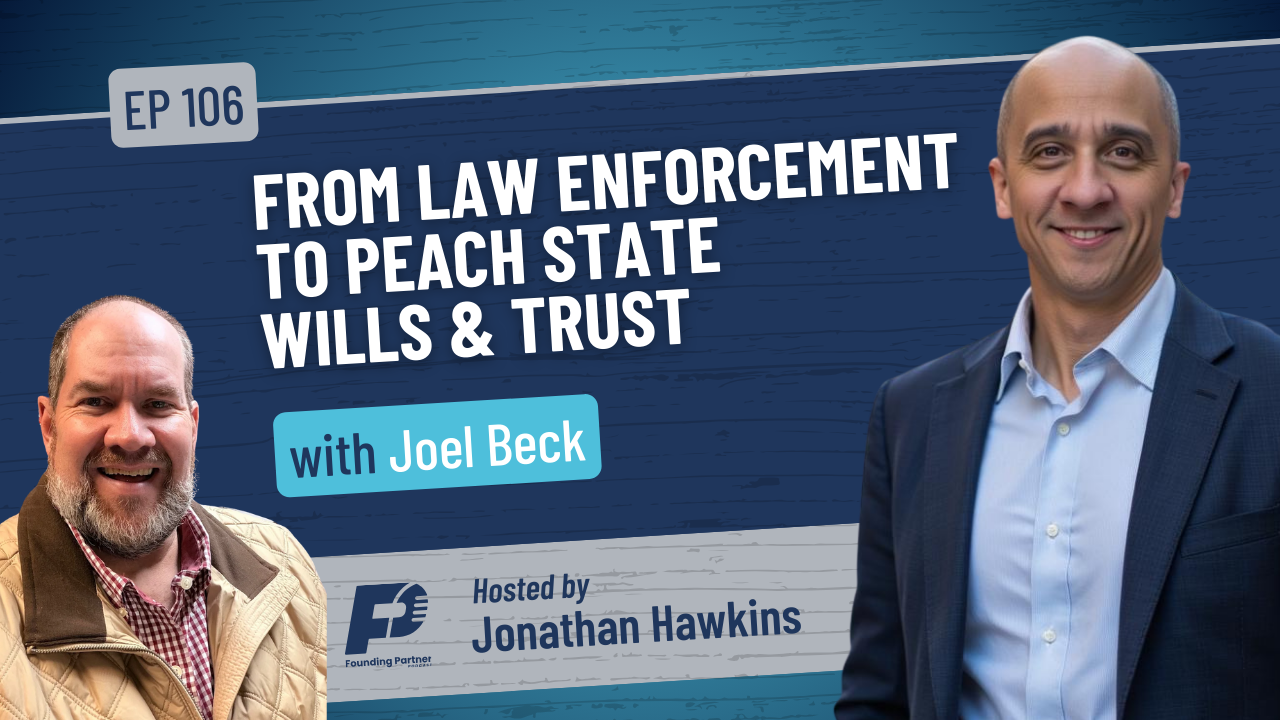
Every now and then, I sit down with a law firm founder who reminds me why I started this podcast in the first place. When I first had lunch with Joel Beck, I walked away thinking, “This guy talks more like a business owner than a lawyer.” He’s thoughtful, strategic, and very intentional about how he built his firm. I knew immediately I had to get him on the show.
And as you’ll see, his path into the law — and eventually into building Peach State Wills & Trust — is one of the more interesting and deliberate journeys I’ve come across.
Joel Didn’t Start in Law — He Started in Law Enforcement
Before Joel ever stepped foot into a law school classroom, he had already lived a full career. After earning his business degree from Georgia Southern, he didn’t go into finance or consulting. He went straight to the police academy.
Law enforcement was the job he had wanted since he was a kid. He spent years there, learning about people, conflict, and life. Eventually, he realized it wasn’t going to be a lifelong career, so he moved into private sector roles still connected to the field.
That eventually led him into a world most of us don’t see up close:
NASD/FINRA, the regulatory body overseeing broker-dealers, financial advisors, and even the NASDAQ market. Joel went in as an investigator.
And here’s where his path pivoted: FINRA offered an education benefit. If you studied something related to their work, they’d help fund it. Surrounded by attorneys every day, Joel looked around and thought: I think I could do that.
So he went to law school at night while still working full-time. He moved from investigator, to paralegal in enforcement, to enforcement attorney after passing the bar. He stayed another six years in that role.
But something else was brewing.
The Leadership Program That Pushed Him Out the Door
Joel was tapped for his organization’s leadership development program. As part of it, they sent him to the Center for Creative Leadership for a week-long intensive.
Before going, he completed personality assessments, 360-degree reviews, and leadership evaluations. While working with his executive coach, something clicked — and not in the way his employer probably expected.
He realized that to grow the way he wanted, he might have to leave.
He even told the coach he felt an “ethical quandary” because the company was paying for this development. The coach laughed and said, “This happens all the time.”
And that gave Joel permission to imagine what might come next.
He had the law degree. He had the regulatory background. He had the itch for something more. He started reading the few available resources on starting a firm back then — the Berg book, Carolyn Elefant’s MyShingle — and began shaping a plan.
Soon after, he formed an LLC, gave his boss a month’s notice, and walked out the door to start his own firm.
Launching a Firm in 2007 With Three Practice Areas
When Joel launched in July 2007, his firm handled three areas:
- Regulatory and compliance work for financial advisors and broker-dealers
- Estate planning
- Small business work like entity formation and contracts
And yes — this was pure scratch. He didn’t bring a single client with him from FINRA. It was the classic eat-what-you-kill beginning.
He did the usual early-stage hustle: networking, mailers, tombstone notices. Eventually, regulatory work came his way — especially in the wake of the financial crisis — though he reminded me that regulatory cases have a natural lag. You don’t see them the day after the market drops.
Still, business came. The firm survived. And that FINRA-related practice quickly became his largest revenue generator.
But it wasn’t his long-term vision.
The Big Shift: “Less Is More”
As his practice grew, Joel realized something important:
everything still depended on him.
Colleagues and mentors kept telling him to niche down. He resisted for a while — as many of us do — but eventually realized they were right.
He made the decision to phase out the financial advisor regulatory work, even though it brought in the most money. He stopped taking new matters a couple years ago and let existing cases run their course. The final one didn’t close until earlier this year.
And while he was transitioning, he began rethinking how he wanted his firm to appear to the world.
Why He Rebranded to Peach State Wills & Trust
When Joel was practicing under “The Beck Law Firm,” everything was tied to him personally. If he wanted to build a practice that could grow beyond him, or one that could be transferred or expanded without naming complications, he needed something different.
Enter Peach State Wills & Trust — a name that:
- Clearly communicates what the firm does
- Isn’t tied to his identity
- Positions the business to grow
- Avoids the traditional “name-change nightmare” during partner transitions
- Holds up even if he’s not the one doing the work
He worked with a great IP lawyer and got the name registered with the USPTO.
I also mentioned during our conversation that I see trade names used often in law firm breakups to avoid brand confusion when partners come and go. Joel confirmed that wasn’t his reason, but it was a benefit.
The Coaching and Groups That Shaped His Growth
Joel describes himself as a “reluctant student,” but once he accepted that he couldn’t learn everything from trial and error, he dove into multiple programs.
Here’s the path he walked:
Great Legal Marketing (Ben Glass)
One of his first groups. Helped him understand marketing and the business side of running a practice.
Atticus
Focused heavily on management, systems, and operational structure. He stayed for years and learned a lot about building a sustainable firm.
Mastermind groups with estate planning lawyers
Monthly Zoom calls where lawyers across the country shared what’s working, what isn’t, and helped each other troubleshoot issues.
Vertex League (Tracy & Andrew Zimmer)
His current group. They focus on “engineering” a law firm — systems, processes, management, structure.
Joel had just come back from a two-and-a-half-day intensive in Pittsburgh and mentioned he already has a list of things he plans to implement in the next quarter.
As someone who also attends these types of events, I know the feeling of coming home with a list so long you don’t know where to start. I mentioned that to him, and he agreed — the implementation struggle is real.
His solution?
Block off time every week and honor it.
No clients. No exceptions. That’s how he works on the business instead of getting swallowed by it.
Growing a Firm That Can Run Without Him
Today, Peach State Wills & Trust operates out of Lawrenceville, Georgia, with:
- Two attorneys
- Two support staff
- An outsourced marketing team
Joel still practices law, but he also oversees marketing, reviews work, manages the team, and handles operations.
His vision?
- A second office
- Maybe a third
- Serving more families
- Strengthening internal systems
- And doing it in a way that creates a healthy environment for both clients and staff
The biggest challenge at the moment is finding the right space. He’s spent 15 months searching for a new location and hasn’t found the perfect match yet. I shared a mindset I heard recently — that problems are actually evidence of growth, and solving them means you’re helping people and building something real — and Joel agreed.
Practicing Law With His Son
One of my favorite parts of our conversation was hearing how Joel came to practice law with his son, Zach.
Zach’s path was his own:
- Business degree from UGA
- Studied actuarial science
- Decided independently to go to law school
- Clerking during school
- Became an attorney at a commercial litigation firm
He liked the work at first, but over time, the long hours and demands of that practice area left him unfulfilled.
He noticed something:
his dad actually enjoyed his job.
That observation kicked off a series of conversations. What do you like about your practice? What does the day-to-day look like? Why does estate planning feel different?
Eventually, Zach asked about coming to work with Joel. Joel was already planning to hire an associate, but the bigger issue was making sure the business relationship wouldn’t damage the father-son relationship.
They talked openly about:
- Accountability
- No special treatment
- Respect during supervision
- Boundaries between “dad” and “boss”
Zach joined the firm. Joel trained him deeply in estate planning. And Joel’s pride in him — and in his daughter, Anna — was obvious.
Practicing law with your own child is something special. I told him I thought it was really cool, and he agreed.
The Drummer in the Bonus Room
A fun part of our conversation: Joel is a drummer. And so am I.
He started in sixth grade, marched drumline, played theater productions, joined a band in college, and spent about a decade playing at his church. Now his drum set lives upstairs with a sound shield around it. He calls it “percussive therapy.”
I completely get it. During COVID, I played a lot myself. It’s one of those things that stays with you, even if life gets busy.
Marketing That Actually Works for Him
Joel didn’t sugarcoat it: he learned marketing the way most lawyers do — by trying things and seeing what stuck.
What works for him now:
Word of mouth
Former clients returning or referring friends.
Referrals from professionals
Lawyers who don’t do estate planning, CPAs, financial advisors.
Search engines
People find the website through Google.
YouTube videos
This is a big one. Joel has a library of videos — some from the old FINRA days, others covering estate planning — and people call specifically because they found him on YouTube.
He films, sends them to his marketing team, and they handle editing, graphics, uploads, and distribution.
I told him video is on my shortlist for next year’s marketing push, and he immediately encouraged me to do it.
“If you’re not there, you’re missing out.”
His Advice to Law Firm Founders
Toward the end of our conversation, Joel gave three pieces of advice for anyone starting or growing a firm:
1. Get comfortable being uncomfortable.
Lawyers are trained to fear risk. Running a business requires taking calculated risks anyway.
2. Surround yourself with smart people.
Learn from those who’ve done what you want to do. Don’t try to figure it all out alone.
3. Sometimes less is more.
Scaling down and niching can create the growth you’ve been trying to force.
If Joel Weren’t a Lawyer…
I always like asking founders what they would be doing if they weren’t running a law firm. Joel wasn’t entirely sure, but he said it would involve encouraging people and helping them live better, happier, more productive lives.
Or maybe playing drums for an artist he enjoys.
Either way, it fits him.
How You Can Reach Joel
The best way to reach him is simple:
PeachStateWills.com
His contact information is there, along with the ability to send a message directly through the website. Joel hates email — he’s trying to manage that — so he prefers people reach out through the site.
I laughed when he said that because I feel the same way. Email is, frankly, the bane of all our existence.
AND MORE TOPICS COVERED IN THE FULL INTERVIEW!!! You can check that out and subscribe to YouTube.
If you want to know more about Joel Beck, you may reach out to him at:
- Website: https://www.peachstatewills.com/
Connect with Jonathan Hawkins:
- Website: https://www.lawfirmgc.com/
- LinkedIn: https://www.linkedin.com/in/jonathan-hawkins-135147/
- Podcast: https://www.lawfirmgc.com/podcast
Jonathan Hawkins: [00:00:00] So, you know, again, when we had our lunch and just hearing you now, it’s clear to me that, you know, you’re very thoughtful, you’re very business oriented. I know you have a business undergrad degree. But you know, I’m curious, you know, I know, but I’d like sort of take me through, you know, you bought the Berg Book Elefant, but at some point you started to get into you know, looking at programs, law firms sort of programs to help people push along.
So how did you discover that stuff and sort of take me through your involvement in it.
Joel Beck: So I think first what I’d say is I was a reluctant student. And it took me a while to get hold of some things in my head to realize. I don’t know it all. I’m not gonna figure it all out. And I really need to try to learn from some others about how to manage things, about how to grow the firm and to help me accomplish the goals.
And so, you know, I’d learned some things just from the school of hard knocks, right? I mean, we all go through some of that, but then I sought out and connected with some coaching groups and programs and [00:01:00] each has helped me, you know, along the way. Probably one of the first things I got involved with was Ben Glass’s great legal marketing.
You know, he’s a PI lawyer, disability lawyer up in Virginia, but runs this organization, great legal marketing that really helped with some of the practical business side of the law practice, especially with marketing and some management things and that helped.
And I was active in that for a few years and I got some good stuff out of that later on. I still needed more I think kind of beyond marketing and into more of the technical management and operations and systems and different things like that. And so I joined an Atticus coaching group, was involved with that for several years.
And that was very helpful to me.
Welcome to the Founding Partner Podcast. Join your host, Jonathan Hawkins, as we explore the fascinating stories of successful law firm founders. We’ll uncover their beginnings, triumph over challenges, and practice growth. Whether you [00:02:00] aspire to launch your own firm, have an entrepreneurial spirit, or are just curious about the legal business, you’re in the right place.
Let’s dive in.
Jonathan Hawkins: Welcome to Founding Partner podcast. I’m your host, Jonathan Hawkins, and this is a podcast where I get to interview law firm founders and hear about their journeys and the lessons they’ve learned along the way. And today I’m excited to welcome Joel Beck to the program. He is a trust and estate’s lawyer here in Georgia.
He’s got the Beck Firm the Beck Law Firm, I should say. But he’s got an interesting story and background that that’s gonna be sort of fun to explore. So, Joel, I guess first of all, welcome to the program and why don’t you, you know, what did I leave out? Tell us about your firm and sort of what you do and where you are, how many folks you got, that sort of thing.
Joel Beck: Well, hey, first, thanks for having me on. Jonathan, you got a good podcast. I listen to it quite often and I’m, I’m happy to be here. I am Joel Beck. I’m a, an [00:03:00] estate planning and probate attorney. Our office is in Lawrenceville, Georgia, Gwinnett County, that’s the northeast suburbs of Atlanta. We operate our business under the, the brand name of Peach State Wills and Trust.
And we’re here in Lawrenceville. We’ve got two lawyers and, and two support staff and, and we’ve got a, an outsourced team of, of marketing folks that, that support us in, in that regard. And we do nothing now, but estate planning and business planning type work. And some uncontested probate.
Jonathan Hawkins: So Joel, we, you know, we had lunch, I don’t know, a while back. And the thing that struck me is that you sound more like a, a business person than a lawyer, which is always very interesting to me. So, what, how do you view yourself nowadays? Lawyer, business person, somewhere in between.
Joel Beck: All the above. On a good day. None on a, on a bad day, I guess. It just depends. I mean, right when you’re, when you’re running a firm, you can’t just be a lawyer. You’ve, you’ve gotta wear the business hat, [00:04:00] right? And so you, you’ve got to learn, I think, over time to handle all of those things, to keep everything humming along and, and moving and to, you know, to grow and reach the goals that you set for yourself.
Jonathan Hawkins: So another thing that I, people that know me and listen to me know, I, I do like a good trade name. So Peach State Wills and Trust. How long have you been using that and, and sort of what pushed you to move in that direction?
Joel Beck: We’ve been using it a few years. And went through a process, had a great IP lawyer take that, got it registered for us with the, you know, the U-S-P-T-O and so we got the little circle R thing, all that good stuff. But we used it for a few years and the reason why is I was thinking more long term, right.
And building a business to grow and one that really is not dependent on me, right? And when we’re operating as the Beck Law Firm. I’m I’m kind of integral to that, right? But if we’re operating as Peach State Wills and Trust, it’s really not tied to me necessarily. So I was looking at that as a way to further differentiate [00:05:00] ourselves.
You know, the name tells you what we do, right? We do wills and trust, right? But then second, also gear this up so that we can grow. And you know, back then I was thinking about a potential exit strategy one day down the road and just thought, Hey, that might be of, of, of benefit too.
Jonathan Hawkins: Yeah, I’m, I’m with you. I think that at least. Leaves open the option and maybe gives some more flexibility. It doesn’t guarantee you’re gonna be able to do it, you know, so a lot of people ask, well, you know, what, if I don’t ever wanna sell, I say, well, still, it’s still good to have the option.
The other, the other piece that I see a lot of is, you know, I do a lot of law firm breakups, and if, if you don’t really have people’s names in the firm name, then, then you don’t have to worry about changing it. If anything changes, a new partner comes, somebody leaves all this stuff. And you know, I’ve, I’ve talked to a lot of I guess more consumer facing firms that have started to use trade names. And it’s not really for succession planning or exit planning or anything like that, reasons, it’s more of Google Juice. And so I don’t know if, did that co get play any part in it? [00:06:00] You said you put, you know, wheels and trust in there, or is that just sort of an afterthought for you?
Joel Beck: Yeah, that, that wasn’t really a, a determining factor. If it helps, it helps. That’s cool. But that really wasn’t factored into our decision making process there
Jonathan Hawkins: All right, so let’s, let’s, let’s take a step back. So the law for you is, is a second career. So, you know, take me back. What, what were you doing before and how did you end up in the law?
Joel Beck: Yeah. So I’ll, I’ll try to make this short. I went to college did my undergrad at Georgia Southern, got a business degree and immediately got out and went to the police academy and worked in law enforcement. That’s what I always wanted to do as I was a little kid. So did that enjoyed doing that.
Learned a lot about life, learned a lot about some other things. But then also realized this wasn’t gonna be a long-term play in terms of, you know, the rest of my life, the rest of the career, and started exploring some options. So it led to a couple of other positions kind of related. To law enforcement, but in the [00:07:00] private sector.
And then I wound up going to work for NASD which is now known as finra, the Financial Industry Regulatory Authority. And they regulate na securities broker dealer firms as well as financial advisors and, and regulate the NASDAQ stock market. And I went over there as an investigator. And while I was there working for, for the regulatory agency took advantage of some benefits they had, one of which was a, an education benefit.
And they’d pay so much a year, you know, if you wanted to go back to school and, and do something to further your education, if it could somehow relate to, you know, what the, what the organization did. So I went to law school at night. After seeing what our attorneys in our office there were doing, and I kind of thought, Hey, I, I think I could do that too.
And it looks like a pretty good, pretty good gig. And I’d already had several people tell me over the years, well, if you go to law school, get a law degree, you can do a lot of stuff. And so I took advantage of, of that tuition benefit and went to law school at night. While I was in school, they, they made me a paralegal, moved me over to the enforcement department [00:08:00] and continued to work there.
Finished up school, passed the bar. They made me an attorney. I stayed there another six years and worked as an en an enforcement attorney in, in the Atlanta office. And then that led me to leave in 2007 and start my own firm as I was looking for, for further. I guess personal growth and development and happiness and started the firm back then and still here today.
Jonathan Hawkins: You know, I, I, I tell. Any, any person interested in law school I tell ’em, you know, whoever gives you the most money that tuition benefit that, that’s awesome. ’cause you know, again I’m always one for keeping your options open or, or, you know, having optionality. And if you have a gigantic albatross of law school debt hanging around your neck, it, it sort of limits the things you can do.
Right.
Joel Beck: Absolutely. Yeah. I don’t have that experience personally because that was a great benefit for me. But yeah, I would be concerned about, you know, recommending law school to somebody in, in terms of the debt you [00:09:00] take on and all of that. You gotta be careful about that.
Jonathan Hawkins: Okay, so, so you worked for, I’ll call it FINRA, but basically the NSAD, whatever it’s called for a good number of years as a non-lawyer, then another six years as a, as a lawyer. So what, you know, tell me about what was the spark? What pushed you to say, Hey, let me go start something.
‘Cause you know, you work for an organization long enough, I can see you getting comfortable, right? Or a person getting comfortable. So what pushed you to start.
Joel Beck: So I was put into this program that was a leadership development program in the company you know, to raise up the next group of leaders and get you exposed to different parts of the organization, different departments and develop relationships and things like that.
And it was a neat program and I was glad I was able to do that but as part of that program they sent me to the Center for Creative Leadership up in Greensboro, North Carolina for a week to go through CCL’s leadership development program. And when you do that, when you get ready to go.
They subject you to [00:10:00] a host or a battery of different tests and assessments. A 360 degree assessment where you know your peers and your superiors and your subordinates are assessing you on different things relating to your job performance and you know, things like that. A battery of personality traits or personality test and different things these assessments.
And so you go up there and you go through this program at CCL and it was a great program, and then they pair you with an executive coach to kind of develop, okay, what’s the action plan for your professional growth kind of going forward? And I guess what I can summarize is that opportunity that week and all of that assessment and that stuff, it was somewhat eye-opening.
It was confidence building. But it was also an interesting realization as I left there and, and started working with this coach to kind of develop a plan for career growth. I realized that for me to really continue to grow and develop professionally. [00:11:00] I needed to go somewhere else. And so I, I had what, what I thought was an awkward conversation with this executive coach I’m working with.
We’re on the phone one day talking and, and he asked me what I’m thinking about. And I said, well, this, I, I think I’ve got kind of an ethical quandary here. He said, what do you mean? And I said, well, you know, I’m supposed to work. My company is paying you to work with me to develop me and help me grow, you know, personally and professionally here in my career.
But I’m getting the sense that for me to really do that, I need to leave and go do something else. And he stopped me and said, this happens all the time. Don’t worry about it. And so. That kind of, I, I was kind of shocked with that. But anyway, that kind of put the, the spark in things and, and I, I worked with just, you know, over a little bit of time to kind of figure out what I wanted to do and decided, well, I got the law degree.
I’m a lawyer, I’m gonna go out. And, and start my own firm and you know, so back in then this is, you know, this is, you know, [00:12:00] 2006, 2007, right. And the internet was as progressed as it is today. And so, you know, I’m reading books by Jay Berg and, you know, Carolyn Elephant had, had the my Shingle thing going on and, and providing advice and guidance and I’m soaking up things like that.
And it just led where I, you know. Started an LLC, built out a plan and, and then went in and my boss was in new Orleans. And so picked up the phone one morning called, dropped the news and said, I’ll work a month. And I did. And then the firm was born.
Jonathan Hawkins: You know, it’s to people nowadays, it’s hard to imagine that there really were not very many resources back then. You know, you had the Berg Bible, whatever you
Joel Beck: Yes. Yeah.
Jonathan Hawkins: you know, Elefant had her, her, her thing. You know, there were, there were a couple others maybe. But it was hard. I mean, there, there just wasn’t, and, and there, you know, internet was still fairly young back then too.
I mean, internet really started gearing up in what, late nineties maybe. And so there wasn’t much out there. [00:13:00] So, you know, people just don’t, don’t remember that so much the the younger folks. And so I wanna get to some of that, but, so this coach you had there, that, that, that they provided you, is that, is that the first time you sort of had worked with.
I’ll call it a business coach uh, a career
Joel Beck: absolutely. Yeah. Yeah.
Jonathan Hawkins: So, and we’ll get to this a little later. I know that since then you’ve, you’ve been part of numerous programs and coaching and all this. So I do wanna sort of go through that and, and about your experience with that. So, but before we get there, so you decide to go out, you, you, you give it a shot.
So. Did you, so obviously you’re not taking clients with you ’cause you were working.
Joel Beck: Yeah.
Jonathan Hawkins: so, so, you know, what’d you do? What, what, how did you tell people what you did? Well, first of all, what did you say you were doing? Wa, was it FINRA type stuff? Or,
Joel Beck: Yeah. So you, yeah. You know, you, you’re right. I, I went from the enforcement department of the regulatory agency to, to private sector and, and, and private practice. So I didn’t take a [00:14:00] single client. I didn’t have anything, went from that nice paycheck every two weeks to the eat what you kill system and, and, you know.
That, that was an interesting experience. But I started off, I knew I was gonna really just kind of flip sides of the table, right? Instead of being in, investigating and, and prosecuting, you know, cases against broker dealers and, and financial advisors, I’d go to the defense, right. Do some compliance counseling and, and, and regulatory defense work and the like.
But I knew that sometimes that’s cyclical. And of course it, it’s more of a. National scope of practice. It’s, it’s more federal rules. Uniform rules as opposed to to state specific. But I wanted to kind of round out some other stuff. And so I thought back to some things that I enjoyed in law school and, and had kind of dealt with just personally previously.
So I decided I’m gonna add a couple of practice areas to that. I’m gonna do some estate planning and then some general small business law you know. LLC and corporation formations and contracts and kind [00:15:00] of some small transactional stuff. So those were really the three areas. We had this, you know, financial advisor, broker dealer, investment advisor work, estate planning, and, and then business law.
And so when, you know, when, when I left the, the regulator and it, it was really. The end of July, 2007 and, and the website went live. Hey world, here’s, here’s the three things I’m doing. You know, let me know how I can help. And you know, back then you’d send out you know, card stock notices, Hey, you know, I’ve opened a firm, here’s my contact information.
You know, kind of the tombstone notices, things like that. Reaching out, trying to do some networking, beat the streets, let people know, Hey, I’m out here. What can I do? And go from there.
Jonathan Hawkins: So I imagine maybe I’m wrong, but you know, you do, you’re doing FINRA broker dealer style work July, 2007 is when you start, and then within a couple years the the world ends. [00:16:00] I I did you just get a flood of cases? I mean, you’re almost p perfectly positioned at that time when the the great financial crisis hit.
Joel Beck: Yeah. Well, you know what, what I’ll tell you, Jonathan, is, is, is the work came. You know, we didn’t go hungry. There was no bankruptcy filing. Business was coming and, and the, the financial advisor type securities you know, compliance work was, was my, my main practice area. That was the main driver, the main source of revenue, biggest practice area.
There is a lag time, so on the regulatory stuff, right, things have to blow up first. Then pe then the regulators find about it, and then there’s a forever long investigation and stuff happens. So, you know, if, if, if the stock market has has the correction or the crash, it, it’s still gonna take a while for that stuff to, to trickle through the system on a, on a regulatory side.
But, but yeah, there was work and I was, you know, i, I think, reasonably successful in what we did in terms of, you know, representing folks and, and helping guide [00:17:00] them through those various regulatory issues.
Jonathan Hawkins: Okay, so, so now you, you focus on wills and trust and probate. Then you did three different things at least. So take me through the transition, sort of what the thought process of, Hey, I’m gonna. You know, sort of phase out of the FINRA stuff and just really focus on this. So number one, sort of take me through the thought process and then take me through, you know, the, the mechanics.
How did that work? You know, how do you, do you just say everybody, I’m not taking those cases anymore. How do you wind them down? Do you refer, refer them out? Take me through that.
Joel Beck: Well, it was a slow process initially. You know, I was doing a few different things. Had the, the, the broker dealer, investment advisor, regulation and compliance, the estate planning, some general small business stuff. And over time I realized what I was doing, it was really all dependent on me and I wanted to move more towards a model of a firm where the firm could function more and more without me.
Maybe I could not be there. And revenue is happening, you know? [00:18:00] People are doing work, taking care of things. And it took, it took a while and there were some people that told me along the way, niche down, niche down. But I was a slow learner. But I realized, okay, maybe these folks are right. I do need to niche down in practice to downsize what we were doing to be able to then grow in the way that I wanted to grow.
So I made the decision to make estate planning the primary practice area. To cease taking on, you know, the other work the financial advisor related work and, you know, that was. That was a big decision because that was like the, the largest practice area. It generated more revenue than all of the other work combined. And so I did that over time. It wasn’t something I could just switch and be done with that. In some of those cases, you know, they drag on for a while. It takes a while. Some of those cases took, you know, a few years to, to wind down the, the last open one was just closed earlier this year. But I stopped taking on new work, you know, a a a couple of years ago and, and then, you know, [00:19:00] everything finally finished out.
And so now our practice focuses only on prob estate planning and some uncontested probate. We ha we do handle some ancillary business work, but it’s really in the context of estate and business planning for our estate planning clients. ‘Cause it ties into their estate planning, but that’s it.
And if it’s not in our wheelhouse there, it’s not something we’re, we’re bringing in.
Jonathan Hawkins: So lemme ask that there are people out there probably thinking about. Either switching practice areas or phasing one out and really going towards another. Is there any advice that you would give and, and I mean, you know, multi fast advice. So, you know, I guess part of this, for example, is you probably change your website, so you took Fin Roth or whatever but then people call you to say, Hey, I got a case, and you’ve gotta have the backbone to say, no, I’m not taking it.
So what kind of advice would you give to somebody out there that’s maybe thinking about making that transition?
Joel Beck: Yeah, so you, you talk about the website, we’d actually started a different website peach State Wills and, and we’re, we’re [00:20:00] starting with that branding because the way you market the one practice area, you know, the consumer of that can be very different than the way you market to. The consumer of another practice area.
And so that, that was something that, that I picked up on and, and started taking action on. But I think if somebody’s thinking about making a switch, I think you’ve really gotta be honest with yourself and ask a few questions. You know, first, why. know, I, is there a good reason? Why do you want to do this?
And it may be ’cause you, you think the, the, the financial prospects are better there cases are gonna be easier to get. It may just be you, you think you’ll like your job better. You know, you’ll, you’ll get up and be happy about going to work and, and you know that, that’s certainly important. But I, I think you’ve gotta have a good enough reason why, you know, to make that switch.
But I, I think you’ve also got to build out a plan. Where you can make it work. You know, this wasn’t something we could pull off overnight because this was the largest practice area. It was the largest pot of [00:21:00] revenue each year, historically, since the firm opened. And so we walked into this with caution, but with, you know, definitely a goal of where I wanted to be and come out.
And that helped.
Jonathan Hawkins: I think that’s so important. You know, it, you didn’t burn the boats, so to speak. You, it was a measured. Plan to transition. And so anybody out there thinking about it, I mean, maybe you have an s egg big enough and you can do that, but if you don’t and you need the cash flow, then you know, you gotta, you gotta take it step by step.
That’s important. So, you know, again, when we had our lunch and just hearing you now, it’s clear to me that, you know, you’re very thoughtful, you’re very business oriented. know you have a business undergrad degree. But you know, I’m curious, you know, I know, but I’d like sort of take me through, you know, you bought the Berg Book Elefant, but at some point you started to get into you know, looking at programs, law firms sort of programs to help people push along.
So [00:22:00] how did you discover that stuff and sort of take me through your involvement in it.
Joel Beck: So I think first what I’d say is I was a reluctant student. And it took me a while to get hold of some things in my head to realize. I don’t know it all. I’m not gonna figure it all out. And I really need to try to learn from some others about how to manage things, about how to grow the firm and to help me accomplish the goals.
And so, you know, I’d learned some things just from the school of hard knocks, right? I mean, we all go through some of that, but then I sought out and connected with some coaching groups and programs and each has helped me, you know, along the way. Probably one of the first things I got involved with was Ben Glass’s great legal marketing.
You know, he’s a PI lawyer, disability lawyer up in Virginia, but runs this organization, great legal marketing that really helped with some of the practical business side of the of the law practice, especially with marketing and some management things and that helped.
And I was active in that for a few years and I got some good stuff out of that [00:23:00] later on. I still needed more I think kind of beyond marketing and into more of the technical management and operations and systems and different things like that. And so I joined an Atticus coaching group, was involved with that for several years.
And that was very helpful to me. I, I had a lot of, of personal and professional growth there. And, and, and, and during this time period, I, I participated in some kind of, you know, informal mastermind groups that, that, that people had put together. We had some different estate planning lawyers and different.
Parts of the country and we’d, you know, connect for an hour or two once a month via Zoom and, and just brainstorm things. What’s working for you, what’s not, what do you need help with? And, and everybody kind of masterminds and, and helps each other and did that. And then more recently I’ve got involved.
With vertex League that’s run by, by Tracy and Andrew Zimmer up in Pennsylvania. Tracy’s an estate planning lawyer there and, and Andrew is an engineer by education and experience and, and, and with his [00:24:00] engineering background and mindset, they’ve, they’ve really put together some good stuff and in regards to engineering a law firm with regards to systems and processes and management and, and it’s been good stuff and, and I’m involved with them.
We just went. Spent about two and a half days last week up in Pittsburgh, meeting with some other folks and, and, and, and having mastermind sessions and kind of some, some talks on different topics. And, you know, I, I’ve got, got a list of things here that, that I’ve gotta implement and do, you know, over the next quarter to continue moving forward to some goals I’ve got.
So it’s good stuff.
Jonathan Hawkins: Yeah, I saw some of those posts about that vertex league meeting, so I, I was interested about that. And coincidentally, you know, Ben Glass, I was at his summit last week and that it was the 20th anniversary of his, so he’s, he’s been doing it for, for quite a while. But,
Joel Beck: yeah.
Jonathan Hawkins: So I, you know, I have been in groups like that and I get a ton out of them.
The, you said you have a list of [00:25:00] things. One problem that I’ve encountered, and I I’d like to hear your, your, your view on it is you go to these things and you get so much value, you get so many ideas. The list just goes, you know. Long list and then you get back and you’re like, I’m gonna do this, I’m gonna do that, I’m gonna do this.
And then sometimes you, I’m running in circles ’cause I’m trying to do everything. What’s been your experience and then maybe what’s your advice to somebody out there that’s got that long list of want to dos? How do you, how do you tackle ’em?
Joel Beck: Yeah, I, I, it is a challenge no matter what. Right? And, and I’ve had success and I’ve had. Catastrophic failure with that. And, and, and it might be one, one week after the other. But what I have found to be quite helpful is actually blocking out time on the calendar each week and, and being committed to that.
Nobody else can schedule an appointment there. I’m not gonna work on a case. I’m not gonna do something else. I’m gonna honor that time slot to really be able to spend some time to work on the business. Instead of working in the business. And that [00:26:00] helps it, it, it, without setting aside some time, it’s just one of those things, I’m gonna get around to it when, and we never have the time to do that.
What I’ve found, we just have to be intentional. Blocking out time, honoring that commitment, you know, as, and, and, and, and, and keeping it.
Real quick, if you haven’t gotten a copy yet, please check out my book, the Law Firm Lifecycle. It’s written for law firm owners and those who plan to be owners. In the book, I discuss various issues that come up as a law firm progresses through the stages of its growth from just before starting a firm to when it comes to an end.
The law firm lifecycle is available on Amazon. Now, back to the show.
Jonathan Hawkins: So you, you’ve been involved with, you know, a number of different organizations and, and coaches and whatnot over the years. You know. What are your thoughts? Any advice to folks out there that maybe have not gone down that path yet? You know, sort of, should they do it? What? What should they look for? You know?
How do you choose? ’cause there are a lot of programs out there now. Any advice on that?
Joel Beck: I mean, [00:27:00] should you do it? I mean, it depends on what you want. I think you’ve gotta get a little bit of clarity in your mind about what do you want to do? You know, if it’s your law firm, your purpose? And, and having it. What do you want out of life? What do you want out of the business?
And once you really start honestly thinking about that and, and thinking about where you want to be, I, I think then you can look at, okay, well where are the, where are the areas I really need help to, to, to, to make this live out? And, and then work to find, find you know, some resources that can be.
Quite good for you. There’s a lot, you know, several different coaches or, or groups out there. I think a lot of them have some commonalities, some similarities, but, but they’re also different in their approaches. And it may be, you know, if you’ve got somebody that you’re connected with or could get connected with, who is kind of, you know, it appears they’re running a practice like you want to.
They’ve got the success. You [00:28:00] want to you know, ask them what are they doing, who are they working with, who are they talking to and get some other feedback and, and that can help you maybe narrow down what, what resource might be, you know, good for you. Because I think all of the, the different groups or, or organizations, you know, bring, bring some different things forward.
Jonathan Hawkins: Yeah, I think everything you said there dead on. You know, number one, you gotta know what you want. I think you gotta start with that. Always. And I do think, you know, a lot of these groups, offer similar things, but they all have a different personality. You gotta find the one that sort of fits you at the time you need it.
That’s the other thing. You can outgrow these things too. So
Joel Beck: I think so. Yeah.
Jonathan Hawkins: to find another.
Joel Beck: Yeah.
Jonathan Hawkins: So let’s get, let’s get back to your firm. So another thing that, that that I wanna talk about is, so your son is an attorney and he worked, he works with you now. He did not always work with you. So tell, tell me about that.
How did that sort of come about? What was he doing before and how did you guys come together?
Joel Beck: Yeah, so, well we, we came together [00:29:00] just by the father son relationship a long time ago. But he went off to to UGA he, he got a business degree studied actuarial science, and he decided on his own that he wanted to go to law school. And be an attorney. And that wasn’t something that I’d, I’d really stressed to either of my children or encouraged them.
I just was encouraging them to, to find something that they thought they’d like doing and, and find where they could use their skills and abilities and talents and passions. But, but Zach decided he wanted to go to law school, and so he did. And while he was at school he, he was clerking between two L and three L for a for a respected commercial litigation firm in, in Atlanta.
And they asked him to stay on part-time during his three L year, and he did. And then they offered him a, a position. And so, you know, he clerked while he was studying for the bar and then waiting. You know, the three months for the results or whatever, and then, you know, got sworn in and became an attorney.
And he really enjoyed what they were doing. I, I think when, when he was clerking, once he became the [00:30:00] attorney and, and the long hours set in and some of the additional duties come on board and all of that, right. He, he, he kind of changed his, changed his mind and realized. I don’t, I, I’m really not, I guess, self satisfied with this.
He’s working to good firm, good people. But he, he just wasn’t, wa wasn’t, you know, getting the fulfillment that I think he wanted. And, and I think, and, and, and you’d have to ask him, but, but I think he kind of thought back to me and said, you know, my, my dad, he seems to like his job. He, he seems to like what he does.
Maybe there’s something to that. And so he came to talk to me and, and we were, we were having a conversation and he told me, I’m, I’m really not, not happy with, with what I’m doing with the area of the law, and I think I’d want to do something else. Talk to me about what you do and, and why do you like it and, and what do you get out of it?
And so that led to a, a series of, of many conversations and. And then those conversations shifted to what about him coming to work for me, I was already planning on [00:31:00] hiring an associate within the next year anyway. And so I was o open to this idea ’cause I needed some help. I, I needed another lawyer here.
But it, it then turned from the, you know, okay, I think you can do this, you can learn this practice area. And he, and he had worked for me. For a summer or two while in high school and, and already, you know, knew a little bit about what we were doing here, but you know, I knew he could do it. Then we had to move from the, okay, what is this gonna do to the father or son relationship?
Right. Because that. That can be challenging sometimes. Right. And I wanted to ensure, and I think, you know, he, he probably would agree that, you know, a, a workplace relationship doesn’t damage a family relationship. So we had some serious conversations about that. And you know, if you’re gonna be an employee here, you’re gonna be an employee and you’re gonna be held accountable.
And just because your last name, you know, is spelled exactly like mine, doesn’t mean you get a pass. Right. And I’m gonna hold you accountable and. Just like any other [00:32:00] employee and you know, you’re gonna be expected to work and do good work and, and put the time in. And there’s no perks, you know, for, for being the son.
In terms of, you know, not, not carrying your weight and doing you’re supposed to. And it also means that you’ve got to respect it when I’m coming in as the supervisor, you know, to talk to you about stuff. That’s kind of a little bit of a different situation. You know, I’m still your dad. I’m always gonna love you, right?
I’m always gonna be there for you. Be your biggest cheerleader and support you. But if you’re working for me, we gotta deal with that part of the relationship too. Can we handle that? And so we had some really good conversations. And, and considered that. And, and I think we were both confident. Yeah, I think we can make this work.
So, you know, he, he made the move, said goodbye to his other firm, came on over here. We spent a lot of time doing some education and training and, and getting him ready to, you know, handle, handle things and, and it’s been really cool. It’s been a good result. Good outcome. It, it, it’s, as a [00:33:00] dad, it, it.
You’re just kind of proud of that, right? I’m proud of both my kids my son and my daughter Anna for a lot of different reasons, but, but it is neat to, you know, practice law with, with the child. It, it’s pretty cool.
Jonathan Hawkins: Yeah, I, you know, I can imagine, you know, I’ve got, you know, I’ve got three kids and. Some days I’m like, I don’t know if it’d work. I guess two of ’em are teenagers now. The other one is, is past that. But there was a time where it would not have worked when she was a teenager. That my, my current ones have not gotten there yet, but but I, but yeah, it sort of, I think that would be pretty cool.
And it, it sounds like you guys have made it work and it’s really sort of settled in How long has he been there?
Joel Beck: why do you ask me that?
Jonathan Hawkins: Yeah,
Joel Beck: Three, three years maybe.
Jonathan Hawkins: That’s
Joel Beck: I, I’m gonna say three years, maybe three and a half. Maybe it’s four. I, I don’t know.
Jonathan Hawkins: That’s cool. Well, I’m glad that, that you’ve got to experience that and that it’s working out. So that’s really cool. You know, some people I think, [00:34:00] believe it might be important for them, for their, their child to go work somewhere else first before they come back, and he did that. But it sounds like this was almost not by design, but by accident that this sort of happened.
But I guess it was good he did that.
Joel Beck: Yeah. Yeah. I, I think so.
Jonathan Hawkins: So another thing that, you know, as I was getting ready for this episode that I came across, maybe on your website that, that you play drums. Is that, is that right?
Joel Beck: Yeah. Yeah, yeah. Started in sixth grade, long time ago.
Jonathan Hawkins: alright, tell me about that. What, what, so I don’t even see it, but I got a little drum set down there
Joel Beck: Oh, okay.
Jonathan Hawkins: me. So, yeah, I grew up playing the drums too.
I don’t get to play so much anymore, but yeah. So,
Joel Beck: I started in, in sixth grade, you know, in the middle school band and stuff. And, and played was in drumline in high school, marching band, concert band, all that stuff. Played, set for, for some of the different, you know, like theater performances at school. And I was in a band down in college and, and did some stuff down there in Statesboro for a while.
And then, later on in life, I wound up [00:35:00] playing drums at our church, I think for 10 or 11 years. And now I’ve, I’ve just got my drum set set up in the bonus room upstairs. I’ve got one of the, the, the kind of the sound shields around it and, and covered up and, and I just go up there and play. And I call it percussive therapy sometimes.
And percussive therapy can be a great outlet. After, after some days, you know, at the office. So I enjoy that. Still, still, still keep up with that?
Jonathan Hawkins: That’s great. I I don’t keep up with it so much anymore. I, I get through phases. There was a sort of around COVID time. I really, I was playing a lot, you know, a couple hours a day,
Joel Beck: Yeah. Okay.
Jonathan Hawkins: not so much anymore. You know, I always found, you know, God bless my parents for forgetting me. That drum
Joel Beck: No doubt.
Jonathan Hawkins: when, ‘ cause it, the, the practices always at your house
Joel Beck: Yeah.
Jonathan Hawkins: and it is loud.
It’s loud.
Joel Beck: And even if there’s nobody else, if just the drums are there, I mean there, there was no plexiglass enclosure and carpeted roof and [00:36:00] stuff like that back then, you know, it was Christmas of the sixth grade year that that drum set came in to the house. So, yeah.
Jonathan Hawkins: You know, I always joke with my sister that I’m gonna get her son a drum set for Christmas. Just but yeah. That’s cool, man. I, I’m glad you’re still playing. I, I, I. I dream of the day that I’ll start playing a little bit more again. I just, I just, too much going on these days. But that’s good.
You’re still doing
Joel Beck: It’s hard to find time, but, but sometimes it’s just good to take the sticks and beat on stuff for a while. Yeah.
Jonathan Hawkins: Oh yeah. So let’s, let’s get back to the, the firm. So another question I like to, to hear from folks is as their, their firms evolve and that’s sort of the change of the owner’s role in the founder’s role. So when you start the thing. You’re doing everything you’re doing. I mean, the legal work for sure, but the, you know, you’re buying the supplies, you’re doing everything.
And then over time, these, these things sort of change. And I’m curious where you are right now in, in that sort of timeline. What, [00:37:00] what kind of, you know, how’s your day or your week set up in terms of what you spend your time on?
Joel Beck: So it’s a mix. You know, I mean, I’m still practicing law. I’m still meeting with clients and engaged in, in providing legal services, right? So I’m still functioning as a lawyer, but I’m also the owner. So I’m still functioning in that capacity and as kind of the manager and reviewing, you know, work when it’s going out and, and helping design strategies for, for different cases and, and managing staff, managing, overseeing the marketing you know.
Making sure payroll gets out, you know, the, the bookkeepers handling stuff, all that stuff. So, it’s definitely a mix. I’m not at a point where, you know there is an awful lot of time or, or the majority of my time that’s not focused on legal work. I’d say there’s probably a, a pretty good division as we continue to grow you know, and add on some additional legal capacity.
You know, more of my time will be focused on the non-legal work. Right. But where we [00:38:00] are now with, with two lawyers, I’m, I’m definitely still involved in, in practicing law and, and hands on in, in providing services.
Jonathan Hawkins: So you mentioned the marketing. That’s another thing that, that I’m always very interested in. You know, how do you market your practice and, and, and really, you know, how did you learn to market your practice? You know, there are a lot of lawyers out there that start their firm and, and, they’ve never had to market.
They don’t really know how to market. So how did you learn how to do it and what works for you? You don’t have to give us the secret sauce, but.
Joel Beck: Yeah, so. I think I learned, ’cause I had to, right? And, and I learned by trial and error. I’ve, I’ve done some things and had success. I’ve done some things and had catastrophic failure. So it’s a mixed bag. But, you know, we get our business from, you know, word of mouth. We, we, so we’ve got clients that we’ve helped and then they come back to us for additional work or they send other people to us.
We get referrals from other professionals, be it other lawyers who don’t do what. We do, or financial advisors or CPAs or, [00:39:00] or other types of professionals we’re just found naturally on Google, you know, and other search engines because of our website and how that’s, you know, optimized and the information we put out there.
We’ve got an awful lot of videos out on YouTube and on our YouTube channel, and we get calls pretty regularly that, Hey, found you on YouTube. Saw some videos. I knew I had to call. You knew I had to work with you. So we do that. Social media not so much. I mean, we’ve got a presence, but, but I can’t really tie you know, ROI to to social media presence.
But I think it’s just helpful to continue to be known. So that, that’s probably it. And, and we’ve got, you know, a team of people that we work with that, that help us with our marketing and help keep us on track and, and put things together and maintain and optimize the site. We do use some, some paid search you know, and they handle that whatever voodoo that is, they take care of and, and all of that.
And when the phone’s ringing and, and business is coming in, I’m happy.
Jonathan Hawkins: So let’s, let’s [00:40:00] dig into the video piece. So, are, are, are these old videos? Are you still updating, adding new videos? And what’s your process? And then the last thing is. Was it hard to start doing videos?
Joel Beck: So I started this a long time ago. And most of the videos were, were tied, you know, to some financial advisor type matter, regulatory or compliance type stuff, tips, tricks, et cetera. Is it, is it hard to start? No, it’s incredibly easy and, and it’s, it’s even easier today. Back then, you know, I, I had to invest in a, a, a, a digital camera, you know, a digital video camera.
But of course now, you know, the, the iPhone has, you know, a better camera than any of those standalone cameras I ever bought back then. And so you get that a tripod in a mic and, and a good light in front of you, and you just talk and, and you answer questions that you are. I call avatar client, you know, the, the client that you’d like to work with.
What [00:41:00] questions do they have? So just take a question at a time and make a video out of it, three to five minutes maybe some 60 seconds or less, and put those up and, and put ’em on YouTube and put ’em on your website and put ’em on social media and all of that. And so, we still do it. I was just talking to the marketing team today before hopped on this with you, and they were encouraging me to make some more videos.
But it’s a matter of time. You know, sometimes. That’s not the, the priority, but, but we’ve gotten more, we’ve got a list of videos to go make, so we’re still doing it just not as often as the, the marketing team would like. But in terms of what we do, we film the video, I send it to the marketing folks, they edit it.
Put on graphics and all of that, upload it to the YouTube channel and then push it out, you know, on social net social media and, and other stuff and all of that. Tie it to blog posts on our page and things like that. Now all of that stuff is things I used to do when, you know, I had more time and didn’t have as much work and was starting out.
[00:42:00] But now, you know, we’ve got some additional folks that are really good at that and, and they take care of that and frees me up to do some other things.
Jonathan Hawkins: You know, I’ll tell you. Doing some videos has been on my list for a long time, and it’s just always seems to fall to the bottom. But, you know, I, I, as I’ve been thinking of what I’m gonna do, I, I usually pick one new sort of initiative, marketing initiative each year and sort of go all in and video. And the YouTube channel is, is one of the things I’m heavily, heavily considering.
And then if once I decide, then I just commit all in.
Joel Beck: You know, I mean, since, since you, since you don’t do what I do, right? Since, since you have a totally different practice area, I would strongly recommend video. It’s not a shiny new object to chase. It’s tried and true. YouTube is the second most searched search engine. If you’re not there, you’re missing out.
Now for those that do estate planning and the like in Georgia, I’d probably say video is a waste of time. Don’t do anything,
Jonathan Hawkins: [00:43:00] is the worst thing. It’s, yes, exactly.
Joel Beck: a time suck. You’ll get nothing outta it. But, you know, with what you do helping lawyers, it’s gonna be, you know, a good thing for you. So I definitely pursue.
Jonathan Hawkins: Exactly. So shifting back to your firm and, you know, you’ve been at this for a while, you’ve seen a lot of things, you know, for those out there that are. Maybe early in their firm or thinking about starting a firm. Any advice that you give them? Any things that you know that they should be thinking about early on?
Joel Beck: Yeah. I would say first off. Quickly get comfortable with being uncomfortable. And what I mean by that, Jonathan, is, you know, when we go to law school, we spend a lot of time focusing on risk, right? And, identifying risk and identifying all the ways this thing can blow up for our client. Whatever it is, right?
And how do we deal with that and how do we manage and mitigate against that? And I think it, it can work to make us very timid or afraid, [00:44:00] have some fear of taking risk. And that was definitely a mindset problem for me early on. And I wish that would’ve been something I would’ve realized and tackled sooner, right?
So, but somebody starting out, I’d say get comfortable being uncomfortable. Go ahead and take the risk. I mean, make it a calculated risk, right? But do that. I would then say, surround yourself with smart people and learn from them. Don’t try to learn everything on your own and take the time to do that.
Connect with folks who’ve been there and done that and have some expertise and are gonna be willing to share and help you. And then I think the third thing I’d say is sometimes less is more. You know, for me, and people talked about this, you know, over the years, it just took me a while to, to learn about it.
’cause I was like, oh, my practice is different, right? It, it, whatever you know, but, but sometimes less is more. And so, so niching down or, you know, scaling down so you can then scale up. Can often make things easier. [00:45:00] So those would probably be the three tips I’d share.
Jonathan Hawkins: I agree with all three of those. Those are really good, really good piece of advice. So you mentioned earlier, sort of starting with vision. I’m curious, you know, sitting here today, what’s your vision looking forward the next 10, 15, 20 years for your firm?
Joel Beck: I’ve got plans for a second and maybe a third office location to allow us to increase capacity so that we continue growing our, our estate planning practice and, and serving more families and, and helping them plan for the, you know, the what if moments in life and, and be prepared for, for those things when something happens.
But, you know, that’s gonna involve growing our team strengthening our systems, our procedures. And of course, continuing to do excellent work, you know, for our clients. Finding the location has been the challenge. I’m, I’m geared up and ready to go with this, this second spot for, for this community that I wanna be in.
And we’ve had just a terrible time over the last [00:46:00] 15 months trying to identify. Some, some space that would be suitable. So, so that’s a challenge. But that’s the vision to, to continue to grow, to be able to serve more families and to help them and, and have a, have a firm that that helps, you know, serve our, our team as well, look after us and take great care of our clients and, and be a good citizen in the community.
Jonathan Hawkins: Well that’s, that’s cool. And so I was listening to a podcast maybe this morning and it’s a business podcast. And, and they were talking about how problems, so your problem of finding a location, they’re like, you should be happy when you encounter the problems. ’cause if you solve those, that means you’re helping people.
And you’re making money, so, so you should welcome the problems, right? So, and because you’ll figure it out, and if you have the problem, that means a lot of other people have the problem. You just gotta, you have to be the first one to figure it out. So, so that’s awesome.
Joel Beck: Yeah.
Jonathan Hawkins: get, yeah. You had something to add there.
Joel Beck: No, no. I’m, I, I, I, I agree. I agree.
Jonathan Hawkins: Okay, so, this is a question, [00:47:00] So if, if you were not running a law firm,
Joel Beck: Yeah.
Jonathan Hawkins: what do you think you’d be doing?
Joel Beck: I don’t know if I’d be good enough, but there’s. Probably some artists I’d love to go play drums for. Right. But o otherwise I’d be working or volunteering in, in some type of situation or role where I’m really encouraging others. And I don’t know exactly what that would be or what it would look like, but it would involve kind of encouraging and supporting other folks to, you know, be able to en encourage them to, to just live a.
A happy, healthy, productive life and, and make the best out of it.
Jonathan Hawkins: Sounds like you’ve got, you’ve got coaching in your future maybe of
Joel Beck: Who knows?
Jonathan Hawkins: Yeah. Yeah. Well, that’s cool. Well, Joel, man, this has been fun. I thank you for coming on again. You know, when we had that lunch a while back, I really was struck with just how thoughtful you are about the business of law. And I.
And that jump [00:48:00] jumps out to me. It really does. So I, I said, man, I gotta get Joel on here and talk some more about this. So thanks for coming on. So for people out there that wanna get in touch with you, maybe have some questions, wanna follow up, what’s the best way for them to find you?
Joel Beck: PeachStateWills.com. Just go to PeachStateWills.com. You find our contact info, phone number, mailing address. You can send us a a a an email right through the website. I hate email. I’m trying to get better at managing that. One of the ways I’m managing that is not give that email address out anymore.
But if you can go to PeachStateWills.com, you can get a message to me.
Jonathan Hawkins: Email, man, every day I’m like, what am I doing in this thing? So I gotta figure that out. It is the bane of all of our existence.
Joel Beck: It’s
Jonathan Hawkins: Well, yeah. Well, Joel, man, thanks again. I appreciate coming on.
Joel Beck: you bet. Thanks so much. I appreciate the opportunity. Always good to connect.
OutroUpdatedWebsite-1: Thanks for listening to this episode of the founding partner podcast. Be sure to subscribe on Apple podcasts, [00:49:00] Spotify, or wherever you get your podcasts to stay up to date on the latest episodes. You can also connect with Jonathan on LinkedIn and check out the show notes. With links to resources mentioned throughout our discussion by visiting www.lawfirmgc.com. We’ll see you next time for more origin stories and insights from successful law firm founders.