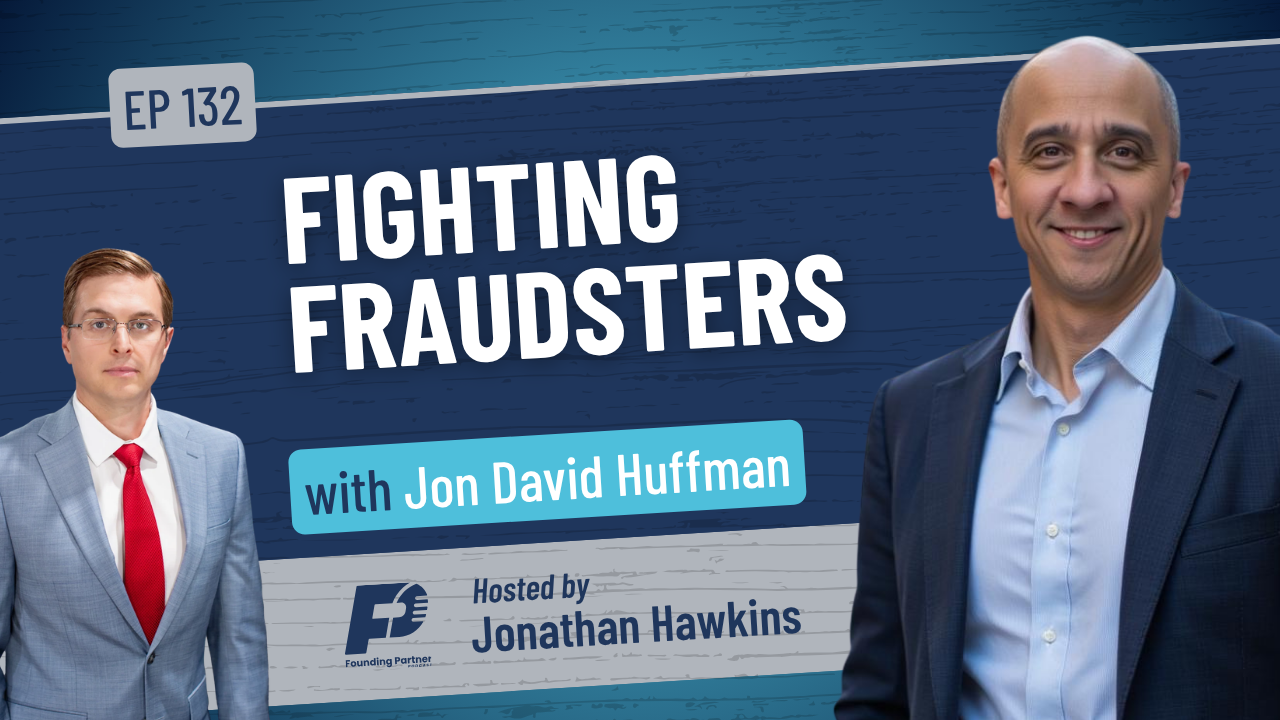
Fighting Fraudsters with Jon David Huffman
From Law Student to Law Firm Leader
Some lawyers dream about becoming attorneys from childhood.
Jon David Huffman was not one of them.
In fact, he never seriously considered law school until a neighbor and mentor took an interest in him and encouraged him to pursue the profession. That belief changed the trajectory of his life.
After joining his future law partner during law school, Jon David never left. What started as a part-time position eventually became a partnership that helped transform a small litigation practice into Poole Huffman, a firm approaching 40 employees and more than 20 attorneys.
Today, the firm focuses on business litigation, real estate litigation, intellectual property disputes, and most notably, fraud-based litigation.
The Case That Created a Fraud Lawyer
Every lawyer can point to a case that changed everything.
For Jon David, it was his first jury trial.
The case involved two clients who believed they were participating in a lucrative business transaction involving an overseas inheritance. Instead, they became victims of an elaborate fraud scheme.
While many attorneys might have viewed the case as just another dispute, Jon David found himself fascinated by something deeper.
The psychology of deception.
The challenge of proving dishonesty.
The opportunity to expose lies through cross-examination.
That first experience sparked a passion that continues to shape his practice today.
Over the years, he has built a reputation for handling complex fraud cases involving business disputes, real estate transactions, securities issues, and other situations where deception sits at the center of the conflict.
Why Fraud Cases Fascinate Juries
Business litigation is often viewed as complex and document-heavy.
But fraud cases are different.
According to Jon David, jurors naturally engage with stories involving deception because they are fundamentally human stories. Fraud cases require lawyers to uncover motives, expose dishonesty, and demonstrate patterns of behavior.
In one notable trial, his team secured a multimillion-dollar verdict involving allegations of fraud and racketeering. The case centered on a publicly traded company that allegedly used false statements and deceptive conduct to take over a client’s businesses.
The verdict was significant, but what stood out most was the central theme that emerged during closing arguments:
If dishonest behavior goes unchecked, it often continues.
That message resonated with the jury and became one of the defining moments of the trial.
The Growth Ceiling Every Founder Encounters
One of the most powerful moments in our conversation came when Jon David described a challenge many founders never see coming.
Success becomes the thing holding you back.
For years, his focus was simple:
- Be the best trial lawyer.
- Bring in the best cases.
- Build a successful team.
And it worked.
Eventually, he built a team of approximately ten lawyers around himself.
Then growth stalled.
The problem wasn’t marketing.
The problem wasn’t hiring.
The problem was leadership.
Jon David realized he had become the bottleneck.
Like many founders, he had built success through personal performance and individual excellence. But continuing to grow required a completely different skill set.
He needed to stop focusing on being the star player and start focusing on developing other people.
That shift changed everything.
From Personal Success to Significance
A turning point came after attending a leadership conference where he observed firms significantly larger than his own.
The experience led to a simple but profound realization:
Growth would require moving from personal achievement to creating success for others.
Rather than asking how he could become a better lawyer, marketer, or rainmaker, he started asking different questions:
- How can I add value?
- How can I mentor someone?
- How can I help another attorney succeed?
- How can I build leaders?
That mindset shift transformed the culture inside the firm.
Attorneys were given greater ownership.
Team members were trusted with larger responsibilities.
Leaders emerged throughout the organization.
As trust increased, so did growth.
The result was a firm that expanded more than 60% in a single year.
Building Systems That Scale
Growth also forced Poole Huffman to rethink its intake and marketing systems.
Historically, nearly all new business came through referrals and relationships.
Today, the firm is increasingly investing in digital marketing and online visibility.
That shift required creating entirely new systems.
Dedicated intake personnel now handle initial screening.
Qualified prospects move to an experienced attorney who evaluates cases before they enter the firm.
Only after that process are matters distributed among practice teams.
The goal is simple:
Create a client experience that remains personal while allowing the firm to scale.
As Jon David explained, founders cannot spend every day handling intake if they expect to continue growing.
At some point, systems must replace founder dependency.
The Leadership Lesson That Changed Everything
One principle surfaced repeatedly throughout our discussion.
The first person a leader must lead is themselves.
Jon David spoke candidly about his commitment to personal development, coaching, mentorship, and continuous improvement.
Rather than searching for quick fixes, he focuses on incremental growth.
Small improvements.
Daily progress.
Consistent development.
That philosophy extends beyond business.
It shapes how he leads his team.
How he approaches his family.
How he mentors younger attorneys.
And ultimately, how he defines success.
Fighting Fraud and Helping Victims Heal
Jon David’s upcoming book on fraud reflects a deeply personal mission.
Growing up, he watched his own family navigate litigation involving deception and business misconduct.
That experience shaped his passion for representing fraud victims today.
The book focuses not only on the legal side of fraud but also on the emotional impact.
Many victims experience shame, embarrassment, and self-doubt after being deceived.
Jon David hopes to help people understand an important truth:
Being defrauded does not mean you are unintelligent.
Fraud impacts highly educated, successful, and sophisticated individuals every day.
His goal is to provide encouragement, perspective, and practical guidance for people navigating one of the most difficult experiences of their lives.
Looking Ahead
As Poole Huffman continues to grow, Jon David’s vision extends far beyond Atlanta.
He hopes to expand throughout the Southeast, establish additional offices, and become a leading resource for complex fraud and deception-related litigation.
But despite the growth plans, the mission remains the same.
Add value.
Help people.
Develop leaders.
Fight fearlessly.
And never stop improving.
Closing Reflection
Many founders believe growth comes from better marketing, more cases, or bigger offices.
Those things matter.
But Jon David Huffman’s story reminds us that lasting growth often starts somewhere much closer to home.
It starts with leadership.
It starts with trust.
And most importantly, it starts with the willingness to become the kind of person capable of leading the next version of your business.
Because what got you here may not get you there.
But growth becomes possible when you’re willing to grow first.
Thank you for joining us for this episode of The Founding Partner Podcast. Stay tuned for more conversations that inspire growth, leadership, and meaningful impact.
AND MORE TOPICS COVERED IN THE FULL INTERVIEW!!! You can check that out and subscribe to YouTube.
If you want to know more about Jon David Huffman, you may reach out to him at:
- Website: https://www.poolehuffman.com
- LinkedIn: https://www.linkedin.com/in/jondavidhuffman
- Facebook: https://www.facebook.com/jon.huffman.7
- Instagram: https://www.instagram.com/jondavidhuffman
Connect with Jonathan Hawkins:
- Website: https://www.lawfirmgc.com/
- LinkedIn: https://www.linkedin.com/in/jonathan-hawkins-135147/
- Podcast: https://www.lawfirmgc.com/podcast
Jon David Huffman: [00:00:00] He sort of introduced this, like, new evidence. And my trial partner, he said it was like I hit a Super Mario star or something when he said it. ‘Cause I changed my whole closing and, and went with a theme, you know, basically, ” If you don’t stop them, they’ll do it again. If you don’t stop them, they’ll do it again.” And it was a lot of fun for me. I was very passionate, very mad about these people ’cause they continued to defraud people. I imagine that they’re still doing it today, to be honest, so.
Jonathan Hawkins: So you’ve sort found this fraud niche. How do you market that? I mean, is it through the good verdicts or are you out there saying, “Hey, if you have a fraud case, send it to me”? How do people know, hey, it’s a fraud case, John David our guy?
Welcome to the Founding Partner Podcast. Join your host, Jonathan Hawkins, as we explore the fascinating stories of successful law firm founders. We’ll uncover their beginnings, triumph over challenges, and practice growth. Whether you aspire to launch your own firm, have an entrepreneurial spirit, or are just curious about the legal business, [00:01:00] you’re in the right place.
Let’s dive in.
Jonathan Hawkins: Welcome to Founding Partner Podcast. I’m your host, Jonathan Hawkins. This is a podcast where I get to talk to founding and managing attorneys and law firm owners and hear about their journeys and how they’ve built their firm and all the cool stuff they’re doing. This week’s guest is a friend of mine, John David Huffman.
He is an attorney at Poole Huffman. That firm has undergone some tremendous growth over the last, I don’t know, decade or so, maybe longer. I know when I first met John David and his partner years ago it was a fledgling little firm, and now it’s a gigantic firm, so we’re gonna get into all of that.
So John David, thanks for coming on, man
Jon David Huffman: Yeah, absolutely. I’m excited to be here. It’s a real honor to be on your podcast, man. You got one of the best ones in, in the country, so I’m excited to be here. Thank you
Jonathan Hawkins: Oh man, you’re gonna make me blush here, you know. Thank you.
Jon David Huffman: It’s
Jonathan Hawkins: All right, so John [00:02:00] David, so let, let’s talk about, let’s talk about, I guess first let’s talk about your firm. So Poole Huffman how long has it been around? I know you guys are, I guess in Atlanta you might be considered midsize. I don’t know, but you’re, you’re becoming a pretty big firm.
So tell m- tell me about what your firm does and, and sort of the stats now, how many attorneys, how many employees, that kind of thing
Jon David Huffman: Yeah, absolutely. So my partner started the firm about 17 years ago. I joined him actually when I was in law school. He’d, he’d been, been around for six months or a year. So right as my 1L year opened up, you know, I don’t know if they still do it, but back then they wouldn’t let you work till second semester.
And I went out and got a little part-time job with him, and have been working with him ever since. We partnered up 11 years ago, a little over y- 11 years ago, and made it Poole Huffman then. So yeah.
Jonathan Hawkins: Well, you’ve been there since the beginning, so, you know, I would say you’re, you’re, you’re, you’re a founder. You’re a
founder
Jon David Huffman: Well, I, I gotta be to be on the podcast, but, but technically he’s the founder. But yeah, we’re [00:03:00] approaching, approaching 40 people, a little over 20 attorneys at the moment. Excited about our growth. We do business litigation, real estate litigation, a lot of fraud-based litigation. I like to tell people that I, I represent people that have been defrauded and conned and deceived in those contexts.
So real estate, business, intellectual property sort of context is where, where we take place.
Jonathan Hawkins: Yeah. So y- you do a lot of fraud cases. So, if you had to pick a niche, would you say sort of, uh, disputes involving fraud is, is sort of your niche? Is that what you’d call it?
Jon David Huffman: that’s, that’s my niche. Absolutely
Jonathan Hawkins: And so how did you get into that? How do you, how do you get into sort of the fraud lane? I mean, I, I know in business litigation it seems like there’s always an allegation of that, but, you know, you’re, you’re saying, “This is what I do,” and I know you try a lot of cases, and we’ll talk about a couple of the cases that that involve some of these allegations of fraud.
But how did you get into that?
Jon David Huffman: Well, a little bit serendipitous. The first jury trial I ever did involved, Well, [00:04:00] I like to tell the story like this. Imagine two guys with a briefcase full of $80,000 on their way to New York, and the expectation is they’re gonna get it to New York and exchange it for $3 million. And that was the start of my first trial and, and really my first fraud case.
I had two clients, and they were defrauded by two friends of theirs in what was really a souped-up sort of Nigerian email scheme. I don’t know if those are real popular anymore, but it was some sort of overseas inheritance, and they needed the $80,000 for transfer fees, and tax stamps, and other sort of nonsense.
But they were both very sophisticated, and we wound up in front of Judge Randy Rich over in Gwinnett County. It was my first jury trial ever, so that was my first taste of it, and I loved it. I loved every minute of it. The idea of getting somebody on the stand and cross-examining them for being dishonest, sort of g- walking through that process and, and we actually got an apology out of the guy on the stand in that case.
It was, it was sort of my first [00:05:00] taste of that and kind of been doing it ever since.
Jonathan Hawkins: I was gonna ask what kind of business deal where you travel across the country with 80,000 in cash and all of a sudden you come back with 3 million? Sign me up, man. That sounds like an awesome deal
Jon David Huffman: That’s, that’s what I thought too. Yeah. And you know, and that, and that’s the thing about fraud. People get pulled into these sort of circumstances that, you step back from them for a moment and go like, “This is ridiculous.” I mean, it just doesn’t make sense. But the, the human element of it is what traps people.
You know, the, the cons were one of my client’s neighbor for nine years, his literal next door neighbor. They used to tell me they, you know, they’d flick each other off during the case. It was, it was kind of comical. And then the other client had a nine-year relationship with like a frater- in a fraternity, like an adult, like fraternity with this guy.
So they knew each other well and and that’s, that is, that is what happens in these cases, so.
Jonathan Hawkins: So, so let me ask this about, you know, The types of jury trials you do versus, let’s say, some of the personal injury. I’ve talked to a lot of [00:06:00] personal injury trial lawyers over the years and, and one of their for many of them, one of their you know, guiding principles is, let’s get the trial over as quickly as possible.
We don’t wanna waste the jury’s time. Get in and out, you know, day and a half, boom, we’re done. Maybe med mal go one or two weeks. These business cases, I mean, they’re, they’re complex. Oftentimes there’s lots of documents and emails you know, probably multi-day, sometimes multi-week trials. I guess the first question is: How do you keep the jury interested i- in these kind of cases?
Jon David Huffman: Yeah, that, that’s a great question and I’ve gotten that one before. You know, I don’t, I have not found it to be very difficult. There’s an element about a fraud case when you stand up in the opening and you say, “All right, I’m putting on this fraud case. This is what’s happening.” That’s sort of like a, like a Netflix trailer or something.
I mean, it’s … People sort of have an interest in true crime and, you know, these fraud stories that are on Netflix. And so all of a sudden you, you sort of describe it to them. Now, not to say we haven’t lost [00:07:00] some interest, I’m sure, along the way at some point in the trials, especially when you try to get into the documents.
You know, you have to walk through things, it gets a little monotonous. But I try to move through those fast. I try to train the lawyers to get through it fast. And for the most part, juries find it interesting because it’s about deceit. So you, you know, in the cross-examinations and even the direct examinations, you’re trying to draw out the deceit, the intent.
You know, maybe the … In order to win you, you really have to prove sort of a multiplicity of lies in the fraud case. You have to prove that they are a liar is really what you have to do to prevail. And, and the juries find it, find it pretty interesting. Not that they wanna be there, I mean, they, they’d rather be somewhere else, but once it gets going they settle into it.
That’s, that’s been my experience.
Jonathan Hawkins: So I saw the headline of an article in our local, I get the emails for our local legal, I guess, newspaper. I can’t remember the headline exactly, but it was basically jury decides to quadruple the verdict after seeing the defendant’s shoes or something like that. I can’t remember exactly.
[00:08:00] So that was your case, right?
Jon David Huffman: It was my case, yes.
Jonathan Hawkins: All right, so I gotta hear the story. It was behind a paywall, so I didn’t get to see what it was about the shoes. So tell me.
Jon David Huffman: Yeah, so I’ll give you a little background on the case. So we represented somebody who had a, relatively small judgment for the kinds of cases that we litigate. It was $66,000 against the company. And the owners of the company had just plundered the company, transferred everything out of it, played a bunch of shell games back and forth, what we would call, like, a fraudulent transfer, for the lawyers listening.
And so that was the trial. It was a fraudulent transfer. They took the $66,000 amount and it turned out to be 282,000 at the end. In talking to the jury, this is where the shoes comes in afterwards one of the jurors said she was very offended because the defendant got up really during the main case and cried poverty, but especially during the punitive damages phase and just said, “I don’t have any money.”
And we had some evidence. I mean, like, we had evidence, like, he’d gotten 200 grand in the last four months of, you know, this [00:09:00] year. And but she said, you know, he was wearing Louis Vuitton shoes. And she was just really offended that he would get up there and say, you know, ” I don’t have any money,” and yet at the same time be wearing expensive shoes.
To be honest, I don’t know how expensive they are. It’s not really my style, but I looked it up. Maybe 4 or 500 bucks to a few thousand, you know? So.
Jonathan Hawkins: Well, let that be a lesson. You know, any attorneys out there, if your client is gonna you know, plead poverty, you can’t wear the Rolex, you can’t wear the Louis Vuitton shoes. You gotta wear just, yeah, rag tags to trial, right?
Jon David Huffman: Yeah, that’s right. It was very interesting ’cause she was the only one, as far as I can tell, that noticed it. I mean, we didn’t notice it. She said no one else on the jury noticed it, but she picked it up. So watch out for those shoes.
Jonathan Hawkins: Yeah, I would not have noticed it at all. I have, I have no clue about any of that. Yeah.
Jon David Huffman: If I had noticed it, I would’ve pointed at them and made some big deal about it, but I, you know…
Jonathan Hawkins: That’s cool. All right, so the, the other thing is let’s talk about another trial you had I saw on your website. So you did a nine-day jury [00:10:00] trial with a $9 million verdict. Was that a fraud case too, or was that just sort of a business dispute type case?
Jon David Huffman: Yeah, no, it w- it was a fraud case. Actually, it had a racketeering component. We got a racketeering verdict in that case.
Jonathan Hawkins: Oh, wow
Jon David Huffman: So yeah, that was a couple years ago. And in essence, my client had a, a couple sort of sister businesses, and they sort of audio in classrooms, sort of a technology solution for classrooms, public schools.
And a little publicly traded company in North Georgia, without getting into all the details, just stole his companies. And they did it through a series of online press releases that were false. I mean, they were publicly traded, so I mean, their SEC filings were false. So it had an element of securities fraud in it.
It had an element of just ordinary, regular fraud, wire fraud, mail fraud. And ultimately, we convinced a jury that they had committed crimes to get the, the racketeering portion of it, so part of it was, was tripled, trebled under the, the racketeering verdict. So, it’s actually the, my second case against the same defendants.[00:11:00]
I had sued the same people before, and that, that case that I was involved in came in as evidence in this trial as sort of a, a pattern of behavior. And it… What was, what was sort of interesting just to get… There was a lot of interesting things about this case, but I’ll give you a little tidbit. So we were getting ready to do the closing arguments, and it had not come into evidence, though we had talked about the first case, it had not come into evidence at all that I was the lawyer on the first case.
So it was just in the evidence, like there’s this other case out there, and it, there’s interacting with the facts of the case. And the closing, we were actually the defendant in this case, believe it or not. So.
Jonathan Hawkins: Wow.
Jon David Huffman: We went on a counterclaim. So they got to go first, you know, in their closing, and he got up there and argued that I was the lawyer on the first case, and da, da, da, da, da.
And so he sort of introduced this, like, new evidence. And my trial partner, he said it was like I hit a Super Mario star or something when he said it. ‘Cause I changed my whole closing and, and went with a theme, [00:12:00] you know, basically, ” If you don’t stop them, they’ll do it again. If you don’t stop them, they’ll do it again.” And it was a lot of fun for me. I was very passionate, very mad about these people ’cause they continued to defraud people. I imagine that they’re still doing it today, to be honest, so.
Jonathan Hawkins: Okay. So you’ve sort found this fraud niche. How do you market that? I mean, is it through the good verdicts or are you out there saying, “Hey, if you have a fraud case, send it to me”? How do people know, hey, it’s a fraud case, John David our guy?
Jon David Huffman: So I have been marketing traditionally through relationships my entire career. So up until about a year ago, 90% of our business came in just through relationships. Other lawyers in different practice areas would refer cases. I don’t know that I was always specifically marketing as, like, the fraud lawyer, but I would market in real estate disputes and business disputes and other sort of complicated litigation.
The last year or so, we transitioned, which some of your viewers might be interested in, ’cause it’s a little unusual in a commercial or real estate-based [00:13:00] litigation practice to do digital marketing. We started doing that. It’s working to a certain degree. We’ve started getting more and more clients through that and through reputation.
So there’s kind of a spectrum. You know, you’ve, you’ve got really warm referrals from a, from a person you know, often another lawyer. You’ve got really cold people that are finding you on Google, and then there’s sort of like a, a middle ground where people are finding you best upon re- you know, reputation or press, you know, or…
And then sometimes I think some of these AIs are picking up some of this stuff, so people are searching. I’ve heard, I’ve heard reports like, you know, “Give me the top lawyers in this niche.” Sometimes my name will come up. I think some of that’s geographically based, so it may or may not be true, but but that’s sort of what I’m seeing out there.
Jonathan Hawkins: All right. Let’s, y- you mentioned the digital marketing. Dive into that for a little bit. So, as you said, m- my experience and most lawyers I know, at least my generation, for what we do, I would say what, you [00:14:00] know, business litigation is, I’ll call it B2B for the most part. I mean, there c- there’s some nuance there, but h- historically, traditionally, it’s, it’s a referral relationship based type of practice in terms of business development.
I guess first of all, what led you to experiment with some of the digital advertising or whatever it is you’re doing?
Jon David Huffman: Well, we started getting more and more phone calls just naturally. I mean, we weren’t doing a whole lot of it. We were spending maybe a few thousand dollars a year on, which is nothing, on, on digital sort of marketing. Just, you know, we were in, I think, Justia at the time. You know, we had some super lawyers profiles, and that was about it.
We, we did a little organic SEO, but we were spending, you know, 500 bucks a month, and the calls just, just kept increasing. Occasionally, we’d pick out some good cases out of it. We were totally unprepared for the, to sort of do the intake early on. We probably lost a lot of good cases. But I just woke up one day and said, “You know what?
I [00:15:00] don’t know. I think there’s something here.” Because it was happening just 100% organically without us attempting. And I’m of the belief that, you know, as, as we get older and older, the people that are younger than us, I mean, they’re meeting, they’re meeting their wives online, you know? So why can’t they pick out a lawyer online?
I, you know, sort of an extreme example, but when I was growing up, nobody dated online. I didn’t meet my wife there. It was almost like a little bit of a stigma associated with it now, and back then, and now everybody’s doing it. And so I think, you know, that that’s gonna be the way a lot of people find their lawyers in the future, and that’s what we’re seeing more and more of
Jonathan Hawkins: That’s interesting. I’m not sure. I haven’t really talked to a lot of commercial, I’ll call it business litigation firms to know whether they’re doing it or not. I’m sure there are folks out there doing it. Have you found that the quality of cases is any different generally, or do you have to wade through a lot of stuff to get, to get the good ones?[00:16:00]
Jon David Huffman: You do. You have to wade through a lot of, a lot of stuff to get the good ones. You’ve gotta be picky, and you do wind up and get some clients that maybe have unrealistic expectations. So the training’s a little different for sure. But there are a lot of good cases that we’re getting through that process, so I,
Jonathan Hawkins: Okay. You
Jon David Huffman: the future
Jonathan Hawkins: you mentioned intake which I know the B2C folks know this very well. You turn on the digital ads or whatever it is you’re doing and, and you’re gonna get just influx of calls and, and inquiries, and if you’re not set up, it can overwhelm you. So it sounds like early on you guys weren’t set up for it.
How did you handle it in the beginning, and h- maybe how has that changed?
Jon David Huffman: Yeah, I mean, when we weren’t trying to get cases that way, we just had like a receptionist, sort of office manager answering the phone, and we j- and the phone calls just got to be more and more voluminous. So eventually we hired some intake people. We have two and sort of a, a third person in training right now that, that do [00:17:00] intake, that first level.
And we just try… I mean, this is not, I’m not an expert in it, but it, it doesn’t, it seems to be much more personality based, you know, than, and you can sort of train the skills. You need somebody warm, friendly. You need to be able to give them sort of a, a script, some guidelines. Our, our cases are probably a little bit more complicated than a, than a traditional PI firm as far as screening them because we do have a lot of different areas, practice areas.
And then one thing that we’ve done recently, and this is a little bit of a secret sauce, is that we hired a lawyer to do the next level instead of trying to pass it around internally within the firm. So we have an experienced lawyer who still litigates, but a good part of her day-to-day is taking the next level after the intake is qualified the the leads, so to speak.
And so they get, you know, the clients get to speak with a real lawyer who has real experience and can really quantify whether the case makes sense or not
Jonathan Hawkins: Okay. So it [00:18:00] sounds like initial screening, I’ll call it, is one or two or three non-lawyers. Then if it makes it through that, it goes to this dedicated lawyer. If it makes it through her analysis, how, how do you distribute it out
amongst your 20 lawyers?
Jon David Huffman: She signs them up and then we distribute it within the, the different teams. We have different teams of lawyers with supervisors, and based upon some internal metrics you know, sort of capacity, what’s going on with them. I mean, certain cases are bigger. Certain lawyers have skills in certain areas.
You know, we’ve got a, a little bit of like a bankruptcy practice here that goes one direction. We’ve got lawyers that we tend to give more of our federal court cases. We’ve got some lawyers that sort of focus in sort of complex real estate disputes. So there is a little bit of, of sort of picking and choosing the cases between the teams, but it’s sort of based on strengths and natural talent.
Yeah
Jonathan Hawkins: And I know just from talking to Todd in the past it was, it was I, I’ll call it a bottleneck or a problem or something [00:19:00] he wanted to get out of, and I think you were in it too, where you two are the ones doing the intake and screening the cases, and he felt like it just, it’s an overwhelming, he can’t do anything else.
He can’t dedicate time to his actual cases if he’s doing this all day. And so I assume this was a part of the natural evolution of we need to get somebody so we can get out and just keep the thing flowing. Is that right?
Jon David Huffman: That’s correct. The first people we hired were the, the first level intake people. Then they would qualify it, and Todd and I were sort of alternating, my partner, were alternating taking the, the sales call, so to speak. And it was overwhelming, and it was frustrating the intake people ’cause we couldn’t get to it fast enough and really give the, the level of, of service.
And so we were fortunate to find somebody who had experience and was interested in the position, and, and brought her in I think October now. So it’s been, been seven, seven months or seven, eight months. Yep
Jonathan Hawkins: It’s really interesting to me just from talking to owners like you, how you begin to design these systems, and it’s really some of it [00:20:00] is, you know, just sort of trial and error. But as you grow, you’re like, “All right, we’ll try this for a while,” and you’re like, “This is just… It’s not working. We gotta try something else.”
So you, you try this new step, and it sounds like this is starting to work. You’ve turned the dial on a little bit on the digital marketing, so you sorta have, you know, you got the flow coming in, you got the, the screening process down. Are you now to the place where you’re like, “Okay, if we want, we can, we can turn that knob a little bit, feed s- some more money into the vending machine, the digital vending machine, and maybe increase, you know, the number of leads coming in”?
Is, is it reached that point yet?
Jon David Huffman: Not quite, but we’re, we’re getting close. That’s, that’s exactly what I’m trying to figure out right now, is how to turn up the dial and sort of increase, increase the flow of cases. So still a large number of the cases are coming in, you know, to, mostly to Todd and I directly, and they, they sort of… There’s a little different sort of system for the way they work.
Most of those leads kind of bounce back to us if they’re of a [00:21:00] certain size to do the actual sales call. So that is still a little bit of a, of a bottleneck. But we’re, we’re getting close. But the sort of mystery of why the phone rings is not something that I’m an expert in. I mean, we, we actually hired a, like a fractional chief marketing officer, and I tasked her basically with that.
I wanna know why is the phone ringing, and how can I make it ring more? You know, that was… Be like, “Answer these two questions for me.” So we just hired her a couple months ago, and we’re trying to figure, figure that out. But I will tell you this, for firm owners or other people that are in sort of this situation, and it might be in marketing, it might be in another place, there’s a principle that I learned just a few months ago that I try to apply.
There’s a whole book on it. It’s called Who Not How, and it’s, you know, it’s a principle out there that a lot of people espouse. But stop asking how to do something, and instead ask who can do this thing has been a much more productive question for me to [00:22:00] ask. ‘Cause I, I just can’t learn it fast enough, and there’s no need for me to try to become a marketing expert
Jonathan Hawkins: And it’s not like you got other things you gotta do either, right?
Jon David Huffman: I gotta, I gotta try cases. I gotta, you know, keep, keep going, so
Jonathan Hawkins: So turning back to your firm, we’ve talked a little bit about some of the intake issues and some of the growth there. You’ve got, I think you said 40 people, 20 lawyers. Take me through the growth. I mean, is it the sort of thing that a lot of the growth has been sort of recent over the last year or two?
And if that’s the case, what do you attribute that to?
Jon David Huffman: Yeah, so we grew a little over 60% last year in 2025. And up until that point, we had just kinda grown, you know, a little bit at a time, add a lawyer here, add a person here. Last year we did have a significant growth spurt. I would attribute it to this. So, Todd, my partner, and I co-manage the firm.
We have a little bit of division of duties, but we have some overlap. But one of the fundamental things that happened, I believe, [00:23:00] was sort of a mind shift for me individually in this. I had built a team of about 10 lawyers that I was working with. I had all the business really I could handle, and I was really overwhelmed, and I had plateaued.
My focus had been up until that point, whatever, like 13 years of practicing law, you know, I wanna be the best trial lawyer, I wanna get the best cases and go out and be the best marketer, and then it was about building a team. I eventually evolved into building a team around me. But once I got to about 10, I just couldn’t go any further, and I kinda hit like a plateau.
It was frustrating. I went to a conference, Crisp, who’s a legal marketing vendor kind of coaching company. They put on a yearly conference. And I was really inspired ’cause I saw a lot of other firms a lot bigger, and I thought that they weren’t exponentially smarter than me. It was just a different way of looking at it.
And I came out with a lot of hope. But the shift was to get off of being [00:24:00] successful myself and look at trying to be, like, success to significance, if that makes sense. In other words, I’ve gotta change my focus from me being the best lawyer, me being building a team, me being, you know, a good marketer, to now, all right, what about others?
Okay, how can I, how can I invest in others? And I shifted and really tried to think instead of every day, how can I do this or be the best whatever, to now, okay, how can I add value? How can I mentor? How can I lead? How can I inspire? How can I encourage? How can I build up somebody and train them? And that focus led to what I think was a, a tremendous culture shift in the firm, which I, is really what I attribute our growth to, is a culture shift.
I could talk about this for a while, but I think that when you’re in a small firm, a- and even our size, a- and maybe, maybe forever, I don’t know, I mean maybe even leaders at Apple and Google and the, the largest companies, you know, in the world are still like this. [00:25:00] I think the culture is, is an expression of the leader’s personality m- mostly, and my personality was maybe not terrible.
I mean, I think there were certain good parts about it, but it was too inward-focused, and it limited our growth. I mean, if they didn’t, if my lawyers didn’t believe that I trusted them with cases, they wouldn’t take the ownership. But the moment I stepped back and I was like, “All right. Let’s do it,” you know, “You take the lead.
I’ll get out of the way. I’ll encourage you,” you know, “You can do this,” and I changed, then all of a sudden we had, we had great growth.
Jonathan Hawkins: That’s a great insight, and it’s something that I’ve thought about a lot lately, and it’s, you know, we’ve all heard about what, what got you here won’t get you there. I think you go a little bit further and you say “What got you here will keep you from getting there.” And so, you know, through sheer force of will, uh, and your just personal performance, you built a team up to 10.
And like you said, I mean, you c- I mean, they’ve studied how many people you can, you know, manage in a team, and that’s, [00:26:00] I think, bigger than what they say is ideal. I mean, you just can’t do it. You just c- can’t do it. You can’t, through sheer force of will, go any further. So, you’re right. I think if you want to keep growing, you’ve, you’ve gotta, something’s gotta change.
And not everybody can change, so, you know, good for you that you were able to reflect and say, “All right, I gotta do something different.”
Jon David Huffman: Yeah. Well, thank you. Thank you. Yeah, I mean, it’s… I try to come in every day and and I, and I’ve learned this from other… E- everything I’ve learned, I’ve learned from other people. None of it’s an original thought. But I, I try to come in every day and just ask, “How can I add value to my team?” You know, how, how can I add value?
I try to ask this personally, too. You know, my wife, my kids. You know, it’s a good question. I ask my… I’ve been telling my kids this for the last few weeks, you know, “Who, who are you gonna add value to today?” You know, as they’re scattering out the door with their backpacks. And, and I try to ask them at, at night, you know, “Who’d you add value to?”
You get in that mindset and you, and you develop that sort of rhythm of thinking, and and it’s, it’s much more fulfilling
Jonathan Hawkins: Okay. So [00:27:00] along the same lines, so we’ve talked about, you know, let’s talk, you know, in the terms of growth, you’ve gotta get the cases in. So we’ve talked about that. We’ve talked about now you’ve got to step back and let the team go. Let’s hit the part where how do you build the team? Like, so, you know, how do you find, and I’ll- we’ll focus on attorneys right now, but how do you recruit and find the attorneys to join the team number one? And I guess related to that I’m curious if you’ve found that it has become easier or more difficult the bigger you get. And I ask that because I think if you’re really small, maybe people are nervous that you’re not stable, and if you, maybe if you get a critical mass, maybe it’s easier.
So talk me through how do you find and recruit attorneys
Jon David Huffman: So I have found that it is definitely easier as you get bigger. When we were smaller, people do have that question, and I, I wanna think maybe one or two even asked us, you know, about job security. Like, are you gonna be here? [00:28:00] Are there enough cases to go around? Do you have the work to do? As you get larger, I don’t think those questions are there as much.
And the truth is, is that it’s not as much risk. I mean, objectively it’s not as much risk. You had, you got three lawyers, you add one, I mean, that’s 33% more capacity. You got 20, you add one, it’s 5%. I mean, it just, it’s mathematically much different. So for us it, it feels different. I will say that we still struggle to find great talent, especially talent that has a little bit of experience.
We don’t necessarily need to hire lawyers with eight or 10 years, but even finding ’em with two or three years worth of experience is, is a challenge. Our best source of lawyers are our existing lawyers. That is our best source that we’ve found through the years. On average, we have generally gotten one solid referral per sort of teammate per, per attorney that comes in here.
Once they’ve been here a few mon- I [00:29:00] mean, they’re not gonna do it like, you know, two weeks in. But once they’ve been in here a few months, get the culture, make sure, you know, you, you are what you advertise and, and you’re a decent person, then, then we generally have found that we could get, get a referral out of them through their network
Real quick, if you haven’t gotten a copy yet, please check out my book, the Law Firm Lifecycle. It’s written for law firm owners and those who plan to be owners. In the book, I discuss various issues that come up as a law firm progresses through the stages of its growth from just before starting a firm to when it comes to an end.
The law firm lifecycle is available on Amazon. Now, back to the show.
Jonathan Hawkins: Okay. So another thing I wanna touch on some firms buy a building. A- and, you know, that, that’s been a… In, in a big- bigger city like Atlanta and, you know, New York or whatever, I guess that’s less common than the small town and whatever, but that has been an approach you guys have taken. But you haven’t just bought one you’ve bought two now at this point.
But let’s talk about y- the first building, [00:30:00] what was the thought process? But then obviously as you grow, if you rent, you can blow down a wall, get another floor or whatever, but if you own the building and you outgrow the building, you know, what do you do? And I guess in your case, you said, “All right, we’ll buy a new building.”
But tell me, tell me about thought process behind it and how the growth has impacted your decisions in that regard.
Jon David Huffman: Yeah, absolutely. I, I think buying our buildings has been one of the best things that we’ve done for our firm growth. But I think it can be replicated without buying a building. In other words, it wasn’t necessarily the fact that we owned the building that gave us sort of credibility, but it was the fact that we had new space, and it was nice, and lawyers like new space, and it sort of gave us a, an air of, of success, I think.
So the first building we bought, I guess it’s been about eight years ago, we were in, in the, in Decatur renting a, a space. We had cobbled together like three different spaces. I mean, sometimes you can’t knock down the wall. You gotta go down the hall or go upstairs and, and that’s kinda where we were. And we started looking around and, and the truth is, Jonathan, [00:31:00] we just, we found a steal of a deal.
It was in foreclosure. We bought this building out of foreclosure. It was 2000, I think, ’18, ’17. You know, the market wasn’t great back then. And so we were able to just steal it. We spent some money renovating it, and it did. I mean, when we told perspec- And this is where it, it got us the most credibility was with potential hires.
The clients don’t really know. They can see it, so ownership or rental doesn’t really matter. But when the prospects to come in and work for us found out that we owned the building, there was some stability, I think, that it brought, especially as we were smaller. And yeah, we just bought, we bought a new building.
My partner and I bought a new building about a year ago, and we’ve moved into it. So we kinda took the next step in that. And that was also sort of just an opportunity. I mean, it was down the road. You know, we paid $65 a square foot for it. I mean, anybody who’s renting space know you can pay, you know, $30 to $40 a year for rent in some s- in some spaces.
So it was, it was a good deal. [00:32:00] But I guess that comes from our sort of real estate background, real estate litigation. We kinda know, know how to find deals from time to time, I guess
Jonathan Hawkins: Well, I wanna dig more into the building, Mc- just to give the audience a little bit of perspective. ‘Cause I do know you guys, you know, you, you capped out in your old space. I mean, you, you just couldn’t grow anymore. I mean, you filled every little nook and cranny and you’re like, “We need a bigger place.”
And boy, did you guys go big, man. So how, how many square feet? The, the building’s awesome, by the way. It’s just incredible. I wanna talk about a few features of it, but how many square feet are we talking about at this building?
Jon David Huffman: The building’s 60,000 square feet, three floors. Yeah.
Jonathan Hawkins: Yeah, so you got plenty of room. You
can grow.
Jon David Huffman: plenty of room. We don’t even have a whole floor yet, so
Jonathan Hawkins: Yeah. Yeah. See, you solved that problem.
But yeah, y- so, y- you know, you had your, your open house mul- probably multiple open houses, but, you know, a couple things that just stand out. You walk in and I’ll let you talk about it, but you walk in into the lobby, which is very large and open, and you’ve got this gigantic dinosaur skeleton. I don’t know, [00:33:00] you can tell me what, what the actual dinosaur is, but it’s definitely a conversation starter right there in the middle of the, of the, of the lobby.
So tell me about the, the origin of that
Jon David Huffman: Yeah, I’d love to. So it’s, it’s an Allosaurus replica. A lot of people ask us if it’s real, and the answer’s no. It’s a, it’s a cast. But I mean, even if you walk into a lot of museums, almost all of the dinosaurs you see, you know, put up together are all casts ’cause the, the bones are too heavy. But this, the background is I took my four kids out to a local mall on a rainy weekend, tried to get them, you know, give my wife a break, and there was a gem store, gem rocks, crystals sort of store.
It’s a little bit unique, but they had one up at the Mall of Georgia here. And the, that dinosaur was in it, and it was for sale. And this was years ago, and I thought, “Wouldn’t it be cool one day to put a dinosaur in a lobby?” That was, that was as far as my thoughts got. And sure enough, a few years later, they had not sold it.
Evidently it’s not a hot ticket [00:34:00] item. And we were able to, to buy it and, and put it in our lobby. So I’ve got a picture of my youngest, you know, years ago, you know, just kind of standing in the head of the thing, you know. It’s, its jaws, you know. So that, that’s the origin, right.
Jonathan Hawkins: So, so that’s a cool feature of this building. A- another cool feature is the little secret speakeasy that you guys built into this thing, which I thought was just so cool, man. So why don’t you describe how you get to it, where it is, what it’s called?
Jon David Huffman: Yeah, sure. So this w- this was really my partner’s idea. He said if, if I got the dinosaur, he wanted the speakeasy. His cost a lot more, but it, it was a good deal. So, we… The, the speakeasy’s name it’s called Allegedly, is what we call it, and there’s a secret door. It’s off, off the main lobby, but you wouldn’t notice it when you come in.
But if you pull a book the right way, then it pops open. You can go in, and it’s a full bar. There’s some some AI generated images of the partners you know, in jail and, and some other fun [00:35:00] artwork, and it’s just a fun spot. We designed the lobby really to function as a, as an event space, not just a, not just a place where you walk in.
So we’ve had, you know, judicial fundraisers and other parties and fundraisers there. So, yeah
Jonathan Hawkins: That’s really cool. I mean, if you’re gonna buy a building and you’re gonna build it out, why not build it out the way you want it to be, make it interesting? I mean, obviously I’m, I, I’ve told, I have pictures from the speakeasy and the dinosaur I’ve been showing everybody. I mean, it, it works, man. People talk about it.
So,
Jon David Huffman: Yeah. Well, thank you. Yeah, that was kind of the idea was it’s a little bit outlandish, but maybe we get a little chatter about it, so
Jonathan Hawkins: And so I’ve, I’ve told everybody, you know, if we’re, if we’re, if we need to do depositions, we’re doing it at your office, so
Jon David Huffman: come on. We’re happy to do it.
Jonathan Hawkins: And so, to put a, you know, put a wrapper on this building thing. So now that y- you know, you said it, it gave you credibility before when you were smaller. What about now when you’re recruiting people and you’re like, “Hey, come see, you know, come to our space.” D- do you find it’s helpful or does it really matter?[00:36:00]
Jon David Huffman: Yeah, I think it matters. I mean, I don’t really poll applicants, but I, I still think it gives us a lot of credibility with the applicants to say, “All right, you got your own building.” You know, we, we’ve had a little criticism, maybe it’s a little outlandish from some people, you know, with the, with the dinosaur.
But we’re trying to convey a culture, you know, of, of fierceness, you know? You know, like our, our website, you know, we fight fearlessly. But that, that’s sort of the, you know, we’re a litigation boutique. We’re fighting cases, we’re litigating, we’re going to trial. I mean, this is the culture. It’s a warrior type culture.
And and I think it, I think it helps. I don’t think it hurts us, for sure.
Jonathan Hawkins: That’s cool. So circling back on your journey, so, did you always know you wanted to be a trial lawyer?
Jon David Huffman: I did not. I didn’t even know I wanted to be a lawyer at all. My… One of my favorite stories that I like to tell was my, my parents had a, a neighbor and he was a lawyer. And for whatever reason, when I was sort of in my mid-20s, he, he just sort of took an interest in me and [00:37:00] sort of mentored me. We’d play some games after hours, you know, after work or whatever, and he brought me over to his law firm, showed me around.
And, and he was really the encouragement, his name was Marshall Jaffe, for me to be a lawyer at all. And he just believed in me, told me I could do it. I never really considered even going to law school. Nobody in my family had ever gone to law school. Nobody in my direct family had ever been to grad school.
And he just believed in me and said, “Look man, you can do it if you wanna do it. You’re smart. Go for it.” And i- isn’t it interesting though? I bet you can look back in your life at a moment or two and say, “You know, so and so believed in me and, and it sort of altered the course of my life.” And you I like to tell the story in part because Marshall Jaffe died while I was in law school at kind of in his mid 50’s, a very young age to honor his memory because it was a, a very big turning point in my life.
But I didn’t know what I wanted to do when I went to law school, what kind of law, and and I fell into, you know, trial work which everybody, you know, when [00:38:00] I was five would’ve known but me, you know? So
Jonathan Hawkins: You know, it’s interesting you tell the story about Jaffe and these people in our lives that come in however briefly and make this impact that can really change the trajectory of our lives. And, you know, on the other side of that I’ve… Well, I’ve experienced people doing that for me, but then I’ve had people tell me, “Oh, I remember however many years ago we had this conversation and you said X, Y, and Z.”
I have no memory of it at all. And we all have those little impacts on people, and we don’t even know it which is really, you know, interesting about life. Getting deep here. But,
Jon David Huffman: Yeah, yeah.
No, I mean, I, I think, I, I mean, that’s one, one thing that I try to keep in, in the back of my mind. You can’t, you can’t really manufacture it. But I think you might be able to increase it by being intentional, you know, trying to look at somebody and, and maybe observing potential that they don’t see yet, and believe in them in [00:39:00] a way that they don’t really believe in themselves yet.
I, I think that’s a big part of being a leader and leading a firm, leading a group of people. And it’s not just professional, but personal too. I mean, there, you know, there’s a lot going on. And I remember reading something a while back where an author was saying that he imagined two scenarios.
One where his employee was, was not treated well and wasn’t recognized and wasn’t believed in, and, and how she went home and how she would’ve interacted with her family, you know, maybe not positively. And on the second hand, he imagined the same employee built up and lifted and encouraged and believed in, and how that person would go home.
And he made this comment along the lines of, you know, I think that leadership or management is one of the highest callings in life because you get to impact people in a way that few other people can. So I know that’s philosophical, but I believe it, you know?
Jonathan Hawkins: Let’s, let’s dig into that a little bit. You, you just now you’re talking about, and I’ll call it [00:40:00] mindset. You talked earlier about how you capped out at 10 and you had to change your mindset to, to continue growing. What other types of mindset shifts have you had to make or that you just made somehow as you personally and as your firm have grown?
Jon David Huffman: So one of the things I’ve learned is that the first person you have to lead is yourself. So now I’m a litigator, so the way I’ve sort of viewed this is, is like a warrior. And I think of it like y- you gotta go to war on yourself. So every day I get up and I, I have a, a routine that I go through. I have coaches that are giving me input.
I try to get feedback from my team on a, on a regular basis, and I’m looking for things, and it’s painful, right? I mean, it’s, it’s difficult. How can I get better? And I try not to overwhelm myself, but if you just, if you just get 1% better every day, I mean, it’s like 28 times by the time y- in one year. I mean, that’s the math.
I mean, just 1% compounded over 365 days is like 28 [00:41:00] times better. So I just try to incrementally get better. And one of the principles that I try to live by is to remember that we overestimate what we can do in a day, and we vastly underestimate what we can do in a year. And part of the thing that came out of this sort of life-changing moment, it really was for me about a year and a half ago at this conference, was the desire to grow and, and that incremental intentionality.
And it’s … And I try to apply it to everywhere. I mean, I gotta get– I gotta be more patient, you know, at home. I gotta be more intentional with my children. You know, I gotta stop drifting in my personal relationships and, … But it applies to everything. You know, it’s, it’s, it’s holistic, I think, the mindset.
Jonathan Hawkins: coaches. What types of coaches have you had over the years? I, I’m a big believer in coaches. I love them. I’m just curious what, what’s worked for you and what have you
wh- where
Jon David Huffman: do co- do you do coaching yourself? Do you coach [00:42:00] people?
Jonathan Hawkins: N-not formally. I mean, if somebody asks me questions, I’ll give them advice. Not that it’s worth much, but I don’t do any formal coaching
Jon David Huffman: I think you, I think you’d be great at it. But I’ve had a long time coach that sort of specializes in the lawyer sort of arena, so he has a lot of attorneys and managing partners as clients. I’ve probably been with him for seven or eight years. He sort of claims to be sort of a marketing coach, but we’ve spent almost the entirety of our time spent on leadership issues and employment issues and, and other types of coaching.
currently I have probably four coaches. So I have a guy who, who’s coaching me on speaking, ’cause I’m doing some speaking. I have somebody who’s specializing in sort of, management and leadership issues. I have this longtime coach that I meet with every quarter, and I just got done doing a, a coach, like a speed reading coach actually.
So I find if I wanna, if I really wanna accelerate my growth in an area, I’ll find somebody who’s good at it and, and, and, you know, do 6, 8, 10 sort of [00:43:00] coaches, coaching sessions with them and run with it. So it’s probably somebody I’m leaving out. It’s a little ridiculous, I realize. I’m kind of extreme probably in this area.
Jonathan Hawkins: Well, it’s funny that in some of the circles that, you know, we run in, it feels like everybody has coaches, and then you step back and most people don’t. It’s sort of funny. Probably people listening to this, this podcast are in the smaller group where, you know, they care about self-development and learning and all these things.
All right, so when you’re looking for a coach, what’s your approach? I mean, how do you, how do you find one?
Jon David Huffman: Well, I figure out what I want them to coach me in. I mean, that’s, that’s the number one thing. I mean, somebody who’s good at one thing is not gonna be good at another. I mean, you, you might find somebody who’s a, who’s a real all-star that can coach you sort of broadly. But I want somebody who’s kind of been there and done it, who’s, who’s got some coaching experience in that specific area.
I mean, like my speed reading coach, he doesn’t know anything about legal marketing, but he knows, you know, how to speed read, so I wanted to learn how to do that. So I look for somebody with expertise. I approach them. I gotta be able to respect them as an individual, so they have to have some similar [00:44:00] values.
But most of the people in the coaching world are really … They’ve kinda made it, they’ve kinda had success, and now they’re trying to give back. So I find a lot of, a lot of them to be just great and giving people. So, it … You’re kind of, in a way, buying a mentorship relationship is really what, what I look at it as.
And I try to give back to them when I can, but it’s certainly them giving more to me. I mean, I’m paying them but, you know, that’s, that’s the way- Yeah … the advice is going. But they … A lot, especially if somebody’s, you know, in their 60s or 70s and they’re doing this, I mean, they’re, they’re finding real significance trying to pass on their, their wisdom and, and their legacy.
And I tend to think, I’ve had some, I won’t get into, I’ve had personal events lately that have had me thinking about legacy, and I think legacy is a little bit more about lessons than it is anything else. That’s what we really remember, and that’s what coaches are trying to do
Jonathan Hawkins: And I’ll tell you I mean, I love coaches. I, I love the idea of accelerating. You know, I might f- I might get there eventually, but [00:45:00] hopefully the coach will help accelerate, get me there quicker. You mentioned legacy there. A f- a while back, I had someone on Scott Zucker. He has a great TED Talk on the legacy letters or ethical wills.
Hopefully you’re looking at that if you’re not doing it. Hopefully that’s something you’re, you’ll do for your kids. You mentioned you had, I think you said four kids. Such a gift whether it’s video or written word, whatever,
Jon David Huffman: Well, it’s, it’s interesting you would say that because I, I just spent some time I, I spent a few weeks thinking about what my dad’s legacy was to me. Okay? So my kids are still pretty young, and I, that’s a great, great idea to do one day of course. But I spent some time, and I wrote him a letter actually going through the quotes that I could remember.
Like, you know, “You might be right, but be wrong at the same time.” You know, that’s a lesson on attitude. You know, all these different things he taught me through the years. I came up with like 12 or, or 14, and I wrote him a letter, and he said it was the most meaningful thing he had ever gotten. So
Jonathan Hawkins: That’s cool, man. That’s a [00:46:00] good idea. That’s
a good idea.
I’m
Jon David Huffman: And, he’s not in great health. You know, I … He could live another 10 years, but he’s, he may not. So I wanted to get it to him and, and tell him how much I loved him and what he meant and, and how I’m passing him down. So
Jonathan Hawkins: That, that’s a great idea. That’s a great idea. So you mentioned shifting a little bit, you mentioned you, you got a speaking coach, but you’re also, I think you’re writing a book. Is that, is that right?
Jon David Huffman: I am. I’m writing a book about fraud. I don’t have a title yet, but it’s, it’s gonna be towards victims of fraud and the journey that they go through. It’ll have a little sort of pseudo-psychology to it and will have some encouragement. The opening chapters, which we’re just about done with, are … The thrust is really trying to, to encourage them in the midst of it, ’cause the, the number-one feeling everybody has when they get defrauded is a sense of embarrassment and questioning their intelligence.
I mean, they really think like, “I’m an idiot,” when it happens. I mean, if you get honeypotted, you know, or you give a bunch of money to somebody … I mean, I had [00:47:00] a, one of my best friend’s wives got in that jury scam, you know, where they call you and say you missed jury duty, and she put 15 grand in a Bitcoin machine and sent it somewhere. people are … There’s a, there’s a misconception about fraud victims that they’re gullible or, or that they’re not as intelligent or not as educated, and, and the s- the statistics are that that’s not true. Educated people, wealthy people, smart people fall for it. You know, when you look at Madoff’s scam, I mean, he, everybody invested with him was wealthy.
And everybody leaves thinking that they’re idiots. And so that’s gonna be the thrust, is to say, “Look, you’re not. It could happen to anybody. I’ve been defrauded,” and a lot of people do. You know, they said over … There was a survey last year that, that they did. Over 50% of Americans had said they had been defrauded, 51%.
So that’s … I have a book coming out about that probably later this year, and I’m gonna be doing some speaking on that topic as well.
Jonathan Hawkins: And I assume this is not gonna be some legal [00:48:00] treatise type of a book. This is a really for, for the masses to read. Masses may be the wrong word, but for the regular kind of folk to read, not, not just some law nerd.
Jon David Huffman: No. No, it won’t have any, no legal citations, no real law. I mean, some, some it’ll have some litigation advice if, if victims wanna consider it about what makes sense, but it’ll be, it’ll be big picture and filled with stories, starting off with a briefcase full of cash going to New York.
Jonathan Hawkins: Well, you do have some good stories to tell. You can talk about the shoes too now, right?
Jon David Huffman: Yeah, if you want to. Yeah, I’ll talk about his shoes. So a couple weeks ago I finished up a trial. Yeah. Well, we talked about it, right?
Jonathan Hawkins: Yeah, we did. But I was– in your book, you can put that in there.
Jon David Huffman: Oh, yeah. Okay.
Jonathan Hawkins: All right, so you’re gonna, you’re gonna ha-have the book and then I guess go on a speaking tour. D- you, you expect it to be local or are you gonna– are you taking this thing national?
Jon David Huffman: Well, most of it’s gonna have to be local or, but just time-wise, but I, I do have some speaking lined up in September that’s in New Orleans. So I imagine it’ll, it’ll be a little bit [00:49:00] outside the state
Jonathan Hawkins: That’s cool. So, so maybe this is a good time. We’ve talked a little bit about you’re thinking about legacy, you’re thinking about becoming a better leader, letting other people step forward. As, as you sit here today and you’re looking forward the next, you know, 10, 15 years, how do you see your role in the firm and, and just in your career maybe changing or staying the same?
Where, where do you see yourself going?
Jon David Huffman: Well, I still want to litigate some cases. I may not litigate them all, and I may sort of raise the bar as to what cases I get involved in. But over the next 10 or 15 years, I’d like to see our firm grow throughout the Southeast, have multiple offices, and I really want us to have a, a real prominence in this area, deception, fraud, you know, this, this concentration.
My heart is in these cases, I believe largely because I watched my family go through litigation when I was a teenager and into my 20s. [00:50:00] My dad really fell victim to sort of a business fraud. It would’ve looked– and a lot of people would’ve just called it sort of business litigation, but at its core, there was deception and fraud.
That’s really what it was, and I find that to be a real through line in many of the cases. And I have a passion about it because he spent so much time trying to find a lawyer that could do it well, and he ran into lawyer after lawyer that for political reasons wouldn’t litigate aggressively or c- you know, capability wouldn’t litigate well.
And even as a young, you know, 20-year-old at the time, I could tell these people, they just weren’t doing it right. I didn’t know how to find somebody, but just watching them. And so I’ve got a real heart to try to take this out and to add value. It’s a, it’s a core principle of our firm that we try. We’re not perfect, but every case that I take, I want to add value to that person.
[00:51:00] And if I can do that for the, the large majority of our clients, we’ll never suffer for business, and that’s our goal. And I tell, you know, we, we have regular all-firm meetings, and that’s one of our core principles. Every client… And sometimes it’s taking a case, evaluating the case, and saying, “Hey, bud, you don’t have a case.”
Or sometimes it’s telling the defendant, “Look, you did the wrong thing. Let’s figure out how to make this right. Let’s resolve it.” I don’t want to take people’s money and litigate cases if they’re not gonna win, and so that’s, that’s the philosophy I’d like to take larger, ’cause I see a lot of the opposite.
Jonathan Hawkins: I, I did not know that story about you and, and your family. That’s, that’s interesting, and thanks for sharing. So we talked about sort of your goal for you. You mentioned the firm growing in the Southeast. What does that look like? What, what do you think that looks like, or what do you imagine that looking like?
I mean, is it, you know, you’re establishing Beachhead offices in other states, or maybe just around the state of Georgia? H- how, how would you like that to unfold?
Jon David Huffman: Yeah, absolutely. I, [00:52:00] I mean, over the next 10 or 15 years I’d love us to have seven, eight, 10 offices around the Southeast, maybe even getting outside of the Southeast at that point. We have a goal by 2030 to have 50 lawyers, and that’ll probably include at least another location, if not, if not two additional locations.
Maybe Florida would be first. We’d try to find a… We, we’re gonna try to find a comparable market to Atlanta and the Southeast. There’s only a, a select number of cities Miami being the most comparable but it, it requires sort of a Spanish-speaking firm if you go to Miami, which we might do, you know, but we’d have to add that capacity.
Or we might go somewhere like Tampa where that may not be as vital. So that’s one of the next steps
Jonathan Hawkins: I’m sure your kids would love you to open the Orlando office so you can get Disney World a bunch.
Jon David Huffman: That’s right. Anywhere near the beach they love, so
Jonathan Hawkins: Yeah. You know, it’s interesting as you explore that you know, particularly when you cross state lines, you know, it adds complexity just to the operation. So it’ll be interesting to see how you [00:53:00] guys, you know, how that happens. The other thing I’ve noticed too, and I’ve, I’ve been in a couple firms over the years, that the growth, I’m sure you’re seeing this now and you’re probably gonna really see it, it’s once you hit this almost a critical mass number of lawyers, all of a sudden the firm just starts really growing almost exponentially.
Where before you’d add one or two lawyers, now all of a sudden you’re adding three or four at, in a chunk, you know. And next thing you know, boom, you’re at 50. So I, I could see you guys getting there pretty quickly. I think you’re sort of at that number where it could accelerate extremely fast. So hopefully you’re ready
Jon David Huffman: Hopefully we are. It’s like I’m working on myself every day to be ready
Jonathan Hawkins: That’s cool. Well, all right, last question. We’ve been going at it for a while. for folks out there that want to start a firm or may be thinking about growing their firm, any advice you’d have for them?
Jon David Huffman: Yes. Start with yourself. That’s what I would … That would be my number one advice. Start with yourself. You need to be better. You need to be committed to getting better. You need to be growing every day and [00:54:00] being intentional about it. I mean, every morning you need to get up and think, “How I can, how can I be better?
How can I add value? How can I increase my skills in the areas that need to be increased?” And then if you’re gonna start a firm or you’re growing a firm and leading one, I mean, you need to learn to embrace the hard, ’cause it, it’s not, it’s not easy. You’re gonna have a lot of criticism, a lot of self-doubt.
Just learn to love it like you love working out and, you bench pressing that weight and how difficult it is on that last rep, and get up and scream, you know? And then probably lastly, I’d, I’d say to people you know, get a mentor. Get a mentor. Ask. I mean, I, I was at the Managing Partners Forum last and I met this guy with a much larger firm in New York, maybe 160, 70 lawyers, something like that, and I just shot him an email and said, “Hey, will you mentor me?”
You know? And, and and he said yeah. And so, you know, we’ve been talking off and on, you know, for, for a [00:55:00] year now, and I’ve learned a lot from him and a lot of wisdom. And I think there’s a lot of people out there that are willing to do it. So it’s find somebody. I mean, you know, don’t find the leader of King & Spalding if you’re just starting a firm, you know?
But find somebody that’s a little bit ahead of you and, and just ask ’em. Get a mentor. And hire a coach too probably. Both would help you, so.
Jonathan Hawkins: That is great advice. If you don’t ask no one is necessarily gonna help you. You gotta
ask.
Jon David Huffman: that is right
Jonathan Hawkins: And I will say this, if you ask and they give you, you know, they take interest and they give you advice and these sorts of things, you know, you better do what they say. I mean, if you ignore them and just do nothing they’re not gonna remain a mentor very long, right?
Jon David Huffman: That’s right. That’s right. Gotta do it. That’s for sure
Jonathan Hawkins: Yeah. Well, John David, that, that’s great advice. Thanks for coming on. For people out there that wanna get ahold of you, maybe they wanna help you open up one of your offices in Florida or somewhere else, what’s, what’s the best way to find you?
Jon David Huffman: Man, that’d be awesome. I’d love… If you, if you guys wanna join us here, you know, I’d love to find somebody in Florida. Yeah, you just go [00:56:00] right here to our website. We, wefightfearlessly.com. You can find my profile and email address and everything, so right there.
Jonathan Hawkins: Awesome. And we’ll be looking for your book. Hopefully it comes out by the fall-ish maybe. So, look for that. I think that sounds like a cool book. So anyway, thanks coming on, John David. This has been real fun
Jon David Huffman: My pleasure. Thank you so much
OutroUpdatedWebsite-1: Thanks for listening to this episode of the founding partner podcast. Be sure to subscribe on Apple podcasts, Spotify, or wherever you get your podcasts to stay up to date on the latest episodes. You can also connect with Jonathan on LinkedIn and check out the show notes. With links to resources mentioned throughout our discussion by visiting www.lawfirmgc.com. We’ll see you next time for more origin stories and insights from successful law firm [00:57:00] founders.