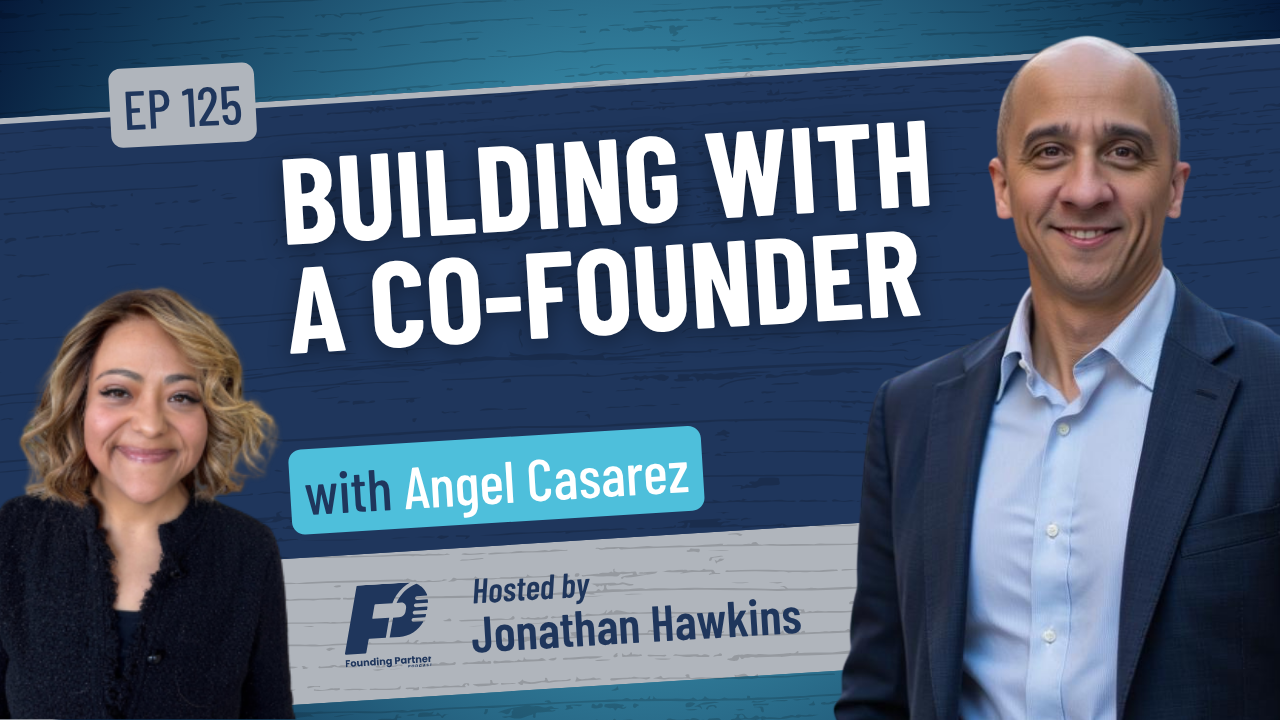
Building with a Co-Founder with Angel Casarez
From Seeing the Problem… to Becoming the Solution
Angel didn’t start her firm on a whim.
After years working inside law firms and later managing litigation for a major company, she had a rare vantage point. She saw how firms operated, what worked, and more importantly, what didn’t.
“I can do this better.”
That thought kept coming back. Not once, not casually, but consistently.
It wasn’t about ego. It was clarity.
She had seen inside 19 different firms. She understood hiring decisions, billing structures, and inefficiencies. And eventually, the idea stopped being optional.
It became inevitable.
Why Partnership Made the Difference
Starting a firm is hard. Starting one alone is even harder.
For Angel, the decision to build with her co-founder Erin wasn’t strategic on paper. It was personal.
“I am a social being. I love having people around.”
What started as friendship turned into something deeper, a true business partnership rooted in trust, communication, and shared vision.
They balance each other. They challenge each other. And when life tested them in unimaginable ways, that partnership became the foundation that held everything together.
Building a Firm During Chaos
Launching in August 2020 meant building in uncertainty.
No clear processes. No normal operations. No roadmap.
Instead of seeing that as a disadvantage, Angel leaned into it.
“We had to think of everything from square one.”
That forced clarity became a competitive edge.
While others were trying to adapt, they were designing from scratch, building systems, culture, and structure intentionally. Even something as simple as going fully remote became a strategic decision, not a reactive one.
And it worked.
The Growth That Forced Hard Decisions
The vision was bold from the beginning.
Fifty attorneys in five years.
But as the firm grew, reality set in. Growth wasn’t just about adding people or clients. It was about protecting the foundation.
At times, that meant saying no.
“We’re at capacity… to provide you the level of work you deserve.”
That’s not an easy sentence for any law firm owner to say.
But it changed everything.
Clients respected it. Relationships deepened. And the firm maintained the quality that fueled its reputation.
This is the difference between chasing growth and building something sustainable.
When Everything Changed: Health, Perspective, and Purpose
Just months after launching the firm, Angel’s health began to decline.
What initially looked like allergic reactions turned into something far more serious. After years of hospital visits, she was diagnosed with late-stage liver disease that progressed to cancer.
At the same time, her firm was growing at an extraordinary pace.
Over 40 emergency room visits. Leadership decisions. Hiring. Strategy.
All happening simultaneously.
Then came the turning point.
Her husband stepped forward as a living donor. After extensive testing, he was a match.
They underwent surgery together.
“He gave me 66 percent of his liver.”
Today, nearly six months later, both have regenerated healthy livers.
And Angel is stronger than she’s been in years.
Leadership Is Growth, Whether You Like It or Not
Building a firm forces something deeper than strategy.
It forces personal growth.
“You can’t hold onto your ego and build a firm at the same time.”
Angel is clear about what it takes:
- Emotional regulation
- Self-awareness
- Willingness to evolve
For her, that includes weekly therapy, constant learning, and intentional reflection.
Because the truth is simple.
If the leader stops growing, the firm does too.
Letting Go to Scale
In the early days, Angel did everything.
Forty-two roles. Every task. Every detail.
Today, those same responsibilities are spread across a team of 90+ people.
That transition didn’t come easily.
“I had to be pushed out.”
Letting go of control is one of the hardest parts of growth. But it’s also the most necessary.
Because scaling a firm requires stepping into a new identity.
Not as a lawyer.
But as a leader.
Redefining Success
For Angel, success isn’t measured by revenue or headcount.
It’s measured by impact.
“When my employees go home and tell their families they love their job… that’s success.”
It’s about creating an environment where people feel valued, supported, and proud of the work they do.
Because behind every employee is a family, a story, a life.
And building something that positively touches all of that?
That’s the real goal.
Closing Reflection
Angel’s story isn’t just about building a law firm.
It’s about building through adversity.
Through uncertainty. Through illness. Through growth that tests every limit.
And what stands out most isn’t just what she’s built.
It’s how she’s built it.
With intention. With resilience. And with a deep commitment to people.
Because in the end, growth isn’t just about getting bigger.
It’s about becoming stronger in the process.
AND MORE TOPICS COVERED IN THE FULL INTERVIEW!!! You can check that out and subscribe to YouTube.
If you want to know more about Angel Casarez, you may reach out to her at:
- Website: https://wclawcorp.com
- Facebook: https://www.facebook.com/wclawcorp/
- Instagram: https://www.instagram.com/wclawcorp/
- Business LinkedIn: https://www.linkedin.com/company/wc-law-corp/
- Personal LinkedIn: https://www.linkedin.com/in/angel-casarez-028a5315b
Connect with Jonathan Hawkins:
- Website: https://www.lawfirmgc.com/
- LinkedIn: https://www.linkedin.com/in/jonathan-hawkins-135147/
- Podcast: https://www.lawfirmgc.com/podcast
Jonathan Hawkins: [00:00:00] So that brings us pretty close to the starting of your firm. So tell me about that. You know, I’m always curious about the origin story. What pushes somebody to start a firm? So before this, you had worked for other firms. You were looking sort of for the thing ended up in-house. What was the push? Why’d you start your firm?
Angel Casarez: It was a lot of different things, but the last one that really pushed me was seeing the ability to see the inside of 19 firms. If you can imagine, well I guess you don’t have to imagine it. You get to do it all the time. I saw the way that they operated. I saw who they hired, who they kept, why they kept him, who they paid, how they billed.
And a lot of it was poor decisions. And I knew they were poor decisions. And I kept thinking to myself, I can do this better. I can do this better. Then, you know, this doesn’t make sense. You can just do it this way. Why aren’t they doing it this way? And so that kept coming up for me. And then I just knew I could do it better, you know, so that’s when I started, you know, [00:01:00] probably a year and a half before we launched is when I started talking to my co-founder, who is one of my best friends, Erin Wintersteen, you know, I had to convince her, you know, look at what’s going on around us. We can do it. We can do it better. She had a similar story as mine in that we came up in a couple different firms and we both hit that ceiling of, they’re no longer talking to us about advancement because managing partners as far as they’re willing to let you go.
Jonathan Hawkins: So let’s about that. So, you had a co-founder. The timing might not have been exactly day one, but you had a co-founder that you had been talking about for a year and a half. You know, some people get thrust. Next day, others do a lot of planning. It looks like you’re more on the planning side.
So why co-founder versus just alone? I’m curious the thought process there.
Angel Casarez: I am a social being. I love having people around.
Welcome to the Founding Partner Podcast. Join your host, Jonathan Hawkins, as we explore the fascinating stories of successful law firm founders. [00:02:00] We’ll uncover their beginnings, triumph over challenges, and practice growth. Whether you aspire to launch your own firm, have an entrepreneurial spirit, or are just curious about the legal business, you’re in the right place.
Let’s dive in.
Jonathan Hawkins: Welcome to Founding Partner podcast. I’m your host, Jonathan Hawkins. This podcast where I get to interview founders who are doing cool and big things, and today we’ve got a guest doing really big things. So I’m happy to welcome Angel Casarez. I think I got that right. Tell me if I got it right.
Angel Casarez: You got it.
Jonathan Hawkins: She is the co-founder and CEO of Wintersteen Casarez, which is a workers’ comp defense firm in Sacramento, California. And they’ve had exceptional growth over the last few years. We’re gonna dive all into that and I’m excited. She’s got some other cool stories and other things that she’s overcome along the way while she’s building this [00:03:00] really impressive firm. So, Angel, thanks for coming. Welcome to the show.
Angel Casarez: Thank you. Thank you so much for having me. I’m really excited to be here.
Jonathan Hawkins: So we’re, we’re gonna go through your story, but first, why don’t you lay the groundwork, just give us a snapshot of, of your firm now so you know, how many people where are you, do you have different locations, all that sort of stuff.
Angel Casarez: Sure. So we have 91 total employees. We have 37 attorneys. Our attorneys cover every venue in California, all the way up from Eureka, all the way down to San Diego. We have one brick and mortar office in Sacramento, California. That’s what we consider to be our headquarters. Our firm is almost entirely remote, so all of our employees and our attorneys, they all work from home.
We’ve found that to work best for our firm, so we’re going to keep it until it doesn’t work anymore if we ever get there. [00:04:00] We start, do you want me to go over the starting
Jonathan Hawkins: Well, well, well, before we get there, I, we are gonna go over that, but before that, let’s, let’s, okay, so that’s good. We got a snapshot. Let’s go back a little bit. So, I wanna hear about, you know, your early days. Straight Outta law school. So you’re doing workers’ comp now. Did you do that straight outta law school or, or how did you end up in the workers’ comp?
Angel Casarez: Sure. So Straight Outta Law School, in Law school. I was obsessed with property law. It was my first love, you know, I thought it was so fun. And so right out of law school I started working for my property law professor at the Eviction Defense Collaborative in San Francisco. And for those who know a little bit about San Francisco property law, it is very fast-paced.
You know, there’s a lot of landlords there that are interested in getting kind of tenants turned around. There’s a lot of financial motivation there. So, I was working with tenants that had been served their five day summons and including the weekend, they had [00:05:00] five days to provide a response. Most of the tenants in San Francisco do not have legal representation, so it was our job.
You know, sometimes they came in on a Thursday. Having had been served the day before and their response was due on Monday. So we had to turn around those responses fast and those responses were petitions to quash, deur answers, you know, we had to do a quick assessment and get something filed.
Sometimes I was running down to the courthouse and filing it at 4 59 just to prevent the sheriff from coming out to evict them. So it was exciting, it was great work, but it burned me out in two years flat. You know, I would have to cancel birthday parties and cancel anything with my family because I had a trial on Tuesday that I didn’t have on calendar on Friday.
So, as much as I loved it, I had to get out. So. As with a lot of my jobs, when I determine that it’s the end of the road for me, I [00:06:00] resign with or without a new job or a thought of where I’m going. I resigned. So I resigned and that weekend I went to a graduation for my law school and I got reintroduced to my evidence law professor who had a workers’ comp plaintiff’s firm.
So that’s how I started working at that firm. He kind of lured me in because he did a lot of sexual discrimination and sexual harassment, so I thought that was going to be my calling. And he did workers’ comp on the side, and so I fell in love with workers’ comp, so I kind of focused on that.
Jonathan Hawkins: So you started out on the plaintiff side.
Angel Casarez: I started out on the plaintiff’s
Jonathan Hawkins: Oh wow. And so eventually, I know you ended up going in-house, but before you did that, did you switch to workers’ comp defense or did you go from plaintiff? Okay.
Angel Casarez: So again, I knew it was the end of the road for me doing workers’ comp, plaintiff’s side. So I resigned and after I resigned, I had just done, did a trial [00:07:00] with a colleague of mine who was a managing partner at a defense firm. And so she offered, she called me and offered me a job. She didn’t know I had resigned an hour before she called me.
And I initially said no, because I thought I was out of the workers’ compensation business entirely. I didn’t think to switch sides, and I told her no. She convinced me to have lunch with her. She convinced me of how different it is to be on a plaintiff’s side versus a defense side. I liked everything I heard, so I went to go work for her.
So I was on the defense side as an associate attorney for two years at that firm. Then I went to my second firm and I was there for 10 years.
Jonathan Hawkins: So you were there, but then from there, I guess you went in-house.
Angel Casarez: Yeah. So from there, again, I wasn’t, I didn’t resign. I was just kind of feeling like there was something more. I had, I was an associate attorney. I became a senior attorney. I became a partner, a managing partner, and then that’s kind of where these artificial ceiling came in, right? There was no discussion about [00:08:00] making me a shareholder.
No discussion of the possibility of it. And so I needed more than that. So a client approached me and was asking me to come work in-house, and like a lot of attorneys. In private practice, we kind of go when you hear in-house, because it’s a different way of practicing that I wasn’t, you know, I didn’t want to do and it wasn’t for me.
But in reality, what she needed was someone to kind of babysit her attorneys. She needed someone, you know, that phrase that people say all the time, if you need an attorney, you need an attorney, and then someone to, you know, supervise your attorney. That’s what she needed. She needed me to supervise her attorneys.
And so when I started there, they were working with 19 different defense firms across the state of California, way too many firms for the type of program that they had. So I came in, I evaluated the firms, and I built them a program that only had five firms that [00:09:00] did all their work, and I managed those firms.
Jonathan Hawkins: So was that like an insurance company or something else that you worked for there?
Angel Casarez: It’s a private company. It’s the, the company’s called Foster Farms. You might be familiar with it. It’s a chicken company.
Jonathan Hawkins: Okay. So they had their own that’s interesting. Their own program in internally for that versus an insurance company. Okay. So that brings us pretty close to the starting of your firm. So tell me about that. You know, I’m always curious about the origin story. What pushes somebody to start a firm? So before this, you had worked for other firms. You were looking sort of for the thing ended up in-house. What was the push? Why’d you start your firm?
Angel Casarez: It was a lot of different things, but the last one that really pushed me was seeing the ability to see the inside of 19 firms. If you can imagine, well I guess you don’t have to imagine it. You get to do it all the time. I saw the way that they operated. I saw who they hired, who they kept, why they kept him, [00:10:00] who they paid, how they billed.
And a lot of it was poor decisions. And I knew they were poor decisions. And I kept thinking to myself, I can do this better. I can do this better. Then, you know, this doesn’t make sense. You can just do it this way. Why aren’t they doing it this way? And so that kept coming up for me. And then I just knew I could do it better, you know, so that’s when I started, you know, probably a year and a half before we launched is when I started talking to my co-founder, who is one of my best friends, Erin Wintersteen.
You know, I had to convince her, you know, look at what’s going on around us. We can do it. We can do it better. She had a similar story as mine in that we came up in a couple different firms and we both hit that ceiling of, they’re no longer talking to us about advancement because managing partners as far as they’re willing to let you go.
Jonathan Hawkins: So let’s about that. So you had a co-founder. The timing might not have been exactly day one, but you had a co-founder that you had been talking about for a [00:11:00] year and a half. You know, some people get thrust. Next day, others do a lot of planning. It looks like you’re more on the planning side.
So why co-founder versus just alone? I’m curious the thought process there.
Angel Casarez: I am a social being. I love having people around. I have a large family. I have a large you know, friend base. I keep friends with, my friends from grammar school, from law school, from high school. I love having people around. I’m not a person that works well solo, and I knew I didn’t wanna do this alone.
I didn’t wanna be a sole owner. If I had to do it all over again, I might be more open to exploring the idea, but at the time, I’m, I was not, and luckily for me, it’s worked out perfect. Like this is exactly the way that we were supposed to build this firm.
Jonathan Hawkins: And so you guys started August, or you started August, 2020. Smack dab in the middle of COVID. And remind me. So we were, you know, here in the south, in Georgia. We didn’t stay closed too long. We, we opened up [00:12:00] pretty, pretty quickly. What was it like in California? I remember, I think I remember a story is you guys were closed down for a long time, right?
Angel Casarez: Correct. I mean, some would say we’re still closed in a, in a way because our calendar has not gone back to normal. We’re still doing our hearings remotely. We’re doing some expedited trials and trials in person, but the, for the most part, it’s still closed. Think about trying to start a business.
You know, I hired an attorney, attorney to do our articles of incorporation and he tells me normally I do this, but now I have to do this. And he couldn’t even give me any specifics on how to file the documents. You know, so it was a challenge in both the business sense and practicing law. And overall I think it was an advantage now that I look at it because we had to focus and we had to focus real hard.
And it wasn’t like business as usual because there was no usual, there was no prior business for us. So we had to think of [00:13:00] everything from square one, you know, what’s the best way even deciding whether we needed a brick and mortar office. Us, you know, pre COVID, we might’ve just said, yes, of course everyone has offices.
That’s what we need to do. But instead, we didn’t have that option. So we had to figure out how to make a remote situation work from day one. And we found that it works and it works really well.
Jonathan Hawkins: It eliminates a huge line item on the overhead.
Angel Casarez: Absolutely. Yeah, absolutely.
Jonathan Hawkins: So, so how were the, what were the work, what the, I guess, I dunno if it’s courts or administrative bodies or whatever were those open? were the workers’ comp cases being processed?
Angel Casarez: Yes, they were being processed, but not in the same way. So we went through a period of trying to figure out how to have hearings via Zoom. Now. Then the hearings became. Just like even different types of platforms. So there was a lot of learning and it was, I would wanna say a [00:14:00] couple years before we saw any, you know, feelings of being back to normal.
Jonathan Hawkins: And so because you came from in-house to starting this, I imagine you had no clients when you started, or did you?
Angel Casarez: Correct? No, I didn’t have any clients and I was under the assumption that. The company that I left was not going to give me work. Right. But luckily that was not true. They gave me a chunk of work and Aaron brought a good number of work. So in total we started with about 60 files
Jonathan Hawkins: That’s not, not too bad, not too bad,
Angel Casarez: not too
Jonathan Hawkins: better than you a zero, right? Better
Angel Casarez: Yeah, absolutely.
So we were able to hit the ground billing.
Jonathan Hawkins: And so was it just you two? Tell me, tell me who was with you. Did you have paralegal, assistant, any attorneys?
Angel Casarez: When we started, it was just Erin and I as attorneys, as working attorneys, and we managed to convince one of our colleagues from one of our old firms who had been at that firm for 20 [00:15:00] years. She was a office manager, and we convinced her that we saw the light, you know, this light this beacon of a firm that we could build together.
And so she resigned from that firm having, you know, been there for 20 years and kind of jumped off the cliff with Erin and I. And so it was the three of us. We had shared space in an office building and two rooms in a shared space, and that’s where we launched August the third of 2020.
Jonathan Hawkins: So tell me about the, the vision in the early days. What, what did you envision that you would build? What was it that you wanted to build?
Angel Casarez: We wanted to have a firm of 50 attorneys in five years. That was the goal. We marched towards that goal until about three years in when we realized it was actually a possibility, right? To me, that goal was something that would never materialize, but that’s the direction that I was gonna head in, and when I realized that it could materialize, we had to, [00:16:00] whoa, hold on.
Maybe we want 50 attorneys in eight years, or maybe, you know, we, maybe we wanna slow down a bit. So the goal was 50 attorneys and the reason. That was the goal was because from what we’ve learned is if I wanted a firm that was a sustainable, that was a great job for folks that provided good benefits, that had an a solid retirement plan, that had the opportunity for growth, that had management positions, that had everything that I envision this firm to have.
It can’t be a mom and pop shop. It can’t be a five attorney firm. It has to be a large firm.
Jonathan Hawkins: Well, I love big visions. I love it. I mean, that just gives me energy hearing other people with big visions. And then I love people that actually go do it. And so think that, you know, it is, it’s. You know, a lot of people just play small ball when they start. They’re like if I can just make a living or whatever.
You guys said, no, we’re going big. We know it. And then you got [00:17:00] there, you started going there. And so what made you want to sort of pump the brakes as you were really, I mean, today you’ve got 37 attorneys. It’s been about six years, so you, you know, you’re pretty close. Why did you guys decide to pump the brakes a little bit.
Angel Casarez: For, you know, various reasons. The, the interesting thing about the practice is that, you know, sometimes we have too many clients, sometimes we have too many attorneys, or not enough attorneys, or, you know, we don’t stay the same when we, we have a growth rate in the last three years of over 600%. So we’re not the same firm today that we were three weeks ago.
You know, I had to check the number just before I jumped on this call. So that I knew how many employees I had because I thought we had hit a hundred yet, you know, that might be next week. So we’re not the same firm. So we have to decide right now what is our need, you know? And if you ask me that in this second, we’re good.
We don’t need more attorneys. We don’t need more clients. We don’t need, we’re, we’re gonna coast for [00:18:00] the next two months and then in two months we might need more attorneys. So I will head in that direction. We might need more work. So we’ll head in that direction.
Jonathan Hawkins: So you alluded to something that, that I’ve experienced myself and that others who are building things, experience, and that is if you go too fast. Everything starts to break. I imagine you’ve probably encountered that at least more than once. I, I mean, as you’ve hit some of these milestones what’s that like and how did you overcome that?
Angel Casarez: Yeah, that’s really difficult as you can imagine with the type of growth that we have, but it’s. The way that I work best is I’m a learner, right? And so when I, when something starts to break, I get excited. I stop and think, okay, this isn’t working for 30 people. It’s not gonna work for a hundred. ’cause remember, I’m headed towards a hundred attorneys now and maybe 300 employees.
So how exciting that I get the opportunity to come up with a solution when I only have 91 employees. I’m not, [00:19:00] this is, I don’t want this to break when I have 300 employees. So let me take the opportunity to stop, learn. Why did this break? How can I fix it? I go out there and I learn, I interview people. I vendors come to me all the time, you know, and sometimes it matches.
Sometimes they come to me and they say, Hey, do you have this problem? Actually, I do. Let’s talk. I’ll give you five minutes to convince me that you, you can solve this problem, and I can learn really fast whether you’re going to help me or not, and then I move on to the next. Thing, you know? And then I fix that and sure enough, you know, a couple weeks later, something else will break.
And I’ve come to realize that that is the joy of my job. Like that’s what I get to do. And if I didn’t wanna do that, I’m in the wrong job
Jonathan Hawkins: I love that mental approach. So true. Because things are gonna continually break, especially if you’re growing, and especially if you’re growing that fast. I mean, that is tremendous. 600% in eight years or six years or whatever it is, that, that’s insane. And you, you, you kept it together. Now we’re gonna [00:20:00] add another element of the story here in a minute. But before we get there I’m curious you’re not in an everybody’s remote. So that may be adds to the element too. But are you to the point where employees are coming on board and you don’t even know who they are, you haven’t met them?
Angel Casarez: Yes. Yes. And that has more to do with. My health issues that I had. Then the way that we wanna build this firm, because what I did in the beginning was every new person that started, I would interview them, right? And so you get to a point where that can’t happen. So then someone else interviews them and they give me a summary and then that can’t happen.
So then, you know, we just adjust. But I wanna know when someone gets hired and they start here, we have a very robust teams. Network. You know, we have a teams page for each of our various groups within the company. We have a teams page for every employee that’s just, you know, celebrations. So anytime anyone wants to celebrate something, they put it on the teams page.
So when [00:21:00] someone starts here, we have I’m not sure if you got a chance to look at our social media, but that day, August 1st, 2020, when Erin and I are sitting around her kitchen table about to launch this firm. I look over and I see that she has those pictures of her kids when they started school and they have a little sign that says, you know, my name is Jack.
I’m starting the sixth grade. I like pizza. So then I’m like, you know what, we’re gonna do that. You know, me and Erin and Nicole, who was our third person, we’re gonna do that. So we did it. I bought a poster board at Walgreens and I, we got into the office and we had a poster board that says. You know our name, how many years we’ve been in the industry, our favorite color, our favorite drink, and our favorite saying, and we do that.
To this day, it’s gotten more sophisticated. It’s no longer that Walgreens board, but when a new employee starts, day one, they get a post in the all teams page that says, welcome, you know, so and so. This is a picture of them. [00:22:00] This is their favorite things. And everybody welcomes them in, kind of relates to whatever it is that they’ve posted about, oh, I like Golden Girls too. Or Green is my favorite color also. So to answer your question, it’s been a challenge, but I feel like we’ve been able to handle it.
Jonathan Hawkins: So I love that. I love the Golden Girls reference too. There’s probably a whole, there’s probably a whole part of the audience that doesn’t know what that is.
Angel Casarez: love the girls. You’d be surprised. Even the kids, when the kids say it, I’m like, what’s happening?
Jonathan Hawkins: Yeah. So I mean, it’s obvious, and we’ve talked about this before, but it’s obvious culture and creating the culture is very, very important for you and even, you know, when you’re remote you gotta be even more intentional about it. So, it sounds like from the beginning that was something that’s very important to you.
So how would you describe your culture and what you wanna build?
Angel Casarez: We have, you know, we’re very committed to our values and Erin and I, before we launched, literally sat down and wrote them on a [00:23:00] poster board. What are our values? You know, we want workers. We want people that are going to work, not pretend to work, not glamorize work. We want people to get the job done.
We want people that are honest, that have integrity, that are not, you know, you make a mistake, you tell us right away, we fix it. Most of the time all mistakes are fixable, but you have to tell us, you know, we want folks that are kind and respectful. If you’re not kind and respectful, you don’t last here.
You know, maybe you made it through the interview process, but the minute you’re not kind and respectful, you’re gone because that’s not, one person is not going to kind of, disturb what we’re building here. And so we stay true to those values. We have ’em on our website, we post ’em everywhere. When we hire, we refer to them.
When we fire, we refer to them. When I post something on social media, we look at ’em. You know, they’re really important to us. And sometimes it’s hard to stick to those, you know, sometimes it’s really hard to do it, but at the end of the day, that’s what we [00:24:00] stand for and that’s, you’ll see it shine through in everything we do at this firm.
Jonathan Hawkins: I like that. I think that’s very important and your growth is a testament to that, I think as well. And so we’ve talked about that a lot. So 600% in six years, you know, you wanted 50 when you started. Now it sounds like a hundred is where you’re headed, maybe more.
And you mentioned this a minute ago, sort of the health issues, which, you know, 600% growth in six years is impressive enough, but then you throw in sort of the issue that, that you mentioned and it’s even more impressive.
So tell me a little bit about that, what you’re willing to share because again, what you’ve done is already incredible and working through that piece of it is makes it even more incredible to me, so.
Angel Casarez: Thank you. So I have a family history of liver disease. My grandfather died when he was in his early 40s from liver disease. My mom about 11 years ago had a liver transplant. My [00:25:00] sister about seven years ago, had a liver transplant, so April of 2021. So we’re, you know, months after we launched the firm.
Not a year, not even a year, I started having these episodes of they seemed like allergies. And so my medical team was trying to figure out what I was allergic to. They were well aware of my history. And so we had done all the scans necessary and I was fine. And so for a couple years it was just, I’d have these allergic reactions and they were trying to figure out did I get bit by a bug?
Did I, you know, was I allergic to all of these things? And what that looked like was that anytime I traveled, so if I got off a plane, I was sick, I would end up in an ER. I was in the ER for probably about 40 plus times while we’re building this firm, right? And finally in February of last year, I was diagnosed with liver disease that led to cancer.
Jonathan Hawkins: Wow. I mean well how are you now? Tell me how you are, how [00:26:00] are things now? Okay.
Angel Casarez: I am doing really well. I’m just about six months post a liver transplant. All of my numbers are great. I’ve been released by all of my specialists. I’m down to just one nurse case manager and my primary care physician. I am doing better than I think I have in 15 plus years. You know, a liver disease is a slow role.
It’s not something that from one day to the next you’re sick. I’d probably been down going down this line for a while and I didn’t notice it. But I’m doing great. I have a lot of energy. I’m very healthy. I’m eating well. I’m sleeping like a baby. I wake up well rested, I’m doing great.
Jonathan Hawkins: So you got, you got the transplant. So is a liver transplant, is that the sort of thing they have to get a good match? Is is all of that for that to work?
Angel Casarez: Yeah, correct. So normally what happens is people receive a liver from a deceased donor. And so I was going to do that. I had a [00:27:00] deceased donor and the surgery fell through because it wasn’t a good liver, as you can imagine. The frustration of being on the brink of death and having a solution and then the solution being pulled from me, it was very tough.
And so the day after that, my husband signed up to be a donor and as Miracles will have it, he was a exact match on everything.
Jonathan Hawkins: That’s amazing.
Angel Casarez: So yeah, he got worked up really, really quickly because he had to do 16 plus diagnostic tests. He had to do so much blood work that he asked them like if they could save some for him, and he was a, a match. So on October 2nd, we both walked into UCSF and they cut out 66% of his liver. They cut out my entire liver and they replaced it with his 66% and both of the livers have regenerated. So both of us now have about a [00:28:00] 98% complete liver.
Jonathan Hawkins: Wow. That’s amazing. That really is amazing. I And the, and that your husband was a, a perfect match for what you needed. That’s, that
Angel Casarez: It’s very rare. I can’t tell you the amount of attention we. From the nurses and the doctors, they were so excited about it. They’d rarely see it. So they were really excited to have us in their care. They took really good care of us. It was amazing.
Jonathan Hawkins: story. And, you know, doing well. I’m happy you got through all that. It’s, and you’re sitting here, you look great. You’re, you’re, you know, you, you’re healthy. Going through it, it had to be incredibly difficult emotionally, but also physically. And as you mentioned, you’re building your firm at the same time. How the hell did you do that?
Angel Casarez: Well, Erin Wintersteen, first and foremost. She, both of us are real tough, as you can imagine. So [00:29:00] she took a lot of the burden that stirs a lot of emotion.
Jonathan Hawkins: Yeah. Yeah.
Angel Casarez: So she was kind of the fill-in CEO, you know, and I, I had a, even though I was sick, I had a lot of time on my hand. So she would give me projects and I would sit there in the middle of the night in my ho hospital bed and just like, we’re figuring this out. The nurses would be like, what are you doing? What are you doing at three in the morning on your laptop?
And I’m like, oh, I’m reviewing attorney resumes, you know? And it kept me engaged, it kept me motivated, it kept me, this is the joy of my life. Like I love law. Like I wanted to be an attorney since I was. In the fifth grade, you know, I’m where I’m supposed to be. So it brought me a lot of joy and being a business owner is where I’m supposed to be.
So when you meld those two things together, you know, when people ask me, what’s the secret of your success? It’s really that it’s finding your passion and making it into a sustainable business.
Jonathan Hawkins: You’ve got a great [00:30:00] partner. I mean, you’ve got a great partner. So I mean, you know, part of what I do is I, I, I know a lot of firms that have handshake partnerships that have lasted 40 years. I’ve also done a lot of law firm partner breakup type work. And so it can go both ways, but when you find the good partner, lots of magic can happen. And so. Obviously you guys were friends before, but how have you, I mean, this is a good example, but how do you guys work together and make, make this sort of work?
Angel Casarez: I see Erin as my second marriage, right? So it’s the, I’ve been married to my husband since, Ooh, 1999. We’ve been together since I was 17. It’s work, you know, we have to, I’ve picked the right person and then it’s work. Same thing with Erin. I picked the right person and then it’s work. You know, we, we know each other, just like me and my husband do in terms, I know her finances, I know her children’s birthdays.
She can recite my social security number. You know, like we know each other that well. And that [00:31:00] intimacy is what it takes, you know? We are, you know, when I, we first launched, I saw I had a certain type of personality and she had a certain type of personality and it was exactly the same, and that’s why we’re going to succeed.
And it wasn’t that at all, we’re opposites, and that’s why it succeeds. You know, sometimes something is too much for me and she opt in. Sometimes I’m excited to do something, so I get to do it, or she’s excited and she gets to do it. But we communicate, you know, sometimes we do therapy, sometimes we go get our nails done together.
You know, same thing that I do with my, my husband. Really it’s, it’s an intentional relationship that is not easy, but it’s meaningful and it’s worth the work.
Jonathan Hawkins: And I know you’re both very hard workers. So, I know partnerships can be hard if, if one person’s not pulling their weight or as much as the other.
Angel Casarez: absolutely. It’s the same thing as like our values that I tell you is, and [00:32:00] sometimes people kind of push back on me and wonder why. I always say, you have to work. You gotta work. You know, because everyone thinks, of course you have to work. But I’ve been in so many situations where people pretend to work or hide the ball or make things more dramatic than it needs to be.
I cut through that real fast, like, you’re here to work. If you don’t wanna work, that’s fine. You can find another job, but you’re here to work. And so me and Erin are the same. We’re not afraid of working. We will do any po. I’ve done every position in this firm, and at any point I will sweep a floor. I will deliver a check, like I’ll do anything that is necessary in. I expect that from our people too.
Real quick, if you haven’t gotten a copy yet, please check out my book, the Law Firm Lifecycle. It’s written for law firm owners and those who plan to be owners. In the book, I discuss various issues that come up as a law firm progresses through the stages of its growth from just before starting a firm to when it comes to an end.
The law firm lifecycle is available on Amazon. Now, back to the show.
Jonathan Hawkins: And so another question I [00:33:00] have, so, I have noticed and I’m sort of going through it myself here, but as, as the firm grows, there are limits that you bump into. And some of that’s logistical and this, that and the other, but I think a lot of times it’s, it’s, it’s sort of when the leaders hit sort of a ceiling. There’s a ceiling that sort of hit with the, with the organization as well. So I’m curious is your thoughts on, you know, growing as a, a leader and a person, and then how that is reflected in the firm? You know, is it, is it a chicken egg thing? What is it? Do they happen at the same time? What are your thoughts on that?
Angel Casarez: I think it happens at the same time, you, if you don’t wanna grow, you shouldn’t own a business. And I tell my managers as well, if you don’t wanna grow, you can’t be a manager. Because being a manager and a business owner forces you to grow. It forces you to self-reflect, it forces you to identify the type of person you are, the type of person you wanna be, the type of person you wanna interact with.
And [00:34:00] man, it’s like, it punches you in the face sometimes and you have to stop and decide. which way do I wanna go? Do I wanna hold onto an ego or an an identity that I think is true? Or do I wanna learn and grow, or do I wanna build a firm? You can’t have both, and it is tough to decide. I wanna build a firm and not placate my ego, right?
And so that work for me represented itself. I have it. Every Friday at eight 30 in the morning, I am with my therapist, you know, and I’m talking to her about problems and I’ve talked to her for 15 years. And not once have I gone to her and given her my experience, and she has not given me an immediate solution.
So for me, that keeps me going. No matter what I’m going through, I can give her the details and she guides me in a way that makes perfect sense. It can be something that I’ve been pondering for a week and in 15 minutes I’m laughing about it. I’m like, that is the [00:35:00] silliest thing I’ve ever heard. Here’s my solution.
I’m going to follow it. You know, that requires a lot of work on my part. You know, I have to figure out what is the problem, what do I want my solution to be, and is it consistent with who I am as a person and as an owner? That stuff is tough. It’s easier to like hide under the sand and be like, this is the type of person I am and I’m sticking to it. I’m always like open for growth and it’s might be painful growth, but it’s growth.
Jonathan Hawkins: So what advice would you give to law firm owners out there? On how to grow as a person so that their firm can grow.
Angel Casarez: First and foremost, you need to be emotionally regulated. You need emotional regulation. There’s a lot of attorneys in my field, I’m not sure about yours, that are not able to regulate their emotions. If you can’t do that, you can’t manage and you can’t own a firm. There’s different ways to do that. Some people can self-study a way to do that.
Some people like me have to read and do therapy [00:36:00] sessions. Some people have to meditate. Some people have to exercise. You know, there’s different ways to get there, but you have to get there if you wanna own a successful business.
Jonathan Hawkins: I’ll tell you, I mean, you know, being a lawyer is stressful. Just working the cases, representing a client, taking their, you know, all that stressful, the deadlines, blah, blah, blah. But owning a business is stressful too. I mean, you gotta make payroll. All you gotta make the investments. Is it the right, is this the right decision and do I need to keep this person on, fire them all these things?
And, and I think that’s right. You’re gonna feel a lot of stress and you’re not gonna know what you’re doing. So you have to be able to push through that. And like you said, regulate that so.
Angel Casarez: I’ve had a lot of practice. You know, looking back, another kind of secret to the success is that. From a very young age. I’ve always been curious, and I’ve always been a learner. I’ve always, like, if I wanted to do something, I would be like, Hmm, how can I make that happen? And I just start talking to people and start reading and start [00:37:00] exploring.
And you would be surprised how many people don’t. I thought everybody did that, you know? And so when I would come up against people that didn’t, I would be like, look it up, read. You know, ask someone, oh, you don’t know how to do that. Ask someone. Let’s find you that answer. And you know from my earliest childhood memory with that was when I’m a big sports fan.
I love the Oakland A’s. I will love them forever, even though they’re not the Oakland A’s anymore. Don’t fight me on that. But when I was you know, I was in fifth grade when I was obsessed with them. I would watch every game. I would listen to their games on the radio. I would, I had a subscription to the local newspaper so I can read the stats every day and cut it and put it into a scrapbook.
And so one day, you know, no one in my family had ever been to an Oakland A’s game or a professional sports game. And so I wanted to go. So I’m like, Hmm, you know, I was watching a game on TV and it said, upcoming home stand. Call for tickets. So I pick up the phone and I call and they’re like, sure you can have a ticket.
[00:38:00] You know, give me your credit card. And I was like, oh, I don’t, I don’t have a credit card. I don’t even think my parents had a credit card. So they were like, okay, then you need to get yourself to San Jose and buy tickets in person. Well, San Jose, for me, I was born and raised in, or I was raised in Gilroy, and so San Jose was a two hour bus ride.
So then I’m like, okay, how do I, okay, where’s the bus stop? How do I get there? How much does it cost? So I got myself on that bus, got to San Jose, went to a Ticketmaster, handed them my $4 and 95 cents, and bought a ticket that I still have to this day, one of my prized possessions. And I went to the Oakland A’s game, you know, and that’s just, and same with law school, same with undergrads, same with everything.
It’s just, and same with the business. It’s like, okay. S corp. What is an S corp? Who do I need to talk to about what that is and does that make sense for me and what I’m building?
Jonathan Hawkins: I love that. You know, I was, when I was a kid I did like the A’s for a little while when they had the Bash brothers, you know?[00:39:00]
Angel Casarez: Yeah. A 1988 to 90. Yeah.
Jonathan Hawkins: That was fun. So let’s go back to back to your childhood a little bit, your upbringing. So I think you’re the first to go to college, first to go to law school.
Tell me about growing up and, and, and all of that, which I’m sure has led to, you know, you your go-getter tightness now. Right.
Angel Casarez: Yeah, so a little bit about my mom. You know, my mom wanted to be a teacher her whole life, and she wasn’t allowed to be a teacher because she was a woman growing up in Mexico in the 1950s and sixties. So she wasn’t allowed to have a job or go to higher education. So better believe it. When I had any inkling or opportunity to do it, I was going to do it.
And so that’s kind of how I was raised with, you know, my mom raised four girls. All a year apart, right? And so that, I can’t even imagine having four kids a year apart. And my mom did it with not speaking English, working two jobs. And that example for me was like, you could [00:40:00] do anything. Like there’s nothing that could stop you.
And luckily, or you know, we lived, I grew up two blocks from a library. I spent my summers at that library. I spent my weekends and evenings at the library. In the summers, I would start by being picky about what book I read, and by week two I just started grabbing them by sections because I would read sections for the, you know, during the summer.
So I’m like, why am I being choosy if I know I’m gonna read that whole rack? So I would just grab five at a time and read ’em and five at a time. And so that definitely helped because one of my strengths, I think, is I can walk into any room and have a conversation with anyone. I can talk to you about baseball, about business, about the law, about the Real Housewives, like I love having all of that information because I think it makes me relatable and it makes people wanna connect and that makes me successful in this [00:41:00] business world.
Jonathan Hawkins: Yeah, we’ll talk about Real Housewives later. I’ll admit I’ve seen a few. It’s on to my, in my house sometimes, so.
Angel Casarez: Only a few. You know, my husband is that person that’s like, you know, what are you watching? And five minutes later he’s sitting there next to me like, and what did she do?
Jonathan Hawkins: Exactly. Yeah. Yeah. Alright, so I wanna go back again to the early days of the firm, you know, you and Aaron starting this thing. I think, were there people who called you, quote two silly girls trying to start a law firm or is that what you called yourselves?
Angel Casarez: No. No. And the funny thing is when they called us that we weren’t even offended. We were just like, okay, time to show them we’re not two silly girls. So the, the story goes in our first year, I was trying to get this big corporation’s. And in order to get it, we had to interview with the president of the board.
So I’m ready to go. I have just finished, you know, my years at Foster Farms. I knew what that meant. I had been to board meetings, you [00:42:00] know, I was ready to go. I interviewed with him. It went perfect. You know, by the time the call ended, he told me, you have our business. You have all of our business in Northern California.
So I’m thinking win when. So I get off the phone and the next day he calls me back and he says, oh, you need to interview with the vice president. And I’m thinking, oh, that’s, well, I thought we already had your business and you’re the top gun, so why am I going backwards? But okay, I’ll do whatever you need.
And so, one of our Erin’s superpowers is that she knows everyone in this industry. She knows the adjusters, she knows their bosses, she knows their bosses, bosses. So she kind of was digging around, you know, why did we need this second interview? And someone you know, just told her straight out, oh, he just wants to make sure you’re not two silly girls trying to run a law firm.
And again, we weren’t offended. We were like, oh, we, well, it’s time for us to show this guy that we’re not two silly girls. So we had the date set, you know, I was practicing [00:43:00] my perfectly dressed suit, you know, in the mirror I was. Getting ready to go. I had my desk ready. Erin was ready. We log in to interview with his vice president to convince him we weren’t silly girls, and he’s a hot mess.
He’s wearing a tank top his, his internet’s going in and out. He’s talking to me, leaning sideways because he couldn’t get his camera to work. I mean, it was ridiculous. It was certainly not worth our time. So I get off the call and I go up to my husband and I’m explaining to him what the heck I just experienced.
And my husband says, oh, it seems like they’re two silly girls trying to run a corporation.
Jonathan Hawkins: Well, well, maybe you weren’t upset, but I’m offended for you. But I will say this, I always love good motivation. for me, if somebody says I can’t do it or you can’t do it or whatever, I’m like, okay, I’m gonna use that. So hopefully you used that.
Angel Casarez: You have to remember, I mean, I’m a woman. I’m Mexican, I’m an [00:44:00] immigrant. You know, I get that all the time. I get underestimated all the time. And again, I think that’s powerful for me because if you’re starting me at the ground, cool, let’s go.
Jonathan Hawkins: So I wanna, so let’s get back to the business again. So, again, we’ve talked about it, but you’ve had this incredible growth. As you look at your firm and your vision and you want to get bigger, what, what do you see as some of the current constraints? Sort of holding you back and how do you go about starting to address those?
Angel Casarez: In all honesty, our current constraints is we have an endless amount of clients. And an endless amount of attorneys. We had some challenges a few months ago finding because we don’t just hire any attorney, right? So if, as you know, the market is tough, and to find someone that’s going to fit into our firm is difficult to do since the beginning I’ve wanted to start kind of a feeder system wherein we hire folks out of law school and train them.
Ourselves. So instead of [00:45:00] retraining an attorney with five, 10 years, we are kind of molding them to fit into our firm from the beginning. But that requires a lot of work, as you can imagine. So we launched that program and where we hired four attorneys with no workers’ comp experience, and we’re kind of training them on the way up.
And that’s really powerful for us because if now we can control the, you know, the feeding system in, we have the clients we need, you put those two, two things together and if we haven’t launched yet, we’re going to launch, right? And so the challenge is if I hire 20 attorneys tomorrow, that’s not going to promote a healthy company that’s gonna break this thing really fast.
So, although I want to hire those 20 attorneys, I have to restrain and say no. So that’s the most important thing. No, you know the, I made a rule currently that we’re not hiring attorneys until at least May 1st. [00:46:00] So as soon as I make that rule, what happens? You know, two attorneys that we’ve been waiting for call us up and say they’re ready to come over.
Jonathan Hawkins: Always. Always. That always happens, right?
Angel Casarez: Sorry. You know, and the, the, the, the, I want to say yes, I wanna say, come on. I wanna say we’ve waited for you for two years, but we have to stick to our guns. We have to say no. Hopefully you’re still around on me first,
Jonathan Hawkins: That takes some.
Angel Casarez: vision is more important than that individual win.
Jonathan Hawkins: Yeah, that takes some serious what do you, I don’t even know what the word, but just fortitude. So that’s interesting. You know, a lot of lawyers, I’ll talk to their, you know, they’re just like, I want more cases. I want more work. I want more work. I, I’ll deal with it later. And, and it’s hard to turn that away or, or hold that at bay as well.
And it’s, and it just, from talking to you, it sounds like if you wanted to turn that. Knob, you could just turn it and it would just start coming. So how do you say no to that as well? Because I know you want to grow. So how do you say no to growth when you know you could do it?
Angel Casarez: [00:47:00] Right. So in order to have the growth that I want being, you know, the hundreds of attorneys I have to sometimes sacrifice short-term growth. Right for the larger vision. And that was a very telling a client, oh, I’m sorry, we’re not taking work right now. You know, please don’t send me work was excruciating.
Because number one, are they going to be offended? Are they going to pull their current work? Are they never gonna think about us again? But you know what really happened was they respected that they don’t want us to do terrible work. They wanna work with us. You know, so that was the first time most of them had ever heard that from an owner.
You know, we can’t, we’re we’re at capacity, I’m sorry. In order for us to provide you the top level legal work that you deserve, we’re going to need you to put a halt and we’ll get back to you when we’re ready to take more files. So it required a buy-in by, you know, this was led by Aaron. I was like, no, you know, bring in everything we can bring in because that’s the way I [00:48:00] was raised in law firm.
You know, law firms never said no. I never saw my boss say, no, I’m not taking that case. I never saw anyone do that. So we didn’t have a model to follow. So we were, you know, it was either take everything until we break and we don’t meet our goals or challenge ourselves and our clients to know that this is for both of our better, better goods for our, for our future.
And we took that risk and it’s paid off. We have better relationships with our clients. And now they almost feel like they get to send us work. You know, they’re excited when we tell them, oh, we have capacity. We’ve hired a new attorney. You can send us files again, and they get really excited.
Jonathan Hawkins: That’s cool. I gotta admit, I’d be scared to take that approach, but that’s really cool. Yeah. Because and you know, maybe that wouldn’t work for everybody, but,
but that is, that, you know, stood out to me when we, maybe the first time we talked and you mentioned that. I was just like, wow.
That’s, that’s, that’s impressive [00:49:00] that you’re, you have the restraint and, and the foresight say, Hey, no, this, we got a bigger vision. Not now. We gotta build for later. So that’s, that’s impressive in a lot of respects. So, good for you.
Angel Casarez: Thank you.
Jonathan Hawkins: so we’re running out of time here a little bit, but, you know, what’s your approach? You know, we’ve talked about your big vision. What is your approach to creating the vision and then going to get it.
Angel Casarez: That’s a great question. When we first started, the three of us, the three of us did every single thing that gets done today, right? So the, I did 42 different things. Erin did 42 different things and Nicole did 42 different things. Yes. Now I have 91 people doing those exact same things. Only they’re doing it at scale.
Right? And so it, it has been very important to understand, oh, that’s no longer my job. I got it. That’s someone else’s job. I need to step back and focus on my job. And you know, I say often like, [00:50:00] that’s below my pay grade. That’s above my pay grade. You know, that’s not included in my benefits package kind of as a joke, but in reality it’s like I should not be delivering checks or checking the mail.
I used to do that, but if I were to do that, that does not a successful company build. Right? But I have someone to do that, so I have to be, I have to. Again, self grow to know when I need to step back and allow others to do their job because they’re perfectly capable of doing it. I use the mail example because it’s the easiest one, but it gets more complicated.
You know, just, I don’t handle files anymore. I don’t practice. I’m not a practicing attorney. I’m a law firm owner. I could, but that’s not where my value is. That’s not where I add value to this company anymore.
Jonathan Hawkins: Was that hard have you? Was that hard for you stepping away from some of those roles?
Angel Casarez: Extremely, extremely hard. I had to be pushed out basically because I had to decide, you know, again, staying true to that [00:51:00] vision, I can’t build that company. If I’m taking a deposition or I have a trial tomorrow, you know, I can’t do it, you know? Running a business, as you know, is not only Monday through Friday, nine to five, but it’s 24 7.
So if I’m in a deposition on Monday at 10 o’clock in the morning while the banker’s trying to get ahold of me or payroll needs me, that’s not gonna create success,
Jonathan Hawkins: Absolutely. I, if you are on, if you get thrown on a tr you had a, you have a meeting set with a banker or whatever, whoever, and you get thrown on a trial calendar, you know, it’s like you gotta go to trial. Right? so,
Angel Casarez: And then I become not successful or working in my best capacity. On either side.
Jonathan Hawkins: so lemme ask this. What, what does success mean to you?
Angel Casarez: a great question because I ask folks that question too, and more specifically, I always ask, besides money, what motivates you? What do you want out of this, this, whatever that this is. [00:52:00] It’s really. Having a job and creating jobs is very important to me. You know, the difference between me having a good childhood or having a good day as a child or as a teenager, or as an adult was how work went for my parent.
It’s how work goes for my sister. How work, you know. ’cause we love to talk about our jobs. And so I find that as my responsibility to create something so that when each one of my employees goes home, they’re excited. They talk to their spouses about how great their job is, how engaged they are, how motivated they are, how happy they are.
That’s my measure. You know how, because I see the responsibility not only for the employee. But their family, their neighborhoods, their cities, their, you know, it’s, we can have that impact on people’s lives. So I don’t take it lightly. So what motivates me is that, is creating jobs for good people, creating [00:53:00] good jobs for good people.
Jonathan Hawkins: I love that. And you know, the bigger you get, the more, more impact you’re gonna have. I mean, it’s just a reality both on, for the clients who represent. Also all the people that come through your firm, hopefully they stay, but even if they move on somewhere else and your impact just continues to grow. So I love that. So
Angel Casarez: yes.
Jonathan Hawkins: for little people out there like me that want to grow a big firm like yours, what advice, what, what advice do you have for me?
Angel Casarez: A, a little of everything that we’ve been talking about, right? So surround your first and foremost, surround yourself with the right people. You know, I like to think of life as I’m in the, always in the middle, right? There’s people that are better than me, more successful than me, all these other things more than me.
And then there’s folks that are trying to get to where I’m at. And so I’m always reaching up, Hey, give me your knowledge. Give me your time, give me this. But I also just as often reach down, oh, you need this. Oh, I’ve found this out. [00:54:00] I don’t gate. Keep any information if anyone wants to know anything specific.
What software program I use, what bank I use, you know what payroll company I use, I share it, you know, because I think that was the most, one of the most important things is that surround yourself with the right people. Always be curious about growth. You know, for me, knowing I’m growing into a big firm, whatever service or vendor I’m using works for now, but I’m always thinking what’s gonna work?
40 employees from now, a hundred employees from now, you know? So I’m always on the lookout for that.
Jonathan Hawkins: I’m curious now obviously you can talk to other law firm owners, but do you reach outside of, of the legal space and talk to different types of owners and founders to see what’s, what’s working for them?
Angel Casarez: Yeah. I’m very important that I do that. I do that all the time. I find that. You know, the firms that I had worked for kind of had a dysfunction. You know, it’s like they, [00:55:00] it’s hard when you’re an attorney and then now you wanna be a business owner. It’s hard to decide which one’s more important. They’re different.
So you have to understand they’re different. So I spend a lot of my time in spaces that are, how do you sell shoes? You know, what’s the best way to sell shoes? How do you advertise them? You know, what banker do you use? I’m selling legal services. It’s the same as selling shoes, you know? So I try to be in that space as much of a business person as I can be.
It benefits everyone. You know, my greatest pride I believe I told you this, but last year we were ranked on the in 5,000 list of fastest growing companies in the United States. We were ranked 678 out of 5,000. Not 5,000 firms. Thank you. Not 5,000 firms, 5,000 businesses. We were ranked across all businesses.
When we looked at the firms in the legal industry, we were 14th in firms. You know? So it’s really [00:56:00] important to me to have a solid, good business first. And by the way, we’re a law firm.
Jonathan Hawkins: Well, congrats on that. That’s really impressive. So.
Angel Casarez: Thank you.
Jonathan Hawkins: So, you know, as, as we, as we wrap up here, you know, I want to move outside. I wanna ask you the, this is a question I occasionally ask people. We’ve talked all about building your business and your law firm. If you weren’t building a law firm or practicing law, what, what would you be doing?
Angel Casarez: I would own a soap company.
Jonathan Hawkins: So tell me about that. What, what.
Angel Casarez: I know it’s so strange. I’m fascinated by soap. I just love it. I love it. I love being around it. I envision like this French boutique with like a soap sinks everywhere, so you can try out my fancy soap and you know, you buy a birthday gift for soap. I think it’s just like the simplicity, you know, I often feel like the complexity of a large law firm and.
The way I operate is on such a large scale that I [00:57:00] almost, you know, kind of wanna be that little soap company that’s just, here’s a piece of soap, you bought it. Awesome.
Jonathan Hawkins: Well, well, you know, I talk to a lot of law firm owners that are towards the end of, of their journey in the law, and they, they want to. They say they wanna transition. And my, from my experience, the ones that are able to do that successfully have sort of a plan B or something for after. So you got your plan after if you’re ready to get outta here. So,
Angel Casarez: Right.
Jonathan Hawkins: Angel appreciate you coming on. This has been real fun, love getting to know more about you and your story. But for anybody out there that wants to get in touch with you, what’s the best way to find you?
Angel Casarez: That’s a great question. So our website is wclawcorp.com. That’s probably the easiest way to find us, that’ll get you to all of our social media networks. So we have a lot of fun here. If you wanna see what that looks like go on our Instagram page, our Facebook page. It’s [00:58:00] all wclawcorp.
Jonathan Hawkins: Good point. If you’re a worker’s comp defense lawyer looking for a job, they’re not hiring yet, but you can get on the list. Reach out and you can join this cool team. So again, thanks, Angel.
Angel Casarez: Yes. Thank you.
OutroUpdatedWebsite-1: Thanks for listening to this episode of the founding partner podcast. Be sure to subscribe on Apple podcasts, Spotify, or wherever you get your podcasts to stay up to date on the latest episodes. You can also connect with Jonathan on LinkedIn and check out the show notes. With links to resources mentioned throughout our discussion by visiting www.lawfirmgc.com. We’ll see you next time for more origin stories and insights from successful law firm founders.