Building an Appellate Boutique with Laurie Webb Daniel
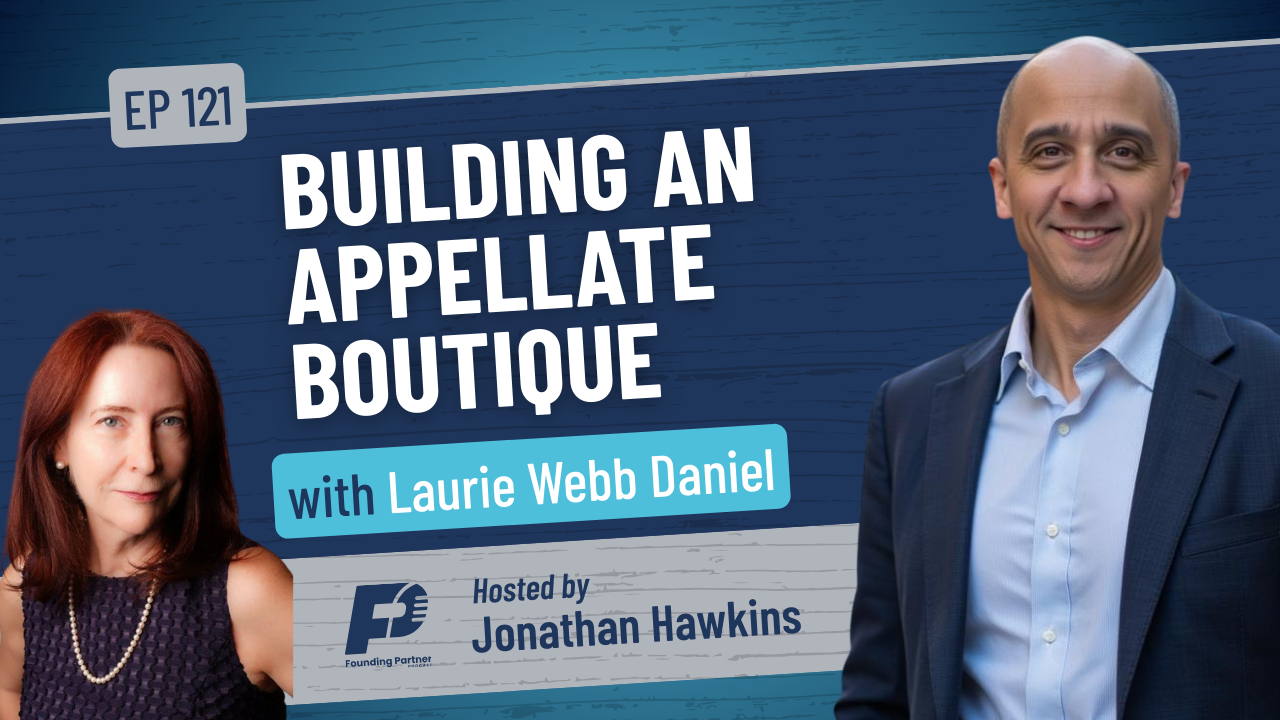
The Path From Boutique to Big Law and Back Again
Laurie Webb Daniel’s career has come full circle.
She began at a high-end litigation boutique in Atlanta, where she worked alongside elite trial lawyers as the legal strategist on complex cases. Early in her career, appellate practice was not widely recognized as a specialty, but Laurie quickly found her niche.
Twelve years later, that boutique merged into Holland and Knight. Laurie joined as an equity partner and helped build the firm’s appellate practice while connecting with lawyers across the growing national platform.
Over time, her reputation grew well beyond the firm.
For the last decade of her Big Law career, roughly 95 percent of her work came from outside the firm, referrals from trial lawyers and other firms who trusted her appellate expertise.
That realization eventually led to a question.
If most of the work was already coming from outside the firm, what would happen if she built her own?
The Leap Into Entrepreneurship
After nearly three decades in Big Law, Laurie made the decision to start something new.
She describes the moment vividly.
She and colleague Matt Freelander left the firm together and launched their boutique appellate practice.
As she puts it:
“Matt and I held hands, jumped off the cliff, landed in deep water, quickly swam to the top, and have been doing swimmingly ever since.”
The move was bold, but the foundation was already there.
Because her practice was largely referral-driven and independent of internal firm matters, many of the lawyers and clients she had worked with chose to follow her when she launched the new firm.
That early trust made all the difference.
What Appellate Lawyers Actually Do
Many people assume appellate lawyers only appear once a case is already on appeal.
Laurie’s work shows that is far from the whole story.
Her firm focuses on:
- Appeals in state and federal courts
- Strategic trial support
- Motion practice in high-stakes litigation
- Working alongside trial teams to shape legal arguments from the beginning
Rather than “embedded appellate counsel,” Laurie prefers to describe the role as a true partnership with trial lawyers.
Her team helps shape the legal strategy, preserve issues for appeal, and refine the narrative of a case.
In high-stakes litigation, that collaboration can make the difference between victory and defeat.
Building a Boutique Appellate Firm
Today, Laurie’s firm includes eight lawyers and two staff members, with work spanning Georgia, Florida, Alabama, and beyond.
Their reputation has grown quickly.
Within three years of launching, the firm earned national recognition in Best Lawyers for appellate practice, along with top-tier rankings in Atlanta.
Much of that growth has come from the same source that built Laurie’s original practice.
Relationships.
Trial lawyers across the country bring her firm into cases where appellate strategy matters.
In many instances, her team works alongside other firms rather than replacing them.
That collaborative model allows the boutique to plug into major cases without needing the infrastructure of a massive firm.
The Freedom of a Smaller Firm
Leaving Big Law also gave Laurie something she values deeply.
Freedom.
At a large firm, many decisions require approvals, committees, or layers of process. Marketing budgets, sponsorships, and strategic outreach often have to follow rigid structures.
Running her own firm allows Laurie to move faster and make decisions that align with her values.
If she believes a sponsorship will build meaningful relationships, she can approve it immediately.
If she wants to help a smaller firm facing unfair sanctions, she can reduce fees and take the case simply because it is the right thing to do.
That flexibility has become one of the most rewarding parts of running her own practice.
A Supreme Court Moment
One of the most memorable moments in Laurie’s career came early.
She successfully petitioned for review before the United States Supreme Court and ultimately argued the case herself.
Standing before the Court is daunting for any lawyer.
For Laurie, the experience was intense but exhilarating.
The courtroom is smaller than most people imagine, and the justices sit just feet away from the podium.
Justice Scalia challenged her repeatedly during oral argument with increasingly complex hypotheticals.
Laurie answered each one until finally responding:
“Respectfully, Your Honor, I disagree.”
It was a moment that perfectly captured the intellectual rigor and pressure of Supreme Court advocacy.
The Power of Reputation and Referrals
Laurie credits much of her firm’s success to a simple principle.
Do excellent work, and make sure people know about it.
Winning an appeal or securing a significant ruling can ripple through an industry. When that happens, Laurie makes sure clients and colleagues hear about it.
Not through aggressive self-promotion, but through thoughtful communication about meaningful results.
That approach keeps her firm top of mind when trial lawyers need an appellate specialist.
In a practice built largely on referrals, reputation becomes the most powerful marketing tool of all.
Advice for Lawyers Considering the Leap
For attorneys thinking about leaving a large firm to start their own practice, Laurie offers practical advice.
Start with a vision.
Think carefully about:
- The type of practice you want to build
- The clients most likely to follow you
- Whether you need physical office space or a remote model
- Your marketing and relationship strategy
Then build a practical plan to support that vision.
And one more critical step.
Secure a line of credit before you leave your firm.
Cash flow takes time to build, and having financial breathing room can make the early months far less stressful.
A Career Built on Courage and Curiosity
Laurie Webb Daniel’s journey reflects the evolution of the legal profession itself.
From a young lawyer determined to succeed in a male-dominated courtroom to a nationally recognized appellate advocate and firm founder, she has built a career defined by courage and connection.
Her story proves that sometimes the biggest opportunities come from taking the leap.
Even if it feels like jumping off a cliff.
Thank you for joining us for this episode of The Founding Partner Podcast. Stay tuned for more conversations that inspire connection and growth.
AND MORE TOPICS COVERED IN THE FULL INTERVIEW!!! You can check that out and subscribe to YouTube.
If you want to know more about Laurie Webb Daniel, you may reach out to her at:
- Website: https://webbdaniel.law
- LinkedIn: https://www.linkedin.com/in/laurie-webb-daniel-47080311/
Connect with Jonathan Hawkins:
- Website: https://www.lawfirmgc.com/
- LinkedIn: https://www.linkedin.com/in/jonathan-hawkins-135147/
- Podcast: https://www.lawfirmgc.com/podcast
Jonathan Hawkins: [00:00:00] Did you guys have clients or were you starting from zero? Curious and then how did you, you know.
Laurie Webb Daniel: we did not start from zero. And as I said,
I was very observant of my fiduciary duties to my partners. And again, I love Holland and Knight. It was a great place for me during those 28 years. So I did not do anything to recruit anybody, any client, until after I left. And I’ll just share this one little thing. When I did give my notice the reaction was, well, that’s a bold move.
And that was kind of interesting. And I think it was, I referred to it as jumping off the cliff, but the nature of my practice, and I mentioned most of my work was coming from outside the firm. I’d say the split was probably in the last 10 years of my time there probably 95% of my work was coming from outside the firm.
Welcome to the Founding Partner Podcast. [00:01:00] Join your host, Jonathan Hawkins, as we explore the fascinating stories of successful law firm founders. We’ll uncover their beginnings, triumph over challenges, and practice growth. Whether you aspire to launch your own firm, have an entrepreneurial spirit, or are just curious about the legal business, you’re in the right place.
Let’s dive in.
Jonathan Hawkins: Welcome to Founding Partner podcast. I’m your host, Jonathan Hawkins. This is a podcast where I get to interview founding attorneys and hear about the firms that they’ve built and our building. And today’s guest is Laurie Webb Daniel. She is an appellate lawyer based here in Atlanta appellate only. I believe she’ll, she’ll tell us about that.
But she’s a former big law lawyer that went out and has started building a, a pretty impressive appellate practice. So Lori, welcome to the show.
Laurie Webb Daniel: Thanks. I’m happy to be here. And hello everyone. [00:02:00] Yes, I am an appellate lawyer. I did leave big law four years ago to start an appellate critique, but I have to say this, it’s the role of the appellate lawyer, but it’s not always in the appellate courts. Just to make that clear, we say we are a resource for motions, appeals, and strategic trial support. And high stakes litigation. It’s a bit of a mouthful, but it does kind of capture the various kind of aspects of our practice. So, we are focused and skilled at conveying a winning message in a few words or a few pages whether oral or written. But we do trial support and we do love to be in the trial courts and are able to collaborate with very fine trial lawyers. That’s the most fun ever.
Jonathan Hawkins: And so, yeah, let’s dig into that a little bit. And by trial support, I mean, I call it you’re like embedded in the trial. You’re at the trial basically helping preserve for appeal. Is that how it works?
Laurie Webb Daniel: Well, it’s more than that and frankly, I don’t really like the term embedded appellate counsel that you hear [00:03:00] it a lot, but embedded who, I mean that for me is kind of weird connotations actually. It’s more of a partnership with the trial team. We are a member of the trial team. Usually with rare exception enter an appearance in our council of record along with other firms.
It’s always other firms now that I left the big firm, and in fact it was that way even when I was. In a big firm practice. Most of my work was coming in from outside the firm and I was working with other firms. There may be reasons for that could be explored at some point, but the fact is that was the nature of my practice in the last, I’d say probably the last 15 years of when I was at the large law firm, even though I headed up the appellate team and they were just. No, it’s just the nature of big firms, I think but it’s fun. So it’s not just monitoring, it’s actually collaborating with the trial team.
Jonathan Hawkins: All right, so let’s dig into your firm. So it’s, I know it’s not just you, so tell [00:04:00] us, you know, how many attorneys, staff, what’s your setup?
Laurie Webb Daniel: We have eight lawyers now and two staff members. I think I need to add a few more on the admin side. It’s a really fun practice. And I’ll roll back just a little bit. To give a little background because I think that might be helpful. So I have a boutique practice. I started in a boutique firm, actually a litigation firm. And it was about a 10 lawyer firm, high-end litigation boutique in Atlanta.
Everyone else were travelers. I mean, they’re excellent American College of Travelers. Really just tops and that niche. This is back, it started in the 80’s. And at the time, appellate wasn’t really recognized as specialty, but it was kind of my focus as a law person on the team.
So these great trial lawyers had a different skill set. They could slice and dice anyone who’s on the witness stand give a [00:05:00] powerful closing argument. But I was really good at working with them. As the law person on the team, and often it was right from the start kind of figuring out the legal strategies. So 12 years into that practice we merged that firm into Holland and Knight a great firm. Nothing but good to say about that firm. And we at that time. Holland Knight was just getting ready to, to launch into a more national presence. It was the largest firm in Florida at the time. This was 1994. So at that point the firm was growing. I reached out, connected with a lot of lawyers as they were coming in new to the firm. So it was kind of an interesting dynamic because it was rapid growth in the big firm arena and I took advantage of that to the benefit of the firm by really networking quite well with, and we would add a new office.
I would immediately welcome people in and establish relationships. So back in those, those earlier days, and I merged in [00:06:00] as an equity partner. I was lucky that way. it’s different if you come up as an associate and, and make partner in a, in a big firm, that’s a whole different deal. I would, I merged in as a partner, but it was wonderful building relationships.
So I was doing the same thing with various offices and that firm we brought in New York. I made a lot of good connections with the New York office, LA and so, because. They knew me and they were coming into a big firm and they, I, I would give them the pitch on what I did law personally. Yes, I can help you, I can help you with motions, appeals, strategic trial support.
And it was great. It was beautiful and a lot of fun. And after just a few years I was made head of the appellate team. It was a Florida based firm initially. Now it’s not, but Florida, Texas, and California. We’re the early states that view appellate as a specialty and they have board certification for appellate lawyers.
So, so this was my practice Niche was a good fit with that firm. It was wonderful. So it was [00:07:00] from that background. And then as I said later with my reputation grew, I started getting more and more work from outside the firm roll forward. 28 years of being equity partner at the big firm, which again, a great firm. I started thinking about those boutique, you know, those days in the, in the boutique, you know, and it’s a different type of practice. And I started thinking about it and eventually decided it was time, it was time to launch my own firm with. It was a niche practice that I had developed and so I did four years ago you asked about how many. So, at the time was my number one guy at the big firm who was expressing some desire to not be in a big firm. I did not recruit him. to be clear. I observed my fiduciary duties, but eventually when he said he was going to leave, and I said, well, you know what? Don’t leave without me. So the way I [00:08:00] put it, this is a visual image and I think it kind of works. Matt Freelander and I held hands, jumped off the cliff, landed in deep water. Quickly swam to the top and have been doing swimmingly ever since. It was scary, but it was, we were ready. We started my daughter who had just finished University of Chicago Law School, came in with us initially, and then we added people.
So now yeah. We’ve got eight lawyers and I can tell you about some recent hires, but I don’t wanna just ramble if you’ve got
Jonathan Hawkins: So, so, so I wanna go back. I, I think it’s, it’s interesting to me, and I’m curious you know, when you, you were initially at your boutique and it’s, it’s really I know that you were catching Holland a night on the upswings. But it’s a different culture going from sort of the small boutique where you get to run the show to all of a sudden you’re in a big firm that has the headquarters somewhere else.
How was it for you? I know you [00:09:00] very quickly made connections, but was it culture shock going from the small place to the bigger shop?
Laurie Webb Daniel: Well, PE people used to ask me. it like to go from your own firm into a big firm? And at that time, Holland and Knight was, I mean, I went from a 10 lawyer firm to probably 450 lawyer firm. Big contrast there. But I said, well, you know, it, it, it still feels like my own firm and that’s the way Holland and Nate was when I joined and, and I was in the leadership early. And very much involved in the growth. And I love the firm and, and I still do. It’s just, I told, I told Holland and I, when I left that you know, I wanted to be partners just in a different way. And we do sometimes still work together.
Jonathan Hawkins: So, I don’t know how much you wanna go into this, but I imagine being a partner in a big firm is a, it’s a lot. I’ll just say that. ‘Cause you have to do a lot of work. You’ve gotta do all this other stuff. You’ve got a politic, you’ve gotta do all these things. And then you’ve got [00:10:00] all these offices spread across the country, maybe the world.
How is that to manage?
Laurie Webb Daniel: Well, I was not only head of the Holland Knight firm-wide appellate team for a bunch of years. I also headed up the Atlanta Litigation Practice Group. you know, I was. I was helping manage, you know, trial lawyers who were not litigators and there was growth. And I’m thinking, why, why did they put an appellate lawyer? You know, we’re like kind of nerdy and you know, not usually what you’d think of as being that you know, head of a general litigation group. But I think it worked really well, partly because I. Do have a love of connecting with people. And so, we were successful. I did that for seven years.
it was a lot. I was fortunate because of the way my practice grew and that when I merged into Holland Night, I already had a practice, but it wasn’t as, it wasn’t [00:11:00] originating. My own business back in, in those earlier days. I was good with networking and getting relationships, but and it’s just a matter of enjoying what you do and enjoying the people you’re working with.
And, and, and that’s, that’s what I did. I sought out again, those, it’s re was relationship building and then was able to pull people together when I was doing the, the more challenging practice group management, because that, as far as, economics was more valuable to the firm than like, you know, firm wide appellate because appellate wasn’t viewed as pro in, in terms of profit. The, well, the office performance was, and there were numbers that came out. But I did try hard to. Have some collaboration within our office to build, to do what they call it, cross-selling, whatever. So people would get to know each other. I had meetings, I called it dive Surprise, where I bring in, take out food from some, a different restaurant every month to kind of lure people in, you know, [00:12:00] with like, guess what we’re having today.
You know, one name might be the varsity or it might be dust as Ethiopian Kitchen, or it might be whatever nobody knew. Anyway, that works. So it’s bas basically, again, it comes down to, to relationships and reaching out, connecting with people.
Jonathan Hawkins: So you, you had your, you were at the small firm. You, you were then went to the big firm, you there for 28 years, so completely different. And then four years ago you started your own and as you said, you jumped off the cliff. So again, almost another. A culture shock moment maybe. ’cause I mean, I personally know that just starting a firm, you know, the story, he’s like, you know, if you need something, it’s just you call down the hall and it shows up magically when you’re at the big firm.
When it’s your firm, you gotta, you gotta, you know, you gotta put the stuff in the closet to go get, so what was that like?
Laurie Webb Daniel: Yes, yes and no. It didn’t always magically show up at the big firm, just so you know. There were, you had to kind of know your way around and how to, how to get what you want at a big firm. If, for example, you want a sponsorship [00:13:00] or something like that. I mean, you have to justify things in big firm. They did.
There, there was some, some pretty darn good administrative support. Though there, and that’s the thing I miss the most, it’s like we’ve been successful, we’ve been really successful at, you know, maybe beyond my hopes and dreams even. But with the success comes the challenges of managing it and making sure you’ve got enough time to do the best. Client work possible. And, and, we do, we do very intense brain work that requires not, it requires us to think and focus and not be interrupted all the time. And it’s hard to do both. So that, that part is the biggest challenge is getting the admin that a wonderful administrator, super smart, super. Big problem solver, just what you want. The problem I have with her is she doesn’t work full-time, so, you know, I need three of her full-time it feels like. So we’re looking [00:14:00] at getting some more administrative help. That is the number one challenge for me to be able to get the quiet, calm. Brain time to dig in on a challenging appeal and yet manage the nitty gritty, how to collect on our ar.
Jonathan Hawkins: Yeah. Yeah, I was gonna, so that’s the next question. So you talked about the administrative part. What are some of the other. Differences that, that you immediately saw from the big firm to, to having your own shop again?
Laurie Webb Daniel: Yeah. So one thing, you know, I wanted to, I wanted. Avoid the, I don’t know, bs, red tape, whatever you wanna call what you have to do in a, in a, in a large institution, whether it’s a big firm or whatever, you have to go through certain channels, get certain approvals, whatever. And I mentioned sponsorships and a lot of, I felt that a lot of times the. And, and it, it’s not just my former firm. I, I’ve seen this in other big firms that they, if if it’s direct client relationship where you’re [00:15:00] going out and targeting some big client and doing a spiel, then it’s fine. They’ll pay for your travel and, you know, the big dinner and wind d whatever. If it’s a sponsorship, they don’t. And this is the, it was harder, very harder. And it’s because a lot of lawyers. Don’t get referrals from other lawyers. That’s not a big source of you know, generating origination. Not so for me, because as I said, I collaborate with other lawyers and sometimes, you know, the, I mean, we have great relationships.
It’s almost always seamless and in a way it’s sort of like they realize that having an appellate person who they can communicate with and can. Relieve them of certain burdens that they may not like. They may not like doing charge conferences at a trial. Most people don’t. I don’t even like it, but I, you know, I can do that so they can think about their closing argument. So I get a lot of referrals, a lot of referrals from other [00:16:00] lawyers, from trial lawyers, but I wasn’t getting. Support for that outreach because most of the lawyers in the firm did, don’t get referrals of that many. And so that, that was a difference. And so coming down to sponsorships, starting a new firm. I needed to get the name out, get the firm’s name out. I had my name out there already, but I needed Web Daniel Freelander to be out there as a firm. So, I had the freedom to just say, okay, yes, I’ll sponsor, you know, whatever. And I wanted to do it at a big level. So people would say, and, and I’ll just say this three years out last year, we were ranked by best lawyers on a national. Tier, I believe it was a tier two nationally as an appellate firm
nationally. Yeah. I mean, and that, that’s just you know, an indicator of, of that we are getting our, our, that we’re small, we’re getting known not just in [00:17:00] Atlanta where we’re ranked in the top tier number one tier in appellate, but also nationwide. And that’s a big difference. I mean, I was ranked in best lawyers in Chambers and all at, at Holland Knight. But it, it was harder, it was harder for me to get what I needed as far as marketing.
Jonathan Hawkins: So, so lemme ask, so you’re ranked nationally. Do you have a national practice? Do you travel for, for your work? Or is it mostly in Georgia?
Laurie Webb Daniel: I do, I mean, we have been based in Atlanta and have a very strong practice there. We also though, have been known, regionally, 11th circuit. I started off doing mostly federal appeals for the first 15 years and then the state it’s been pretty even since then. But we do a lot. I’ve got clients in Alabama and Florida as well as Georgia, but also, yes, nationally.
I mean, I had a big, big case outta Colorado recently up appeal, and we got the elsewhere as well. And I, I will take this opportunity to mention [00:18:00] about my recent hires because it’s been a, a, a, a development that I wasn’t really looking for, but I think is good. And we took advantage of the way things the dynamics in the legal world. Now the big one is the DOJ and there’s been a lot of exodus from DOJ with a lot of top talent. So, we now have a strong presence in South Florida because I recruited the appellate chief and who the deputy appellate chief out of the Southern District of Florida. Fabulous lawyers, amazing experience in the 11th circuit. Dan Matkin, who was the former appellate chief managed 200 appeals last year in the 11th circuit. And the government work is challenging both of them. Prior to working for the government had had worked in private practice and they, they both had clerked on, you know, for 11th circuit judges.
So a good fit. But yes, we are, we’re [00:19:00] moving, yeah, big time in Florida now, which is there a lot of work down there. It’s, it’s competitive. It is very, very competitive market in the appell arena. But we’ve got some good talent.
Jonathan Hawkins: So is that a strategic hire or an opportunistic hire? And by that I mean, were you saying, were you thinking, Hey, I wanna expand to Florida, let’s see what we can find, or just through prior relationships this came up.
Laurie Webb Daniel: it’s more of a second. As I said, I wasn’t really planning on doing a push like that. Now, now I will say we already have had and still have two Florida lawyers who are members of both the Florida and the Georgia Bar. One my Skylar McDonald, who’s been with us almost since day one.
She came on early lives in Tampa. Clerk for Judge Hall on the 11th circuit. And so she works remotely and, and has, but she’s very involved in the local bar there. And Lee Hines practiced in Tampa. His father was a very prominent criminal defense [00:20:00] lawyer in Tampa. He was at Holland and I, with me for a while left long before I did, but has come back. So I had it in my mind that yes, someday. But the opportunity came when the Trump Administration started stirring things up at the DOJ. And then it was a friend I know was a very prominent DC lawyer who knew Dan and sort of put us together and yeah.
Jonathan Hawkins: So, so you’ve had success with adding those folks. Has it made you start to think, all right, let’s, let’s look at other, other places and, and maybe start growing that way? Or is it still just as the opportunities come across your
desk?
Laurie Webb Daniel: I think, yeah, I think more of sort of an organic growth. And I don’t wanna get too big. I do think though, with relationships and I’m finding we are being asked to go in and assist other. And, other firms, because we work with other firms, it’s not as critical that we [00:21:00] are members of, of the, the local bar.
If it’s a state practice federal practice, it’s very easy. So, so we are being asked and, and again, that’s kind of a relationship building, kind of being a trusted advisor which is a wonderful position. I love that characterization of our role, which, we are getting more and more often where a national company will ask us to come in and, and work with other firms in other locations.
I expect that’s gonna continue to grow as we continue to develop the relationships and, and our reputation.
Jonathan Hawkins: So let’s go back when you jumped off the cliff with Matt. Did you guys have clients or were you starting from zero? Curious and then how did you, you know.
Laurie Webb Daniel: We did not start from zero. And as I said, I was very observant of my fiduciary duties to my partners. And again, I love Holland and Knight. It was a great place for [00:22:00] me during those 28 years. So I did not do anything to recruit anybody, any client, until after I left. And just share this one little thing. When I did give my notice the reaction was, well, that’s a bold move.
And that was kind of interesting. And I think it was, I referred to it as jumping off the cliff, but the nature of my practice, and I mentioned most of my work was coming from outside the firm. I’d say the split was probably in the last 10 years of my time there probably 95% of my work was coming from outside the firm.
Jonathan Hawkins: Oh wow.
Laurie Webb Daniel: So it was not appeals coming up through the firm. And under those circumstances, you know, we went with the form letter that the firm sent out as far as us leaving and clients had a choice. But they all chose us, every one of them.
Jonathan Hawkins: Yeah. I mean, that makes sense to me. Especially if it’s mostly work coming [00:23:00] from outside, I mean, who else are they gonna go with? Right.
Laurie Webb Daniel: Well, I was in the end, the last like 10 years, I was essentially operating an appellate boutique within a large firm. And I mean, again, I was loyal to the firm that, you know, I wasn’t trying to siphon anything off. It just came to a point finally I’ll just put it this way I was licensed to practice law in 1982, so roll forward.
I was at an age where I needed to do it then or never.
Jonathan Hawkins: You know, it’s funny, the, the reaction I hear from other attorneys who leave big law that they get it’s sort of mixed. Some of it it’s like you’re crazy that to try it. And then others are like, please take me with you.
Laurie Webb Daniel: I, yeah. I would think, yeah, but it, it’s, again, on the, on the, a boutique it’s interesting to kind of see these articles that are coming out now, some on boutique practice. And I think the age of the boutique, I mean, as I said, I started in a boutique 40 years ago. But I think now it’s a particularly [00:24:00] attractive type of practice.
If you’ve got a specialty, where you clients want you for that specialty and they don’t really care about the big firm now, where it’s more of a challenge where that, the boutique practice is a challenge. It’s for, you know, if, so I deal with a lot of really high exposure cases, a hundred million dollar cases a lot and not all that much.
Some of them are more, but. Big, big bucks. Sometimes. The board of the client wants a big firm name. It’s CYA kind of, so there are, there are some times when I don’t get work because I’m in a, a smaller firm and, you know, it’s just not one of the, the big firm names and, you know, it’s high risk and whatever. But other times the clients, once they get to know you and know your work and realize. You know, you’ve got what they want, it’s a good match. Then, then, you know, they will go with you in an appellate boutique. So [00:25:00] it’s gotta be, I think it’s important if someone’s gonna break off and start a firm, you know, to have some, some relationships already established so that the attractive nature of a smaller firm is, is, is gonna over. Overshadow the, the risk that clients might feel when they’re deciding who to hire for some big matter.
Real quick, if you haven’t gotten a copy yet, please check out my book, the Law Firm Lifecycle. It’s written for law firm owners and those who plan to be owners. In the book, I discuss various issues that come up as a law firm progresses through the stages of its growth from just before starting a firm to when it comes to an end.
The law firm lifecycle is available on Amazon. Now, back to the show.
Jonathan Hawkins: So you’ve got a cool story. So I’ll, I’ll lay the groundwork a little bit. So, I think your dad was a lawyer I believe. And then at some point you, maybe you’ve done this more than once, but at some point you, you got to argue a case in front of the US Supreme Court. [00:26:00] And then your dad accompanied you. Why don’t you tell me about
Laurie Webb Daniel: Yeah. Alright. So yeah, this is, this is kind of a fun story and, and I do enjoy telling him and it’s, it’s kind of wild. So, so when I was a junior in college my dad always, as I was growing up, was a very prominent trial lawyer in Atlanta. And when I was a junior in college, I always started thinking, what was I gonna do? After college. So I had talked to, asked my dad about should I be a lawyer? And he said no, you, you really should be a paralegal. Right? I’m thinking, what? And, I remembered. So he, he was a southern gentleman and I, he did not like to encounter a woman in the courtroom because he was used to opening doors for women, not fighting them. And he used to I remember refer to one woman in particular, he said, I overheard him say this. He wasn’t talking to me, but I overheard him saying, referring to her as that goddamn female woman lawyer. And I thought, I, I don’t wanna be a paralegal, I wanna be a goddamn female woman lawyer. [00:27:00] So I didn’t tell, talk to him anymore about it.
Finish college. I waited tables a couple of years, saved my money and went to the state university, the state where I was living at the time, and, and got and got a law degree. Well, anyway, somehow or other, well, my mom got me back to Atlanta and I ended up actually going into practice with my father and my husband by the way.
And the 10 lawyer firm. And, and we, I was a law person on the team and we had a case that. Yeah, a mixed result in the 11th circuit. And I said I thought we had a shot at the cert petition. I knew it was a long shot, but I said, look, there’s a dissent from the denial cert in this case on same issue.
Let me, can I try? And they said, yeah. So I I did, I did up the cert petition and it was granted. And then the question came who was gonna argue it? And Dad at the time was in his sixties Hal was in. M 20 years younger than that. Anyway, I was still fairly early in my career, but anyway, I did I did, they said, yeah, I could argue it.
So that was the day my father [00:28:00] carried my briefcase in the US Supreme Court and it, it, but he, let me say this about him. He was a great man, great trial lawyer, and he also had the ability to accept new views and change his mind. And he did, he changed his mind. And we worked really closely together. He was a wonderful mentor, and if you asked him before he died, who his best associate ever was. He would name a woman who was, not me, but a woman that who’s, who’s a partner at Holland and Night. Now she was an associate and he would invariably refer to her because I mean, she tried the last case. He tried to a jury and he loved her and she, for good reason. She’s excellent. Anyway, so yeah, that was, kind of, sign of the change of times because, it, you know, it, it was, there were very few women in the courtroom in 1982. Actually. That was he, that was actually in the seventies when he made that remark to me. It discouraged me from being a lawyer. He thought I wouldn’t be able to get a job, [00:29:00] but
Jonathan Hawkins: So, so tell me about going to the US Supreme Court. What was that like for you? I, I can imagine how, I mean nervous, I would feel just overwhelming probably. I don’t know. Tell me, tell me about the experience.
Laurie Webb Daniel: Well, I thought it was fun. It, it was, you know, it’s kind of like standing in front of the fire and squad. I was pretty young. I was really focused, really well prepared. I remember you go in and you check in down, kind of in the basement with the Clerk of Courts where the clerk of Court’s office was, and my opposing counsel. Was, it was, what was Hansel and Post? Did they go into Jones Day? I don’t know. They, they merged in, I think it was, I think it was Jones Day that acquired them. But anyway, I remember being behind him and going in, and of course the people in the clerk’s office thought I was his associate. And I said, no, I don’t know.
I actually, I’m the opposing counsel. And then you know, the protocol, it’s daunting Questions. Scalia was new. Kennedy and Scalia were both new and they were on either [00:30:00] side of the bench and the Supreme Court, it’s a very, it’s actually rather intimate. It’s, it’s not a big courtroom in the, in the, and the, and the podium is very, very close to the bench, so you kind of have to turn when you speak to the justices and Scalia just. He was like a, you know, I say a bulldog. Anyway, he, he, he, it was like he grabbed onto my pant leg and just wasn’t gonna let go. And he kept wanting to, you know, and he kept, I kept answering his, he would do these hypotheticals and I kept answering them, and then he’d change and get the facts weirder and weirder and weirder.
And finally, I just gotta say respectfully, your honor. I disagree. It was intense. I would’ve liked to have done it again. I don’t think. I think my chances are very slim because of the way the Supreme Court practice evolved and now it, it’s really kind of a club of, of, you know, elite people where, and again, when you go to the CYA factor of clients choosing counsel you know, they just don’t wanna risk not going with one of those Supreme Court Elite.
And I’ll say this what’s interesting that the [00:31:00] caseload in the Supreme Court’s been diminishing every year and it’s, I think at all time. Low, at least on the, yeah, I think he may be all time low right now. Meanwhile, they’ve got these clerks, each justice has all these clerks and they have their year clerk.
And so you’ve got all these former Supreme Court clerks out there going into big firms and there’s just not enough work.
At. You know, and, and so you talk about competition when they start coming down. I remember Miguel Esda coming down and I had a case, you know, with him actually against him one time. But I’m saying, Miguel, what are you doing down here? You know, go back, go back to dc You know, this is, this is not your territory, but in fact it is. I’m seeing it. And that’s kind of an interesting dynamic on, in the appellate world, because there’s just not enough appellate work in DC for all of the top talent. So I’ve gotta have that, have that kind of as a, a competitive issue to a certain extent.
Jonathan Hawkins: That’s interesting. The, the other thing, and I’m curious your, your view on it, you know, you’ve been doing appellate work for most of your career [00:32:00] at this point. And my, my view is, you know, I grew up as a business litigator and occasionally we would have cases to go on appeal, no big deal, and we would just handle ’em.
And so, the idea of having the boutique that would come in and, and the case, they weren’t a hundred million dollar cases, that’s for sure. So, so I’ll, I’ll put that out there. But the idea that, you know, that you have these boutique appellate firm only, you know. Type firms. Is that a new thing in your view or in light of sort of the way you’ve, sort of,
Laurie Webb Daniel: It’s new and yeah, it, it, it, it is new and, in a lot of areas in the us as I mentioned previously Florida, Texas, and California. Not so new, but I think. Typically you’d see the established larger firms with appellate groups that would, you know, have a, have a practice. There are some appellate boutiques in California, some very fine appellate [00:33:00] fatigue in more than one I think.
But and also Texas, that I know of some, but it’s still, it still. Not absolutely common, but I saw it actually, it was my time at holiday night when I learned about the Florida Bar has, you know, a separate appellate practice section and it, how it was recognized. So I, I, I decided to start the appellate practice section for Georgia, for the State Bar of Georgia.
And I did that like 25 years ago. So, was building that as a niche. You know, really for a good while now, which has helped by the way.
Jonathan Hawkins: So another thing I’ve seen is, is there are co like one or two or three, I’ll say sort of, I’ll call ’em plaintiff side appellate lawyers, and then I don’t know where you fall, but do you, so you have the appellate niche and then they’ve niched down even further. Do you have to pick a side into your view on that or is it
Laurie Webb Daniel: On personal injury, solidly defense there’s no way you could do it either way. Same with like my good [00:34:00] friend Mike Terry, who’s often plaintiffs and I’m against them. I say sometimes we are a little bit like, you know, I mentioned the, uS Supreme Court, kind of elite. You know what people wanna go with, with the lawyers who routinely argue in the US Supreme Court, who know the judges are on a first name basis, or the justices, I should say, justices. It’s a little bit of that. Going on in Atlanta because of some really, really, really talented plaintiff side appellate lawyers, which has benefited me as defense side in, but that’s in the personal injury space. But that’s where you’ve been getting a lot of nuclear verdicts in Georgia because, the measure of damages is the enlightened conscience of the jury. Okay? So you got a good trial lawyer there, blame the jury, get a hundred million. We have I used to do a lot of antitrust work and other types of commercial litigation where [00:35:00] damages were economic and then you gotta have some proof, some real proof of what you know, the losses are and not, it’s not, you know, it’s not so open-ended.
So in that respect, yeah, the dynamics have actually been, been good for me. I don’t get a percentage of the big hit, not even a reverse percentage. We got just today an opinion reversing $113 million jury verdict, and Matt Freelander got this one and he said If I had this on a reverse contingency, I could
retire. Yeah. Yeah. Matt, we just don’t do it that way, but
Jonathan Hawkins: well, you need to experiment. You need, you need to experiment.
Laurie Webb Daniel: I have some, and I, I do have an open mind on that. It’s easier said than done on the defense side.
But it’s, you know, like I said, we have an open mind. We, we wanna make sure that our clients are you know, what works for them. We gotta keep. it at a level. I mean, I’ve got, right [00:36:00] now I’m the only equity partner in my firm, so that means I’ve got a payroll of keeping the, what I call the big brains. You know, sometimes I call ’em the youngsters ’cause they’re all, they’re all fun. They’re all range in age from like 36 to 48. So gotta make, gotta gotta make sure I got the money in there for payroll.
And we did a lot of contingency work at Webb and Daniel, which was the Pati, my dad’s firm as Paul Webb and Hal Daniel. But in business cases, those were all, that was all business litigation. But there’s a big investment.
Jonathan Hawkins: Yeah.
Laurie Webb Daniel: a small firm to do a business case on a, and we did a fair amount of plaintiff’s work and on the business side, plaintiffs and defense. But it, it’s a much harder business model. And we do at our firm, do plaintiff’s work in the commercial space. Just can’t do it in personal injury. But I do like, I do enjoy plaintiff’s work. if it’s business.
Jonathan Hawkins: So. Let’s go, let’s go back. So you, I wanna talk a little bit about client development [00:37:00] or business development, and you mentioned when you started your firm, you did, you know, you did some sponsorships and you, you talked a lot about relationships. But how have you gone about, again, you, you broke off, you started your firm.
How do you get out there and say, all right, start sending me the work. What were some of the things you did that, that you looked back and said, yeah, that worked pretty well.
Laurie Webb Daniel: Well, the practice has grown since I left the big firm. One thing I’ve gotten a lot of referrals. As I said, I get referrals from a lot of trial lawyers, so does Matt. Matt’s really good at it and, and some others making those you know, establishing those relationships. Professional organizations are good.
Getting the name out but I’ve always said. I said to my younger lawyers you know, if you, if you get a good result make sure people know about it. And it’s not just, It is not just tooting your own horn, you know, which, you know, you gotta do a certain amount of that. I mean, you gotta make sure people know about it. You know, and if I get a media inquiry, if it, if it’s a big client, I, I have to [00:38:00] get permission. But if it’s something more general you know, I can comment. And even with the larger clients like we had a media inquiry on a case that’s been, well, one, one of several anyway. A reporter reaches out to me, I go to the client, they go, well, we don’t usually comment.
I go, well, how about this? How about if I just have something like I say to the reporter, our position is well stated in our brief, and then I give them a hint as to where to look in the brief. So it’s not a no comment. It’s a little something and it’s a quote and, it reporters like it, so then they, you know, they like. They reach out to me and, and then if it’s a win, if we won, then I can have a little more room on, like, maybe even if you just say, oh, we are very pleased with a th a thorough analysis, the court of appeals get whatever, a a Anyway, that. That’s good. But it’s, it’s also making sure if you’ve gotta [00:39:00] win, if you’ve just gotten a good result in a issue that’s important industry-wide, like, you know, in this personal entry space, you know, a lot of insurers ha ask us to handle the high, high stakes stuff and let the clients know, Hey, this, the court just. Reversed on this basis or you know, whatever whatever you can let the clients know and then they come back and, or they tell other people to.
Jonathan Hawkins: So you mentioned earlier, you know, there’s some big clients that. The boards want to do the safe route and go with the big firm. So I, I, you know, putting those aside, I imagine, I could be wrong, but I would imagine not being affiliated with a really big firm could also help in the business development because people that may not have referred to you while you’re at the big firm feel less threatened to refer to you when you’re on a boutique.
Is, has that been your experience?
Laurie Webb Daniel: I think that’s right. I think that’s right. And, and frankly, I am at liberty to set [00:40:00] rates how I want to. And you know, one of the problems that I, I got sometimes when I was managing a practice group, I’d raise, I’d say, okay, we’ve gotta raise rates and, oh no, no. Why gonna lose? You know, ’cause they’re, they’re.
You know, you, you kind of worry a little bit, you know, if you can be competitive, even in a big firm, if you’re not one of the top, you know, New York firms or it is competitive they have competition too. So, there is that price advantage to a certain extent. I, I need to always kind of assess when, where I should be on that.
Because you know, where is the market? Where is the place? But I, yeah, again, I’ve got payroll and I gotta, you know, and, and if we’re doing really good work, you know, I hate losing out on a representation because somebody’s going with a lower rate person. But, you know, I’m not gonna, I’m not gonna go down if I think it’s not worth it.
[00:41:00] And, but. I’ll say this, I will sometimes give a break to a client that’s got some reason why I, well, there there was a small, smallish law firm that got zapped with sanctions and it wasn’t, you know, a hundred million dollars in sanctions, but it, it was real money to them and their insurer. Wasn’t gonna cover any further defense Once they got zapped with sanctions and they were on their own and, and I just said, guys, I’m gonna give you a break on this.
This is not right. You shouldn’t have been sanctioned and we’re gonna fix this. And we did. I did. I got it, I got it, I got it vacated completely. I mean, it was gone. But I just wanted to, and that’s an example of me. Kind of the vision for our firm is, is we wanna enjoy our practice and I wanna have the freedom to make those decisions.
If I wanna represent somebody like that, he wasn’t pro bono, [00:42:00] they paid some, but if I wanna do that because I feel like it’s satisfying to me to fix something, then I can do it without having to like beg for permission.
Jonathan Hawkins: that is, that is nice. That is nice. So, let’s shifting a little bit. So real quick, just in the operations, again, you know, in a big firm you’ve. Got all this support that that run helps run the firm and you can really focus on doing client work. But now that you’re running the firm, you’re, you’re, you gotta worry about payroll, you gotta do this stuff.
How do you balance the operations piece with the client work?
Laurie Webb Daniel: Well. The client work comes first. So, you know, in a way it’s not balanced. It’s not balanced. And, and that’s part of the stress. And I’m not, I’ve always handled stress well. I’m type B, type B, and that means I have staying power because you know, I just, I don’t know, I just don’t get worked up much.
But I will say, there is some stress [00:43:00] in feeling like I haven’t caught up with the admin stuff. It’s, there’s always stuff that I need to do. That’s where I’ll tell you what I’m, I, I honestly think AI is gonna help with this. And I did attend a program where some guys, they’re talking about AI summarizing your emails and this and that.
I mean, it’s not like AI writing briefs for me, it’s like it’s the admin side that I think I can get some further help. I probably need to hire some human to help with it also. But I really am very interested in. And AI to help with that side of the practice, but definitely the client work dominates.
I I’m just not gonna, and, and I’m not, I’m, I’m doing okay. But it, it is the part where I it does, it doesn’t keep me up at night, but it does, you know, I don’t like it. I need to get it a little more under control.
Jonathan Hawkins: I don’t, it’s, it’s like I’ve never worked at the post office, but [00:44:00] I think it just never ends. The mail keeps coming and you just have to keep delivering it, so,
Laurie Webb Daniel: but you know, it’s a good thing. I
mean, you know, it, if, if I was, if I was sitting around and had time, you know, on my hands, then I would have other problems.
Jonathan Hawkins: So you’ve been at it for four years, you’ve had, you know, great growth. As we’re sitting here today, if someone else is out there thinking about maybe leaving big law to start their own firm, is there any advice that maybe you’d give them?
Laurie Webb Daniel: Yeah. I mean this is general advice, but I think you have to start with a vision. Think about what you want, big picture. And then you have to, it’s a good idea before you leave to get some details there. Flush it out, you know. What clients might come with you from the start? What’s your marketing plan for getting new clients? Do you wanna have a brick and mortar space or do you wanna, you know, be more virtual? You know, does it make sense for you to spend the dollars [00:45:00] on brick and mortar did for us, we wanted that and I think it’s a good thing for our firm.
But those are the kinds of decisions, you know, you pay attention to, you know, revenues and expenses. Just kind of get some idea, do a business plan and maybe seek counsel from someone who might be able to help advise you know, a new firm launching. But I think it’s a combination of vision and then getting some basic starts. You know, you gotta be practical. And there’s gonna be a lag in cash flow. Usually,
Jonathan Hawkins: Yeah.
Laurie Webb Daniel: Get your lines of credit lined up that’s what I did when I was at the big law firms. Their partners get deals with banks on lines of credit. That I got that in place. I did do that. No breach of fiduciary duty there when I got the line of credit in place and needed that, but it didn’t take that long.
Before the cash started coming in, but it was some leg, you know, you gotta send out the bills and wait for people to [00:46:00] pay. And it started happening but I would say that line of credit. Yeah, definitely gotta have that.
Jonathan Hawkins: That is great advice. That great advice. Get it before it’s hard to get it when you’re self-employed.
Laurie Webb Daniel: Oh, not only that, after it got the term, you know, two years into it, oh well it’s ending
now. That’s fine. I didn’t need it. But at that point I didn’t need it. But it was pretty funny. I got dropped, of course, I got dropped when I wasn’t at the big firm anymore, but that’s fine. Like I got launched and that’s what I wanted.
Jonathan Hawkins: Yeah. So, if you weren’t practicing law, what would you be doing?
Laurie Webb Daniel: Yeah, I never used to think about that. And I’m not ready for that. I’m not ready for that. I’m not retiring. People ask me sometimes, oh, are you still working homeboy? Am I working? But I do now sometimes think about it. And so I’m a writer, you know, that’s what I do. And I have to try to make the narrative interesting and the cases that I have, even if they’re like pretty dry. But I’ve got just this whole part of my [00:47:00] brain that has novels sort of written children’s short stories over here. I don’t know which side the brain does that. But anyway I would like to do that. I would like to do it at the beach.
Jonathan Hawkins: That that
Laurie Webb Daniel: maybe someday, I will, after a while, I’m not ready yet, but at, at some point I will.
And I may never, I may never really retire, but I’d like to have maybe a little bit more time for, you know, such things as writing novels.
Jonathan Hawkins: Well, that would be cool. That would be cool. Well, Laurie I appreciate you coming on. This has been real fun. I liked hearing the story about Supreme Court. That was cool. And, and what, what did you say? You wanted to be one of those damn female.
Laurie Webb Daniel: female. Yeah. No kidding. Goddamn female woman lawyer. That’s what he referred to this woman just to, he was talking to somebody. I don’t know who he was talking to. I’ve ever heard this. I’m gonna be goddamn female woman lawyer, and I guess that’s what I am.
Jonathan Hawkins: Well, I’m not gonna do it to you, but that would be a great title for this podcast. But.
Laurie Webb Daniel: [00:48:00] Well.
Jonathan Hawkins: So for anybody out there that wants to get in touch with you, maybe they got a case they wanna associate you on or whatever, what’s the best way to find you?
Laurie Webb Daniel: Well, you can Google me Laurie Webb Daniel, and that brings up actually the website, which is webbdaniel.law. But even just my name does it. I’m on LinkedIn. I’m not as active as I am sometimes on that and I try to, I try to have LinkedIn post be actually interesting rather than just self-glorification.
And so I do sometimes do movie reviews about lawyer connected movies or some other things that are of interest that are not just self-promotion. But anyway, Googling Laurie Webb Daniel, attorney Atlanta pretty much pulls up our information.
Jonathan Hawkins: Well, great. Laurie, again, thank you for coming on. This has been real fun.
Laurie Webb Daniel: No, it’s been great. Thanks for inviting me.
OutroUpdatedWebsite-1: Thanks for listening to this episode of the founding partner podcast. Be sure to subscribe on Apple podcasts, Spotify, or wherever you get your podcasts to stay up to date on the latest episodes. You [00:49:00] can also connect with Jonathan on LinkedIn and check out the show notes. With links to resources mentioned throughout our discussion by visiting www.lawfirmgc.com. We’ll see you next time for more origin stories and insights from successful law firm founders.