Building a High-End Business Litigation Boutique with Michael Caplan and James Cobb
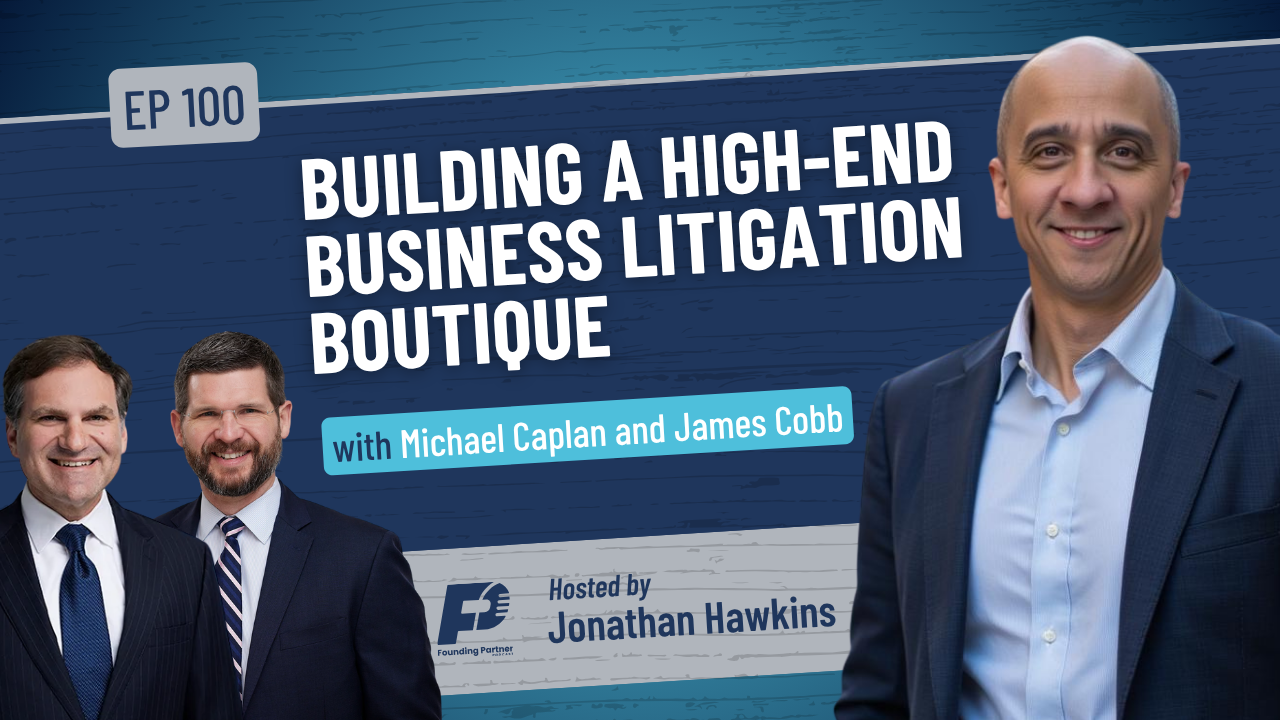
The 100th Episode, Take Two
Our first recording disappeared into the void, so for episode one hundred I brought Michael Caplan and James Cobb back into a real studio to redo a story worth saving. I have known them since before they launched their firm. They left two of Atlanta’s premier boutiques to start from scratch. They did it on instinct, and they did it together.
“Gut feeling,” James told me. “Best professional decision I’ve ever made.”
Before Partners, Opponents
I first watched them on opposite sides of a contentious securities case. It was hard fought, but they kept it diplomatic. Later they realized they had already crossed paths years earlier, both reaching the sharp end of the ABA moot court competition and losing to the same South Texas team.
After that case settled, they had lunch. Then months of conversations. For a long wooing period, two to three years by their memory, they swapped outlines about what a firm could be: high-stakes business and commercial litigation, appeals, and class actions. They debated hourly versus contingency, defense only or a mix. They even argued about the order of their names.
They finally settled on Caplan Cobb. James laughed that soft “n” to hard “c” beats hard “b” to hard “c.”
The Christmas Dinner and the Bourbon Call
It became real over a holiday dinner. With wine on the table, Mike’s wife, Anna, cut through the talk. If you are going to do this, write a check. They opened a bank account, started a logo and a website, and aimed to launch later.
Then the timeline jumped. An ethics wrinkle meant Mike needed to disclose his plans. He met James at Twain’s in Decatur over bourbon. “I’m going in tomorrow,” he said. James did not hesitate. “You are not doing this alone.” They both walked in the next day. The firm opened in February 2014, months earlier than the original target of May.
Day One, With Red Covers and Real Life
Starting a firm meant practicing law and running errands. Early on, Mike printed and bound an Eleventh Circuit brief himself at Kinko’s, checking the court’s required cover colors and thinking about the support he used to have.
Then came the story that set their cultural compass. The night before a pro bono argument in the Eleventh Circuit, Mike’s wife went into labor. Their daughter arrived around three in the morning. Argument was set for eight. From the hospital he called the clerk, who moved the case to last on the calendar. James brought dress shoes to the courthouse. Mike argued without sleep. On the court audio, Judge Beverly Martin can be heard saying, “I can’t believe he’s here.”
It is inspiring and, as James said, also a picture of how oppressive our industry can feel. Their response inside the firm has been to do excellent work and bring humanity to the practice. Minimize false emergencies. Save the late nights for when they are truly necessary.
What They Built
Caplan Cobb is a litigation shop that handles high-stakes business disputes, appellate work, and class actions. They try cases. They resolve the ones that should never see a courtroom. They face the biggest firms, and sometimes they are across the table from their former mentors.
They also take matters that aim at impact. They served as counsel to the Federal Defender Program in a case involving the cessation of executions in Georgia during and after COVID. They challenged Georgia’s twelve-week abortion law, winning at the trial level and continuing after a reversal by the state supreme court. And they led a nationwide class action against a prison telecommunications company that deactivated prepaid accounts and kept the balances after ninety days, which produced a significant recovery.
How The Work Arrived
They planned for the possibility of no clients on day one. That is not what happened. Both of their former firms handled the departures with real professionalism. Clients were given options, and Mike continued on some active matters in partnership with his old shop. Within days, referrals arrived. Former opponents sent cases. Friends booked breakfasts and lunches. Calendars filled.
They decided to bet on themselves early. They hired an administrator. They added a lawyer even before the workload strictly justified it, so they could market, serve clients, and avoid a culture of manufactured urgency.
Their first associate, Brandon Waddell, came in to help prepare for trial. He had been looking at a role in Washington. He stayed, built a career, and is now a partner. He also fell in love, chose Atlanta, and chose the firm.
Today they have 18 lawyers, with 8 partners. Seven of those partners started at Caplan Cobb. One alum became a federal magistrate judge. Another lawyer left to go in-house with a client. James shared the stat that struck me the most: since they started, they have never lost a lawyer to another law firm.
Mentors and Provenance
Both founders credit where they came from. James points to Rogers & Hardin, naming Richard Sinfield and Dan Laney. Mike points to Bondurant, Mixson & Elmore, naming Emmet Bondurant, Jeff Bramlett, and Frank Lowrey. That gratitude runs through their story and shows up in how they lead.
Culture and The Work Itself
They describe themselves as aggressive litigators who remain ethical, professional, and kind. They push against false urgency. They plan and prepare to reduce self-created stress. When nights and weekends are necessary, they show up. When they are not, they do not invent emergencies.
They are also working toward a hard institutional goal. Make any single lawyer dispensable. Relationships make that difficult. If the firm is going to outlast its founders, it is essential.
The Surprises
Some surprises were business-side. When they formed the firm, the talk everywhere was about the demise of the hourly rate. They use alternatives where they fit, but in major business litigation the hourly model has remained sticky. Mike said it is probably more common now than it was ten years ago.
Growth surprised them too. Sketching a firm in a basement is one thing. Seeing 18 lawyers and a widening partner circle a decade later is another.
I added a frame I use when I advise firms. Most firms top out around thirty-five years, or within five years of the last founding partner. There are exceptions. To be one of them, you have to make the place bigger than any individual.
Looking Ahead
Mike resists rigid forecasts. He measures success by principles in action. Excellent work for clients. Professionalism with opponents. Thriving in the community. Attracting people who raise the bar. Whether they are 18 lawyers or 36 a decade from now matters less than staying true to that core.
James keeps it simple. He wants to do this work here, with these people, to the end of his career. Also, guitars are mandatory at partner retreats. Fun matters too.
Closing Notes and How To Reach Them
I have told Mike and James this privately. Many in our legal community look at what they built as a model for how to start and grow a high-end litigation boutique without losing your humanity. I was proud to have them for episode one hundred, and I was even happier to hit save.
- Michael Caplan: mcaplan@caplancobb.com
- Firm site: www.CaplanCobb.com
AND MORE TOPICS COVERED IN THE FULL INTERVIEW!!! You can check that out and subscribe to YouTube.
If you want to know more about Michael Caplan and James Cobb, you may reach out to them at:
- Michael Email: mcaplan@caplancobb.com
- Micheel LinkedIn: https://www.linkedin.com/in/michaelacaplan/
- Company LinkedIn: https://www.linkedin.com/company/caplan-cobb-llc/
- Website: www.CaplanCobb.com
- Facebook: https://www.facebook.com/caplancobb/
Connect with Jonathan Hawkins:
- Website: https://www.lawfirmgc.com/
- LinkedIn: https://www.linkedin.com/in/jonathan-hawkins-135147/
- Podcast: https://www.lawfirmgc.com/podcast
Jonathan Hawkins: [00:00:00] You know, again, you guys, you know, grown to a very strong firm. I mean, you started strong, but you’re really strong. As you look back, is there anything that sort of has surprised you along the way on this journey you guys been in, been on? I mean, you bet on yourself, gut feel. You did it. You had a vision. It sounds like you’ve achieved a good piece of it. I’m sure it was not a straight line, it never is. But any surprises along the way other than the 11th circuit argument you had to do?
Michael Caplan: You know, one surprise, I guess from business perspective, when we form the firm you know, there was a lot of talk about the demise of the hourly rate. That was about, what, 12 years ago. There was articles about how a lot of firms were, you know, doing alternative fee arrangements. And we began our firm with a similar mentality. We wanted to present alternatives to the hourly rate. And we have, I mean, we’ve incorporated those to some [00:01:00] extent.
But one thing that has surprised me is how sticky that has been, you know, and that today, I think more than even 10 years ago, that is probably the most common fee structure that exists in major business litigation matters. That’s a business surprise.
Welcome to the Founding Partner Podcast. Join your host, Jonathan Hawkins, as we explore the fascinating stories of successful law firm founders. We’ll uncover their beginnings, triumph over challenges, and practice growth. Whether you aspire to launch your own firm, have an entrepreneurial spirit, or are just curious about the legal business, you’re in the right place.
Let’s dive in.
Jonathan Hawkins: Welcome to founding Partner podcast. I’m your host, Jonathan Hawkins. This is a podcast where I get to interview founding attorneys, learn about their journey and lessons they’ve learned along the way. And this is a very special episode. [00:02:00] This is the 100th episode, founding partner podcast.
And it’s very special ’cause I have my two friends, coming on. we got Mike Caplan and James Cobb, and it’s also special ’cause this is actually the second time, we’re having this podcast. We can talk about that too. The first attempt, got lost. So, I think this time, hopefully that doesn’t happen, but I think being in person will also give this a different feel also.
So Mike and James, thanks for coming on. Thanks for doing this again.
Michael Caplan: Thanks for having us. We’re excited to be here, and I’m glad that that first one got lost ’cause we had an excuse to be together in this fancy studio and be celebrating your 100th episode.
James Cobb: Amen. Also, the first episode was terrible, we get a chance to redo it.
Jonathan Hawkins: There you go. There you go. So, so, yeah. So I’ll do a quick intro of you guys and then you guys can sort of explain your firm. I’ll give it from my perspective. you know, I’ve known you guys for a long time since before you started your firm and you’re coming up on your [00:03:00] 12th year anniversary and for people who are not from Atlanta, you know, you guys have built what I think is one of the preeminent sort of business litigation boutiques in Atlanta and in Georgia. And you guys both have good pedigrees. You came out of, good boutique firms, to form this and create your own. And I think your timing was, really good. I remember back in the day, probably your colleagues thought you were crazy ’cause you were leaving really good firms.
They’re like, what the hell are you guys doing? but with hindsight, you know, you guys have really built something special and I remember when you started, and I remember when you hired your first attorney, and now you’re up to how many?
Michael Caplan: 18. 18. That’s right. As of next or later this month should.
Jonathan Hawkins: Awesome. So why don’t you sort of give an overview of, of what your firm does. I call it sort of business litigation, but I think you guys probably can describe it better than that.
James Cobb: Sure. Why don’t you go ahead, Mike, I can jump [00:04:00] in.
Michael Caplan: Sure. So we’re a litigation firm that specializes primarily in business litigation or commercial litigation, appellate practice and class actions. We consider ourselves generalists in the sense that, you know, there are a wide variety of matters that we are capable of handling, but they typically involve high stakes business litigation or issues that involve, you know, significant exposure or significant complexity. and, you know, we enjoy being in the courtroom. We also enjoy trying to resolve matters that never see the light of a courtroom. so that tells you a little bit about our firm. I can go into more detail if you’d like,
Jonathan Hawkins: and I would say, I’ll kick it to James, but, and, and you guys are going up against the biggest of the big firms. I mean, it’s not like, you know, I mean. You can probably give me the list, but I mean, we’re talking big firms that you’re going against. So this is [00:05:00] substantial, significant dispute litigation that you’re involved in, which is impressive. I mean, it’s just, it really is and I mean that sincerely. So I wanna go back, I wanna go all the way back. So I, I sort of alluded to it. You guys both were at, at very prestigious boutiques here in Atlanta. but you guys decided to leave, to start your own firm. So, I imagine, I wanna hear the story, but I imagine when you went to tell your firms, they probably thought you guys were crazy. So
Michael Caplan: as as did our families and most of everyone else.
Jonathan Hawkins: So I guess the first question is, is what what compelled you to do it? What was the spark? Why’d you do it? And then maybe the second part, why did you two do it together? How, how did you guys come together?
James Cobb: That’s a good question. I’m happy to take first one. You can take the second one.
Michael Caplan: Sure.
James Cobb: So why did we do it? So I was immediately before this firm practicing at Rogers & Hardin an [00:06:00] incredible, really full service boutique. But at the time, very, very strong litigation firm had practiced at a, a large firm in Boston called Ropes & Gray before that, and had a great experience at both firms. I thought I would spend my entire career, at Ropes & Gray after move, I’m sorry, at Rogers & Hardin after moving back to Atlanta. Was very happy there. Worked with exceptional lawyers. I still feel today, like essentially every good habit I have as a lawyer is due to what I learned under those guys in particular, Richard Sinfield and Dan Laney and a host of others. And I, I, never thought I’d leave, had a bright career there, bright future. But I always had this itch to do something that was a little bit different. But I didn’t think I was, I thought I was too risk averse to do that. And Mike can tell the story of how we got to know each other and how we kind of danced around this idea for some time. But, you know, there came a point where the path was clear. It was either spend the [00:07:00] rest of my career at Rogers & Hardin and, you know, build a practice there or try to do something that’s new and have a little bit of more control over my destiny. And for a lot of reasons, I wanna hear what Mike says before I tell, tell you what my reasons were. But this felt like the right move despite the fact that if you looked at everything on paper and you did a pro con list, you know, there was a lot going for staying with Rogers & Hardin. I have incredible affection for that firm and for the lawyers that, that I practice with there but this felt like the right thing to do. In the end. It was a gut feeling, and I’m incredibly glad I did it because it, it’s been the best professional decision I’ve ever made.
Michael Caplan: Gut instinct is a great way to put it. I think that that probably best defines, you know, my own decision. I had a similar story to James. I was at a firm called Bondurant, Mixson & Elmore, which is a great firm still, still around and, and a firm that we actually do quite a lot of work with these days, [00:08:00] are often against now. I worked with lawyers there who were my great mentors like, Emmet Bondurant, Jeff Bramlett, Frank Lowrey and others, and also expected to spend my career at that firm. James and I really interacted the most as opposing counsel in a securities case where we were both the kind of lead associates or perhaps among the lead associates on the case. And ultimately got to know each other pretty well in that capacity as, as opposing counsel It’s a pretty contentious case where, you know, there was a lot of discovery fights and there was some acrimony, but James and I were always able to communicate very well diplomatically. We kind of enjoyed, I think the dialogue that we had, even when it was, you know, challenging because of the dynamic to the [00:09:00] case. So that’s how we really gotta know each other. Although, it turns out, as we figured out later, that James and I first met as effectively opponents in a moot court competition. We were both participants in, for our moot court teams. James was at George Washington, I was at UGA and we both landed in the finals of the ABA moot court competition. And we found, you know, we realized later that we were in that same competition together. But through our opposing counsel relationship, we got to know one another. Ultimately, that case settled, and I believe I suggested lunch with James and we had lunch. And almost spontaneously at the end of that lunch, I asked James, you know, what was his goal in his career? Did he intend to stay at Rogers & Hardin or did he have other ambitions? And part of me was very [00:10:00] interested in opening a conversation with James about potentially starting a firm, but I, it was almost a spontaneous thing. It wasn’t like I invited him out to lunch because that’s what I intended to do. And that began what became about a year or so long wooing period, if you will, and and deep conversation about what it might look like to start a firm together. And, you know, I think the reason that we did it is, or the reason that I did it, it was similar. It was, I faced this opportunity to begin a firm to bet on myself, to control my own destiny, with someone who I had immense respect for. And, you know, almost instinctively, or from the observations that I made about James in terms of his character, his professionalism, his style of advocacy, you know, the quality of his communication, the seriousness that he took his work, but also, you know, the humanity that he brought to his [00:11:00] practice. you know, being kind to his opposing counsel and able to deal with difficult situations in a, you know, very professional and diplomatic way. It was just very impressive. And I had this innate confidence that, forming a firm with him would work. And it did. And I don’t think that I would’ve done this. I don’t think I would’ve formed a firm if it was not for the opportunity to do it with James. Because, you know, like I said, I had full intention to, you know, really stay at Monron and, and, you know, build my career there. But I also had this entrepreneurial spirit and this desire to sort of see what it was like to, would be like to build a firm, from the beginning. And when the opportunity really presented to do that with James, I said, I’m all in.
Jonathan Hawkins: So I gotta know who won the ABA moot court competition.
Michael Caplan: Well, neither of us,
OU8A9916: Well, We, we both, we lost the same team.
James Cobb: That’s [00:12:00] the part of the story. Yeah, yeah. we both lost to the same team.
Michael Caplan: were, we were, we were both, you know, we, we both made it to the, to the semifinals and finals and, and I won’t say who made it to which, but we both lost in South Texas.
James Cobb: South Texas College of
Jonathan Hawkins: where those lawyers are excellent.
Michael Caplan: Yes. Yeah. They, They, They, must have been really excellent. Yes. you, you asked Jonathan.
Jonathan Hawkins: we both on the US Supreme Court now, right? Yeah.
James Cobb: You asked if, if the lawyers at Rogers & Hardin and Bondurant thought we were crazy when doing this. And all I’ll say is, is I have vivid memories of talking to people about this decision and Universal. And I think Mike would say the same thing about his experience, but universally it was a combination of we’re disappointed, but we wish you the absolute best and we’ll do whatever we can to help you succeed. And I think that was a, you know, that that was a kind of a, both Mike and I had the confidence to do this, but it was also a nerve wracking thing. I mean, we had young kids, [00:13:00] had a fourth child on the way at the moment, at the time. and that was a, a wonderful response to get from a group of lawyers that you have a lot of respect for. Yeah.
Jonathan Hawkins: So let’s talk about, I wanna talk more about the timing. So you said you guys were basically wooing each other or whatever for, for about a year, you know, the, the timing is ne never seems to be perfect. So, you know, af you know, at some point it happened. So what made it happen? What, and how did that sort of go down? Because you’re at two different firms, you know, were, did the timing for both of you line up perfectly or did, how did that go down?
James Cobb: It was probably a three year wooing period I that, yeah, it was a long time because there were moments where I was actually thinking about this, the other, talking about this the other day with Gretchen, my wife. there, there were moments where it was right for you and not right for me. There were moments where it was right for me and not right for you. And then there [00:14:00] was a moment where it was right for both of us. And
Michael Caplan: I don’t, but there’s also the, the Christmas dinner we should we should talk about.
James Cobb: Yes.
Michael Caplan: Yeah. Yeah.
James Cobb: But y you, know, I don’t want to go too much into the details about what was happening with my experience at Rogers & Hardin other to say it was incredibly positive and I was presented with an opportunity that really forced me to decide what direction do I want my career to go in. And that coincided with where Mike was and help me make the decision that, okay, now’s the time. If I’m gonna do this, this is the time to do it. Not, you know, 10 years from now, which I think would’ve been the alternative, which would be about where I am today in my but I, I wonder what your response to that is.
Michael Caplan: Well, yeah, we spent a, we spent a good bit of time, you know, the beginning of the wooing period was, Hey, you know, let’s talk about what a firm might look like. And I think, you know, we, over the course of a few months, we, we exchanged, you know, like an [00:15:00] outline of, of what areas of practice we might focus on. We talked about, you know, what are model might be, we talked about would we focus on hourly fees or would we think about contingency fees? Would be, would be we be a defense only practice, or would we combine, you know, plaintiffs and defense work? And, and those conversations were a key part of building the confidence and the excitement because, you know, we were sharing a vision, but also, you know, allowing each other to kind of, you know, openly test what, a strategy would be and, and what the firm might look like if it, things went well. And, but, you know, the conversa, we didn’t write any checks. We didn’t, you know, sign any documents. We were really just talking. And that lasted for quite a while. I don’t know that it was fully three years, ‘ cause I like it was probably closer to two. But, then came a Christmas [00:16:00] dinner where, you know, we were. We had at this point said to one another, we were convinced that we should do it. But, you know, there were opportunities at, at our firms that we really, and responsibilities at our firms that we were very serious about. I mean, James had trials, you know, coming up and, you know, I remember I was working with Emmet Bondurant and Frank Lowrey on a big case that ultimately went to the US Supreme Court and, you know, so we didn’t want to miss out on these opportunities that we had and also not fulfill the responsibilities that we had as you know, part being part of teams at these firms. But on the other hand, you know, it increasingly grew serious. Well after a few glasses of wine and a really nice Christmas dinner at James’ house, I think it was my wife Anna, who sort of turned to us all and said like. Are we this or not? Not?
And she basically said, if we’re gonna do this, [00:17:00] then y’all need to break out a checkbook and write a check. And I think it was within, you know, a, a, few days of that dinner that we decided to, you know, form a bank account or, you know, write a check, commit a certain amount of capital to, you know, begin working on website and logo and things of that sort. And that’s what really I think, took us over the hump. And then of course, you know, if you want to, I can sort of broadly tell a story of how we ended up starting the firm a bit earlier than we expected
Jonathan Hawkins: Yeah.
Michael Caplan: Because, yeah. So I mean, you know, obviously duty to client comes first and, there was a, a, I had a client relationship where, you know, we were sort of restructuring, not just me, but other lawyers at the firm that I was with, where in discussions with a client about expanding our relationship and those discussions, ultimately led to me feeling like if I might need to tell the client if that I have [00:18:00] an intention to leave the firm and form my own firm. But of course, you know, you, you typically don’t want to do that with a client before you tell the, you know, partners at your firm or the folks that you’re working with. And so, I had something of an ethical quandary and, I met James for dinner after getting some legal advice and deciding, look, we’re at a place where if we’re doing this, I now have a duty to, to tell my firm that I plan to do this. My, you know, my colleagues at Bondurant so that I can also tell the client. And so I met James for a glass of bourbon at Twains at Twains in Decatur, and said, James, you know, if we’re doing this, we’re, you know, I’m, we, we gotta commit to doing it right now because I think I need to go in tomorrow and, and make the, the disclosure that this is our intention. And I told James that, you know, I think he had some things coming up and he, we had not intended to start the firm this quickly. I think we [00:19:00] intended to start a few months later. And James being the incredible human being and, and partner that he has always been and, and is, said, well, if you’re going in tomorrow and telling your firm, I’m doing the same thing. And that’s what we did.
James Cobb: Yeah, That was, you know, I, had a trial coming up in a case that, I wanted to see through. And so I think we were planning to start the firm in like, may of 2014, but this was in February of 2014. And I remember you being kind of amazed that I said, well, yeah, I’ll go, you’re not doing this alone. and as I’ve thought about that over the years, it’s, it’s the kind of thing that I would expect of you right. That, that I know you would do that if the situation had been reversed, you would’ve said exactly the same thing without any hesitation. We had a lot of discussions in Mike’s basement about what the firm would look like, right. And I mean, down to details like the name, Caplan Cobb. And there was this moment where both of us were advocating for the other.
To have their name first, right? Mike was like, [00:20:00] no, it’s gotta be Cobb Caplan. And I was like, no, it’s gotta be Caplan Cobb. And we settled on Caplan Cobb because it sounds better to transition from a soft in to a hard C than transition from a hard B to a hard C. And it, I think it was the right decision.
But that there are these, these vignettes from that experience that have just confirmed partnering up with him was the right ’cause. He is not an ego first guy, and I’m not an ego first guy. We’re in this together. Our goal was to build firm. If you look at the history of small firms all over the country, very few survive the retirement of their founding I’m sure you’ve, you know, thought about that with this podcast. And our goal, I remember having a, a discussion about this. We wanna build a a firm that outlasts our careers, right? And how do we do I don’t know. I mean, We’ve tried figure that out. We’re in that process now. But that was the goal from the beginning. And I never had a doubt was the right guy to deal with.
Jonathan Hawkins: So I do have a theory on that. There are exceptions, you know, this is the rule. There’s always exceptions and you know, I encourage firms to try to figure out how to become the exception, but I, I [00:21:00] think the lifespan, the max lifespan of a firm is 35 years, or within five years of the last founding partner.
James Cobb: Is that the rule against perpetuity?
Jonathan Hawkins: Hang it close close. Pretty close. But that’s sort of my theory and, and we’ve seen some of that in reason, I won’t name names,
Michael Caplan: Sure.
Jonathan Hawkins: But recent
James Cobb: Sure.
Jonathan Hawkins: Legal stories we’ve been hearing here in Atlanta, it seems to be sort of holding true. There are exceptions. I mean. Their firms have been here, you know, 150 years at this point now.
So there are definitely ways to do it, but yeah. you gotta work to do it. It doesn’t happen by accident.
Michael Caplan: Yeah.
James Cobb: For sure.
Jonathan Hawkins: So I wanna talk more about your partnership, and sort of the dynamic. Before we get to that, I I want to go back to, you mentioned James at the time, you had your fourth on the way or maybe had arrived at this point. You know, you were both at very, you know, prestigious firms, probably making good money. That was probably, you know, not easy to [00:22:00] just walk away from, like I said, the first thing you, you know, had to get your spouse award and sounds like Mike, your, your spouse is the one who actually forced it to happen.
Michael Caplan: Well, she was just tired of hearing us talk about it. She was like, either y’all are gonna do this or not.
Jonathan Hawkins: or shut up?
James Cobb: Shut
Jonathan Hawkins: but so, you know, question a lot of people have is, you know, when you start a firm, you know, do you have, did you have cases or clients? Did you have work or was it just a complete leap of faith? Or did you have what you believed to be a pipeline of potential work, said.
James Cobb: That’s a good question. And, we planned for not having any clients that, I’ll let Mike talk about how that’s not how it actually turned out. But the idea of our firm was really based on the small number of high-end complex litigation boutiques in Atlanta that were populated by lawyers who used to work at big firms who have the credentials and the experience and [00:23:00] the ability to handle very complex and significant cases. But that for, you know, any number of reasons prefer to operate in a smaller environment.
And if you look around, I mean, we started our firm in 2014. You could count on one hand the number of litigation boutiques that had lawyers who clerked for federal judges, who had spent time at, you know, big law firms and who had experience representing corporations in very significant disputes, either on the plaintiff or defense side.
And so we saw an opportunity there. But also, you know, Mike is really charismatic. I try to be charismatic and we’ve built good relationships and we thought our referral sources are gonna be our best. Source of business. It turned out to be a little bit of both, you know, and Mike can talk about that. But, you know, we were, we started getting phone calls maybe on, you know, week one and we hired our first associate within six weeks. He’s now a partner at firm. We hired our second associate within a few months. He’s now a federal [00:24:00] magistrate judge in the Southern District of Georgia. And that idea that there’s an opportunity for a firm that has lawyers who, you know, have the experience and credentials of the big law environment, but want to practice at a small one and handle kind of generalist type business cases, has played out, you know, really, really well. That’s still our bread and butter in terms of our business, but we did end up having some cases on day one.
Michael Caplan: Yeah, unintentionally. So, I mean, the short answer to your question is, you know, the people who thought we were crazy probably had a bit of a point because we really didn’t have clients, when we started the firm and and although we had confidence in ourselves and a belief that we could get clients and get referrals from other lawyers, primarily, you know, we had not tested that belief. And, you know, to be candid, I think maybe I had brought in a small matter at Bondurant at the time I formed the firm, but I had not, I had not originated [00:25:00] many cases either, as a, as an associate. And part of the, you know, part of the challenge of originating cases when you’re a young lawyer is, is just title, right? And, and at that time I was an associate. But it did turn out that, you know, in large measure due to what was a, I think incredibly, uh, generous and, uh, professional approach that, Bondurant took to my departure, which was similar to James, where they, you know, where folks were. You know, obviously disappointed that, that I was leaving, but also, you know, supportive. I mean, they handled it very professionally with clients and they gave clients the option of letting me continue to work on their cases. And so, for, so even on day one, we, you know, not, we didn’t expect to have this opportunity, but we were able to, work on some cases that I had currently been, at the time was working on, by essentially partnering with Monro. And I think that’s very unusual for, for [00:26:00] that, you know, to happen. And that’s really a testament to, you know, the lawyers, at that firm, putting their clients first. and then, you know, as James said, I mean, within days of forming the firm, you know, James and I had, uh, made a very strong effort to market ourselves when we. Left our, our firms and began our new firms. We, I think, got an article in the Daily Report. We, you know, um, scheduled breakfast and lunches with just about everybody we knew and, uh, tried to keep our calendars extremely busy. And, um, you know, from the relationships that we had built and the, you know, desire of, of our friends and colleagues and, you know, co-counsel and even opposing counsel, we were fortunate to, to begin getting referrals very, very early. I remember one of the big cases that I had been working on when I left was, adverse to a lawyer in town named Bruce Brown. Good lawyer and a, and a good friend. And, [00:27:00] uh, and you know, just like James being my opposing counsel and a relationship that I built and, you know, my now partner, Bruce was one of our first referral sources. He sent us a client, I think he had a conflict or something like that, and it became a pretty significant matter for us. And I was very grateful for his recommendation and that, you know, took a lot of, confidence on his part to recommend to a client, you know, a firm that had just started literally weeks before. So, you know, we were fortunate to have the, you know, the, uh, sort of spirit, a good spirit of others to, help us begin our firm. And, and that really did happen in, in the beginning months.
Jonathan Hawkins: Meant to be.
Real quick, if you haven’t gotten a copy yet, please check out my book, the Law Firm Lifecycle. It’s written for law firm owners and those who plan to be owners. In the book, I discuss various issues that come up as a law firm progresses through the stages of its growth from just before starting a [00:28:00] firm to when it comes to an end.
The law firm lifecycle is available on Amazon. Now, back to the show.
Jonathan Hawkins: So so I wanna circle back on sort of the partnership piece. you know, I talked to a lot of folks that are going into partnership with people. I mean, I’ve had people that form a partnership and it’s done within 12 months, you know, and they come together and it doesn’t work. And you guys have been at it for almost 12 years now, maybe 14 if you count the years to it took to, get there. And so as you, as you sit here today and reflect back, you know, for others out there that may be exploring a partnership, what advice would you give in terms of, you know, how to explore it on the front end and then how to make it work after you’ve come together?
James Cobb: One of my closest professional advisors is my father-in-law, Charlie D’Huyvetter who is an accountant and started a firm on his own early in his career, and he was [00:29:00] very supportive of going down this road with Mike. And Charlie framed it like this. He said, look, a small partnership. Is like a marriage in a lot of ways on the financial side, you know, everything financially about your partners. You’ve gotta make decisions that impact your personal lives, at least the financial aspect of them. And you’re taking on this obligation if you start hiring employees to support them. and that’s gonna fan out beyond just the people you hire. It’s, it may be supporting kids and spouses. and so you ask yourself the question, when you’re considering a small partnership, do you want to be married to this person in that, you know, professional sense of the word? So that helped me frame this decision. And, you know, Mike and I spent a couple of years getting to know each other and through that process, you know, I, I came to view him as having strengths that are complimentary to my weaknesses and [00:30:00] weaknesses that are complimentary to my strengths. And tho the combination of those two things I, I think, has been the key to the success of our partnership. But I also feel like I was incredibly lucky to have my path cross with him. And you can’t plan for that, right? You, you have to be opportunistic when the opportunity presents itself, you have to be willing to do it. So that’s luck. Like, right? If I had never met, met, Mike, we wouldn’t have this firm or all these people who are now working with. So I’m grateful for that, but I think the finding someone with a shared vision with complimentary strengths and weaknesses to me is would be key.
Michael Caplan: Yeah, I wholly agree with all that. yeah, I and I couldn’t imagine doing this, having done it individually. I, to me, you know, part and parcel to the decision to start the firm was, as James just articulated, I mean the, the opportunity to do it with him and, and to, you know, share in [00:31:00] the, you know, in the, decision making and build something together. And, and so, you know, in terms of the, what I, looking back and, and, you know, thinking about people who are maybe listening to this podcast and deciding whether to start a firm, you know, I think that. Thinking through what your goals are is very important because starting vem is very hard. I mean, it’s, it’s certainly we’ve, we can talk about all the exciting aspects of it and, and, we have been very fortunate in the success that we’ve had and the, the growth that we have achieved, which has been probably more than we expected. but, you know, there have been, you know, challenges. I mean, at the beginning the, the first number of years were extremely challenging and required a, you know, not only, the work doing the work of, of a, you know, business litigator day in and day out, but doing it with far less resources and we had become accustomed to and having the, you know, burden of, marketing ourselves and our practice [00:32:00] and trying to build a successful business. I mean, all of the logistics mechanics of, of, organizing a firm. I mean, I’ll never forget the day when I had an 11th circuit brief due. This was in the first couple months of our firm’s, you know, founding. And, it was the day of filing. And, you know, I had to go to Kinko’s and do the binding and figure out what colors to use because the 11th circuit rules require a certain color paper for different briefs. And, and I thought back to the, my time at my last firm and said, boy, you know, somebody else would be doing that. And, and that was may be the only day where I thought to myself, did I do the right thing? Because had not yet built, you know, a paralegal or staff function at our firm. And so one of the things that I would say is, I mean, today is a little different because of the, I mean, we had a lot of digital resources, right? We had electronic research, we had computers. We basically were able to, you know, keep our firm in [00:33:00] our laptop. But, you know, there are still a lot of aspects to operating firm today that even with tech technology doesn’t solve. And, and that is, you know, your operations, your, you know, your marketing, your, you know, all the other things that go on beyond just being a good lawyer. And so what I would say is have a good plan for, how you are going to, handle the administrative and operational aspects you know, of your firm and be wise and thoughtful about your use of time. Because, you know, if. If we didn’t have the time to go out and market ourselves and, you know, be really intentional about, the way we invested our time at the beginning, I don’t think that we would’ve achieved the success that we have. And so, and one of the important decisions we made early was hiring a, you know, administrator. we made an important decision even when we perhaps didn’t need or have enough work to hire a [00:34:00] lawyer. we kind of continue to bet on ourselves early. And if you are going to make a bet on yourself, then you gotta be willing to kind of go all in with it. and so, and that, that, I think reflecting on some of the decisions where we, and, and, when James talks about, you know, complimentary skill sets, I mean, this is the example, you know, my. My tendency is to be cautious about, well, should we, you know, invest in this new, you know, software or should, is it really worth it? And James is like, well, you know what? We bet on ourselves to, you know, start this firm. Why don’t, you know, why don’t we assume that we’re gonna achieve the goal that we have set, set out in six months? And, and if we are gonna achieve that, then we probably need this resource, or we probably need to hire this person. And very thoughtfully considering the decision making in, you know, with the, with the confidence that, you know, we can achieve the goals that we have set out. And, and that type of, you know, betting on [00:35:00] yourself and that kind of direction in terms of growing your firm in a way that allows you to, you know, devote your time to the most important parts of how you grow your practice, which include, you know, marketing yourself, developing business, and then, you know, practicing law with your clients, I think is very, I important.
James Cobb: Before you move on, there’s a fantastic story involving the 11th circuit that I gotta think is the actual day that you thought, did I make the right decision in starting this firm? When Eva was born and you had, so Mike’s youngest daughter, youngest child, Mike had an argument. Was it a, was it a pro bono? It was
Michael Caplan: a pro bono case that’s right.
James Cobb: pro bono. A we’re handling pro bono.
Big, big case. Obviously incredibly important to the client argument in the 11th circuit, which is always a big deal ’cause you don’t get that many oral arguments in appeals. And the night before, the oral argument that morning, Mike’s wife goes into labor. Was born at what time?[00:36:00]
Michael Caplan: About three in the morning.
James Cobb: And what time was your oral argument set for?
Michael Caplan: It was set for Eight. I ultimately, generously able to make the argument later in the deck.
James Cobb: So we, had, we had, by this point in time, had we had enough in way of resources to like have a contingency plan. Okay. You know, Mike’s gonna be in the hospital, we’re all emailing, how are we gonna make this work?
Someone’s gonna call the clerk’s office and see if we can get a continuance of the argument. I think you ended up calling the clerk’s office from the hospital they said, sure, we’ll move you to last on the calendar as opposed to first.
Michael Caplan: That’s right. And so I, yeah, I, I left the hospital at about nine o’clock, so it was about six hours after Eva’s birth. Thankfully my in-laws had come and changed my clothes in parking lot I brought shoes to the courthouse. Right. Yeah. James had to bring my shoes because I had either boots or, tennis shoes on and, uh, yeah. Made the argument with no sleep on the day of my daughter’s
James Cobb: There’s an incredible, there was a podcast made about this case, and part of that pod podcast [00:37:00] has the audio from bench, and there’s this, this recording of Judge Beverly Martin leaning over to whoever was next to her on the bench sa when you walked into the courtroom saying, I can’t believe he’s here. That’s a, that it’s an incredible story because it really illustrates Mike’s dedication to his clients. It’s also a terrible story because it, it illustrates the oppressiveness of this industry we live sometimes, right? Because that’s, that’s ridiculous. That this day, the birth of his child, he had to show up in court. But you do it because it’s our ethical obligation. It was absolutely the right thing to do. But one thing that we’ve tried to do as firm is bring some humanity to the way that we practice. Like our job is, our job is stressful enough that we do not need to add more stress to what like to be a lawyer in high litigation. And I think that’s probably the, the best thing Mike and I have accomplished is, is bringing together a group people who genuinely enjoy practicing together and minimizing the number of times we have to show up in court on the day [00:38:00] the birth of a child. You know.
Jonathan Hawkins: That’s an incredible story. I’d never heard that one. So yeah, thanks for sharing that. So, so you, you sort of what you brought up there. I wanna touch on, so you guys bet on You went out there, you’ve got 18 attorneys now, all, probably all clerk, federal clerkships, very credentialed, blah blah, blah. is probably fairly easy to get people to join your firm Now, I would imagine it’s, it’s not a hard sell. Hey, come join our firm. Yes, I wanna go to your firm, but. The early days is probably something else. That’s one thing for you to bet on yourselves, but lawyers as a class are generally risk averse. So how do you convince these highly credentialed, federal, former, federal law clerks that are at big firms, Hey, come join us. We don’t have many cases. Trust us. We’re going places. Join us. How did you do that? How, how did you find your people? How’d you convince ’em? [00:39:00] How’d you recruit ’em? And, and was it challenging or did it just, were they, were they drinking the Kool-Aid?
Michael Caplan: James, good look in my you know my, my loose tounge? You know, it’s a good question. We were lucky to have some of the folks who joined us early, like Brandon Waddell, are now partner, you know, kind of make the same bet on us that and himself that, you know, we made. And, you know, it’s, it’s one of these things where it’s a combination of, like James said, opportunity or opportunism and relationships and, you know being candid and honest with folks and, and, but also excited about the possibility of what one can achieve together or what, what a great team can achieve together. And so, I think Brandon had been clerking for Judge Beverly Martin and, you know, I had
James Cobb: Judge kravitz actually.
Michael Caplan: Oh, that’s right. And that’s right. And, but he had gotten to know Judge Martin had worked with her, for [00:40:00] some time. And, and Judge Martin recommended that we have lunch. He was coming off of his clerkship. I think he was. thinking about going to DC to take a, a job at the, uh, US Trademark Office. And, it initially started as, you know, an temporary role because we were preparing for trial and a, commercial real estate litigation matter, and we needed some help to get ready for trial.
And we persuaded Brandon to come on board and, and work with us. And that was thanks in part, to Judge Martin’s recommendation and her, you know, very, uh, positive, I think assessment of our firm. And, and ultimately, you know, we really enjoyed working together. We did some great things together and, it doesn’t hurt that he fell in love with, uh, uh, his now wife who, you know, was living in Atlanta and he decided not to go to dc.
Like I said, you know, opportunity isn’t always, you know, what you create, but sort of your timing and your luck and decided to stick with us and, you know, we. That is probably a similar [00:41:00] story for the other folks, particularly in the early days that we hired. We, you know, told, we talked to them about our firm.
I think the excitement that we brought to our practice was, something that, you know, really resonated with folks. you know, like James said, I mean, we work really hard, but we really like what we do and we really care about doing our work. At a level of excellence that, you know, makes us highly competitive within the market, but we also know how to prioritize our lives where, you know, it’s not just about how great of a lawyer you are, it’s also about how good of a person you are and, you know, and, and we’ve always prioritized things like family and, you know, personal lives and, and respected those pursuits of others and encouraged them.
And, and that’s been a firm part of our principles from day one. being a small firm, you know, we’re able to, you know, have really solid [00:42:00] relationships with the people that we work with and, but also respect the boundaries and respect the fact that, you know, most of the people we work with have families like we do.
And we all desire to be with our families when we can. But when it’s time to make a sacrifice and, you know, stand up for a client and work a night or a weekend, we do. Only if that’s necessary. Not as a means of, you know, just culture, firm culture. we try to avoid false emergencies and, you know, that to me is a big deal.
I think that a lot of firms, for whatever reason, management style or just individual, organizational style, you know, there you hear a lot about false emergencies. And if you can get things done a little bit early, you can plan, prepare, think ahead, and avoid the last minute stress. The self-created stress, you really can achieve a much happier daily work.
Life. And, uh, look, [00:43:00] you know, litigation practice is challenging and stressful as it is, and the external pressures of litigation practice provide a sufficient amount of stress that it really is incumbent upon us as, you know, leaders of our firm. but also just as the, you know, folks that work with other lawyers to do our best to avoid creating, you know, additional stress or pressure that, that could be avoided if you just plan right, or you think ahead, or you, you know, you organize yourself.
James Cobb: In a, flip your question a little bit. You, you said at the beginning, it’s probably really easy to get people to come work your firm, and I don’t, I don’t know if that’s true, but the hard thing is finding the right people because there, there are folks out there who have the kinds of resumes that we are interested in, but really the personality fit, you know, The thing that I loved the most about, Ropes & Gray too, but primarily Rogers & Hardin, was I always felt like these folks are practicing [00:44:00] the absolute highest level, handling the most significant cases for their clients, but they have not lost their humanity in doing so. And I want that to be the description of our firm, you know, 20 years from now.
And we’ve tried, worked really hard to maintain our firm’s humanity. And a big piece of that is getting people who not just care, not just about doing work at the level we expect, but also treating people the right way. Being fundamentally kind. We’re aggressive litigators. We fight like hell in court, but we’re not disrespectful.
We’re not unethical. We’re not unprofessional. We pride ourselves on being the opposite. And for some reason, and I don’t know why, I mean you can speculate, but it’s worked. And at our 10 year anniversary a couple years ago, we. Went back and like, okay, here’s all the statistics about the number of clients we’ve served and the number, you know, the amount of money we’ve recovered for our clients, the amount of liabilities we’ve avoided, but the, the most important, or the most significant one to me, and this still [00:45:00] true today, probably gonna jinx it by saying it loud. Since we started the firm, we have never lost a lawyer to another law firm. We’ve lost two lawyers. One left, left us to become a federal judge and Okay, good. Very proud of that. and the other left us to go work in house with one of our right? And everybody else come to us has stayed with us.
And this is a, this is a really hard job. And I think, I feel like that’s, that’s probably the thing that I’m most proud of with the firm that we’ve created. And I think a lot of that credit goes to Mike and the credit for not, maybe I’ve, I, I’ve withheld my tendencies to drive people away, but I, I’ve tried to contribute to that too.
Michael Caplan: You Absolutely.
Jonathan Hawkins: That, that is a great, stat, I’ll call it. Although the longer you practice I
Michael Caplan: I know. Yeah. We’re fixing myself. It’s inevitable. Like, like
Jonathan Hawkins: So, so you’re coming up on your 12th, year anniversary. When is that? Is it February? So we’re almost there. This timestamp, we’re, we’re in September, so a few months [00:46:00] away. You know, again, you guys, you know, grown to a very strong firm. I mean, you started strong, but you’re really strong. as you look back, is there anything that sort of has surprised you along the way on this journey you guys been in, been on? I mean, you bet on yourself, gut feel. You did it. you had a vision. It sounds like you’ve achieved a good piece of it. I’m sure it was not a straight line, it never is. but any surprises along the way other than the 11th circuit argument you had to do?
Michael Caplan: You know, one surprise, I guess from business perspective, when we form the firm you know, there was a lot of talk about the, demise of the hourly rate. That was about, what, 12 years ago. There was articles about how a lot of firms were, you know, doing alternative fee arrangements and, we began our firm with a similar mentality. We, wanted to present alternatives to the hourly rate. And we have, I mean, we’ve, [00:47:00] incorporated those to some extent.
But one thing that has surprised me is how sticky that has been. you know, and, that today, I think more than even 10 years ago, that is probably the most common fee structure that exists in major business litigation matters. that’s a business surprise. I mean, I would’ve thought that our industry would’ve.
You know, would’ve innovated more, along those lines. you know, in terms of forming the firm, I mean, obviously we, what we talked about, you know, I think that although we had grand ambitions for, you know, our practice, we did not, I don’t think ever fully visualized the idea that we would be an 18 lawyer firm within, you know, 11 or 12 years.
and so it’s been, you know, the growth has been surprising and, and obviously extremely positive because we’ve gotten to, you know, hire all these amazing people and, and then become partners with, you know, some of the lawyers that we’ve had the opportunity to work with the longest. And, [00:48:00] you know, the, one thing that’s been wonderfully surprising has been, you know, how, rewarding it has been to grow our partnership. we’re now a partnership of eight lawyers and, we are going to, you know, probably continue to grow our partnership as, you know, the years go by and, uh, making that transition has been really rewarding and been something, that, you know, I guess in the early days we, I didn’t think as much about how important and how, how, meaningful it would be to, you know, to have, partners beyond, you know, James, who are incredibly important to our practice.
James Cobb: Yeah. something that, this is gonna sound, odd, how difficult it is to make yourself dispensable in the law practice, right? Like the, and, and, and. And we all like to talk about or think about how we are indispensable to our clients, but this is a [00:49:00] team-based industry, at least for the kinds of cases we handle. There are very few cases where I am the only lawyer on the matter, and the importance of being dispensable and kind of building a structure and processes that allow for that, that allow for people to step in and out if there’s a health issue, if somebody wants to retire, if someone wants to take an extended vacation, because we’ve had to work so hard over the course of the last year that those are really important to people’s overall happiness with the industry that we’re in and the career that they’ve chosen.
but it’s incredibly difficult to do because our business is so relationship based. And that was a surprise to me, I think primarily because, like Mike said you know, 20 minutes ago before starting this firm, you I hadn’t really originated much in the way of business and so had not been the primary client contact on my cases, or if I was, was, you know, I was contact was it in-house legal [00:50:00] where the relationships were not necessarily as important. but I think that’s an incredibly important part building a firm that can survive past 35 years, or your rule against perpetuities on the a firm is making any individual lawyer dispensable so that if somebody decides they want to move on, the firm is gonna survive past that. And that’s incredibly difficult to do.
Jonathan Hawkins: so James, you mentioned a minute ago, something you’re very proud of, of the firm and that, that no lawyer has left to go to another law firm. And so that’s awesome. I wanna ask, is there anything else as you look back, that you’re particularly proud of, of the firm? Whether it’s some pro bono case that you handled or something else. Is there anything else as you look back that stands out as something like, we did something really cool there, whether it’s for somebody else or even just for the firm, or somebody in the firm?
Michael Caplan: We’ve well, mean, the pro the pro bono work that we’ve well mean the pro the pro bono work that we’ve impactful and that’s, you know, that is something that we, envision that we would do when we formed the firm. And we were inspired [00:51:00] by the lawyers that we had worked with, who also did tremendous pro bono work. you know, just in the last year, I mean, our firm has been involved in some of the most significant pro bono matters, in my view, that are happening in, in Georgia, where, we were counsel to, the Federal Defender Program in a case involving, the cessation of executions in Georgia, during and after COVID
and, you know, we, we were also the firm that stood up and challenged the, A 12 week abortion ban in Georgia and, and succeeded at the trial level. And that case continues after the George Supreme Court, you know, reversed the initial decision making of the trial judge. so we have, you know, those are two examples.
We’ve also, you know, represented individuals and, I think had a pretty outsized impact in our community for the size that we are. you know, we’ve also taken on some cases that were not pro bono cases, [00:52:00] but were successful, plaintiff’s side class action cases that we achieved some significant results in it’s a case against a prison telecommunications company that was implementing a policy where essentially after you made a prepaid deposit of a certain amount of money to receive phone calls from somebody in a. Jail or prison, the company would essentially deactivate the account and take any money that was in the account.
After 90 days. We challenged that policy and ultimately, made a significant recovery on behalf of a nationwide class of people who, were damaged by that. And that was pretty meaningful. So, I mean, we’ve, we’ve done work both pro bono work and you know, what I’d call for-profit work that, still makes us pretty proud of, you know, the, the, the results that we’ve achieved.
James Cobb: Yeah. I’m gonna go back to our people. You know, like Mike said, started with two partners. We’ve now got eight of those eight partners, seven of them [00:53:00] started with the firm. Two of us plus five others that promoted. We’ve brought in one lateral and with 18 lawyers and that many partners. When you get everyone together, there’s lot of people who are very significantly by the business firm built. And that’s incredibly gratifying to see that kind of day-to-day impact on our folks’ lives.
Alright, last question. So, again, we’ve talked about all the stuff you guys have done over the last 12 years. As you look to the future, what’s, the vision? what do you, what do you guys see? And it may be for the firm, it may be something else. And it may be the same, or it may be different. So Mike, we’ll start with you.
Michael Caplan: Well, you know, it’s kind of like when we started the firm, I, wanted to be careful about not having too many. Very specific expectations, right? The idea was always and remains today [00:54:00] that with the right set of principles and the right group of people, we can do really great things. And that continues to this day. And what I would measure our future success by is. The same, are we living by our key principles that, you know, bring us to work every day that cause us to be the, you know, to, provide excellent work to our clients, to, you know, be professional in our dealings with others, including, opposing counsel, and to, you know, thrive in our community and, really, treat the art of advocacy, you know, with the kind of seriousness and quality that we bring to it and, you know, are we attracting talented people that, you know, in some ways are, have more impressive credentials than James and I have and our partners have? And, uh, I hope that we’re doing that in 20 to 30 years. Will we be, you know, another 18 lawyers? Will we be 36 lawyers another 10 years? I don’t know. [00:55:00] And you know, I, I imagine that we will continue.
Jonathan Hawkins: Alright. James, vision for the future, whether it be for the firm or personally?
James Cobb: So vision for the future of the firm to me is to continue on the path that, that we’re on now. keep finding the right people, keep looking for opportunities and taking them when they present themselves, and keep working to improve the team and and, uh, having a significant impact on our clients’ businesses and on their lives. Personal. I hope that I never work anywhere that this is what I want to do till the end of my career. And, uh, you know, as, long as I can this out, I absolutely will.
Jonathan Hawkins: You’re gonna be, uh, touring with, uh, guitar in a, Yeah.
Michael Caplan: Gotta have fun too. Yeah.
James Cobb: Our, our partner retreats are pretty guitar heavy.
Jonathan Hawkins: Yeah.
Michael Caplan: That’s right. Speaking of, we have one tomorrow and guitars are mandatory. I hope you know that.
James Cobb: Of course they are. Yeah
Jonathan Hawkins: Well, [00:56:00] guys, Mike James, thanks for coming. I’m glad we could do this. Thanks for, for joining me for the hundredth episode. So, uh, so, and congrats on everything you guys, you guys have done with your firm. I mean, it’s, it truly is impressive. And, and i’ve told you this before and I’m not, you know, trying to buddy up or anything, but I hear from others that you guys are sort of a model that other young and up and coming sort of business leaders aspire to be. So, uh, great job. so for anybody out there that wants to get in touch with you, discuss whatever, maybe they got a, a big case in Georgia that they wanna get you guys involved in. What’s the best way to find you?
Michael Caplan: Well, I can be reached, uh, my email address is mcaplan@caplancobb.com. you know, we’re on the internet or
find us a website you can find, you can find us on, on the web at www.CaplanCobb.com. And before I move on, I want to say this, Jonathan, it’s an honor that you invited us on this podcast for [00:57:00] your hundredth podcast.
And, We, you know, we have benefited from your advice over the years and we appreciate that quite a lot. You’ve been, you know, a mentor and counselor to us, and, you know, we’ve been co-counsel on opposing counsel and I deeply appreciate our relationship and I think it’s amazing that you’ve built this podcast and you’re celebrating your 100th episode in addition to starting your own firm and being very successful at that as well.
James Cobb: Here, here, i’ll also say I greatly prefer to be. You in a counselor role with you or a co-counsel role than an, uh, opposing counsel role. We won’t talk those. That experience here, but, can’t talk about this, uh, but I’ll echo everything Mike said. Thank you so much for having us. This podcast has turned into something big and, and I feel like it’s a great honor for us to have been the guest on the hundredth episodes. So thank you.
Jonathan Hawkins: And how do they find you? James, what’s
James Cobb: Same place. CaplanCobb.com. you can get all of our contact information, see all the [00:58:00] amazing people we’ve hired and, uh, find us there.
Jonathan Hawkins: Awesome. Thanks guys.
Michael Caplan: Thank you.
Jonathan Hawkins: We have fun.
Michael Caplan: Appreciate it.
OutroUpdatedWebsite-1: Thanks for listening to this episode of the founding partner podcast. Be sure to subscribe on Apple podcasts, Spotify, or wherever you get your podcasts to stay up to date on the latest episodes. You can also connect with Jonathan on LinkedIn and check out the show notes. With links to resources mentioned throughout our discussion by visiting www.lawfirmgc.com. We’ll see you next time for more origin stories and insights from successful law firm founders.