Build the Firm You Actually Want with Michelle Dellino
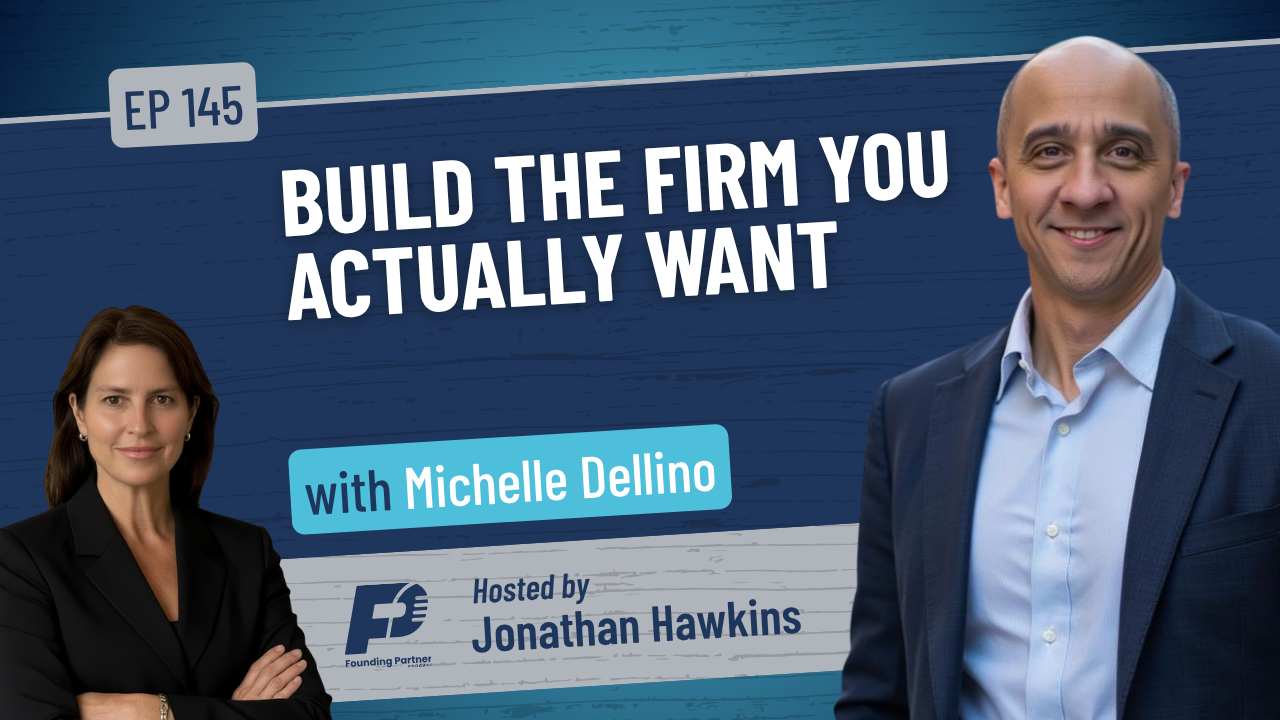
When Michelle Dellino started her own law firm in 2013, she did not have some lifelong dream of becoming a law firm CEO.
In fact, if you had told her earlier in her career that she would eventually own a practice, she would have thought it sounded terrible.
She wanted to practice criminal defense. But while working for another firm, Michelle began noticing inefficiencies and opportunities to do things differently. Then came a surprisingly defining moment. She asked for a parking space near the office and a little more money. Both requests were denied.
That helped push her toward something she never expected, building a firm of her own.
Today, Dellino Family Law Group has grown into a full-service family law practice with approximately 40 people and 17 attorneys, with several more attorneys preparing to join at the time of this conversation. The firm has expanded beyond Seattle into other parts of Washington, and Michelle is already thinking about what comes next.
But the most interesting part of her story is not simply how much the firm has grown. It is how much Michelle has changed as a leader while building it.
Learning What Kind of Firm to Build
Michelle started with both criminal defense and family law because criminal defense was what she knew and loved.
Over time, however, she recognized that the two practice areas created very different business models.
Criminal defense demanded immediate responses, constant availability, and a steady stream of new clients. Family law created longer client relationships and more opportunities for referrals. It also offered Michelle a clearer path toward building the kind of scalable business she wanted.
For a while, she resisted narrowing the practice. Eventually, she accepted the lesson that had been given to her early on: you cannot be all things to all people.
The transition was not instant. Criminal law disappeared from the actual caseload before it disappeared completely from the firm’s marketing and website. Michelle admitted that it took years to fully clean up that messaging and develop the discipline to stop taking the occasional criminal case.
That experience helped shape advice she now gives other founders. Start with a niche and a clear vision whenever possible, rather than trying to become everything at once.
Growth Means Learning to Let Go
Michelle’s role today looks almost nothing like it did when she opened the firm.
In the beginning, she handled cases, consultations, sales, marketing, hiring, onboarding, and virtually every other function of the business.
Today, her primary role is CEO. She focuses heavily on the firm’s finances, overall vision, strategy, and growth. Other people handle responsibilities that once automatically landed on her desk.
She still conducts consultations one day a week because she enjoys them, and she maintains a small group of select clients. But even letting go of consultations required a shift in how she thought about her value to the firm.
As Michelle explained, part of that shift came from looking at the economics. If someone else can perform a function effectively while freeing the founder to make decisions about strategy, expansion, and the future, keeping everything for yourself can become the thing holding the business back.
It also came down to something more personal.
She had to decide what she wanted her life to look like.
That does not mean stepping away from responsibility. Michelle was clear that nobody will care about the business exactly the way its owner does. The founder still carries responsibility for the clients, employees, payroll, and direction of the firm.
The goal is not to stop caring. It is to become more intentional about where that care and attention are spent.
Hiring for Values, Not Comfort
Michelle’s first attorney hire came from Craigslist.
She lined up several interviews in one day, picked someone she liked, and hired him without anything resembling the hiring process she uses today. He stayed with her for ten years and became an important part of the firm’s early history.
There were plenty of hiring mistakes after that.
One of Michelle’s biggest lessons was realizing that hiring for culture can easily become hiring people who simply feel comfortable or familiar.
Today, she looks much more closely at values alignment.
A strong résumé is not enough. Michelle shared the experience of hiring a highly respected managing attorney whose résumé looked excellent, only to discover that the role and person were not the right fit for the firm.
Now there is a hiring funnel. Candidates begin with a phone screening and move through additional interviews depending on the role. Some complete written skills assessments or personality testing before reaching the final decision maker.
Her philosophy has evolved toward being slower and more deliberate about bringing people in.
Because at this stage, a poor hiring decision does not only affect Michelle. It can disrupt an entire team.
The Hard Parts Nobody Sees
From the outside, growth can look like new offices, larger teams, bigger revenue, and professional success.
Michelle’s story is also a reminder of what people do not see.
She spoke candidly about 2021, a period when the firm was successful and she had achieved several things she once thought would make her happy. Professionally, financially, and personally, she had checked boxes she once believed would provide a sense of arrival.
They did not.
During that period, Michelle received a bar grievance related to a failure to supervise after another attorney handled a matter during the pandemic. The situation consumed her. She catastrophized what might happen, worrying that discipline could destroy the reputation and business she had spent years building.
The stress became severe enough that Michelle experienced suicidal ideation for the first time.
Looking back, she sees the situation differently. But she also recognizes how real that fear was while she was living through it.
Her experience became part of a larger lesson about mindset and resilience. Michelle had already traveled a difficult road long before becoming a lawyer, including dropping out of high school, running away from home, and being arrested as a juvenile.
She rebuilt from those experiences too.
As she put it, “The most important words that you ever, like, hear are the ones that you say to yourself.”
The difficult seasons did not disappear because the firm became successful. Michelle learned how to move through them differently.
Confidence, Risk, and Building Something Bigger
When Jonathan asked Michelle what she believes contributed most to the firm’s success, she did not point first to experience.
She pointed to confidence.
Michelle believes clients are ultimately looking for two things: hope that their situation can improve and security that the person sitting across from them can help guide them through it.
“I built a multimillion-dollar business just selling hope and security,” she said.
Her willingness to take risks mattered too.
Michelle hired early. Instead of spending months calculating whether every decision was perfectly safe, she was willing to try something, watch what happened, and pivot when necessary.
That willingness has carried into the firm’s expansion.
The firm recently opened an office in Spokane, roughly 285 miles from where Michelle sits in Seattle. Rather than treating the distance as an obstacle, the team used systems it had already developed through years of remote and hybrid work.
Michelle’s ambitions do not stop with Washington. She discussed expanding throughout the Northwest, with Oregon and potentially Idaho as future possibilities.
But she also recognizes that expansion only works when the infrastructure underneath it is ready.
Systems, administration, leadership, and back-office support have to grow alongside the vision.
Creating Marketing That Builds Trust
Michelle’s approach to growth is not limited to traditional law firm marketing.
For years, she has used educational content to build relationships with people before they ever become clients.
Her firm offers webinars covering both essential divorce topics and more specialized subjects, including relocation, high-conflict custody, and prenuptial agreements. Current clients can participate, and prospective clients can learn without immediately committing to representation.
She has also co-hosted a separation and divorce meetup for years, creating a space where people can hear from professionals and ask questions.
That educational content has become an asset that continues working long after it is created.
Michelle described meeting a prospective client who had already watched so much of her YouTube content that he knew what she was going to say. By the time someone reaches a consultation after consuming that kind of content, trust has already started forming.
For Michelle, the value goes beyond client acquisition. Someone may never hire the firm but can still walk away feeling less afraid of the family law process.
That combination of education, visibility, and connection has become an important part of how the firm grows.
Closing Reflection
Michelle’s story is not about finding one perfect blueprint for building a law firm.
It is about getting clearer as you grow.
She learned which practice areas fit the business she wanted. She learned that a great résumé does not guarantee a great hire. She learned that professional and financial success do not automatically create personal fulfillment. And she learned that letting go of responsibilities can sometimes be the only way to make room for bigger ones.
Her advice to future founders brings all of those lessons together.
“Start from the beginning with a clear vision of the kind of firm that you want to be.”
The vision will not eliminate mistakes. Michelle has made plenty, and she is open about them.
But knowing what you are building makes it easier to recognize which opportunities belong in the future of the firm and which ones are simply distractions.
If you do not know what that vision is yet, Michelle’s advice is equally clear: you may not be ready to start.
AND MORE TOPICS COVERED IN THE FULL INTERVIEW!!! You can check that out and subscribe to YouTube.
If you want to know more about Michelle Dellino, you may reach out to her at:
- Email: michelle@dellinolaw.com
- TikTok: https://www.tiktok.com/@seattledivorcelawyer
- Instagram: https://www.instagram.com/dellinolawgroup
- LinkedIn: https://www.linkedin.com/in/michelledellino
- Website: dellinolaw.com
Connect with Jonathan Hawkins:
- Website: https://www.lawfirmgc.com/
- LinkedIn: https://www.linkedin.com/in/jonathan-hawkins-135147/
- Podcast: https://www.lawfirmgc.com/podcast
Jonathan Hawkins: [00:00:00] So let’s go back. So you mentioned you were at a defense firm, I guess a criminal defense firm when you left to go start your own.
Take me back to, I’m always interested in what spurred you to do it? Were you an entrepreneur all your life and you just always knew you were gonna do it, and it was just a matter of time? Was it now I mean, what was it that got you to do it?
Michelle Dellino: I mean, when I think back on it now, I mean, I was always I had a little bit of a non-traditional path. I had a lot of jobs before I ever went to law school or really even college. So I did a lot of things. I like to sell things to people. I like to teach people that there are things that you need that you don’t even know you need.
So I kind of, I don’t know, had a little bit of an entrepreneurial streak because of that, but I never planned on having my own practice. If someone had told me that, I would’ve said, “That sounds actually terrible,” in the beginning. I just wanted to do criminal defense. But I realized while I was working for this other person’s criminal defense firm, and driving all over for her, and closing clients on the phone, and I realized the way that she was doing things [00:01:00] just wasn’t super efficient, and there was a lot of potential there.
Welcome to the Founding Partner Podcast. Join your host, Jonathan Hawkins, as we explore the fascinating stories of successful law firm founders. We’ll uncover their beginnings, triumph over challenges, and practice growth. Whether you aspire to launch your own firm, have an entrepreneurial spirit, or are just curious about the legal business, you’re in the right place.
Let’s dive in.
Jonathan Hawkins: Welcome to Founding Partner Podcast. I’m your host, Jonathan Hawkins. Today we have Michelle Dellino, who is a owner of Dellino Law Group, which is a family law firm based in Washington State. I would say based in Seattle, but fairly recently she opened a new office and maybe she’s got more that I don’t know about.
But Michelle, we- welcome to the show. Why don’t you sort of give us a brief overview of your firm and, and how many attorneys, that sort of thing?
Michelle Dellino: Sure, all the good stuff. Yeah, [00:02:00] Jonathan, thanks for having me. It’s great to be here. Yeah, we did just open a new office. Our plan is not just to stop there. So my firm was founded in 2013. When I started out, we were doing family law and criminal law. My background was first in criminal law, but we are now a full-service family law firm.
We have our main office in Seattle, and we have offices starting to move all around the state, in Eastern Washington, in Spokane, over on the peninsula in Bainbridge Island down in Vancouver, Washington, which is near the Oregon border. So we are really starting to cover the state. We have the, probably the second-largest family law practice in Washington right now.
We’ve got 17 attorneys. We’ve got four or five more starting in August, and I think we have a total of around 40 people. So we’ve got all kinds of things. We’ve got paralegals. We have an intake team. We actually have a discovery attorney team and you know, a few other things in between. So our practice is litigation-based [00:03:00] family law, so we’re focused on helping people that need court intervention.
Sometimes people don’t need to go to court, and they’re able to solve things more amicably, and we do that too. So not every case resolves in a trial, of course, but you know, a lot of the time you need to go to the courtroom during the process, whether it’s a high-conflict case or a DV case or w- you know, whatever that may be.
So we do all of that, but we’re litigation-focused, and yeah, that’s what we got.
Jonathan Hawkins: So I wanna go through all of that, but I wanna start with opening the new office. So, I think that’s pretty recent just from things I was reading. What… And it’s on the other side of the, the mountain range, right? So
Michelle Dellino: Yeah. It’s, it’s as far away… It’s 285 miles from where I’m sitting. So yeah, Spokane is the second-biggest city in Washington, but it’s a totally different client base, totally different community. And it just sort of felt like time for us to go over there. And that was in July when it opened.
We started planning, you know, before that, earlier this year. I [00:04:00] started actually thinking about it last year. And so this year felt like the, the time to make it happen.
Jonathan Hawkins: It’s funny, I’ve been to Spokane maybe three times and I’ve never been to Seattle.
Michelle Dellino: You’ve been to Spokane? W- why?
Jonathan Hawkins: Many, many, many years ago I had a case and our client was based in Spokane and so we had to go out there a number of times for depositions and things. So yeah, so yeah. It’s very different, very different climate and everything
Michelle Dellino: Yeah. And that’s
Jonathan Hawkins: what I imagine that Seattle’s like. Yeah. Although I am coming out to Seattle soon, so I, I will look you up when I come out
Michelle Dellino: All right. I hope you do. That sounds good.
Jonathan Hawkins: So yeah, so let’s talk about, so before you opened the Spokane office, had you opened any other satellite offices or was it sort of the first
Michelle Dellino: we ha- well, not out of our immediate area. We have like we’re in Seattle, and then right across the water, and this is still in the Seattle metro area, we have a Bellevue satellite office that I opened several years ago. More than that now. So we’ve had that, and then we have two offices in [00:05:00] Seattle.
But we hadn’t really gone outside of our immediate jurisdiction. Yeah … and now this year we’ve gone with full physical offices in Spokane and over on Bainbridge Island, which is still pretty close, but it’s a different county and kind of like a little different world. So two in really close to each other
Jonathan Hawkins: Okay. So take me through, I’m always fascinated when people open up the new office. Now it, it’s still in the same state, but it’s basically as far as you can be and still be in the same state. So what, take me through the process of how do you, you know, how do you, you know, go in with the, scout the office space, and then you open it up, you gotta staff it with people, you gotta start advertising for it.
Take me through sort of the lead up and the process of how you’ve accomplished that.
Michelle Dellino: Yeah, I mean, I think there’s different ways you can do it. I like to be involved in what’s going on. And so when it came down to scouting the location, I grew up going to Spokane as a child. My dad was born there, and we had family there, and I had really, honestly, negative opinions about it. I just hated going there.
But I kind [00:06:00] of put on a different look at it and realized that it’s not the Spokane of my childhood. And we went over there. We enlisted a broker. I’ve, I have a great broker in this area, and he hooked us up with somebody over there, a commercial broker. Told him what we wanted. He sent me a bunch of spaces ahead of time.
So you know, I thought, “I’m not gonna be ma- able to make a decision about where my team will be and where my client’s gonna be unless I see these places.” So couple of us went over there. We did kind of a, an all-day thing where we looked at a ton of spots, and during that time, it was really easy to see what we didn’t want almost more than what we did.
So we narrowed it down. We went back again. We sort of solidified our place, and once we had our place, that was really important. It’s important for all the things for law firms, I mean, one of the most important being your Google business page. So once you’ve got that and you know, “I’m gonna be here”
And we did a little bit of looking into demographics before that. Do we wanna be where the other law firms are? Where are the people? Where … You know. So we made [00:07:00] ch- We decided we wanted to be in downtown Spokane, so we found somewhere that’s, that we liked. And once we dialed that in, then we started to dial in our marketing and our Google business page and all of our online marketing efforts and started solidifying that.
And then once we did that, we started interviewing. So we basically posted some jobs, reached out to people, and then we had an interviewing day over there, so I got to go over there and do that. Staffed up a little bit, and now we’re rolling, so
Jonathan Hawkins: Did anybody from your Seattle office, are they gonna
Michelle Dellino: No.
Jonathan Hawkins: a little while to sort
Michelle Dellino: No. Well, we had… I did send, we had somebody new starting over there, the person who’s gonna kind of man our office, and we sent a couple people from here over there for a few days to kind of get her acquainted and just make her feel less like she was on an island. We also have a attorney who’s been here a while that lives in Spokane part-time, so she’s over there too, which is great.
But nobody from over here, I don’t think, will really wanna move over there, although your money would go further over [00:08:00] there. So I mean, if you wanted to be over there, they’ve got, they’ve got warm summers, so I don’t know. It wouldn’t be for me, but I think maybe eventually
Jonathan Hawkins: Flash, flashbacks to your youth
Michelle Dellino: Yeah. Yeah, exactly.
Jonathan Hawkins: Yeah, it’s very… So you, so that m- makes a lot of sense. You get the location and then you start sort of the marketing process. So I assume you’re getting leads and maybe getting some cases, and maybe just handling those out of Seattle, and then boom, you start putting people in?
Michelle Dellino: Exactly, yeah. Spokane, they offer virtual appearances there too, but there’s a real preference for going to the courthouse. So, you know, you could practice there, and we’ve had cases there before. A lot of counties in Washington still have the offer for option for virtual appearance.
Where I am in Seattle right now, I’m, like, really close to the courthouse right over here, but no one ever goes there because our family law calendars are 100% virtual. So, Spokane is kind of a mix of both. So yeah, we’ve had cases there in the past, and now we’re starting to bring them in, and we’re starting to see a real lead volume related to that.
So it’s kinda cool [00:09:00] to realize we can put people on the ground over there now.
Jonathan Hawkins: So how’s it been so far managing that office from Seattle?
Michelle Dellino: It’s been pretty easy. All of our, our functions, our back office is kind of centralized anyway, and we have a lot of people that work for us that work remote. So we… I, I would say we’re not really what you would call a traditional hybrid office. I think a hybrid… When I think of a hybrid office, I think of you have to go in part of the time, and you can be remote part of the time.
For us, we are hybrid in the sense that we don’t require attorneys to come into the office unless they need to meet with a client. We we, we allow most of our staff to work remote. We do have some people that we say, “Hey, these are your anchored days in the office,” for support staff. But managing isn’t really that much different to manage that office than it is to manage, I have an employee that lives in California. I’ve got an employ- two employees that live in Georgia, so it’s not really that much different. And I think because we’ve been operating [00:10:00] pretty much virtually for part of the time for the entirety of the firm, it feels just kind of normal, which is cool.
Jonathan Hawkins: So for your version of hybrid, was that because you wanted it to be that way or, or was that
Michelle Dellino: Oh, yeah.
Jonathan Hawkins: helped for recruiting or, or
Michelle Dellino: No, it was always because I wanted it to be that way. I mean, when I started the firm in 2013, I definitely wasn’t thinking about recruiting. I was just thinking that I like to go where… Part of the benefit of working for yourself should be able to, be able to work from wherever. And so back then, I would just think, “Well, as long as I’m here and when, when we have court,” I wanted to build the practice back then, so everything was effectively in the cloud.
So we, we never had paper files. We were always we were always kind of, I think, doing that. A lot of people moved to that during COVID, but it was no different for us during COVID because we were always that way, and it was ’cause I wanted it to be that way. And I think that at a certain point in time, especially practicing law is stressful, so, you, you know, and not everyone works the same.
I worked at Starbucks many, many years ago, and one of the things that they taught me [00:11:00] there about management was you can’t manage everybody the same, and everybody doesn’t work the same, and that really stuck with me. Some people are awesome when they come into the office. They need that quiet. They need to be in an office space.
Other people, it just destroys their productivity. So when I think about hybrid, I think it needs to be what’s right for that person, or it’s never gonna work no matter what.
Jonathan Hawkins: So are you a a Lee Rosen
Michelle Dellino: Oh, yeah. Oh, yeah. I ‘
Jonathan Hawkins: Cause he was all, you know, working all over the world, and so I don’t- did that have any influence on you way back?
Michelle Dellino: Yeah, yeah. I, I started in Lee Rosen’s institute in I think 2014 or ’15. So yeah, Lee… I was, like, the really, the early the early, the early advent of that kind of stuff. And so Lee was all about working wherever, opening satellite offices, doing all the things. You know, I learned a lot from him. His compensation model, pretty much everything back then.
So yeah, absolutely
Jonathan Hawkins: So I, I did a little stint with [00:12:00] Lee, but it was later. It was maybe in 2020, I don’t know. But I’d s- I had followed him and knew of his stuff forever, and I just finally did it. But, you know, Lee was one of the early, you know, we’ve got all these consultants and practice people and all these now, but back then Lee was one of the, one of the only ones, right?
Michelle Dellino: Yeah, he was. He was. It, and yeah, I mean, that was it. It was like, that was it, and he did these seminars. I remember one, the first one I think I went to was 2015 probably. He did one in New York, and he would just rent a Regis space for the day, and there was a bunch of us in there, and we would just sit there and do like a mastermind for the day, and that was like the only…
Nobody else was doing that. Now it’s like you can go to mastermind every other week if you want to, right? But yeah, I mean, I think I went to one in New York. I think I went to one in Vegas. I went to one in Philadelphia. I was pretty into his stuff. If he was doing it, I was going to be there for the first few years, ’cause there wasn’t anything else.
I mean, and it, and he really had a really strong community. So it was
Jonathan Hawkins: And so the other thing Lee Rosen, at least my, [00:13:00] my sense of Lee Rosen was sort of the stage flat fee billing model for family law. Do you do that? Do you do that at all?
Michelle Dellino: No, and it’s funny that you say that ’cause like I, I really felt because of Lee that, oh, I should be doing this. I felt like that in the beginning. I felt like I was gonna take my firm to flat fees. I played around with it a little bit, different stages. I played around with it with agreements.
We did pre- we do prenups, things like that. And I did flat fee in criminal ’cause that’s kind of the model, right? But then I realized that’s not the standard here, and sure, I could be the first one to really start doing it, but I think that when you have a model that works, you don’t wanna mess with that.
And so I felt like what we were doing was so good and our… We don’t struggle with collections like ma- many other firms do. So I just felt like if it’s not broke, don’t fix it. I think with the advent of AI and the way things are changing, there will need to be, and I envision someday having a different tier of services that are [00:14:00] flat fee services.
But with litigation work, with what we do, hourly works. But yeah, Lee r- Lee pushed that so hard, and there were a lot of people that were kind of like, “Oh my gosh, if you’re not getting on board with flat fees, you’re doing it wrong,” and I had to kinda get past that.
Jonathan Hawkins: That’s interesting. So, you mentioned you started out, you did criminal and family. So maybe why did you do both, and then why did you jettison the criminal?
Michelle Dellino: Yeah, great question. I went to law school because I wanted to do criminal law, like, for a number of reasons, but it was the only thing I w- really wanted to do, and I worked at the public defender during law school. I did some jury trials as a law student. I loved it. Like, I really just, that’s all I wanna do.
And so then I got a job working for the court. That was fine, but ’cause they weren’t hiring at the public defender, I worked as a contract attorney there, I think it was for $14 an hour, after when I first got my license for a little while. And then when I was done working for the court, I went to work for a private defense firm for a couple of years.
[00:15:00] And so when I started my practice, I couldn’t imagine not doing criminal, but I also kind of knew enough by that time to know that criminal is a differ- is a business model that relies on immediate response, always being available, and you have to always be buying more clients. And so that became really obvious to me, and I thought, “There’s gotta be a better way to…”
At the time, I thought about it like supplementing the criminal practice and just being something else for passive income, for someone else to be working on the family law while I would do the criminal. So that was why I did it in the first place, and then I realized really quickly, and Lee actually, I did some coaching with him in the beginning, and he had told me very early on, “You know, your practice is not gonna take off until you stop doing criminal, and you can’t be all things to all people.
It’s a problem for marketing. It’s not as good of a business model.” And I really didn’t wanna hear that for a long time. So I had some attorneys doing criminal, and then I started building up family because one thing was undeniable, the [00:16:00] family law business model is better, and the relationships are better.
The criminal defense, it’s like a quick DUI, in and out. They don’t really wanna talk to you. You’re probably not gonna see them again. Family law clients are gonna be your clients for a long time. You’re gonna know everything about them, and they’re gonna refer people. And the biggest thing, I think, is that a cr- criminal client’s gonna pay you for a misdemeanor once, and that’s probably all the money you’re gonna see.
A family law client is going to continue to keep paying you. I mean, that’s just the reality, and it’s, and this is a business as much as a lot of lawyers don’t wanna acknowledge it. This is a business, and we are here to make money. I’m not here just solely out of the goodness of my heart. I do like working with clients.
I do like helping people, but I’m here to make money and to take care of the people that work for me, and so family law allows that a lot better. So finally, I got over myself and stopped practicing criminal law.
Jonathan Hawkins: It’s a lot harder to leverage criminal law,
Michelle Dellino: Oh, so hard. Yeah.
Jonathan Hawkins: I’m not sure you can. I
Michelle Dellino: No, I, I don’t know anybody that’s built up a … I mean, I know people that are successful criminal attorneys, but I don’t know anybody [00:17:00] that’s built a, a large criminal defense practice really efficiently or effectively. You’re just reliant on Google, and it’s really, it’s, it’s really difficult.
And I guess one thing good that came out of criminal post-pandemic is there’s a lot more virtual appearances. Before that, I’d spend my early years, I’d be in the car all day driving around to every little misdemeanor, muni court, sometimes the superior court. Like, you’re in the car all the time. I mean, I burned out my first car it was a 2004 Saab, putting on like 200,000 miles just driving all around the state of Washington, so
Jonathan Hawkins: Yeah, you drive around all day in, in the courthouse, and then at, in the evenings is when you start catching up with all the people that called in and whatever you had to do.
Michelle Dellino: Yeah. Calling back leads. Yeah. It’s a grind. But then you gotta go to the jail to see potential new clients. I’d get up at night and run down to the jail ’cause somebody might wanna meet with me, or their parents wanna meet with me, and I don’t, I actually don’t miss that at all. I still think about, I think about my last jury trial, which was a hung jury, a lot.
I think about picking a jury. I think about how much more fun that was. Sometimes I think I’d [00:18:00] like to do that again, but if I never do it again, that’s totally okay
Jonathan Hawkins: So tell me about family law out there for the, for the, the trials. Is it bench trial? Is it, or
do you have jury
Michelle Dellino: bench trial, complete bench trial. And that’s why I think attorneys that have jury trial experience, whether they’re civil litigators or criminal attorneys, kind of have a… It’s, it’s easier to get over the fear of a family law trial because it just feels more like a conversation with the judge.
It doesn’t feel like… It’s a trial, and family law trials are document-heavy way more than criminal trials. They’re very paper-heavy. There’s a lot of financials. There’s a lot of experts in cases that are going to trial, and there’s a lot of, you know, there’s custody, so you’ve got custody evaluators. But it’s all a bench trial, so in a way, if you have good trial prep skills, you sh- kind of should be prepping your family case from the start like it’s gonna go to trial, and then it’s not really that heavy of a lift.
I don’t think a lot of attorneys would agree with that, but that’s how I see it.
Jonathan Hawkins: Okay. So you decided to [00:19:00] phase out the criminal and, and go to family. H-how did you, h-how did, I’m curious, the logistics of, back to Lee, he said the mixed message. How did you start to change your messaging and your website? Was it just cold turkey gone one day, or did you
Michelle Dellino: No, I wasn’t. I phased it out. And you mentioned the website. Man, I gotta tell you, like, my website, when I… The only, like, SEO optimization I did in the beginning was for criminal, ’cause it was just like I didn’t care about the family as much, and you had to be able to, you know, be found by criminal clients.
So I had a lot of, like, criminal content on my website, and it was helping our website rank better even though it was totally not valuable. So it was still there until, like, it was hidden, but it was still there until a few years ago till we totally redid the site. We had Hennessey Digital totally redo our site, and they did a phenomenal job, and they’re a great marketing partner.
But before Hennessey, we had redone the site several times since we had just become a family law firm, and there was still, well, there were still places where we hadn’t [00:20:00] removed the criminal. But I, I knew I had to do it because Lee had always told me, you know, it was mixed messaging. And then I started to hear from other people, like, “Well, we’re not being taken as seriously as the other family law firms because we do criminal.”
I didn’t love that ’cause my sweet spot was like, we can do your divorce, we can do your protection order, and we can do your misdemeanor assault, and it’s all the same transaction or occurrence that caused all of these. So we kind of had a, a corner market on that, but we had to stop doing it. We had to just…
We were cold turkey as far as we wouldn’t take the cases anymore, and we started referring them, but there was a lot of cleanup that needed to happen that took, I’d say, probably three years or more to really clean house and get all of the criminal messaging totally gone. So it took time, and I had a hard time.
I would hang on to a client or two, or somebody would call back in, and I’d be like, “Oh, I’ll just take that one.” And then I, I had to just finally have better discipline and stop doing it, so.
Jonathan Hawkins: So here’s a question for you, get your opinion. I’m a big believer in niche practices. I love it. You know, I, I, I agree [00:21:00] with Lee, sort of the mixed message. It’s hard. I’ve even, you know, I’ve represented a lot of lawyers over the years that bring, you know, they wanna form a new partnership and they’re bringing two different types of practices.
And in their mind there’s gonna be the synergies. Maybe sometimes it works, some- sometimes it doesn’t. But I’m curious about this. One thing that I have seen a little bit of with family law, paired with family law are sort of an estate planning practice, because I guess the theory is, is when people separate, then all of a sudden they gotta redo everything.
What are your thoughts on, on that?
Michelle Dellino: Yeah, we do estate planning. So, and we really only, but we really only started doing it I mean, I have always kind of done it. I did it as a a volunteer attorney. I’ve been doing it as a volunteer attorney for, like, 15 years through a neighborhood legal clinic. And so I would always do, like, basic one-off, like, flat-fee wills for people if they asked, and then I realized a couple of years ago exactly what you said.
It’s a major life change, and you’re disservicing these people if you’re not referring them on to estate planning or doing it for them. [00:22:00] And we also do a lot of prenuptial and postnuptial agreements, and every time that you confront a prenup and a postnup, you have to talk about if the agreement is going to end at death or if it’s going to, or if these rights are gonna alter your estate agreement.
So it’s really common now that we have a client that does a prenup and an estate planning package. So we don’t do super high complex like, you know, tax planning trust work or anything like that. We still refer that out, but we do basic estate plans, and at the end of a client’s case, we have a whole workflow that basically asks them if they are ready to do an estate plan, so
Jonathan Hawkins: And so you, you, you can internally cross-sell or upsell or whatever you call it. Is that on your website too? Is that something that you
Michelle Dellino: Yeah, we have estate planning, yeah, we have estate planning on our website. I don’t think, and we have a, I don’t think we have well, we have a little bit of marketing for estate planning, but not a lot because we don’t need it. It’s kind of like it’s an in-house funnel essentially, ’cause we have all these people that are coming in for divorce and they’re gonna [00:23:00] need to change it, or they don’t even have one, you know?
So we, we have it on the website, we talk about it. I like to talk about it because I think when you’re spending money on things like prenups and estate planning, it’s eliminating lots of money you’re gonna spend later. But we’re not, it’s a lower, I mean, I hate to bring it back to this again, but I will.
It’s a lower value case. So for me to be spending a bunch of time trying to bring in a lot of estate planning doesn’t make sense. That money is better spent bringing in like one divorce is five estate plans or whatever, you know
Jonathan Hawkins: Yeah, I think that’s right. I feel like if you’re gonna do estate plan, it’s a different business model. I think your, your processes, your, your staffing, all of it’s gotta be sort of set up for that sort of process and, and it’s hard to do both. So I, I, yeah, I get that. So let’s go back. So you mentioned you were at a defense firm, I guess a criminal defense firm when you left to go start your own.
Take me back to, I’m always interested in what spurred you to do it? Were you an entrepreneur all your life and you just always knew you were gonna do it, and it was just a matter of time? Was it [00:24:00] now I mean, what was it that got you to do it?
Michelle Dellino: I mean, when I think back on it now, I mean, I was always I had a little bit of a non-traditional path. I had a lot of jobs before I ever went to law school or really even college. So I did a lot of things. I like to sell things to people. I like to teach people that there are things that you need that you don’t even know you need.
So I kind of, I don’t know, had a little bit of an entrepreneurial streak because of that, but I never planned on having my own practice. That never would if someone had told me that, I would’ve said, “That sounds actually terrible,” in the beginning. I just wanted to do criminal defense. But I realized while I was working for this other person’s criminal defense firm, and driving all over for her, and closing clients on the phone, and I realized the way that she was doing things just wasn’t super efficient, and there was a lot of potential there.
So when I realized that, I kinda tried to share some of my thoughts. They really didn’t wanna hear it. They weren’t that receptive. And I would drive, like I mentioned earlier, I would drive all over hell to go to court, and all I [00:25:00] really wanted was a parking space in, near the office because the office is downtown, was in downtown, and I’d have to drive to court in the morning, and I was supposed to come back in the middle of the day somehow and be there, and then I’d have to go to another court.
So I wanted a parking space, and I think it was, like, $189 at the time. And so I asked for a parking space, and when they said no to that, I thought, “This is probably gonna be the end of me being here.” I asked for that, and I asked for just a little more money, and they said no. And I said, “All right. Then it’s time for me to go,” and I gave them notice.
And they ran me all over hell while I worked there, and I worked out my notice period. And on my last day, I came in. They knew it was my last day, and I was coming in to pick up my stuff. They had cleaned out my desk and put everything in a trash bag. And I yeah, and I think I was the only person at that time that had left there, like, on good terms.
I mean, they didn’t fire me. I quit ’cause they wouldn’t give me a parking space, and I thought we could do things better. So I came back the last day, and my stuff was in a trash bag, and I kinda said, you know … I [00:26:00] said something about it. I don’t remember what I said, but I said something. And he was like, “Well, you’re moving on.
We gotta get your desk cleaned out for a new employee.” And I was just kind of realized then this isn’t how you treat people, and I’m never gonna treat people like that. So I think holding onto things like that is really important because, you know, sometimes you learn what not to do, and if you don’t learn from that, then that’s your fault, right?
But no, I would, so I would never clean out an employee’s desk like that.
Jonathan Hawkins: And at least put it in a box, not a trash
Michelle Dellino: At least don’t put it in a trash bag. I mean, come on. And at least, and they knew I was coming back there, so it was just kind of really bad. And y- you know, the whole idea to start my firm was kind of ’cause I was pissed off about the parking space, and because I realized I could probably make more money because I saw these things that they could do more efficiently.
And so it just seemed like a good idea, but I sure didn’t go into it thinking I was ever gonna do this. That was never my plan. And but then once I started working for myself, I realized I can do things in a way that makes sense. I can have people work for me, ’cause I started hiring right away, and I can [00:27:00] try to change people’s lives that way.
Instead of being one-to-one, I can be one-to-many. And also too, I’m kind of insulated from having to worry about what anybody else thinks of me, and I kinda like that
Real quick, if you haven’t gotten a copy yet, please check out my book, the Law Firm Lifecycle. It’s written for law firm owners and those who plan to be owners. In the book, I discuss various issues that come up as a law firm progresses through the stages of its growth from just before starting a firm to when it comes to an end.
The law firm lifecycle is available on Amazon. Now, back to the show.
Jonathan Hawkins: So let’s talk about one of your first hires. I came across this on LinkedIn, I think. And, and for some of the younger folks, they may not even realize what this is, but you hired your first person off Craigslist, which back in the day was huge. But still, even as big as it was, hiring an attorney off Craigslist,
Michelle Dellino: Yeah.
Jonathan Hawkins: I kind of crazy.
Michelle Dellino: It was a little crazy. Yeah, I kind of was like, “I need to hire.” I didn’t wanna pay, like, LinkedIn. I kind of felt like I was posting on the job [00:28:00] board at the law school, and there just wasn’t a lot of anything. So I thought, you know, you get everything else on Craigslist, and there was a job section, and there was maybe a…
I don’t know if there were a lot of lawyer jobs in there. So I posted a attorney job on Craigslist, and I didn’t really know what I was doing. But then I had one day at my office, and I had, like, I don’t know, six or eight people stacked up. I had them come in. I interviewed a bunch of people, and I picked one, like, right that day.
I didn’t… There was no interview process or anything. It was like, “Okay, I think this will work.” So I hired him. I hired an attorney that day, and he was a pretty new grad. He’d been, maybe had like a year of experience, didn’t really know what was going on, but I liked him. I felt like this was the right pick.
And he was with me for 10 years. Not all of it was good, but he was a pretty critical person for me for a long time. So yeah, and that came from Craigslist, so there you go.
Jonathan Hawkins: You know, it’s interesting about hiring. You mentioned you didn’t know what you were doing. [00:29:00] I don’t think anybody does.
Michelle Dellino: I still don’t. I
Jonathan Hawkins: even if you think you do, y- you’re gonna step in it. I mean, that’s just part of the game. I mean, you know, just right or wrong, you’re gonna h- you’re gonna hire the wrong people.
Sometimes you don’t even know who you need until after, you know, two or three hires. You’re like, “Oh, this is what I need.” So how did you figure out the hiring stuff over the years, or have
Michelle Dellino: And I, I figured it out from making a lot of mistakes that’s how. And even now I wouldn’t say that I necessarily have it totally figured out. I think I learned… First of all, I learned that people say they’re hiring for culture, they, what they really mean is they think they’re hiring, they’re hiring for somebody that’s comfortable for them.
It doesn’t necessarily mean that’s what your office needs though, or that’s really even what your culture is. You’d hi- I’d hire people in the beginning because, oh, so and so says they like them, or they worked with them, or whatever, or they knew somebody, and I wasn’t really objective about hiring for the right values.
And so now I think about it [00:30:00] more. I’ve gotten away from, “Do I just like this person?” Sure, I want people in the room that I want to be with, but at the end of the day I look for does this person fit into our values and what I think is important for the firm. It’s not just about a resume. I’ll tell you what, I hired a managing attorney a couple years ago who had a freaking great resume, highly respected in the legal community, really wanted to do managing the lawyers.
It was an absolute train wreck for two years. The person really didn’t want to do that job. Just ’cause you’re a good lawyer doesn’t mean you’re a good manager. The person was really toxic in a lot of ways. And the resume, like, if I just went by resume, that was one thing, but I didn’t… Even then I didn’t look for values alignment.
And so that’s now really what I come back to. What’s the values alignment, and are these values this, this person really has? Because if not, it’s gonna disrupt the team I already have. It’s not just about me anymore, right?
Jonathan Hawkins: So have you developed sort of a, an interview questions you make sure you ask? Do you have, like, assessments or
Michelle Dellino: We have a [00:31:00] funnel, we have a funnel now where people come in. We have a process. That’s the other thing. It can’t just be me. I mean, we do hire some people, and depending on what role it’s for, I might not meet them, which is probably okay. For certain roles, I definitely will meet them. But we have a, a process for the different roles that we have.
They all start with a phone screen. If they get past a phone screen, they move on to a different interview with somebody else, depending on the department. Then if they are, like, a support staff person, they’ll receive a written skills assessment that they need to do. We use a personality test at, at times too, where people will do that, and we kinda get the, the background on the way this person might think about different things and how they handle stress and things like that.
And then they kind of move along the funnel, and then if they get to the end of the funnel maybe I’ll meet with them or whoever is gonna make the decision in that department will meet with them, and then we’ll make an offer. But it’s no longer it’s no longer just, you know, quick to hire. I’m pretty much now, like, slow to hire and quick to fire.
Jonathan Hawkins: Yeah. Yeah. So the other thing about building a firm, I mean, your [00:32:00] firm, you got a kickass firm. You’re kicking ass. You just opened this new office. You’re, you know, it looks great. But it’s not always like that, and there’s a lot of ups and downs and heartache along the way that not everybody gets to see. You know, what are some of the things you experienced?
That one post or somewhere I came across, I think you said 2021 was a rough year. I don’t, I don’t know what happened, but obviously there are just things that happen when you, when you’re building anything that some days you’re like, “Why am I even doing this?
Michelle Dellino: Why am I doing this?
Jonathan Hawkins: stop.”
Michelle Dellino: totally. I, I would say yeah, I would say that I’m in a really good spot now. There’s still… And, and just ’cause I’m in a really good spot now doesn’t mean that some days… My, my mood is still very much dictated by what’s going on here. If it’s great, everything’s great. If it’s not, everything’s not, right?
And so, that is, I think that’s just, I think that’s entrepreneurship. I think that’s running and leading any business, but especially when you own the business. But yeah, along the way there’s been, there’s been definite ups and downs. It has [00:33:00] not all been good. We’ve had some really hard times. It’s, when I think about 2021, the best way to put it is this.
Like, in 2021, I, I’m the kind of person where I used to always think, oh, because I came from, you know, before law school or whatever, there were times when I didn’t really have any money. I had no connections. I had no anything, right? And so I would think then, “If I have this measure of professional success, I’m gonna feel legitimate and I’m gonna be happy.
If I have this level of financial success, I’m gonna be happy and everything’s gonna be fine.” So I would think if those boxes were checked… Oh, and then before 20 21, I gained… This is a kind of connected to this. I gained a ton of weight. Like, I had gained like 80 pounds in the first early years of my practice ’cause all I was doing was my practice.
And so I started to lose a lot of that weight in 2020. So then I thought, “If I lose the weight and if I have money and if my practice is successful, I will have everything.” By 2021, I, my practice was [00:34:00] very successful even then, I had money, and I’d lost weight, and I was still not happy. So that just goes to tell you, like, that is not the measure of true happiness, right?
And what happened in 2021 really was, I received a bar grievance for the first time, and that bar grievance was for something that happened during the pandemic when everything had gone remote, things were really crazy, and I was actually really sick at the time. And something happened in the office, and another attorney handled it, and it ended up being screwed up, and that client complained, and it was like a year later.
And so I got this grievance, and it was for failing to supervise. It wasn’t even, like, my client. And, you know, I’d gotten a couple grievances before that were just people that were crazy writing in, and they’d just been dismissed at intake. And this grievance, they opened an investigation, and they were talking to people, and my ethics counsel was like, “Yeah, this was something that you should have corrected this by doing XYZ.”
And I [00:35:00] was really, really, really freaked out, and I catastrophized the whole thing in my mind, and I was like, “Oh, my gosh. You know, if I’m publicly disciplined, it’s gonna be the first thing people Google. I’m gonna lose all the business at my firm. Everybody gonna lose their job. Everything that I’ve worked for is gonna be gone.”
And now, like, I wouldn’t see it that way, but I really went down the rabbit hole on it. I was completely stressed for months. And I just sort of started feeling like, you know, there’s no way out of this for me. I’m stuck with this, and then my life’s gonna be ruined.
And it sounds so silly. Maybe to some people it doesn’t, but it sounds silly to me now. But at the time, I was in this really bad tunnel vision over it. And I had a really hard time pulling myself out of it. At that time I’ll even say, like, at that time, for the first time ever, I had suicidal ideation for the first time ever. I thought, “Everybody else is better off if I’m not here.” And that, to me, was like, really the bottom. So yeah. It’s not all roses, man. Like.
Jonathan Hawkins: Yeah. Well, thanks for sharing that. And I think you’re right. I think [00:36:00] anybody that’s trying to build a business, you know, you have the highs and you’re like, “I’m kicking ass.” And, I’ve seen it, it’s happened to me. I’ve seen it happen to others. You know, my two firms ago, we had our best year ever, and then within a year the firm was gone.
It’s like these things happen, and it’s usually right after you think you’re on top of the world. And if you haven’t had gone through it, I don’t wanna scare the listeners, but if you haven’t gone through it yet, you probably will. But the silver lining is almost always you’ll get past it and things will get better probably will be even better than they were before.
I mean, obviously your firm is at a place probably, you know, that it hasn’t been before, so, good thing you didn’t let that hold you back, kept going
Michelle Dellino: I turned it around, and that’s the thing. I think if I can turn something around, anybody, anybody can. And if I can… I mean, I, you know, I came from dropping out of high school, running away from home, getting arrested as a, a juvenile. All kinds of really bad shit, honestly, and had to make a [00:37:00] decision about my life.
And if I can come from that to this, literally anybody can with the right mindset. It’s all about your mindset. The most important words that you ever, like, hear are the ones that you say to yourself. So if you can get that right, you’re gonna be fine, you know?
Jonathan Hawkins: Easier said than done.
Michelle Dellino: E- yeah.
Jonathan Hawkins: Yeah.
Michelle Dellino: Fair, fair, Jonathan, fair. Easier said than done.
Sounds so easy now, but it definitely… Somebody said that to the time, I probably wanna slap them, so that’s fair.
Jonathan Hawkins: Yeah. So, so back to the firm. You- you’re covering, if not all, most of the state of Washington now. Have you ever thought about, all right, we’re gonna, we’re gonna cross, go across the border, go down to Oregon? Is that something you’ve thought about?
Michelle Dellino: Absolutely. My goals are absolutely to expand to the entire Northwest, so I think Portland and Oregon is, is the next logical step, and Portland is somewhat of a similar market to here. It also probably means since we are over in Spokane, we’re super close to the Idaho Panhandle, so that’s [00:38:00] another real strong possibility for us.
But yeah, going and having a multi-state practice is definitely next on my list. Like, we could stay where we are now and that would be totally fine, but that’s not that’s not all I wanna do
Jonathan Hawkins: You know, it’s interesting opening another office in the same state. You’re at least in the same regulatory regime. It’s, it’s still s- you know, it’s logistically it’s in another, you know, across the, the state. There’s that. So you learn. Going across to a new border, even if it’s closer geographically, you start adding the complexity of, you know, you got the Oregon State taxes, you got the Oregon Bar, you got different IOLTA’s, all the stuff.
Are you licensed in Oregon?
Michelle Dellino: No, mm-mm. No, we have a couple attorneys that are and it’s not too difficult. They have- there’s a reciprocity with just a CLE that you can mainly do between Washington and Oregon. The law’s different there, so I’m probably not gonna be the one that, that learns family law in Oregon. But you know, it seems like the next best place to go.
[00:39:00] But yeah, the whole idea, that’s the thing, that’s probably why I haven’t done it yet, is just the administrative work of opening another office is a lot. Like, there’s a lot to do there in your own jurisdiction, and going multi-state and the regulatory stuff, the insurance, and all of the, the changes to all the things you’re doing now, it’s, it’s basically kind of a heavy lift.
So sometimes having you know, more back office support with that, I think eventually will make it an ideal for most people. I think you kind of have to have your systems and your admin and everything dialed in, and then once you do that, then you can start thinking about… Like for us, we have all that dialed in, so then we could start thinking about opening in other places in the state.
And now it’s kind of next level of dialing that in to think about going multi-state, so.
Jonathan Hawkins: And so what’s your, what’s your role in the firm now and, and how has that changed from practicing attorney, handling all the cases and the market, doing everything to what do you do now? Do you still do client work? You
Michelle Dellino: Yeah, it’s changed a lot. I mean, first thing I’ll admit is yes, I [00:40:00] still do client work. I shouldn’t do as much as I do. I went through a period where I didn’t do any client work. I started out with doing everything, doing a ton of cases, being the HR, the sales, the marketing. I took every intake call, I did every consultation, everything.
And then over time I switched to no longer doing every consultation, no longer being the one that’s doing the hiring. I would do all the onboarding, everything. Now, if a new employee starts here, our IT people get them their computer, our administrative person gets them on board, they have an onboard list, and I don’t have anything to do with that.
So I’m no longer doing all of that. I have been pretty heavily involved in the marketing over the years, but now I have somebody else who’s leading the marketing, so that’s a good thing. I’m still really involved ’cause it’s my favorite thing, but it’s not … Like, I’m not responsible for the whole marketing funnel anymore, so that’s nice.
So now my role is really twofold. I mean, I’m really the CEO of the business, so I am heavily involved in the financial aspect of the business. I’m involved in the overall [00:41:00] vision for the firm and where we’re going. I you know, so that’s my number one job. But my other jobs are still that I do have one day a week when I do consultations, so I still meet with potential new clients, ’cause I really like doing that, and I still maintain kind of a small load of five clients or less that are really, like, select clients that I’ve chosen to work with.
So there’s still a few of those. Long-term, I don’t know that I’ll be doing client work much longer, but it’s very different than when I had, you know, 50 cases and everything was on fire, and now it’s pretty rare if I am doing a mediation or something
Jonathan Hawkins: So let’s talk about the mindset of stepping back and handing off a lot of those responsibilities.
Michelle Dellino: hard
Jonathan Hawkins: You know, some, some stuff’s easy. You’re like, “I don’t wanna do that. Take it.” But there’s the other things that it really is hard to give up. How, how are you able to do that? You know, consults I have found, like for myself and others I’ve talked to, you know, you know you’re the best.
I mean, you’re a salesperson. You said it earlier, you are the best. No one’s ever gonna do as well as you do. How do you begin to let that go, and how does [00:42:00] your mindset have to change to be
Michelle Dellino: Yeah. It was, that’s really ch- that’s a really … The, the, the consult thing is probably the biggest challenge because I used to do all the consultations. And I let that go a number of years ago now because … And first, it really started with Lee. Lee Lee taught me back then that, you know, you can convert 75 or 80% of the consultations, but then there’s all these other things you can’t do.
So what you need to do is just double your leads, and then you can convert at half as much, and you’re fine. So, and then you’re not doing that, right? So I started to let go by two ways. Number one, looking at the economics of it and realizing that there are many things that can be done by someone else at a lower rate, whether that’s an hourly rate or whether it’s just a different function in the firm, to free me up to make the decisions, like opening an office in Spokane, like I wanna do, you know, X, Y, Z.
And I do my better thinking when I’m not trying to do a million other things. So I was able to really start letting go [00:43:00] partially because of the economics of it, it just didn’t make sense anymore, and partially because I had to really kind of focus on the life that I wanted to have and stop spending time on things that I don’t wanna be doing, and if there’s not an overriding reason for me to keep doing.
So it wasn’t
Jonathan Hawkins: it’s, it, it’s interesting as when you look at any organization, but a law firm particularly the bottlenecks that hamper the growth. You know, early on it’s you, you only have so many hours in the day to do client work, so you gotta unload the client work. And then, you know, you got the admin and all that stuff too.
But consults, I just call it sales. There’s only so many hours. If you did consults from sun up to sun down, you’re still capped, so you gotta get other people in there if you wanna keep growing the firm.
Michelle Dellino: Mm-hmm.
Jonathan Hawkins: And again, back to Lee, I mean, if even if they’re 80% as good as you are, if you got three of them,
Michelle Dellino: Yeah
Jonathan Hawkins: a numbers game.
You’re, you’re probably still doing better than if it was you doing all of them[00:44:00]
Michelle Dellino: Yeah, no, to- totally. I think that’s, that’s very accurate. It, it’s interesting though because I’ll tell you what, I have a a, a friend and a professional colleague Brian Walters, and he and his partner Jake Gilbreath run their firm in Texas, and they’re a really large family law firm in Texas.
They’ve got 35 or more lawyers, and Jake and Brian are the founding partners of the firm. They’re the name partners. They do all of the consultations, and Brian really believes that that’s the most valuable time, that’s the most value for your money in what, the time that you’re spending. And I don’t necessarily think he’s wrong, but it’s also then, you know, he’s, he also practices a lot more than I do.
I don’t practice that much. He practices a lot, and I have oth- there’s other people who don’t practice at all, right? So it’s kind of like what you wanna do, but Brian really has this mindset that that’s the most valuable time in the firm, so they are … That’s all they’re doing, right? And that’s a choice that they’re making, and maybe they’re right about it and maybe they’re not, I don’t know.
But it’s really just the vision that you [00:45:00] want for yourself, you know? And I don’t wanna be doing consults all day. I, I can do them one day a week and stack them up, and that’s it.
Jonathan Hawkins: And, you know, I’ll give the lawyer answer. I think it depends. It may be the most valuable thing at that moment, but, you know, at some point, which I’m sure, you know, you to- you mentioned it, the vision and sort of the, the strategy, but also I think one of the big roles of a leader of a, of a firm that if you wanna grow is recruiting.
You gotta go get people. You gotta, you gotta market the firm, make it a place that people wanna be, and then go get the people to come. So you’re, you’re marketing not only to clients, but I think to other attorneys and staff and all that, and I think that is a role that, you know, I think that a CEO
Michelle Dellino: Yeah.
Jonathan Hawkins: has a large play in.
They might do- not do the, the interviewing for everybody, but you gotta go out and recruit
Michelle Dellino: You have to, and you have to have the relationships and the connections with people, and you have to be visible for that too because I, I [00:46:00] know, I mean, I know that a lot of the people that work here, they work here even if I’m not talking to them constantly, they work here because of me and the relationship that they have with me.
And, you know, you could work anywhere in family law. And so I have to be a big part of that, and it’s not just me on the one-to-one. It’s kind of like I’m responsible for really creating the culture and creating the place that people wanna be. So if you’re heads down in consults or cases or a million other things, you can’t be as connected to the people, so
Jonathan Hawkins: So let’s shift. I wanna talk a little bit about how you get clients. So what sort of… I mean, obviously referrals, all attorneys get referrals, but what sorts of things do you guys do and, and maybe how has that changed over the years as you’ve grown?
Michelle Dellino: That’s a great question. It’s definitely changed, and we do, you know, we do tradit- the traditional marketing that a lot of people do, online marketing. We didn’t do that for a really long time. We were heavily referral-based. But we also do other things that I think people can learn a lot from, and one of them is we do [00:47:00] webinars.
I started doing webinar programming gosh, I don’t know, maybe five or six years ago. So I do, I have two different tracks that I do. One is ca- And we just kind of redo them over and over again. One’s the essentials track. It’s like the essentials of divorce. And, you know, I go on there, I talk about all the things, and I answer questions.
And so potential new clients can get put into, they basically do get put into that pipeline. We also open it up to current clients. If they wanna come, they can come and see what’s going on. So we do the essentials track, and then we do a specialized track on webinars, too, where one week I might talk about relocating, relocation actions with kids.
I might talk about high-conflict custody. I might talk about prenups. Like, so we’ll do specialized sections, too, and I think it, it’s marketing, but… And I f- I met with somebody last week, and he was like, knew everything I was gonna say and was super familiar with me because he’d watched all of my content on YouTube.
He’s just like, “I binged your content,” and I was like, “Oh, great.” So he’d watched stuff that I was doing over the last [00:48:00] five or six years, and when that person then comes to meet with you, they already know they wanna work with you, you know? So in a way, it’s a good thing. I don’t necessarily 100% do it for that, but I like the idea.
It’s important to me that we are providing a resource for people, and there might be people that watch my content that literally are never gonna work with us, but now they feel a little less scared about family law. So the webinars is a big thing. I also host a, I co-host a meetup group with a few other professionals, and the meetup group’s been meeting now for about eight years.
We host it on meetup.com, so that’s like our platform. I think we’ve got over 1,500 active members now, and, you know, they’re not all, like, coming, but we have a monthly meetup group. It used to be totally in person, and we would meet at a local brewery. People would come, we’d chat for an hour and a half. We’d buy them pizza.
And I would always at least get a couple clients from that. So we still meet in person, but it’s only quarterly. The other Zoom monthly meetups are all Zoom. So we have a community surrounding that, and it’s cool. We bring [00:49:00] together a financial person, a therapist lenders and realtors, and everybody comes, asks questions.
We talk about basic topics. So I think it’s important to do, like, real people marketing like that, where they are, people are seeing us. They’re seeing me. I’m talking to them. They’re hearing stuff. They ask a question, I’ll tell them what I think, you know? It’s not legal advice. It’s information. But, so we do a lot of things like that and I think that is important to create, like, a resource that is marketing for you even when you’re asleep.
Jonathan Hawkins: You know, it’s interesting. I have n- I don’t think I’ve ever heard, maybe, maybe I’ve asked the wrong question, but I’ve never heard of a family law firm that does webinars. I’ve heard of estate planning and some other types, but that’s interesting. How, how do you, how do you promo those? Do you have a list?
How do you, how do you get the word out?
Michelle Dellino: We have an email. We have, I mean, it’s pretty much our… We could probably do better, honestly. W- and I’ve, I’ve long wanted to dive into it, but you know, you could data scrape and create different email lists. I haven’t really done that even though I’ve thought about it. We just have a really large database of potential new clients, [00:50:00] professional contacts.
So different webinars might be sent out to different kind of professional contacts where it might benefit them. Potential new client webinars, existing clients. So we largely email market to get attendance at those. Our meetup group and then our intake team. We have a really awesome intake team, and they will tell people, like, “Hey, you might not be ready to do anything, but why don’t you go watch this webinar?
Or why don’t you go to our YouTube page and there’s a ton of content there that you, might make you, you know, answer some of your questions.” So
Jonathan Hawkins: So as you sit here today and you look back on what you’ve built, what one or two things would you attribute that to? Is it experience? Is it personality? What is it?
Michelle Dellino: Definitely not experience because the most important thing I learned in the beginning is just to act as if, you know? And I would say it’s confidence. I think that if you’re an attorney and you’re starting a firm, no one ever asked me in the beginning how long I’d been practicing law. Never. No one ever asked me how [00:51:00] long, no one ever asked me how long I’d had my firm.
No one ever asked me any of that because I think that I know that I was able to project pretty much confidence at all times. You are selling these clients two things. You are selling them hope that things are gonna get better, whether that’s criminal defense or family law, it’s the same thing. You’re selling hope that things are gonna get better, and you’re selling a sense of security that you’re the one to get them through it.
So I built a multimillion-dollar business just selling hope and security, and the way that started really was confidence. I don’t ever believe that, like maybe it’s just, I don’t know, lucky for me, but I don’t, I’m never really scared of anything, and I don’t ever believe that something’s not going to work out for me.
So I think having that mindset made it pretty easy to attract clients and keep them. And then I would say the second biggest thing is I am not by nature a cautious person. I’m a risk-taking person. So I was hiring somebody within, like, two months of starting my firm, and I was just like, “How can I hire more people?”
I see other lawyers I talk to, [00:52:00] and they’re sitting here, like, running these really detailed spreadsheets on if they can afford a paralegal. I don’t see how you can afford not to have a paralegal. Like, or they’re like, “Oh my gosh, what’s the ROI on this particular marketing channel?” And I’m sort of like, “Let’s just try it and find out,” right?
So being willing to take risks and having confidence and being able to pivot. So I’d say being agile is kind of the other thing because you have to be able to realize, oh, this isn’t working, and turn it, so.
Jonathan Hawkins: So yeah, lawyers, they don’t like to take risks. You know that. So you’re probably in the top, you know, 1%, maybe point, 0.5% of lawyers,
Michelle Dellino: comes to that, and a lot of people, that’s just not for them. Like, that’s okay. But I don’t think like that. So that, to me, I mean, and that’s nothing that, that’s nothing that I, you know, worked hard to establish. This is how I am. So I feel like that’s probably lucky for this. That could probably get me in trouble in a lot of other areas, but it works out for this.
And the other thing too is, you know, having the focus on hard work. I mean, that’s a very basic thing to say, but [00:53:00] if you’re starting a firm or you’re building a firm and you’re not just gonna stay a solo shop, you have to work really hard. It’s not just over for you when the laptop closes at the end of the day, right?
So I think the, the perseverance and the longevity with hard work is really necessary for anybody. I mean, maybe it’s easier now because the tech is better and it, you know, there’s things that are easier that we didn’t have back then, but it’s still really hard work. It’s the mental load that you’re carrying all the time.
So you gotta find a way to deal with that. It’s just never over
Jonathan Hawkins: That’s a great point. I feel like a lot of people say they wanna start a firm because they want the freedom. They feel like it’s the, the sky’s gonna open, it’s not, it’s gonna be way easier. Well, well really, at least early on for a while, it is, you’re gonna have less freedom. I guess you could have some sort of lifestyle part-time firm.
Michelle Dellino: Yeah. You could, you could totally have a lifestyle part-time firm. I, and I will say, like, there’s freedom, but what does that really look like? It depends on what it is for you. I mean, I’ll say in the early years too, I was [00:54:00] sure going on trips more, I was going on vacation more, but I was working on those vacations.
I was just working in a nicer place, you know? Or I was… You know, I have memories that now I, I, my structure’s different, life is different now, but I have memories of, that I can admit it was wrong. I remember I was walking through the… I took my mom on a trip in 2015, and we were in Amsterdam, and I was walking through the airport, and I was talking to a client, and I don’t know why I was doing that now in hindsight.
What the hell was wrong with me, right? Or I was standing at the beach talking to a client, and I remember ’cause it was a really good client that’s been a client for many years, but I closed that client standing on the beach in Hawaii. That was totally unnecessary. But, like, there’s a lot of things like that that I did in the beginning, and I wouldn’t do them now, but I actually think they were essential to building the business.
So even when I was able to maybe have more freedom and not have to worry about PTO, I never, it was never shut off. It still is never shut off, you know? It’s just different.
Jonathan Hawkins: Oh, I know. I
Michelle Dellino: Yeah. You, you totally know.
Jonathan Hawkins: well, that’s the other thing I, I tell people. I mean, I know it you know it. [00:55:00] It’s no one’s gonna ever care… This is the other thing that gets me a little bit, where people say you want to step, you know, you want your firm to run without you. I get that’s a great ideal, and obviously you need it to be able to run without you.
But if you’re not around pushing it, guiding it, steering it, it’s, it’s, it’s gonna probably, you know, crash ’cause nobody cares about it as much as you, no matter what incentives you put in place, et cetera, et cetera. It’s gotta be you, right?
Michelle Dellino: yeah, nobody’s gonna care as much as you, and nobody is going… And, and nobody’s really respon- nobody’s responsible but you. That’s the other thing. You gotta accept that, you know? Nobody’s gonna care, and at the end of the day, it’s on you. So, I mean, people, this other thing I think that people should know is, you know, I felt, I, I think people in the early years feel like, “Oh, I’m making more money now than my staff.
Is that really, you know, what will people think?” You are carrying 100% of the responsibility as owning a law firm. [00:56:00] Everything. Every client, every paycheck, every office supply. It is all on you. So you, that is, that is worth the compensation that you are getting if you are making money.
Jonathan Hawkins: Absolutely. And, you know, for those out there that have their, the whippersnappers asking for equity, you know, they didn’t go through the, the desert
Michelle Dellino: No. No. If you’re gonna give them equity, you better, you sure better make sure there’s a reason for that
Jonathan Hawkins: Yes, absolutely.
Michelle Dellino: I don’t regret never giving anybody equity.
Jonathan Hawkins: topic for another,
Michelle Dellino: Yeah, another day.
Jonathan Hawkins: but that’s a question I, I deal with a lot every day. Just deal with it
Michelle Dellino: I bet
Jonathan Hawkins: All right, so we’re r- wrapping up here. For others out there that are thinking about it, you’ve given some good advice already. Is there anything else that somebody thinking about starting a firm, they just, they gotta be aware of and they gotta, they gotta do it, or at least think through it before they start their firm?
Michelle Dellino: Yeah. I would, I mean, the, the basics are really don’t [00:57:00] start … Start a niche practice. Don’t start a general practice. Don’t, don’t have to alter your practice later. Start from the beginning with a clear vision of the kind of firm that you want to be as far as your practice area. But also figure out early on what your, what your vision is, what your values are.
I didn’t figure that out early on. I was just doing, and I was doing what seemed like a good idea at the time. Have a real vision and a real plan. I think that if you do, it’s easier to see where you’re going and it’s easier to avoid mistakes along the way. I have made a lot of mistakes. I’ve made mistakes with staffing.
I’ve made mistakes with, you know, what I decided to spend mar- money on or whatever. I mean, and none of them have been anything I obviously couldn’t recover from. But I think mistakes are good and you learn from them, but I think I could have avoided a lot of those if I just had a, a different vision from the beginning.
So take the time, set your vision. And if you don’t know what your vision is, you’re probably not ready to start a firm
Jonathan Hawkins: Great point. We’ll end it with that. Michelle, this, this has been fun. So anybody out there that wants to find you, get in touch with you, what’s the best [00:58:00] way?
Michelle Dellino: Yeah. I mean, I’m… Let’s see. I’m on TikTok, Seattle Divorce Lawyer. I’m on Instagram with my name. You can email me. It’s michelle@dellinolaw.com. Anybody that wants to chat with me about your journey, I’d love to hear about it. I’m also on LinkedIn, so you can find me there. You can find me pretty much anywhere.
Jonathan Hawkins: Yeah, I li- I like your LinkedIn stuff. That’s pretty much only where, only place I am, so good stuff there. So yeah, go reach out, follow Michelle, look at her posts. There’s some good posts, so keep it up
Michelle Dellino: Thank you. It was great to chat. Appreciate it
Jonathan Hawkins: Thanks, Michelle
OutroUpdatedWebsite-1: Thanks for listening to this episode of the founding partner podcast. Be sure to subscribe on Apple podcasts, Spotify, or wherever you get your podcasts to stay up to date on the latest episodes. You can also connect with Jonathan on LinkedIn and check out the show notes. With links to resources mentioned throughout our discussion by visiting www.lawfirmgc.com. We’ll see you next time for more origin stories [00:59:00] and insights from successful law firm founders.