Build Expertise, Then Build Visibility with David Craig
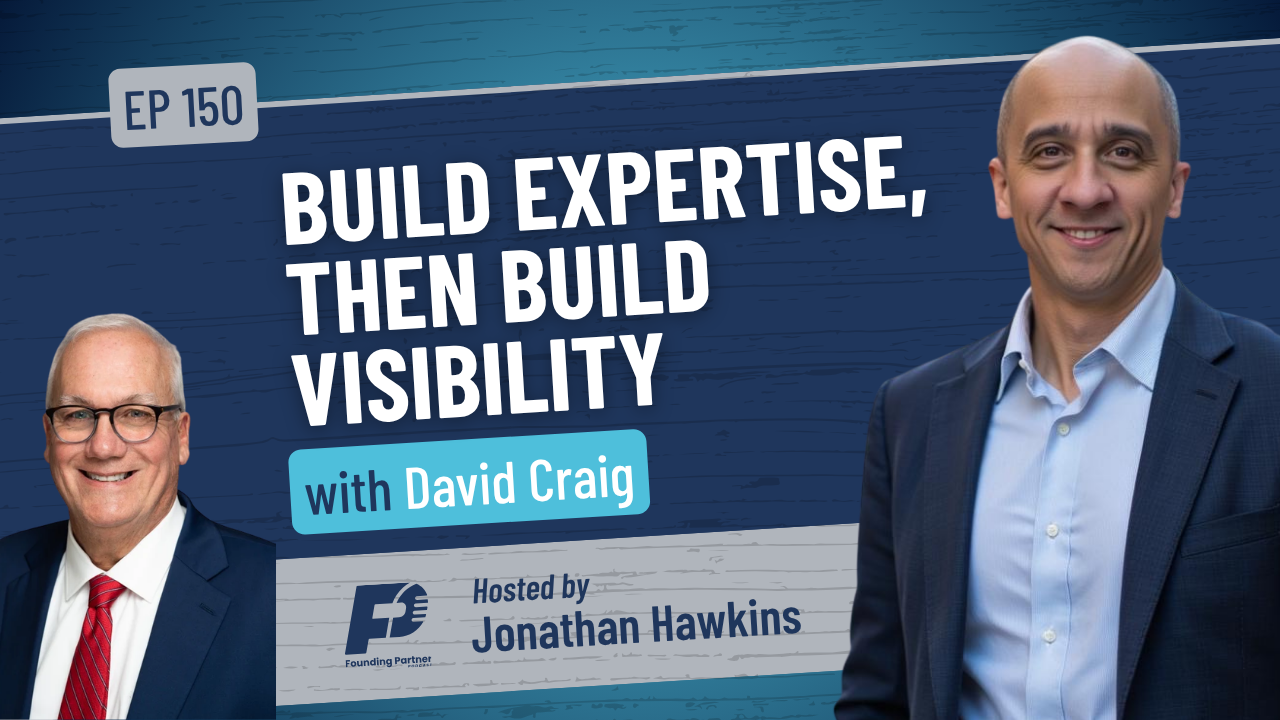
David Craig has never been afraid to try something different.
As a personal injury attorney in Indianapolis and one of the founders of Craig, Kelley & Faultless, David has watched legal marketing transform from phone books to podcasts, social media, online content, and AI. Through all those changes, one principle has remained consistent.
You have to find a way to stand out by becoming genuinely useful.
David joined me on The Founding Partner Podcast to talk about building a firm, finding a niche, developing people, marketing with purpose, and creating a practice that can continue growing beyond its founders.
Finding a Way Around the Competition
When David helped start his firm 27 years ago, they needed clients.
At the time, phone books were a major source of legal advertising. The problem was that competing firms already controlled the valuable back covers.
Instead of accepting that limitation, David found another way.
His firm created vinyl phone book covers featuring a drawing of the local courthouse and useful emergency phone numbers on the front. Their advertisement appeared on the back. They mailed the covers directly to residents, effectively placing their message over competitors’ existing ads.
The strategy worked.
But David is quick to acknowledge that plenty of other experiments did not. That is part of entrepreneurship. You try ideas, learn from what happens, and keep looking for opportunities others have missed.
That mindset still guides his approach today.
As David explained, “If you look at it and say, ‘I can do it, I just gotta figure out how,’” the challenge becomes something to solve rather than a reason to stop.
Building a Team That Lasts
David still loves trying cases, but his role has evolved as the firm has grown.
Today, he spends more time developing attorneys and staff, helping people strengthen their skills and giving younger lawyers opportunities to take ownership.
For David, investing in the entire team is essential.
“You could be a great lawyer and have a crappy team and you get a mediocre result,” he said. “But if you have a great team and a great lawyer, you’re gonna get a great result.”
That philosophy shows up throughout the firm.
Many of David’s attorneys started as law clerks. His partner Scott Faultless was his law clerk more than 30 years ago. David’s son and daughter are attorneys at the firm, his wife serves as chief operating officer, and his youngest son handles video production for the firm and David’s podcast.
The next generation, in many ways, is already there.
Responding Before Evidence Disappears
One of the most distinctive investments David has made is the firm’s in-house rapid response team.
In catastrophic commercial vehicle cases, David explained, trucking companies and their lawyers can begin protecting their interests almost immediately after a collision.
His question was simple. Who is doing the same thing for the victim?
David built a team that can quickly investigate a scene, locate evidence and cameras, send preservation letters, research the trucking company, and coordinate experts.
That speed can change the direction of a case.
David shared an example in which his team’s early work helped uncover an issue with how cargo had been loaded. Because his team monitored the evidence and was present when the load was eventually removed, they discovered information that could have been lost.
For David, the rapid response team is not simply a marketing differentiator. It is an investment in delivering stronger service to clients.
Becoming the Trucking Expert
David did not begin his career as a trucking attorney.
Early on, he practiced across several areas because he wanted courtroom experience. Eventually, he realized he wanted his career focused on work that felt more meaningful to him, which led him toward personal injury.
Then a trucking case changed the direction of his practice.
Instead of treating it as just another file, David learned everything he could about trucking. He discovered that he enjoyed the complexity and competition involved, and eventually made the decision to focus more deeply on that niche.
The commitment went beyond taking trucking cases.
David began speaking about trucking, writing about trucking, studying the regulations, producing content, and eventually writing books and hosting After the Crash, a podcast aimed specifically at people affected by truck wrecks.
His advice for younger attorneys considering a niche is to begin with expertise.
Spend the time learning the subject. Understand the market. Think carefully about where you want to practice and who you want to serve. Then consistently publish useful information that demonstrates what you know.
As David put it, “You need to become an authority, and you need to start publishing regular, consistently on that topic.”
Turning One Idea Into More Value
David’s first consumer-focused book became an unexpectedly powerful business development tool.
When potential clients told him they were interviewing several attorneys, David encouraged them to do exactly that. Then he offered to overnight them his book so they could learn more and develop better questions for those interviews.
“I never lost a case where I sent my book,” he said.
That experience helped inspire his podcast.
If a book could educate potential clients, a podcast could take those conversations even deeper.
Today, David approaches content as an ecosystem. A podcast episode can become video clips, social posts, written articles, static content, and other resources. His team plans marketing in advance and looks for ways to maximize the value of every asset they create.
Most importantly, David keeps the consumer at the center.
His guiding question is whether someone will be better informed after watching, listening to, or reading the content, whether they ultimately hire his firm or someone else.
Preparing the Firm for What Comes Next
David sees AI and automation as opportunities rather than threats.
More than a year ago, he hired a senior computer engineer and tasked him with examining the firm’s workflows. The goal was not to replace employees. It was to identify tedious work that technology could handle so people could spend more time using their judgment and skills.
That shift is also changing how David thinks about hiring.
The firm increasingly needs people with different skill sets than it needed a decade ago. David believes technology can make legal services more efficient while allowing firms to invest in people who bring different kinds of value.
The same long-term thinking applies to visibility.
David sees the authority his firm has built through years of writing, speaking, educating, and publishing as increasingly relevant in a world where consumers may use AI to help identify attorneys.
The technology may be changing, but the underlying strategy remains remarkably familiar.
Become good at something. Help people understand it. Keep showing up.
Closing Reflection
What stood out to me about David’s story is that none of this happened because of one marketing trick.
The phone book covers worked. The books worked. The podcast works. His speaking and videos create visibility. His rapid response team creates a meaningful point of differentiation.
But underneath all of it is a willingness to invest for the long term.
David invests in his expertise, his people, his family, his clients, and the systems that can make the firm stronger tomorrow than it is today.
That may be one of the most useful lessons for any founding partner.
You do not have to follow everyone else’s playbook. You do need to know what kind of practice and life you want to build, surround yourself with the right people, and keep finding ways to become more valuable.
AND MORE TOPICS COVERED IN THE FULL INTERVIEW!!! You can check that out and subscribe to YouTube.
If you want to know more about David Craig, you may reach out to him at:
- Website: https://www.ckflaw.com/
- Facebook: https://www.facebook.com/ckflaw/
- Instagram: https://www.instagram.com/ckflaw/
- LinkedIn: https://www.linkedin.com/company/craig-kelley-&-faultless-attorneys-at-law
Connect with Jonathan Hawkins:
- Website: https://www.lawfirmgc.com/
- LinkedIn: https://www.linkedin.com/in/jonathan-hawkins-135147/
- Podcast: https://www.lawfirmgc.com/podcast
Thank you for joining us for this episode of The Founding Partner Podcast. Stay tuned for more conversations that inspire connection and growth.
David Craig: [00:00:00] They call me and they say, “Well, like, I’m interviewing three lawyers.” I say, “That’s a great idea. I think you should because it’s an important decision. Let me send you overnight my book and take a look at it, and it’ll give you some questions you maybe might ask them.” And I never lost a case where I sent my book.
And so that was the first thing. And then I thought, well, gosh, that book was very helpful, so why not do a podcast? Because a podcast would let me go even deeper. But I do my podcast not for lawyers, I do it to the consumer. And so my podcast is specifically just aimed at people who’ve been in truck wrecks.
And so it’s just taking that book the next step. You’re just providing helpful information to the public, the book, podcast, whatever you’re doing.
Jonathan Hawkins: My personal experience in marketing, and I love doing it, and I’ve got a book and you’re on the podcast, you know, speak, all the stuff. I enjoy that. And they all work. But I found that when you do them together, they work better than alone. But you can’t do them all at [00:01:00] once.
Welcome to the Founding Partner podcast. Join your host, Jonathan Hawkins. As we explore the fascinating stories of successful law firm founders, we’ll uncover their beginnings, triumph over challenges, and practice growth. Whether you aspire to launch your own firm, have an entrepreneurial spirit, or are just curious about the legal business, you’re in the right place.
Let’s dive in.
Jonathan Hawkins: David Craig, welcome to the show
David Craig: Thank you. I’m g- I’m, my, it’s a privilege to be on your show
Jonathan Hawkins: So David, you are a I’ll say you’re a personal injury lawyer. You may just be a law firm owner at this point, but you’re a personal injury lawyer in Indianapolis. Your firm is Craig, Kelley & Faultless. I love that name, by the way. So, why don’t you introduce yourself, tell us about your firm what you guys do, how big you guys are, that kind of thing
David Craig: Yeah, I’d love to. So yeah, we are a personal injury law firm headquartered out of [00:02:00] Indianapolis, Indiana. We have 10 attorneys about 50 employees. We are located in what Fort– called Fort Benjamin Harrison. It’s over in Lawrence Township on the east side of Indianapolis. I have lawyers licensed in Indiana Ohio, Kentucky, Tennessee, Missouri, Illinois, Iowa.
and so primarily in those other states other than Indiana, we primarily handle commercial motor vehicle cases. That’s a large part of what I do. My partner Scott Faltys and myself are both board-certified truck accident attorneys, so a large part of our practice is, is the commercial motor vehicle cases.
But you know, we like to try cases and so my young attorneys, we do a little bit of other types of personal injury, especially here in Indiana, so that they can get experience and try cases. And and I’ve been blessed. I’ve got a, a team of people. My lawyers were law clerks of mine who have become lawyers.
And my partner Scott Faultless, one of the founders of this firm with me and BJ Kelly, Scott [00:03:00] was a law clerk of mine over 30 years ago. So I’ve, and my lawyers have all been with me for years or started off, like I said, like at law school. So we’re, we’re a pretty close-knit group. We’ve been together for a long time, s- so is my paralegals.
My son’s a lawyer here, and my daughter’s a lawyer here. My son’s one of
Jonathan Hawkins: Wow
David Craig: partners. And my wife runs my practice. She’s the chief operating officer. And then my youngest son, I have three kids my youngest one is a professional videographer, and he does my podcast called After the Crash, but he also does our firm videos and does settlement videos for my law firm, but he also does settlement videos for other law firms all over the country.
Jonathan Hawkins: That’s a lot, man. We’re gonna unpack a lot of that.
David Craig: That’s a lot. It is a lot
Jonathan Hawkins: Well, I think it’s cool. I think it’s cool that, and a testament to a firm where, where your attorneys stick around for a long time. That’s rarer and rarer nowadays. So that, that says a lot
David Craig: Well, I think that it just makes smart business. I mean, number one is it makes it easier, but my gosh, the cost [00:04:00] of, of losing folks and, and replacing folks and training people. I mean, I’m not saying my way is the best way, but it’s a way that works for us, and when you come up through the system… Now, I will say you know, that worked for us.
It slowed up our growth by hiring law clerks and, and then developing them. And we’re now at a point where I’m now looking at bringing some other attorneys in from the outside. But you know, it’s, It, it’s worked really well for us to this point
Jonathan Hawkins: So tell me about your firm. So, you know, in the PI space, you’ve got super high volume, you’ve got… Then you’ve got super low volume trial lawyers. It sounds like maybe you guys are in between. Where, where do you guys fall in that spectrum?
David Craig: Yeah. I mean, so we’re trial lawyers. We do try cases, but as you know, as an attorney, I mean, a small percentage of cases go to trial regardless. And so y- we work our cases as if we wanna prepare our cases for trial so we can get a maximum value out of the cases. We don’t do volume. Oh, you know, I…
When I first started my practice, we certainly did ’cause I had no [00:05:00] clients. And so we, we did phone books back when they had phone book books. And, you know, I experimented with television for a little while, but that was way back in the beginning of the firm. Now we’re more, a lot more selective on the cases that we pick.
And like I said, a, a big chunk of our cases are commercial motor vehicle cases and are large cases and, But we still take the other stuff in so we can get experience litigating it and trying it with our younger attorneys
Jonathan Hawkins: In the personal injury space, the way you guys get cases is just, it has changed and evolved so much over the years, and it just, and it’s so fast nowadays. But I did hear your story about the phone book cover, and I wanted to explore that a little bit. I thought that was genius, and I wanted to, like, get a little more detail on that.
So first, maybe tell our audience what, what, what you did back in the day, and then I wanna ask some questions about it
David Craig: Yeah. So I mean, so I’ve, I have a business degree. I love business. I love entrepreneurship. And so when I started this firm 27 years ago we had no clients. We had no customers. We [00:06:00] had no- And so back then the phone books were a big deal. Now we had people who knew who we were because we tried cases, and so we had referrals, a certain percentage of referrals.
So we knew if we started off, we would start getting referrals, but at the same time we weren’t, we didn’t … You know, it’s a slow way to grow your firm. So we looked at phone books. Well, all the back covers were bought by the same firms, and they owned all the back covers in all the different counties. And so I got this idea that we would cover them with vinyl covers, and we would, we would send the covers out to everybody who lived in a city, and on the back of the cover would be our ad.
On the front of the cover would be the local courthouse. I had, I actually hired an artist to draw the courthouse and then we put emergency phone numbers on it, like the fire department, the rescue, the, the police, a local, you know, well, you name it. And we put that on so people would be attracted to it.
So I mailed it out to everybody, and the funny thing was the lawyers who [00:07:00] had the back covers never knew what hit ’em because we never sent it to them. And, and so, what happened was their numbers started going down. Our numbers started going up, and then I made a deal with the phone book companies and said, “Hey, if these guys ever drop off the back cover, I would like to purchase the back cover.”
And sure enough, they dropped off of every back cover in every county that I covered and eventually I had ’em. Now the, the dilemma was I also had to talk to my cover company in not selling that idea to any of my competitors. So, but yeah, no, that’s … And so, you know, we were … You had to look, and to this day I still, we, we still are doing things that I consider outside the box because I believe you can compete with anybody, but you have to actually give it some thought and you have to be creative sometimes.
Jonathan Hawkins: You know, that, that is absolutely genius, I gotta say. And I guess the covers were, you know, to protect the, the phone book and make them last longer or [00:08:00] easier or whatever. But man, I mean, h-how did you come up with the idea? And then did you test it in a small amount first, or did you just, you went all out and sent it to everybody?
David Craig: We sent it we, we would, we picked a city of, like, 70,000 people, and we hit that city. And then we s- then we … And that worked. And then we started moving it from county to county and just hit, blitzing pretty much all of southeastern Indiana. And so, and it, like I said, it started working, and then eventually we got the phone books.
And, and I think… I mean, but we did all kinds of crazy stuff that didn’t work. I mean, I remember when we first started, we put, like, tags in laundromats, that had our numbers on it. You know, we did a lot of stuff, but that was one of the things that really took off and really worked well
Jonathan Hawkins: That’s a couple good lessons there. One, experiment. You never know what’s gonna work, what’s gonna not, but you gotta try. And number two, just because there’s a, a brick wall in front of you, i.e. you can’t get the back cover, you can still figure out a way around. [00:09:00] Yeah, that’s pretty good
David Craig: And that’s true today because, I mean, just think how competitive the market is. And so constantly we’re looking at it saying, “Well, what can we do next year that nobody else is doing? What is it?” I mean, there’s something out there. Now, maybe we can’t… It takes us a while to figure it out. Sometimes it works, sometimes it doesn’t work.
But, you know, I think that you, you know, I don’t have the money. I’m, I’m not willing to spend the money that the major marketers are. We’re not looking for volume because… And so I don’t wanna s- even if I had the money to spend on it, or I wanted to spend it, and it was budgeted, I still wouldn’t do it because I don’t want that volume.
But that still creates a problem, so now you have to figure out how do you market, how do you develop a business, how do you build the business you want with these limitations? And if you look at it and say, “Well, I can’t do it,” then you’re absolutely right, you’re not gonna be able to do it. But if you look at it and say, “I can do it, I just gotta figure out how,” then…
Which is what we do. Which is what… And I enjoy that. It’s just like winning a trial. The tougher the case, the more fun it is. The tougher the competition, from my standpoint, I don’t [00:10:00] mind competition. I enjoy it. I thrive off of it
Jonathan Hawkins: So let’s talk about trying cases. Do you still try cases personally? Oh, wow
David Craig: got a trial coming up. I love trying cases. I like the competitiveness of it. I like, you know, I mean, my goal is to make a positive difference in the lives of my clients and the lives of my people, my employees, my family, and the community in which I practice, and there’s no way better to do that than to go try cases.
Now, I will tell you there was a time when I thought that I would never not try cases until they hauled me out someday on a stretcher. And, and I, and if I had my way, I would … Back in the … When I was younger, I would’ve tried one every other month. To me, that was perfect. Now, it never worked out that way because, you know, sometimes you had to try ’em two back to back.
But I get as much satisfaction now out of watching my son and my younger attorneys try cases as I did when I tried ’em myself. In fact, I get more satisfaction out of their victories [00:11:00] than I do my own victories. So it has changed over the years. I never thought I would. There was a time when I would … I had to try every case.
I wanted to try every case, and now I really enjoy working on every case, but not trying every one. But I still like to try ’em because I feel like that’s necessary to get in front of a courtroom just to … ‘Cause time, things change
Jonathan Hawkins: And so nowadays, do you just pick, you say, “Okay, this is a case I wanna tr- I wanna work on,” or do you parachute in if, if it looks like it’s going to trial or maybe both?
David Craig: I do both, really. I mean, I, I work as a team with all the attorneys and work on cases, help answer questions, help direct strategy. I’m involved in signing up the clients. I’m involved in working with the clients. I enjoy the client part of it, the consumer part of it. And so I’m still very, very involved in the practice.
My… In fact, my wife, who runs the company, she says, “Well, I’m gonna retire at 70,” but she knows that I don’t ever plan on retiring. Now I’ll try fewer cases but that’s the way it should be because you [00:12:00] want your younger attorneys to be better lawyers than you. And so, and I’m proud of the fact that our younger attorneys will be better lawyers than my- the founders of the firm
Jonathan Hawkins: Well, one of the benefits of growing a firm is that you get to step back and maybe pick and choose the things you wanna do versus some of the other things you maybe don’t wanna do anymore. How has your role changed? Obviously you still try cases a little bit, but how has your role changed as the firm has grown and evolved over the years?
David Craig: I think it’s, it’s, it’s changed in that I direct the firm, I manage the firm. I spend a lot more time developing the talent than what I did when I was, when we first started. When we first started, I had to be involved in every single case and did depositions and I was constantly on the roll.
Now I enjoy developing the attorneys, but I also enjoy developing my staff. I’m very blessed in that I have a great team. We just got back, I spoke out in Denver at the ATAA conference, and I had 12 of my staff with me, my [00:13:00] paralegals, my rapid response team, and then there was nobody else in Indiana that brought their staff. And you know, I enjoy, I, I took my paralegals and my rapid response team out there, and there with my part- and two of my partners. And you know, a lot of times you look and say, “Well, I like to build and develop my lawyers.” But I like to develop the team ’cause you could be a great lawyer and have a crappy team and you get a mediocre result.
But if you have a great team and a great lawyer, you’re gonna get a great result. And so I think my role now is different. I look at it and say, “How can I help people develop? How can I help them accomplish what they wanna accomplish?” Because by doing that, I raise the whole ship. I mean, the, the talent le- as everybody’s talent goes up, the quality of the services we can provide are better.
And I think you see that. You don’t see that, you know, you see law firms where people like me have big egos, which we do in order to be, to walk in front of a jury, I think you have to have a decent size ego. But they wanna be the [00:14:00] whole thing, and I don’t wanna be anymore. I wanna be that person who helps develop the talent and increase the, the skillset of my paralegals, my receptionists, my secretaries, my, you know, you name it, my attorneys.
And that’s why I spend a lot more of my time today doing that. And also focusing on, you know, how do we develop the business? How do we keep it coming in the door?
Jonathan Hawkins: So developing the team, that’s how you build a firm that lasts beyond you. And now with your son and daughter in the firm certainly that’s something I’m sure you wanna do. So you mentioned the rapid response team. What is that? Tell me about that.
David Craig: So, you know, so when a semi-rack hap- wreck happens and it’s a catastrophic event, wrongful death, whatever, the first call that the semi-truck driver makes oftentimes is the dispatch. Sometimes they c- they call dispatch before they call 911. And immediately, the trucking industry, they are on, they’re on it.
They send [00:15:00] their, their, they have contracts with their lawyers requiring their lawyers to be at the scene within so many hours. Their claims people are there. Their investigators are there. So the defense, the trucking industry starts protecting themselves and their drivers immediately. Well, who does that on behalf of the victims?
And so some law firms will have people they can call and hire. What I found was that it’s better to have your own team. And so I have Clint Crabtree, he runs that. He’s been with me for, I think, about 20 years. And he, he runs my rapid response team. And so as soon as a wreck happens and I get hired, he immediately sends our private investigator, who works full-time for us, out to the scene, looks for evidence, looks for cameras, security cameras, all those things.
I have another lady who works with the, the team, and she immediately starts sending preservation of evidence letters out. They start scouring the web, looking for truck drivers who work for that company who are dissatisfied. They look at their website. They download it. So within within an hour of hiring me, my [00:16:00] team is already out looking for evidence, preserving evidence, pres- sending out letters, locking down stuff.
And and then we hire the mechanics and the reconstructionists and all that. And so I train these people. I went with Clint to many truck inspections, and now he does it for the last several years, he does it on his own. Like I said, we take him to seminars. But that’s what our rapid response team is.
We have our own in-house team that can immediately– ’cause time matters in these truck cases. I mean, it truly matters, and evidence can be lost, logs can be destroyed, trucks can be moved. I’ve had them, I’ve chased them for s- in, you know, they’ve been moved two states away by the time I get hired. I’ve had them try to alter it, change it. And so we wanna make sure that we preserve it, and we can do our download and our inspection before it’s changed. And so that’s why we, we invested the money in hiring the people. But that’s a benefit to any client that calls and hires us because they know we’re on top of it.
Jonathan Hawkins: Do you use that in your marketing and your branding? I think, yeah, that’s [00:17:00] genius.
David Craig: Yeah. It’s so, I mean, so many lawyers don’t, you look at it and say, “Okay, what makes me different? What do I have that’s different than my competitors?” so you, y- you know, and, and, and, and then also, does it help my clients? Is it beneficial? Do they benefit from that service? I don’t charge them for that.
I have that in-house. That’s a cost of mine. And, you know, these other people who have to hire an investigator, they have to go outside and do those things. So it is a, it is something that distinguishes us from by or from our competition.
Jonathan Hawkins: And I imagine it really drives case value too.
David Craig: Absolutely.
It’s, it’s… There’s been a, there was, like, forgive the example. So there was a case where a semi breaks or stops on the roadway on I-70. And in that case my client unfortunately was on a cell phone, and he ran into the back of the semi and got killed. The truck shouldn’t have stopped on the, where it was at.
And the evidence cl- you know, my [00:18:00] reconstructionist said that, you know, the guy w- didn’t have time to perceive and react and, and miss the semi because of a hill. Regardless, there was only a million dollars worth of coverage on that semi. And he, this was the father, husband, sole breadwi- I mean, breadwinner for this family.
And and so my rapid response team, they find the vehicle. They see where it’s being towed. It’s being towed out to a f- a field or a facility where there’s no security. Okay, well that worries me. Okay, here we have this load, and it, and the, and the reason that it was stopped was ’cause it had lost a piece off of the load.
So we’re looking at it, and I’m s- like, “Oh my gosh, it’s sitting.” So I have a guy wh- who, we have a rapid response team that says, “Hey, look, this load is not secure. It’s not protected.” And so we put somebody out there. And we contact the defense, they say, “Okay, well unload the load at 1:00 in the afternoon, and you can have your people there.” Well, at 6:00 in the morning I get a phone call and my guy says, “Hey, I don’t know what’s [00:19:00] going on, but there’s a whole bunch of people showing up And they’re getting ready, I think they’re going to unload this truck. Well, now the truck only had a million dollars worth of coverage. Now this family, the case was worth a lot more than a million dollars, but if they unload this, so I, I’m looking, so do I have a case against the shipper? The shipper loaded this thing and some pieces fell off, but to have a case against the shipper, you have to show that it’s a latent defect that the truck driver didn’t know about. Well, we w- then, so I called the defense lawyer and he said, “Oh, no, it’s mis- a misunderstanding. I’m so sorry. You know, it’s just a mistake.”
And so they, we stop the, we stop it. I then, I drive over there, I bring my experts, and then we videotape and watch them, and lo and behold, the f- the, the dunnage that was, that kept this truckload, the, the pipes on it, they weren’t fastened down. Now you would never know that ’cause the load was on top of it, so you couldn’t tell that the, the boards in the bottom were not fastened down unless you were there watching it.
And when we watched it, we’re like, “Oh my God, [00:20:00] they didn’t fasten these boards down, therefore they slipped when the f- the truck was vibrating. They lost a piece.” Truck driver didn’t know about it because it was loaded when he picked up the trailer, so suddenly now we have millions more available. Now without a rapid response team, we don’t know that.
Without me having people put in security, we don’t know that. And without my team being there watching a videotape, we don’t know that, and that case settles for a million dollars and not several million dollars. And so that’s why a rapid response team is critical, and having somebody who understands truck accident law
Jonathan Hawkins: That’s interesting. Where did you get the idea? I mean, I don’t practice PI law, but I know a lot of PI attorneys. I’ve never heard of this. But maybe I’m just ignorant.
David Craig: Well, I think the reality is when you see what the defense is doing, then you’re like, “Wait a minute.” You know, I had a case where three people get killed and one little 14-year-old boy was left as a orphan. And the sad thing was in that case, it was down in [00:21:00] Kentucky, the defense lawyer and their people were there before my clients’ bodies were removed from the vehicle. And I found that out through film and footage and doing depositions. And so then I took the deposition and found out, well, their lawyer was required to be there within so many hours. And then I started seeing, okay, well, wait a minute. That’s affecting witness testimony. It’s affecting a whole bunch of things, the truck driver’s statements.
And so you look at it and say, “Okay, I need to combat that in order to add value to my clients’ case. I need to protect them and do the same thing that the defense is doing.” And then we invested in the right people and then as our firm grew, as we had more resources, then you start putting it, investing it back into the firm rather than taking it and building a house in Tahiti.
You say, “No, let’s build a rapid response team so that I can compete with anybody anywhere in the United States.”
Jonathan Hawkins: There’s some good lessons in there for folks listening. That’s really cool. So I wanna pivot back. So you said your son and your daughter [00:22:00] work with you. So I wanna explore that. So, was that something you encouraged? How did that come about? And who came first, the son or the daughter?
David Craig: The son did. So my oldest son went and got his. He was he got a business degree from Bloomington IU, then he went to St. Louis, Missouri and got his master’s. And I thought he was gonna go in business and he was gonna get a joint MBA JD program. And he said, “You know, I…”
And all my kids were in my office. The bus dropped them off at my office, you know, when they were in school. My wife ran the firm. I was here. This is where they hung out. I mean, the whole family was here. And so, you know, they grew up with this. And he came and he’s like, “No, I wanna do what you do.”
And because, and they saw what we did. I mean, there’s nothing like winning a trial or even losing a trial, regardless. After you make your closing argument and your clients come with tears in their eyes and hug you and thank you before they even hear what the verdict is, and your kids see [00:23:00] that, and they grow up and they’re like, “Okay, man, this is a nice rewarding profession.”
And so my daughter was a education major. I thought she was gonna be, she’d been a wonderful teacher. And instead she decided to come work for me. And then my youngest son is our videographer, and he does our, our settlement videos. And so I did not encourage them. I didn’t, you know, they just loved it here.
They all, they started off working here in high school. They, you know, they cleaned, they couriered, they, they did the lowest level jobs just like everybody else in my office, and they worked their way up until now my s- oldest son is actually a partner here, and my daughter is a, is attorney and, when, if she, you know, she’s, if she wants to be a partner she’ll join.
But my younger attorneys here I have three younger attorneys. One of them’s my son, two other attorneys that were law clerks of mine that are also partners. So part of the growth of the firm is you grow these people, you develop ’em, but then you offer, then you share with them, and you have them opportunities to buy into your firm and be, you know, [00:24:00] partial owners as well.
Jonathan Hawkins: So I was gonna ask what it’s, what it’s like working with your, with your kids, but it sounds like you’ve been working with your kids since they were kids. So that’s
David Craig: It’s been the same. I, I’ve worked with them. They’ve been with me forever. And I truly love… I mean, I come to my o- my dog’s in my office. He’s back there on the couch. My kids come to my office. My grandkids now come to my office and my… So it’s often my grandkids are in here in my office playing with trucks and cars and, you know, we’ve done it.
We started over all over again. And some, some, and then so my employees. My employees bring their kids. And so you look at them and you think, “The next generation is already here.”
Jonathan Hawkins: I can see why you don’t wanna retire.
David Craig: Yeah, I don’t. It’s, you know, it’s, it’s fun. You get to spend quality time with your family
Jonathan Hawkins: Yeah.
Real quick, if you haven’t gotten a copy yet, please check out my book, the Law Firm Lifecycle. It’s written for law firm owners and those who plan to be owners. In the book, I discuss various issues that come up as a law firm progresses through the stages of its growth [00:25:00] from just before starting a firm to when it comes to an end.
The law firm lifecycle is available on Amazon. Now, back to the show.
Jonathan Hawkins: So we’ve talked about your trucking practice and you mentioned earlier that you didn’t start out there. I’m always fascinated, and I think it’s a great idea to niche down. And so take me through the process of you, of finding the trucking niche and sort of how you got there.
David Craig: Yeah. So I mean, in general, when I first started practicing law, I just wanted to get in the courtrooms, and I didn’t really care what kind of cases that got me in the courtrooms. So, you know, I did family law, I did criminal law, I did, you know, personal injury, I did corporate litigation, you name it.
Anything that would get me into the courtrooms I did. The better I got at it, the worst situations were that people could afford to pay me. And back then it was a billable firm and so, I would got pretty good at it, got pretty successful. So then I will say the bad guys needed me more than the good guys and were willing to pay me more.
And so I started, you know, [00:26:00] practicing. Thought that was good. I was making a good living but quite frankly, the worse the cases got, in the sense of, let’s not pay people overtime. Let’s make ’em, let’s give them a pizza and not pay ’em. And so hired, “Dave, go ahead and fight for that.” And so I’m like, “Yeah, I don’t really like that concept. Why don’t we just pay ’em overtime?”
And then I had a case where somebody was accused of killing their wife and for insurance money. And again, you know, the people could afford to pay me a lot of money. And that one made the newspaper. It made Indianapolis Business Journal, and it said, you know, “Attorney David Craig has no comment.” Okay? And I was real excited because, hey, I made the front of a newspaper. And so I’m reading it to my son, who now is a partner, was a kid. And he’s like, “Well, whose side are you on?” And I remember thinking, “Oh, now how do I explain to him that I’m on the side of the guy who’s allegedly killed his wife and tried to collect insurance?”
And so I think that was a [00:27:00] eye-opening experience for me. It kinda was one of those things that’s like, what, do I really wanna spend the rest of my life, and where am I headed? I’m getting good at it. And so that kinda changed it, and I said, “You know what? I’m gonna do personal injury. I enjoy that.
I, I like, I like equaling the playing field. Giving clients… And I like the idea of not getting paid unless I win.” The billable time g- it just drove me nuts. The more in- inefficient I was, the more money I could make, you know? And so, and so I kind of switched to personal injury. And I sh- I went to work for a lawyer who needed somebody to try cases, and I tried cases.
And so I joined his firm just to go around and try cases. And so I just ran around, you know, Southeastern Indiana, Southern Indiana, Indianapolis, you know, trying cases. And but I didn’t like the, the way the personal injury firm was run in a sense that I was more family-oriented. I wanted… I had a daughter.
I mean, I wanted to promote women in [00:28:00] my firm, in my office. Diversity. And so, decided to start my, my own law firm. But yeah, I started off in general practice, general litigation, and then went into personal injury, and then I was lucky enough to have a truck case early on and I a truck, dump truck had gone through a building and hit my client.
And so I didn’t know anything about trucking. I learned everything I could learn about trucking, enjoyed it. And I liked … The defense lawyers were a higher paid a higher skill set in those type of cases and I enjoyed that. And so I liked that niche. And so then I thought, “Well, why not learn everything I could learn about trucking get good at it?” And then and then it was a gradual process. I can remember people asking me to speak on a lot of other topics, and I finally came to the conclusion, no, if you wanna do trucking, you quit talking about everything else and you start talking about only trucking. And I wrote two books, and I started doing more, just generating content only [00:29:00] on trucking or trucking centered, and that’s how I niched.
And now I run a podcast on it. I do a lot of other things that are just geared towards trucking
Jonathan Hawkins: And that’s, that’s key. You, you, if you’re gonna do it, you gotta go in. Was it scary? You know, you had the decision to make to stop talking about the other things and only go for trucking. Did, did you have any pause or you just said, “I’m doing it, burning the boats”?
David Craig: For my wife, it was scary, I’m sure. For me, my- that’s not, not the way my mind works. I look at things, you know, when I have a trial, no matter the worse the case is, the more fun I like, the more I enjoy it. The more, the bigger the challenge, the more I enjoy it. So it, I honestly, for me, it wasn’t scary.
But to my family it was, to my wife it was. I mean, ’cause sh- she worked here, so if this didn’t work, then, then, you know. And I would say that, you know, every- now every day everybody wants to be a truck wreck lawyer. And every, and you see [00:30:00] everybody saying they’re truck wreck lawyers. But the reality is not everybody’s invested the time and energy and effort to become a truck wreck lawyer.
They just want a truck wreck case. And I think that one of the advantages I had was I learned to be a trial lawyer first, then I learned trucking because I had a trucking case. And the great thing about trucking is that the Federal Motor Carrier Safety Regulations, CDL manual’s pretty much the same for every state.
I mean, the Federal Motor Carrier Office Saf- Safety Regulations obviously apply to everybody, but each CDL manual is basically the same from state to state. And so once you get into it, once you learn it and you spend time and you start learning from other people then you can really develop a skill set within a niche.
And that’s the one thing I would say to young lawyers is if that’s, you know, in this day and age, I mean, everything’s on, you know, you can access anything and everything from AI, from, you know, you can join groups like the, like the ATA is a trucking group. They [00:31:00] have every kind of video. I mean, every subject, every type of topic that’s come up in a trucking case is on video.
So you can learn. So taking the time to learn the subject matter or whatever niche you want to make is, is, I mean, it’s a, it’s, it’s, you, it’s a missed opportunity if you don’t do that
Jonathan Hawkins: And I found for me personally and others out there, I’m sure this is your experience as well, in the process of learning the writing, the speaking, all of those things really, really force you to really learn it. It’s more than just reading it or watching a video. I mean, when you have to go teach it or write an article about it or write your books about it, you have to– it forces you to learn it.
You become the expert. But then you’ve got all this marketing collateral that you can ch-ch-ch start throwing around. So tell me about the books. Are they both Truckee books, and how do you use them and, and how have you used them over the years?
David Craig: So the first one I wrote was Semi Semi Wreck a guide for victims and their families. And that was the first book, and it talks about, you know, [00:32:00] what you need to know if you’re the victim of a truck wreck. Again, I, I made a decision. So our first decision was let’s niche in trucking. So then the most logical way was, like since I tried cases, I was known I had a referral business.
So 80% of my business came from other lawyers. But then I thought, well, what happens when that market changes? What– When people don’t have cases to refer to me anymore. And so, you know, 15 years or so ago I decided to market to the consumer. And so, all of a sudden now I’d say 20% of my business is referral-based and 80% is direct from consumer. that 20% now, which is funny, is it’s actually more than what the 80% was back when I used to do because my– That’s grown as well. Because when you do s- when I go speak, I speak because I enjoy speaking. I teach other lawyers and, and this year I’ve spoke at two ATA conferences. I spoke at one national webinar, and I [00:33:00] spoke at my own conference that I had here in Indiana through the Indiana Trial Lawyer Association.
So four different seminars I’ve spoken at on trucking. But, but the reality is that the re- part of the reason I do it is because it gives me something to market. So I’m not, I’m not doing it anymore. I– When I started doing it, I was doing it for hopefully to help other people, but also to get referrals from attorneys.
Now I do it, hopefully help other people, but I could really care less whether I get a referral from an attorney because I’m using it to market to the consumer. And so, the book, when I first wrote the first book, it was, I started the book and, and then, you know, when I would compete for a client and they– I can send them a book, I can overnight.
They call me and they say, “Well, like, I’m interviewing three lawyers.” I say, “That’s a great idea. I think you should because it’s an important decision. Let me send you overnight my book and take a look at it, and it’ll give you some questions you maybe might ask them.” And I never lost a case where I sent my book.
And so that was the first thing. And then I [00:34:00] thought, well, gosh, that book was very helpful, so why not do a podcast? Because a podcast would let me go even deeper. But I do my podcast not for lawyers, I do it to the consumer. And so my podcast is specifically just aimed at people who’ve been in truck wrecks.
And so it’s just taking that book the next step. But that’s been a game changer for me, I think, in providing. And that’s the key. I mean, you’re just providing helpful information to the public, the book, podcast, whatever you’re doing.
Jonathan Hawkins: My personal experience in marketing, and I love doing it, and I’ve got a book and you’re on the podcast, you know, speak, all the stuff. and I enjoy that. And they all work. But I found that when you do them together, they work better than alone. But you can’t do them all at once.
And maybe for young lawyers out there, maybe lawyers that are thinking about, “Hey, I wanna go become an expert in this niche and get the word out there,” do you have any advice on, you know, you’ve got articles, you’ve got speaking, [00:35:00] you got the podcast, you got all these things you can do. How should they go about thinking approaching it?
‘Cause it, it’s hard to just go out and say, “Hey, hire me to sp- or get me to speak on this topic that I haven’t yet demonstrated that I’m an expert in.” So how would you go about advising somebody to get into that circuit?
David Craig: I think nowadays, you know, the first thing I would do, and I would best tell people to do, if I wanted to pick a niche, I’d pick a niche that I had an interest in, something I was f- I felt some passion about. And then I would take several months, maybe six months, and I would invest the time and energy to learn everything I could learn about that niche.
I mean, I really would wanna be an expert on that because if you’re not, then you’re gonna fail as soon as you struggle out in public. people realize you don’t know what the hell you’re talking about, then pe- then you’re gonna fail. So if you wanna succeed, you first gotta learn it, and you gotta put the time in and the effort and the energy and call people and talk to people and learn from other people. And then the next step I would do is figure out where do I wanna practice at. [00:36:00] Everybody says, “Okay, I’m gonna practice wherever the hell I’m at.” But what… Is that really the best place to practice? If I wanna niche, what’s my competition like? I mean, do I have to practice in Indianapolis, Indiana? Can I practice out in Evansville?
Can I practice in Terre Haute? Can I pract… And so I don’t think a lot of cons- I don’t think a lot of people think about, okay, I wanna build a practice. So if you put my practice and, and you pick a niche and you put it right in the middle of 10 people doing that same niche, I don’t care how good you are, it’s gonna be tough when you first start to get any traction.
But if I pick a niche and nobody is doing that in a different part of the state, now I can get attention a lot quicker. And so I can… And so I would pick an area where I ha- could be successful. That’s… And so I would actually… It would be a conscious decision, where do I wanna go? What I wanna do? And then the next thing I would do is say, “Okay, what do I…”
You know, and again, I would look at it and say, [00:37:00] okay Google and search engines, okay, is there anybody out here that’s doing this and putting out content on whatever my niche is? And I’d find an area that’s not, and then I would start putting out my information, and I would start off with blogs and videos any type of content that’s relatively easy to generate, and I would start putting that out there in the public, so that people could start seeing I know what I’m talking about.
And if you’re d- if you’re b- if you’re marketing to consumers, you want Google and the analytics and AI to recognize you as an authority. And so you need to start put- you need to become an authority, and you need to start publishing regular, consistently on that topic. And I think you could do it any niche.
And I think you could do it relatively quick today versus when I started That’ll, so that’s what I w- that’s how I would get started. The speaking, the attorney, the referrals, [00:38:00] if you want to be a truck lawyer, it’s tough because, like I’m on the Board of Regents of ATA. I belong, I’ve been, I’ve been doing trucking for, you know, 30 year, 40 years.
And so it would, you could do it, but it would take a time to break in and get referrals from other lawyers. I’m board certified. Well, you don’t even get to be board certified right off the bat. You have to have experience, you have to pass a test. And so, you know, I would do it and say, okay, if I want a niche, then in trucking or whatever, I would pick an area where I could, I would be visible to Google and the, and the S- and AI
Jonathan Hawkins: So you’ve mentioned it a couple times and your son, one of your sons helps you on this, and that’s the video production stuff. So tell me about what sort of things you’re doing with the video production and, and where you’re putting that out into the world.
David Craig: Yeah. So, so I do a lot of different things. You know, I do a podcast that, that I just do once a month. And I [00:39:00] have– It’s all trucking. So I– you know, today I had, you know, a mediator who does national- nationally on trucking, and I interviewed her this morning. And so the first Thursday of every month, a new episode is released, and I’m on 92.
It’s the 92nd episode. And so then that full interview gets released, and it’s on YouTube, the visu- the ver- the video version, and then all the other, you know, places Spotify or whatever, Apple, wherever. And then what I do is every week, I cut it and put a clip out, and I push those all out on social media and LinkedIn and Facebook and you name it.
And I send it to my, my guest, and if they wanna post it, they can. And so every week for the month, there’s a new clip, a new soundbite, a new static ad that we’re running on that content. At the same time, I’ll look and say, “Well, what kind of content is it?” So it’s about mediation. So I’ve hired two [00:40:00] journalism majors, and I have a journalism major, and she has a, a master’s degree, and they write…
I say, “Here’s the topic I want. Here’s my feeling about mediations,” for example. And so they will draft a piece of content And so now, now I’ve got written form. And so that written content then goes out on my beliefs, and I review it and what I think about mediations. And so we’re putting that out at the same time I’m talking and just doing videos.
So I try to maximize every asset that I have in any way I can. And then maybe we just do a couple static ads on that during the course of the month. In addition, I do a weekly video on … For example, I did a red flag series last year. And so what might be a red flag when you’re hiring a truck accident attorney?
If you, you know, if you go in and the furniture are all old and the signs are outdated that might not be a good sign. That might be a red flag. And so just … And so we do a, a, a weekly [00:41:00] video that we put out, and we distribute everywhere. And then I do a case analysis on a more detail. So let’s talk about a case.
Let’s break down a case, and maybe I do one of those a quarter and we promote that. And so you … I mean, you name I’m doing, I’m doing several videos a week, a month, a quarter consistently for year after year after year. And the only thing I look at is, is, is it helpful to the consumer?
Can the consumer gain some information from this that whether they hire me or they hire somebody else, they will be better off after having heard my video or hearing my, or reading my articles or whatever
Jonathan Hawkins: And I think some lessons there for, for folks out there. Number one, pick your, your target audience, your avatar. And for you, it’s the consumer, not other attorneys, not whoever. So pick who you’re talking to so you can speak to them, you can get inside their head, speak to [00:42:00] them. Do it consistently. I think that’s key.
I mean, the… So many people out there, I’m sure you’ve seen them over the years, they, they get excited and they run out and do a bunch of stuff for four weeks, and then they stop and never do it again. And then months later they, “Oh, I’ll do it again.” And it’s really the slow, consistent, just slog. And there are gonna be days, I mean, I’m sure you felt it, I feel it, where you say, “Ah, I just don’t feel like it.”
But I– But you, but you do it, and you, and you thank yourself later. And then the other piece is, is the, the, the variety and the the reusing of, of assets. You, you get one, you know, you record the, the podcast, and then you can use it dozens of different ways. And then you’re, you’re getting in front of people in different ways.
And, and again, it’s you gotta do it over and over for, for years. I mean, hopefully nowadays with media and social media, you can get out there pretty quickly, but you gotta be out there you know, you gotta be in front of people all the [00:43:00] time
David Craig: I agree. And, and, but a lot of this stuff isn’t that expensive. You don’t have to spend tens of millions of dollars like some of these folks. I mean, you can, you know, you can … Especially when you first start, you got lots of time. So, you know, s- y- and so I calendar it out. I mean, so I meet every year, at the end of the year, I bring my whole marketing team, so my website company my PR person, my own internal marketing, my video people, my marketing coach.
I mean, you … I bring everybody together and say, “Okay, let’s … What are we gonna do next year?” And we plan it out the whole year in advance. And sure, we’re flexible and we have things we, you know, that we’ll h- we’ll add, but we, you know, we do it. And so tha- that way it’s a lot easier to be consistent when you’ve got a plan in place for an entire year and you, you’ve got content.
You say, “Here’s what we’re gonna cover, here’s what we’re gonna do, and here’s why.”
Jonathan Hawkins: That was gonna be my next question. How do you come up with the, the ideas for the content?
David Craig: Yeah. I mean, I think it’s [00:44:00] just, you know, the great thing about it, still practicing law. You know, I, I s- I see some people, they, they tell you, “Well, you need to get out of your practice and be the…” You know, if you work within your practice, you can’t work on your practice. But if you really went to law school to be a lawyer and you love being a lawyer, you don’t really wanna be outside of your practice.
And so the great thing about being in your practice, talking to your clients, I still talk to all the clients when they call in, the ones that are… I mean, ’cause again, I’m not a high volume, so if it’s a truck wreck case, you know, they, they wanna talk to me. And so, by doing that, you know, you learn, okay, what is the, what are the questions they ask me?
What are the concerns they have? What do I need to tell them? The most recent book I wrote was, It’s Never Been Easier to Hire the Wrong Attorney, because in this day and age, it, there, everybody wants to be a truck wreck lawyer. And so, and so I, and I started hearing that from people. Like, “How do I know who’s the best lawyer?”
And so I wrote a book. And so then all of a sudden that gave me a whole bunch [00:45:00] of content that I could do on videos and content and blogs and on how to go about picking an attorney in an area, any area, including truck wreck lawyers. So I think listening to people, b- having, being actively involved in your practice, th- that’s the best way to know, okay, what is it that people want?
Not necessarily what my website people tell me. Not what, you know, the… ‘Cause a lot of that’s genet- generic stuff. I wanna know what you as my client, what is important to you and what questions do you have, and then let’s, let’s talk about it
Jonathan Hawkins: So I wanna shift, shift the conversation slightly. You, you’ve had a long successful career. You’ve seen a lot of changes. Back in the day, you had the, the, the Yellow Pages, and now we’ve got podcasts and social media. So I wanna get a sense for sort of some of your, as you look forward well, as you look around today and as you look forward what you see coming in the, in the practice of law.
So hot topic, we’ll, we’ll start with AI. [00:46:00] I don’t know how you guys are using it. There’s a lot of fear out there. I had lunch with somebody today that’s an hourly type lawyer that’s fearful of AI. So I’m just curious how you guys use it and what you see and how you see it maybe changing the practice of law into the future
David Craig: Yeah. So, a little over a year ago I went to we… I hired away a senior computer engineer from a huge company. And I said, “You know, I need you because the future is in automation, it’s in artificial intelligence, and I need somebody in-house that can deal with all that.” My son, who’s, y-you know, younger, and so he’s interested in those, the one with the MBA.
I said, “Can– I want you two working together and take us into the future.” So we invested in a non-income producing position to help me. Now, I also said, “I want you to help me in my marketing. I want you to develop an app that I’m [00:47:00] working on,” so he can develop that for me to help marketing. But also, I s- had him just walk around and follow all my employees, spend time with them and say, “How can I make their job more efficient? And how can we utilize you know, the existing software that’s out there, and then adapt it to our practice, and then tell our employees, ‘You don’t have to worry about it. We’re not looking to replace you.’ How do I make your job better? How do I make your job easier? How can you– can we take away your…
from the tedious tasks thinking, w-working?” And then I’ve hired people like a social worker, program… So I’m, I’m hiring different types of people than I might have hired 20 years ago. Because the people I need tomorrow are gonna need a different skill set than the ones that I hired 10 years ago.
There are ones I hired just even a year or two ago. Because I don’t need people who can key punch and type in a whole bunch of [00:48:00] data because I can get that in other ways. So I look at AI as a great thing. I think it’s beautiful because it’s making us more efficient, and it’s letting me hire different skill sets, and I think the quality of the services I can provide are far greater than back when we were doing tedious tasks.
So we’re, you know, we experiment with all the different things. We, we use it regular, every day. AI is used here in my office in different ways. And we utilize it. I also think, you know, for research, I mean, the, the– my clients are looking at things differently than they were a few years ago. And I’m blessed in the sense that Luckily for me, when people ask AI who the best truck accident attorney is in Indiana luckily AI thinks I am.
And so I get the benefit, but that’s, as you know, it’s years in [00:49:00] building up content and authority before AI or any type. It’s just, you know. And so I, I am reaping benefits from AI that I wouldn’t be reaping had I not done these year after year of, you know, tedious work to create this information out there for the public
Jonathan Hawkins: So as we see the, the practice of law changing, what do you think younger lawyers should be doing now to set themselves up for a successful career in the law?
David Craig: You know, I think like, like we touched on, I think looking at niching. I think looking at, you know, where do I wanna practice? I mean, there are some areas that don’t have attorneys. And so it depends on what kind of practice you want. I think knowing, really knowing what you want out of life.
There are certain lawyers who wanna be still, you know, work 8:00 to 5:00. And so you wanna avoid certain kinds of law. I know a lot of miserable lawyers out there [00:50:00] because they’re doing the wrong stuff. And so I think if I was a young lawyer, I, I am right now and I get to speak at a law school I, I tell people, you know, take the time see what is it you want out of life.
I love working. I work six, seven days a week. I love building a law firm. I’m expanding. I’m just, I got a St. Louis office, getting ready to expand into Springfield, Missouri. I got law- you know, all these other states that we’re practicing in. So we’re growing, but that, that’s what I like. I, I enjoy that. I get satisfaction out of that. Some other lawyers in my office wouldn’t enjoy that. And so I think knowing what it is you want, and then looking at it and instead of saying, “Boy, I, I can’t get into that,” it’s like, “Okay, how do I, how do I get into that market? What’s the way I do it?” And I don’t– I think with AI, I think with the, the s- the things that are out there today, I honestly think I could start, if I was a brand new lawyer and I could [00:51:00] build what I have now a lot quicker than what it took me to get here
Jonathan Hawkins: Well, I’ll say this just from this conversation. Yeah, there’s, you have a lot of energy. You seem excited about what you do. You seem happy. And like you said, there’s a lot of miserable lawyers out there. So, any tips out there for finding your place and making a, a enjoyable career, not just a what quote successful career?
David Craig: Yeah. I mean, I think that, again, is, is really reflection. I mean, I don’t know how many people actually start off by thinking, “What is it?” And then also having your, your whole f- your partner. I think, you know, all too often I see inconsistency between your partners, you know, what they want out of of life.
And so I think getting on the same page, because I wouldn’t be where I’m at but for my wife. My wife bought into the concept. And so, but I see all too often your, you know, where a partner doesn’t. You know, and so I knew her, [00:52:00] you know, I started dating her when she was 15 and I was 16, so she knew when I had, she knew me when I had no potential.
And yet she stuck with me. And so, but I think that’s an extraordinarily important decision, because you could have the most talent, you could be, you have the most energy, you could be so excited, and then you go home and your partner or your significant other doesn’t support you. Then I don’t care who, how good you are.
So I think finding that first partner, and then the next thing I would encourage you to do is be very careful in the legal partners you pick because that can be devastating. That can be draining. I see it way too often where people pick the wrong partners. And so I think taking the ti- ’cause, and they’re excited.
They say, “Okay, let’s… You wanna go business with me? Let’s go in business and…” You know, but no. You make sure you’re on the same page. Make sure you, you have the same future goals. Make sure that you’re compatible. And I think that’s extraordinarily important when you’re picking it. And then I think investing in the t- [00:53:00] people, I mean, again, most of the people I have here have been with me for 27 years or longer, and so y- I invest in those people, and I help them, and they help me.
And I hear lawyers say, “Well, I’m not gonna send my paralegal to some…” Well, go, ’cause what if they leave me? Well, then what in the world? I, I… You’re not gonna… You’d rather have unskilled, unknowledgeable, untalented people who never leave you? Or would you rather have, you know, really skilled people and help them and help them rise up and pay them more?
You know, I would rather help people grow, and I think that a lot of the young lawyers don’t necessarily look at it that way. They… And you go to law school, law school does a great job of teaching you to or making you feel important, but I’m not any more important than the receptionist who answers my phone or the person who cooks my, cooks our lunch today on Thursdays.
I think that you have to say, “Okay,” you have to put your [00:54:00] egos aside, and you have to s- say, “Okay, I want help. I wanna learn from other lawyers. I wanna listen to other lawyers. I wanna watch your podcast Jonathan. I wanna, I wanna learn what there is to learn.” And, and not be afraid to do that. And if you do that, then you’ve got a, I think you got a, a head start
Jonathan Hawkins: And I think you’re right. You– The team is essential. A good team is essential, and good people want to grow. And so you gotta give them opportunities of growth. And if you don’t, they’re gonna leave. I’ve I just, I mean, I think that’s what’s gonna happen. But David, I’ve enjoyed this conversation. It’s been fun getting to know you and, and seeing what you’re doing.
Thanks for coming on. But for those out there that wanna find you and, and maybe reach out and refer you a big case or, or whatever, what’s the best way to find you?
David Craig: So, you can, you can look us up on, on the website ckflaw as our law firm. We’re everywhere. I mean, you can find us… My podcast is After the Crash and you can s- find [00:55:00] me there. But yeah, just, but just Google me and I’ll be there. Just ask AI.
Jonathan Hawkins: AI. That’s right, AI. Thanks again, David
David Craig: Yeah. Thanks, Jonathan. I appreciate the opportunity
OutroUpdatedWebsite-1: Thanks for listening to this episode of the founding partner podcast. Be sure to subscribe on Apple podcasts, Spotify, or wherever you get your podcasts to stay up to date on the latest episodes. You can also connect with Jonathan on LinkedIn and check out the show notes. With links to resources mentioned throughout our discussion by visiting www.lawfirmgc.com. We’ll see you next time for more origin stories and insights from successful law firm founders.