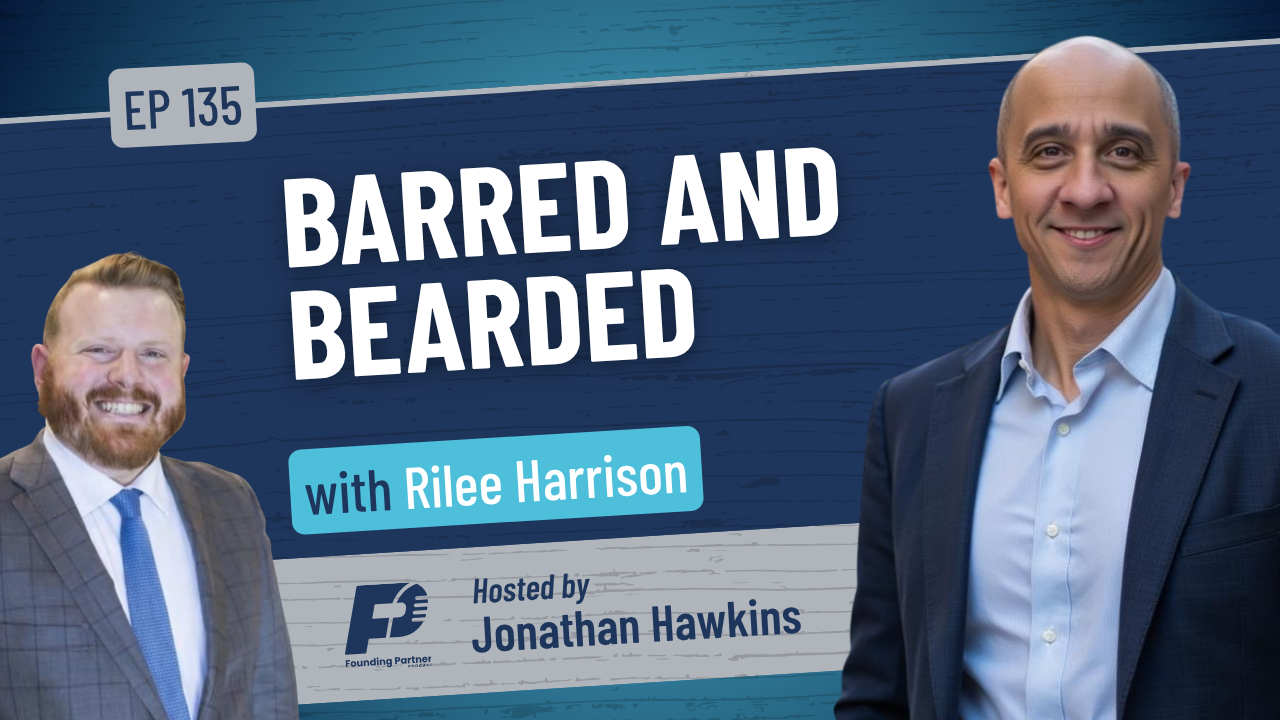
Barred and Bearded with Rilee Harrison
Starting a law firm is never easy.
Starting one while raising young children, entering a rapidly changing legal market, and leaving behind a successful position at one of the state’s top firms takes an entirely different level of conviction.
That is exactly where Rilee Harrison found himself just a few months ago when he helped launch Maples Harrison Zeman in Oklahoma City.
Our conversation covered everything from entrepreneurship and law firm growth to social media strategy, leadership, and even barbecue. What stood out most was how intentional Rilee has been about building both his career and his relationships.
Betting on Yourself at the Right Time
Like many entrepreneurs, Rilee always knew he had a strong entrepreneurial streak.
Before launching his own firm, he established two personal benchmarks. First, he wanted enough financial security to absorb the risks of starting a business. Second, he wanted proof that he could generate clients on his own.
Once those pieces were in place, the timing started to make sense.
The changing legal landscape also played a role. With alternative business structures, large national firms, and increasingly sophisticated legal operations entering new markets, Rilee saw an opportunity to build something proactively rather than reactively.
Instead of launching alone, he partnered with two experienced attorneys who each brought decades of litigation and firm management experience to the table.
The result was a unique opportunity to start with infrastructure, experience, and momentum already in place.
Building a Trial Firm That Serves Everyone
One thing became clear very quickly during our conversation.
Rilee does not view personal injury cases as numbers.
His vision is to build a firm capable of delivering exceptional trial-level representation whether a case is worth $25,000 or several million dollars.
That means maintaining manageable attorney and paralegal caseloads, investing in people, and creating systems that allow clients to receive personalized attention throughout the process.
For Rilee, every case deserves the same level of preparation and commitment.
The goal is simple:
Help clients receive the full value they deserve while building a firm that can scale without sacrificing quality.
How Social Media Became a Business Development Engine
One of the most fascinating parts of our discussion centered around social media.
Many lawyers view social media as advertising.
Rilee views it as relationship building.
Years ago, after generating a referral from a friend who simply did not realize he handled injury cases, he had a realization: people cannot hire you for work they do not know you do.
That led him to become more intentional about sharing his professional journey online.
Over time, platforms like Twitter and LinkedIn became networking tools that connected him with attorneys, referral sources, and future clients across the country.
The strategy was never complicated.
Be visible.
Be authentic.
Stay consistent.
The result has been hundreds of self-generated cases throughout his career and a professional network that spans nearly every major legal market in the country.
The Power of Being Yourself
When I asked Rilee what advice he would give lawyers who want to build a presence online, his answer was immediate.
Don’t be fake.
Too often, lawyers try to portray a version of themselves that does not exist.
Rilee believes authenticity is one of the most valuable assets a lawyer can have.
He shared how, before his first trial, he openly posted about being nervous and scared.
Instead of hurting his reputation, it strengthened it.
People respected the honesty. They saw someone who genuinely cared about doing a good job.
That willingness to be transparent has become a defining part of his personal brand.
Whether online or in person, people want to work with someone they trust.
Trust starts with authenticity.
Building Systems for Sustainable Growth
As a new firm owner, Rilee has quickly discovered that running a business requires a different perspective than practicing law.
Today, he spends time thinking about forecasting, staffing, operations, hiring, marketing, and long-term scalability.
One philosophy stood out in particular.
The firm intends to stay ahead of growth by hiring before they absolutely need to.
Rather than pushing employees to the breaking point, they would rather be slightly overstaffed and positioned for growth.
That approach reflects a larger commitment to culture.
Happy employees create better client experiences.
Better client experiences create stronger outcomes.
Stronger outcomes fuel growth.
It is a simple formula, but one many firms struggle to maintain as they expand.
Relationships Are Still the Ultimate Competitive Advantage
Whether we were discussing networking, social media, referrals, or firm culture, one theme kept surfacing throughout our conversation.
Relationships matter.
Rilee’s career has been built on meaningful connections with clients, lawyers, mentors, and friends.
Those relationships have opened doors, generated referrals, created opportunities, and provided guidance during important decisions.
In an era increasingly dominated by technology, automation, and AI, that lesson feels more relevant than ever.
Technology can amplify relationships.
It cannot replace them.
Closing Reflection
Launching a law firm requires courage.
It requires faith in yourself, trust in your team, and a willingness to embrace uncertainty.
What impressed me most about Rilee is that he approaches growth the same way he approaches trial work: with preparation, authenticity, and a long-term mindset.
He is not trying to build the fastest-growing firm.
He is trying to build the right firm.
If his first few months are any indication, the future is bright for both Rilee and Maples Harrison Zeman.
And if you ever find yourself in Oklahoma City, you may want to leave enough time for some brisket.
AND MORE TOPICS COVERED IN THE FULL INTERVIEW!!! You can check that out and subscribe to YouTube.
If you want to know more about Rilee Harrison, you may reach out to him at:
- Website: https://www.mapleslawokc.com/
- LinkedIn: https://www.linkedin.com/in/rilee-harrison-b1129a67/
- Twitter: Barred and Bearded
- Instagram: https://www.instagram.com/attorneyrilez
Connect with Jonathan Hawkins:
- Website: https://www.lawfirmgc.com/
- LinkedIn: https://www.linkedin.com/in/jonathan-hawkins-135147/
- Podcast: https://www.lawfirmgc.com/podcast
Jonathan Hawkins: [00:00:00] So I’m a lawyer out there I’m gonna do social media.” What would Rilee tell them not to do?
How should you not approach social media?
Rilee Harrison: Don’t be fake. Be yourself. If you’re not, I mean, if you haven’t ever tried a case, don’t talk about trying cases and success on it, right? People are going to appreciate and be more open and honest and they’re gonna wanna work with the person that is open and honest about it, right? I mean, I think I did a post one time before my first trial about how scared I was and how nervous I was to go and do it, and just the fact that I was open and honest about that and talked about those fears, people were more apt to work with me because they knew I gave a shit because I was nervous and I was scared about it.
I wasn’t acting like this hotshot that knew what he was doing, ’cause I didn’t know what I was doing. I was gonna go do it for the first time. You know what I mean? So I think that’s the biggest advice I [00:01:00] would give is be yourself.
Jonathan Hawkins: 100% agree.
Welcome to the Founding Partner Podcast. Join your host, Jonathan Hawkins, as we explore the fascinating stories of successful law firm founders. We’ll uncover their beginnings, triumph over challenges, and practice growth. Whether you aspire to launch your own firm, have an entrepreneurial spirit, or are just curious about the legal business, you’re in the right place.
Let’s dive in.
Jonathan Hawkins: Welcome to Founding Partner Podcast. I’m your host, Jonathan Hawkins. This is a podcast where I get to interview founding attorneys and hear about all the cool stuff they’ve done and that they are doing. And today’s guest is somebody that I came across years ago on Twitter. Never met until, I don’t know, maybe a year or so ago on LinkedIn.
So really excited to have Rilee Harrison on today. And Rilee recently went out and [00:02:00] started his own firm maybe three months ago. I don’t know. I… We’ll get into that, but very recently. His firm is Maples, Harrison & Zeman in Oklahoma City, and he practices primarily personal injury law, I believe. So Rilee, welcome to the show, and thanks for coming on, man.
Why don’t you give us… Fill in the gaps in terms of, of who you are, what you do, where you are
Rilee Harrison: Yeah. So, like you said, Rilee Harrison. Thanks for having me on. Big fan of the podcast. It was really cool that you said, you know, “Hey, do you wanna come on?” So I was like, “Yeah, that’s awesome.” So, but anyways yeah, so like I said, left my old firm approximately three months ago, two and a half, three months ago and partnered with two partners.
Two guys that had, had experience been doing it a while, and had different, different experience lanes. Do primarily just personal injury anything catastrophic injury. We’ve got privacy cases. We’ve got interesting different kinds of cases, but basically anything that’s catastrophic injury or just general personal injury as well.
We’re building out system to be able to handle it all. [00:03:00] And yeah, in Oklahoma City. I’m in the north side of Oklahoma City. But we take on cases all throughout Oklahoma, and have a couple cases going on in some other states that are just, you know, unique stuff that we got either brought into or we got the client.
So anyways, that’s me.
Jonathan Hawkins: All right. Let’s talk about your firm a little bit. Personal injury, there’s lots of different business models. What you are now may not be what you guys wanna be later, but, you know, how would you describe it? Is it low volume trial work? Is it mid volume, a little both? Is it the goal to be sort of high volume pre-suit?
How would you describe it?
Rilee Harrison: Yeah, so definitely, definitely litigators. 100%, that’s who we are, what we do. I actually posted on, I think it was LinkedIn this morning, and I said something to the effect of is, “I just want two things. I want to be able to give exceptional client service,” which means taking the case all the way to trial, giving the full value making sure that, you know, they’re not just a number, making sure that they’ve got…
You know, we have a low client-to-attorney and client-to paralegal ratio, right? [00:04:00] And I wanna be able to do that for as many people as possible. So the goal is, is to build out a exceptional trial firm that does great work for people, that can do that same kind of work on, you know, eight-figure cases, also do it on a 25 to $50,000 case for someone.
So building out systems, processes, and teams to be able to handle that. So, I would say that the goal and kind of already what we’re doing is that middle goal that you talked about. But we wanna be able to do that same level and care as the people that have 10 cases. We wanna be able to do that with however many, and we’re committed to building out the right amount of people and the right amount of teams and not overloading people so we can be that kind of firm.
That’s what we have the vision to be.
Jonathan Hawkins: Yeah, we’ll get into the vision a little later. Definitely that’s a topic I like to explore with folks. But so like you said, you, you guys founded the firm like three months ago-ish maybe. So, h- take, tell me about how long have you been practicing law?
Rilee Harrison: Me seven years
Jonathan Hawkins: Okay. So what was it about three months [00:05:00] ago that you said, “Okay, now’s the time”?
Did you always know you were gonna start a firm and, and what was the spark or what was the thing that pushed you actually to finally do it?
Rilee Harrison: Yeah. So, you know, I’ve always had an entrepreneurial spirit, for sure. I had kind of two things in my head. I needed a kind of a nest egg number that I had in my savings, and then I also, if I was gonna do it, I needed to know that I could generate business. Those were my two things. Like, if I could do those two things, I could do it at some point if I wanted to.
But i- what really, it was just kind of a combination of things. It was getting to that point. Also, just the way that the legal space is changing as well. You know, you’ve got the MSOs that are coming up. You’ve got the ABS models in Arizona. And then really you’ve just got law firms that because of COVID and everything going so digital, they systemize.
They made it where they could sign [00:06:00] tons of cases. They made it where they could do those things, and they’re going to come into these states and stuff. So I was always just a little nervous about just because there’s so many options now, you don’t have to give a law firm to a lawyer anymore, right?
There’s other ways to, to do it. And I knew that the only way I could potentially, you know, have some skin in the game and guarantee it was if I went off on my own, and I figured out a way to do it. But what I was nervous about was going off on my own and not being able to build it fast enough because of all of those, you know, the Morgan & Morgans, the, those big firms in the world that are gonna be coming in.
And so where I had a unique opportunity was, is that I started talking to the guys that I partner with now. They both have been practicing law 25 years. They’ve both had a lot of success. One of them had his own firm for– He’s had his own firm for about 22 years solo shop done the last five to 10, done a lot more car wreck stuff, a lot more personal injury, but he’s, [00:07:00] he’s an appellate guy.
He’s a brief writer just really, really solid lawyer, right? And then the other one he’s had his… He had a, a firm with partners for the last 12 years, and then the 11 before that, he had his own firm. And they were a great firm. They still are. He ended up leaving. But they, they handle large scale cases, kind of that first model that you talked about, less cases, but really large cases.
And so started talking with them about, you know, how can we build something that still handles those large cases, but we can also provide that excellent service to everybody because at the end of the day, the way I look at it is, is the insurance company, I mean, their goal, they get, they get a certain amount in, in premiums every year, right?
And the only way that they make more money is by spending less on paying out claims, right? So they have a Advant– It’s to their advantage to pay less on claims, right? So you have to have someone in [00:08:00] your corner that knows what’s fair, what’s reasonable, and what’s right. I never wanna make something into something it’s not, but I want to get that full and fair value for the client.
And so when I started talking with these guys and their experience, their background, the success that they’ve had it really allowed for us to be able to move a lot quicker than a lot of firms are able to move that are, quote-unquote, “new firms” right? Because all of us had books of business, all of us had cases kind of ready to bring to the table that were in various stages of resolving.
And so really it was just, let’s combine this together and see what it looks like. And it’s honestly been, been a really, really great two and a half, three months. We’ve, you know, we’ve already started doing some things we talked about. So, we’ve already started advertising, we’ve already started doing some things that a lot of firms can’t do early on because they don’t have the capital to, they don’t have, you know, the, the folks that have had some of the success that partners have had.
They don’t have the background I’ve had in [00:09:00] kind of, you know, systems and processes and marketing and some things I’ve done. So anyways, that’s why it was just… It kind of felt like the right time. It was scary. My old firm’s one of the best firms in the state, incredible people over there. I miss them.
And, and it was really, really hard to make that decision. But at the end of the day, I’m, you know, excited that I… You know, kind of coming out and betting on myself and seeing what we can build
Jonathan Hawkins: And the other thing you didn’t mention is you’ve got, I think, two, two young kids also right?
Rilee Harrison: Yeah. So we,
Jonathan Hawkins: There’s always, there’s always, you gotta make sure you can pay f- pay for the, you know, get food in their bellies, right?
Rilee Harrison: Well, two, yeah, two kids. Two and then well, so we were foster parents, my wife and I were. I’ve posted a lot about that on social media. But the little boy, it’s actually a really cool situation. He’s back with his biological father. But we just have a great relationship with them. They live in a house we own, stuff like that.
And so, he actually does two weeks with him and then a week with us. So he calls him Poppy calls us Mom and Dad. And so we do… does two weeks there, a week with us. And then my wife’s pregnant. And so yeah, we are s- [00:10:00] coming November, we’ll have every third week, we’ll have three kids in our house.
So it’s gonna be a, it’s gonna be some wild times. So, and, and starting a business and my wife running her business, but we’re, we’re up for the challenge and we’re excited.
Jonathan Hawkins: Enjoy it while it
Rilee Harrison: now when we still have some energy.
Jonathan Hawkins: Yeah, exactly. Enjoy it while it lasts, while you’re young. It’s, it’s gonna be fun. So, so back to you, you g- you got your two other partners. Y- you knew, you sort of felt it was the right time. Take me through, you know, how did you guys find each other? How did y- how did these dis- discussions unfold?
You know, I get a lot of calls on this, and I’m just curious how it happened for you guys. And how did you know it’s right with these? And, and, you know, I imagine you maybe had d- had discussions with others over the years too, but for whatever reason, it was the three of you
Rilee Harrison: Yeah. So, you know, like I said the one of the guys is really that I started talking with, he reached out to me actually on, it was like maybe LinkedIn. One of my posts resonated with him. He sent me a message and was like, “Hey, you know, I know you got a great deal, but if you ever decide [00:11:00] to, you know, potentially think about it, let me know.
I’d love to get a shot at it.” And we just kinda started talking and then we started going to lunch and chatting about, you know, kinda what my vision for a firm would look like, what he wanted his vision for, you know, where I’d had success, where he’d had success. And, you know, it, it’s someone who’s already built two successful firms, right?
And so my thought process was, is, “Okay, like, you know, I’ve got someone here who’s had success before. They’re gonna continue to have success.” And then what I can do is essentially complement it really well with running what I like to call kind of running a modern lar- law firm, right? Using data really good systems, really good processes, the case management software working, right?
Us doing those kind of things. So that’s the stuff that I know how to do. And also litigate, like I’ve, I’ve litigated my entire career. And so I thought we were a really good complement to each other. So we just started talking about it. And then he had a he had another lawyer that they had bought a building together.
They were gonna basically work together, but just as two separate [00:12:00] firms. He started going to lunch with us as well talking about, you know, what the, what it could look like, what the future could look like, what I envisioned, kinda what I would do, and what I could take off of their plate so they could do what they’re good at, which is cases, right?
And so we started chatting and started talking and started going back and forth, and it really just, it made sense, honestly. So, and yeah, and, and vetting. I mean, I’ve talked to some other people in the industry what they thought and, you know, thought about the move and you know, had, had some good feedback, some not, you know, some in the middle.
And at the end of the day, I just kinda had to make a gut call for what I thought was right for me and what was gonna work. And so far I, I feel like I made the right decision, so I’ve been happy with it.
Jonathan Hawkins: I will say very astute there. You ask 10 people, they’re gonna probably give you 10 different advi- The advice is gonna be completely different. And it, you never know really who to trust. And at the end of the day, you gotta, you take the information in and go with your gut, man. You just, you just gotta, you just gotta do it.
So I [00:13:00] know it’s only been three months, but h- how’s it been? What’s it like being on the other side, on the ownership side now?
Rilee Harrison: You know, it’s been, it’s been interesting. It’s it’s been really good. I’ve been really really proud of the team, really impressed with kinda how everyone’s came together and how everyone’s, you know, working towards goals. There was already a couple employees that, that were here before I got here that we all…
But they were all kind of in different law firms, right? So they all kind of… We’ve melded that together. And we’ve hired a few people already got some more probably coming pretty quick. But it’s been, it’s been really cool being on their side. It, it’s definitely interesting how the mindset changes on, you know, okay, I used to remember, you know, I was excited about resolving that case, right?
Well, now I’m, I’m excited about the overall amount for the whole firm on how many cases and what statuses they’re in. And, you know, if we know it’s in this status, we know cases in this status are typically done in nine months. We know they’re done in six months, right? Figuring out those things so I can forecast and kind of take an [00:14:00] overall picture of everything.
And then also just building out systems and processes that won’t just work now, but we can replicate it when we have, you know, double the amount of people. We can replicate the pods that we’re doing. We can replicate the things that we’re doing, right? And then also just, you know, it’s been interesting just kinda weighing through all the opportunities that have came too, right?
Like, I’ve got opportunities like, “Hey you know, I’m looking at winding down this practice. Why don’t y’all take over cases?” I’m like, “Oh man, okay. I’m not gonna say no, but we’re gonna have to gear up,” you know. Or, or, “Hey, why don’t you rent a space in this office from us too, and go ahead and expand?” So there’s a lot…
It’s interesting how many more decisions that you have to make. But overall it’s been, it’s been really cool. It’s been fun. It’s been exciting. I’ve felt really energized and kind of some love from folks in the community that have really given me a lot of support and a lot of encouragement in making this decision.
Because Oklahoma, you know, for at the end of the day, it’s a small legal community, so like I was gonna have to still continue working with the same people I worked with before, [00:15:00] right? The same vendors, the same doctors, the same stuff. And so, it’s been really nice seeing how encouraging people have been and yeah. Anyways, I hope that answered the
Jonathan Hawkins: It d- it did. You know, a couple things I wanna hit on. You know, the mindset shift. You know, I look back at my, sort of my journey from associate to I was a, a partner at a couple of other firms where there were m- many partners and I was always the youngest. And then later I started my own firm, and it’s, you know, becoming a partner, my mindset was different.
But even just starting my firm is different than when I was a partner in an established firm. It’s just funny how every time your role changes, your, your mindset shifts a little bit. The other thing you hit on is, is the opportunities. And this is a real thing I’ve experienced. I’ve talked to others as well.
When you go out on your own, especially early days, it– everybody hears about it, and all these people are reaching out, and all these opportunities start coming across your desk. And it’s so exciting, and it’s a little overwhelming, and you wanna say [00:16:00] yes to everything but you gotta be careful.
Can’t say yes to everything. That’s… And that’s where it gets a little more, you know, you never know for sure, but y- you gotta say no to some things. You can’t say no– say yes to everything. So, enjoy it, man, and just be careful with all those opportunities, I’ll just say.
Rilee Harrison: 100%. Well, and that’s what’s awesome that I’ve got two partners that have had their own firms for years, right? And came together to join this and form this. And so they’ve, they’ve experienced that and lived that, right? So we’re talking through those decisions, which I think is really cool. And having some, you know, some guidance on that.
And then honestly, them, them trusting me a lot too with a lot of the business stuff has been really cool, so
Jonathan Hawkins: So you, you, you’ve mentioned systems, processes, softwares a couple times. So where did you get your experience with all of that? How did you develop your skillset there? I’m curious.
Rilee Harrison: My last two firms both had different processes and systems, but the first one I started at was a volume PI [00:17:00] firm. Really good systems, really good processes, got cases through very quickly, very efficiently. Had a very built-out case management software where they had even six, seven years ago, had everything digitized and systemized it and as quick as possible, you know, letters would, you know, there was templates for everything.
It would pop out a letter that you could just change something in it if you wanted to. Otherwise, it was ready to go, stuff like that. They were really ahead of the game in that. They, they took a case management software and they really customized and made it their own and did a really good job with it.
So, learning that was really, that was the first thing. And then the last firm I was at they were the same way. I got to watch the folks on the, that were really doing the operations, really vet new products, learn about new products, bring on new products and then implement some and do some of those things.
And then I oversaw the marketing and the intake and stuff like that. So I got to bring in [00:18:00] and build out some of the intake software and some of those things that we used and stuff too, and build out some systems and some processes on intake and stuff. And so anyways, that’s really just from that.
And then I, I did, I participated in a lot of like mastermind meetings and conferences and things like that in my last role. And so I got to learn a lot through that.
Jonathan Hawkins: You know, conferences are, are, are really huge. I mean, I th- they’re fun. They c- you can get a l- you can become, you can become a junkie a little bit, I think. But a- and, you know, but it’s good that you got out there. I don’t know if, if you had to push for that or if they pushed you or, or a little of both
Rilee Harrison: Yeah, a little of both. But yeah, but no, it was a, it was an absolute blessing and something I’ll never take for granted. I learned a ton met a lot of people. And so it was, yeah, definitely a, definitely something that was an incredible help in my career, so
Jonathan Hawkins: All right. So I wanna, I wanna do a pivot. We’ll come back to the legal stuff in a minute, but I, I wanna talk, I wanna talk [00:19:00] Twitter for a little while. So yeah, I mean, you’re, you’re, you, you know, that’s where I first came across you. I, I mentioned offline, it was, I think it was post-COVID, so, or during COVID, whatever.
That’s when I really, really started… We were sitting at home, you know, what, what else are we gonna do? So I started getting on Twitter a bunch, and I’ve never been a big poster on Twitter, but I am, I’ve been a major lurker. And so, you know, I came across you around that time. It’s, I can’t remember. But I looked up before as I was getting ready for this, and you’ve been on there since 2011.
So you’ve been on there a long time, 15 years. So, tell me, sort of take me through your… I wanna dive, we’re gonna talk a lot of Twitter ’cause or X, I still call it Twitter, but
Rilee Harrison: Yeah
Jonathan Hawkins: How did you get there and, and really take me through some of the evolution of your ac- activity there. ‘Cause by the time I found you, you were posting a lot.
I don’t know if you were like that from the beginning, but yeah, take me through it
Rilee Harrison: Yeah. So, How’s the best way to [00:20:00] put this? So essentially, and it kind of all ties in, and it kind of ties into the work stuff too. So I’m gonna kind of give you just kind of the, the beginning and we’ll just evolution kind of, ’cause it does tie into my work quite a bit. So essentially going back to high school, which is like, really this guy’s talking about founding a law firm and he’s talking about high school right now.
But everything I’ve ever done, I’ve been super involved in it, right? Like from, you know, captain of the football team, on student council to undergrad. I was an outstanding junior and outstanding senior at my university, right? And so I was always very like connected, got to know people, met a lot of people.
So even just from an early age, like my social media stuff, just because I was out doing so much, I had more, just more followers and more friends and more stuff just because I got out there and met people, right? That’s really all it like boiled down to. And so the way that– So I always kind of had a little bit of a following just because of that, but nothing crazy, but just because of that, right?
And so [00:21:00] I had always networked well, had always kind of done well. And so whenever I graduated law school and came back up to Oklahoma City I realized, you know, every… I was gonna do plaintiff work. That’s what I wanted to do. That’s what I was, what I was like, “This is my thing,” right? And basically every firm that I talked to, they gave a cut of, you know, you get a larger percentage of the fee if you’re the one that brings it in, right?
You rainmake, you, you get more money, right? And so I was like, “Hmm.” So I kind of made a decision early in my career that I really needed to… ‘Cause I was one of those guys, like I said, entrepreneurial spirit, right? I wanted to be involved in everything. I wanted to, you know, this person, you know, I wanted to do real estate with this person.
I wanted to do a company with this person. I wanted to do this, I wanted to do that. And I said, “You know what? I need to make my money first, and then if I can invest in other stuff, awesome. But like, I need to get good at something.” And so I was like, “I’m gonna focus on two things.” And it kind of morphed, the second one did a little bit, but first thing [00:22:00] was litigation, learning how to litigate, learning how to push cases through, understanding how to go to trial, understanding how to trial work.
And the second one was generating business, right? And so generating business morphed into, I realized I really enjoy just kind of like the business side of things, the marketing, the intake, the business development. I kind of morphed that all in together, but we’ll talk about that. So, so anyways I’m an associate attorney, first year-ish, don’t really get any, you know, maybe generate one or two cases, nothing crazy.
And I end up, I worked for about seven or eight months with a firm and then I left. I joined that, that firm I was telling you about, the, that I call my first firm really, but it’s the, the one that was the PI you know, the, the volume PI. And about a month in, two months in One of my buddies posted on Facebook, and he was in a wreck that looked horrible.
And I texted him. I said, “Hey, man.” I said y- I said, “That looks bad.” And he goes, “Yeah.” He goes, [00:23:00] “I’m, I’m a little sore.” And nah, he goes, “I’m gonna see how I feel tomorrow, but wait.” He texts me the next day. He goes, “Hey, I can’t walk.” He goes, “Is that the kind of work that you do?” And I was like, “Yeah, it is.” I was like, I, you know, I’m really more in the workers’ comp, but I was like, “We can help you.”
And he’s like, “Okay, great.” He does the case, works through it, and at the end of it, I get a call because I’m not really even doing car wrecks yet. I get a call from the senior paralegal in that department. She’s like, “Hey, so and so’s case settled, and by the way, you’re getting a $12,000 bonus.” And I’m like, “$12,000 bonus?”
I was like, “I don’t wanna be a lawyer. I wanna bring cases in. That sounds way more fun,” you know? So I’m sitting there, and I had a couple of takeaways from it. I was like, “I’ve got 3,500 friends on Facebook, right? I know 3,500 people If just of those 3,500 people know what it is I’m doing, I’m gonna get business.
And that was that friend that I said [00:24:00] he, he literally said, he goes, “I didn’t even, I didn’t know if you did that kind of work. I had no idea what kind of work you did.” So I had already started networking in the, like, Oklahoma plaintiff legal community, and I had, I’d hit it pretty hard. I just had a lot of cool opportunities that came.
I was in a mentor-mentee program. I had done some of those things together. And then what happened was, is essentially the guy who was my mentor-mentee, he became the president, the past president during that time. COVID was going on, like you said, and that’s how all the, the Twitter comes in, trust me.
It’s coming. I know you’re like, “Why is this guy talking about networking when I wanna talk about Twitter?” It’s important, trust me. And so, I started doing the networking there, and so, so I started to generate some cases and I’m like, “Oh, this is pretty cool,” right? So my first thought was, in my mind I was like, “Well, I’ve got all these friends on Facebook already,” right?
“So friends and family need to know what it is that I do.” So I start maybe posting like once a month on Facebook, like a picture of me in a suit or a picture about something I do, or something about MedPay or [00:25:00] something informational, something that they may wanna learn, right? I start getting some cases.
I’m also networking with our plaintiffs association, and I do workers’ comp, which a lot of attorneys don’t do, so I have attorneys start referring me their workers’ comp cases. And that turned into some of them referring me their smaller car wreck stuff, right? And I’m just like, “Hold up. Wait a second.” Like it’s all, it kind of starts coming.
And what I realized was, is that every one of these relationships is someone that at some point I, I had met in person, I had networked with, they trusted me, they liked me, and even as a new lawyer at 28, 29 years old, they trusted me enough for their friends and family to work with me And I thought to myself that because I’m an associate lawyer and I’m not a firm owner, I really can’t do direct-to-consumer advertising, right?
Because I would be competing against firms I work at that [00:26:00] advertise. So I thought to myself, “What about if I did business-to-business?” And I was like, “And, and how could it work where I could meet other lawyers across the country?” I don’t have the money to go to conferences. I don’t have the ability to travel.
I can’t put out an ad. And it just kind of clicked for me that I had naturally just started posting more about law on Twitter, and some of my stuff started going kind of viral, and it kind of started popping off. And then it started getting shared on Instagram accounts that have half a million followers that are sharing my, my deals.
I mean, I get posted, even today I get posted once a week probably from some kind of, you know, humorous lawyer page or funny lawyers or Litigation God or one of those, right, of some- one of my tweets or one of my memes that, you know, went viral at some point. And so I was like, “I could start doing it that way, and that’s how I could network.”
So I [00:27:00] saw social media as essentially a networking tool with other lawyers, right? That’s kind of what I saw it as. And I was like, “You know, I’m gonna make a couple promises. I’m gonna be myself. I’m gonna be authentic to myself. I’m not gonna… You know, I’m gonna, I’m gonna tell the truth. Like, that’s what I’m gonna do,” right?
And I just kind of started doing that. I started posting stuff that I thought was funny. That’s why I stayed off of LinkedIn for so long is ’cause I was like, “I don’t wanna be serious and stuffy,” right? But a year ago I started posting on LinkedIn and I actually looked at it. A year ago I was getting like, you know, I had like 1,000 views or something like that.
In the last year I’ve went from 365 days, 1,000 to like 700,000 impressions. You know what I mean? And so the platforms have kind of done on each other, and now it’s gonna be, I’m still figuring out how I’m gonna do it, but at the same time it’s you know, it’s always fluid and figuring out what I’m gonna do.
But now that I’m actually a law firm owner, right, I can do more of my brand direct to consumer as well as attorney. So I’m considering, you know, doing a little more video content, posting a little bit more [00:28:00] on some of those where it’s more like informational stuff rather than just my attorney friends.
The funny stuff will be for the attorney friends that are like, “Oh, that’s hilarious,” ’cause it’s, you know, about clients or whatever. But the other stuff would be more to direct to consumer. So, definitely some strategy in there, but basically it was, “Okay, how can I meet other lawyers and how can I do?”
And it really has been cool. I’ve really made some really good friends. I think one of the questions that you had was have you gotten any business from Twitter, which is
Jonathan Hawkins: well, I, I wanna, I wanna get there in a second. Hold that, hold that, ’cause I’m very interested in that answer to that question. But before we get there, so there are all these different social channels. I mean, you, you mentioned there’s Facebook, there’s obviously Twitter, there’s LinkedIn, there’s Instagram, there’s, you know, there’s others I guess TikTok, all the stuff.
And, you know, each one has its own personality and sort of, you know, best practices or all the stuff, you, you know, there, the way to learn it. why Twitter versus something else? Why did, why didn’t you go [00:29:00] to, to another one? Was it by accident, or you maybe you tried all of them and Twitter worked better?
Rilee Harrison: Twitter just, it just felt right for me. I enjoyed writing. I enjoyed just kind of saying stuff that I thought was funny that, you know, just putting my stuff out there and everything. And so I just gravitated toward it because I– it was, it was short form. I wasn’t writing novels. I wasn’t, you know, I wasn’t having to, you know, act like something I’m not.
I could just get out there and put my thoughts out and people thought they were funny or thought I was stupid or whatever, but they liked it regardless and then went from there. And I’m just not good-looking enough to succeed on like Instagram or TikTok, so that was really what that boils down to.
But no, it was just one of those…
Jonathan Hawkins: barbecue looks pretty good. I’d be pretty
Rilee Harrison: I do, yeah. So I post some stuff like that, and that was the thing with LinkedIn. I was, about a year ago, I was like, “You know what? Screw it. I’m gonna do LinkedIn too, and I’m gonna get more involved with it and, but I’m gonna do it my way,” right? I’m gonna post some stuff that’s serious and I’m gonna, you know, give some of my thoughts on business and all that, but like, I’m gonna let people know who I [00:30:00] am, right?
Let people understand, you know, that what I like, who I am, because at the end of the day, if like someone wants to be your friend or wants to work with you, either way, they need to trust you, and they need to know a little bit about you, and they want to, they need to want to work with you, and they also need to wanna see you succeed, right?
Whenever I’m thinking about referring a case out, like I’m thinking of the person that, one, it’s gonna benefit the client, ’cause I always try to put the client first, but two, who can I benefit, right? Who’s someone that’s up and coming? Who’s someone that’s hungry? Who’s someone that wants it? Who’s someone that needs it?
And that’s the kind of person that I wanna feed business to, right? And so, and those are people that are real. Those are people that are raw. Those are people that are honest. Those are the kind of people that get those cases, especially when they’re not as proven or not as experienced.
Jonathan Hawkins: I like that approach. So, so yeah. So the other thing about social media, just my experience, so I like I said, I lurk on Twitter. I’ve never r- I’ve posted a couple things, but nothing. It’s been so long. It’s just LinkedIn was sort of what I [00:31:00] embraced and, you know, really did a lot there. And just in my four or so years sort of being active there, I, it’s, it’s harder now than it was when I started four years ago.
I think every platform is that way, and I think Twitter’s the same way, I’m sure. And then, you know, that post-COVID, I’ll call it a year-ish, you know, during COVID and post-COVID is before it was sold. I’m not gonna get into all that, but before it was sold, and, and I, you know, there were, like, there was real estate Twitter, there was crypto Twitter, there was finance Twitter, and I had…
There were really, really good, strong people that were there posting really good stuff. I mean, just quality stuff. And then I don’t know what happened. The, you know, the, the algorithm always changes, but a lot of people left. And I feel like it, it wasn’t as good as it was post-COVID. But it also, I think when the algorithm started changing, it became harder even for me when I was following people, [00:32:00] for them to show up in my feed.
I felt like it, it was, it seemed to be harder for people to get traction. Did you experience that in your journey on Twitter?
Rilee Harrison: Yeah, I did a little bit. What I’ve noticed actually, which is interesting now, is that in the past I would get real nervous if like I would post something and it didn’t have like, you know, five, six, seven, eight, 10 likes in like two minutes, right? I’m like, “Oh no, this is gonna be a stinker. No one’s gonna like it,” and stuff.
What’s super interesting now is, is that those posts actually like I just like, I just gotta leave it. Then like I’ll have posts that will end up having thousands of likes that will have had 100 likes in an hour, right? So it is just different algorithm-wise. People did, you know, yeah, some left with, you know, when the sell happened stuff.
But at the same time it’s been interesting watching how it’s like shifted. There’s kind of new personalities in the law Twitter space that have popped up and stuff. But, you know, I’ll tell you this, it’s interesting how just much [00:33:00] consistency has to do with it. I notice that if I go three or four days without posting, it takes a p- a couple of posts before they start getting like traction and likes again, right?
So it’s interesting how much consistency is. I think honestly the same thing is pretty similar on LinkedIn too. I think you see a lot of that too on just the consistency of posting. I’ve actually done some searches with like ChatGPT using it to like, hey, you know, what kind of– how often should I do, how do you build a profile?
‘Cause obviously we’re gonna be building out our new law firm profile accounts and like how to build it out and stuff, and it’s been some interesting insight on that. But yeah, it, it definitely changed somewhat, you know. And I’ll tell you this, I kind of took a little bit of sabbatical a little bit.
Up until about a year ago I was, I was slowing down myself and, you know, that was one of the things in my old firm, I was so focused on that firm, on, on everything I was doing there. I was so busy that I really slowed down a little bit. And it- I’ve gotten back into it the last six [00:34:00] months to a year and been really happy.
It’s, I feel like I’m back getting my thoughts out there and getting, you know, people to know what I think and, and everything. So, but anyways ’cause that’s what someone was like, “Yeah, how much time do you put into all that?” I was like, “Honestly, my, my networking and stuff is kind of on autopilot at this point.”
So, ’cause even when I wasn’t posting, my posts were still getting shared, you know, with 100,000 of views on Instagram and stuff like that. So, but anyways
Jonathan Hawkins: It’s in- interesting you, you took the sabbatical. I, I’m sort of in a sabbatical now on, on LinkedIn. You know, I, I, I posted almost every day for like three something years. And you, and you, you can recycle and, and reframe old posts, so that helps. But you just… I just got tired, man. I just got tired and,
Rilee Harrison: It’s exhausting
Jonathan Hawkins: And so, and I’ve been really busy.
But I will probably start back up here soon on LinkedIn.
Real quick, if you haven’t gotten a copy yet, please check out my book, the Law Firm Lifecycle. It’s written for law firm owners and those who plan to [00:35:00] be owners. In the book, I discuss various issues that come up as a law firm progresses through the stages of its growth from just before starting a firm to when it comes to an end.
The law firm lifecycle is available on Amazon. Now, back to the show.
Jonathan Hawkins: But okay, back to the question that I said we were gonna pause. So, maybe you can answer this however you want, but the ultimate question is, do you get cases out of it? But was that the reason you started and did the reason shift?
So maybe that could all come together.
Rilee Harrison: I wouldn’t say it was really necessarily the reason I started. The way I looked at it was, and I know you may even roll your eyes at me a little bit, but I looked at it as a deal as like, a lot of my success early was just because of making friends and getting to know people, right?
And I thought to myself, I was like, “You know what? Worst case scenario, I get on, I start following some other lawyers and they start following me. I make friends. I go to another state to do something. I have people to give me recommendations. I have someone to hang out with.” [00:36:00] You know?
Worst case, I make friends. Best case, I get a case here or there. And I have I don’t really track it necessarily like social media versus in person because even like my friends and family referrals and stuff, I mean, I credit a lot of that to social media, right? To staying in front of them on Facebook, to doing those things.
Even some of the attorneys locally, they’ll refer me a case and they’ll send me a post. It’s been really interesting. We signed a lot of cases in our first like two and a half weeks as a new firm. I was like, “Holy schnikes.” I was like, “If this keeps up, we’re gonna have to double down on hiring and it’s gonna be nuts.”
And what I noticed was is we had posted a lot on social media and all three, me and both my partners, we all generate business, right? We all have the capability and the capacity to generate business. And so because we were posting so much, things were getting shared on all of our social medias, we were top of mind for a lot of people.
We slowed down a little bit on it ’cause I was like, “Hey, we need to hold off.” In the last like two, three weeks, we started posting consistently [00:37:00] again, then boom, it’s you know, we’re gonna sign like 10 cases this week. And I’m like, “Whoa, this is wild. We gotta crawl, walk, and run on this thing,” you know.
But yeah, so that was the deal. I mean, I’ve seven years, I’ve generated 350-ish to 400 of my own cases now at this point without spending any money just with word of mouth, with networking both locally and using my social media like I have. And so, and have resolved, I’ve got several six and seven-figure cases right now that have came from people that I’ve never met in person before that have followed me online or one of their friends followed me online and they resonated with what I said and trust me to handle cases for them and for their clients.
So
Jonathan Hawkins: See, that, that is incredible. I mean, you know, there’s no guarantees that if people get active on social media, but but that is incredible. And, and you know, you mentioned maybe at the very beginning of the conversation the whole MSOs and private equity and all that, and that, [00:38:00] that’s coming and people are w- very worried about…
Some are very worried about it. It’s really if it wasn’t MSOs and private equity, it’d be the Morgan & Morgans of the world coming in. And, and they can outspend everybody. And so everybody gets nervous about that. But there are still really good avenues, you know, social media being one of them, or just relationship development I’ll call it, that doesn’t really cost anything, and it’s fun and enjoyable ’cause you’re make, you’re, you’re making friends.
That’s the other thing that, that really surprised me about really getting active on LinkedIn is I’ve made friends all over the country, people that, you know, when I, when I s- when I do see them at a conference in person, it’s like we’re long lost friends that hadn’t seen each other forever a- and it’s the first time I’ve met them in person.
And that’s just a really cool thing. And so you can have fun, develop relationships, which is the, really the point of life maybe even, and it doesn’t really cost you anything
Rilee Harrison: Yeah, [00:39:00] 100%, man. That’s the way I look at it. It’s, I’ve got friends, I mean, if I go basically any city I go to, like I was in Louisville last week, and I had several lawyers I texted, met up with one. And you know, it’s just, it– I’m at a point now where it’s like basically any city in America I go to, I know someone there from either social media or from the conferences I’ve been to or something, right?
That I’m either gonna meet up with or I’m gonna at least get some dang good local recommendations where I need to eat at and drink at, so, or get coffee at, so
Jonathan Hawkins: Exa- exactly. All right, so for the lawyers out there, if there’s still lawyers out there that are not active on social media, what kind of advice would you give them after doing this for a good number of years?
Rilee Harrison: Yeah. You know, here’s the deal. I think what I would do is that first off, figure out what you want in your career, right? Not everyone wants to own the law firm. Not everyone wants to worry about going to every networking event and [00:40:00] shaking every hand and getting that kind of, that business in and the pressures that come with that, right?
That call that you get from your friend whenever, you know, their friend that they sent over to you or their parent that they sent over to you is pissed at you because what the kind of work I do is people are hurt, they’re angry. It’s typically not a great result, you know? Not everyone wants that stress.
So first thing is figure out and have that conversation with yourself on, you know, but the first thing would be is figure out who you wanna be. And if you wanna be that person, then awesome. Figure out ways and avenues to be it, right?
Go network in your community. Go make sure everyone that you’re doing knows what you do, who you are, why to choose you, and why to work with you, right? But first thing is figure out and have that soul-searching conversation with yourself if that’s what you want. If not, go and find those people that are going to rainmaker network [00:41:00] and be, like I said earlier, pick two things that you wanna be good at in your legal career, or one thing that you wanna be really good at, right?
I wanna be the best damn researcher in the state. I wanna be the, I wanna be the appellate guru in my state. Obviously all my stuff’s plaintiff-based, but I wanna be the best, I wanna be the one that’s taking the depositions of the doctors. I wanna be the one that crushes that, right? If that’s who you wanna be, that’s okay.
And then the second thing to answer your question more is if not, figure out what’s unique to you and also what stays true to you, right? Like getting on doing videos, doing some of that stuff, I’m getting better at it. And I do like it, don’t get me wrong, but I’m not as comfortable with it as I am with posting something funny, right?
Or jumping on Zoom and just chatting with someone. I’m just not as comfortable with it. So figure out what’s comfortable to you, what stays authentic to you, and what’s unique to you on ways to get cases in. And that way maybe like with me, because I was involved in everything, I made so many friends and I had so many [00:42:00] Facebook friends, stuff like that, I was like, “I could utilize this,” right?
Or it may be, “Hey, like I was a nurse before I went to law school and I know nursing really, really well, so I’m gonna go in to every medical clinic and talk with their staff, tell them why, you know, why I’m different,” right? “And why they should work with me because I speak their lingo. I was a nurse too.
I understand this,” right? Figure out what’s unique to you and go figure out that thing and then shout it to the rooftops, and the cheapest way to shout it to the rooftops is by social media
Jonathan Hawkins: All right. So I’m a lawyer out there and I’m thinking, “All right, I’m gonna do social media.” What would Rilee tell them not to do?
How should you not approach social media?
Rilee Harrison: Don’t be fake. Be yourself. If you’re not, I mean, if you haven’t ever tried a case, don’t talk about trying cases and success on it, right? People are going to appreciate and [00:43:00] be more open and honest and they’re gonna wanna work with the person that is open and honest about it, right? I mean, I think I did a post one time before my first trial about how scared I was and how nervous I was to go and do it, and just the fact that I was open and honest about that and talked about those fears, people were more apt to work with me because they knew I gave a shit because I was nervous and I was scared about it.
I wasn’t acting like this hotshot that knew what he was doing, ’cause I didn’t know what I was doing. I was gonna go do it for the first time. You know what I mean? So I think that’s the biggest advice I would give is be yourself.
Jonathan Hawkins: 100% agree. I think people, just like juries, they can sniff out very quickly insincerity and bullshit, so
Rilee Harrison: 100%. It took us, it took us 45 minutes to get there, but now, now it’s a real conversation, so
Jonathan Hawkins: Yeah. Yeah. So, all right. I’m gonna shift again, man. We’re, we’re gonna bounce around. We got [00:44:00] more more material than w- we’re gonna get to, but the, another thing that I, just from the research, another thing you, you post about is, is nice, good-looking brisket, man. That’s… So tell me about your, you know, your grilling.
Is that a, is that a hobby? Or is it just, I mean, do you do it a lot? And how did you get into that?
Rilee Harrison: I love to cook. Again, I love people, I love relationships, I love hanging out. I love that. And so I’ve always kind of gravitated towards like hosting the party and being the one that makes the food or makes the thing. I like to cook for my family too. Like I just, I enjoy cooking. I think I’m okay at it.
And so, I did a lot of stuff on my Blackstone and I really wanted to start getting into smoking and so, for Christmas my wife got me a really nice smoker for Christmas and I’ve been going to town on that thing ever since. Been posting about it and been learning and been, you know, getting new recipes and all that, but it’s been really, really fun.
So really, really fun
Jonathan Hawkins: I’ll tell you, I, I was like, “I’m gonna have to swing by Oklahoma City and get a taste [00:45:00] of some of that,” ’cause some good looking, good looking m- meat you’ve been posting out
there, so
Rilee Harrison: when I, have my success, like it’s not gonna probably be like me driving a Maserati or me, you know, doing anyth- any of things like that. It’s gonna be the, the one splurge I’ll have is a, a pretty nice place that’s open for entertaining and a nice outdoor area for cooking and outdoor entertaining.
That’s, that’s one of my… I’ll, I’ll know I’ve made it whenever I have that, but that’s my my thing. I enjoy entertaining. I want that hangout place. I want that space, and I want to just ultimately just be able to enjoy that time with the people that matter to me. So, and that’s what one of the reasons I think I got into cooking was because I you know, I could, I could be the one that provides that.
So, so I’ll go to… Well, friends will have a pool party or whatever and stuff, they’ll text me, “Hey, do you mind making like, you know, the pulled pork or the sliders or bringing some ribs over?” And I’m like, “You betcha I will.” So anyways.[00:46:00]
Jonathan Hawkins: So, is it, have you yet combined your love of entertaining and cooking with your love of relationships and your love of, of marketing business? Have you guys maybe at one of your prior firms or maybe at your current firm done the big, the big event where you, where you s- the party where everybody comes in?
Have you done that yet?
Rilee Harrison: No, we’ve my old firm did had one scheduled a few weeks after I left. There was like gonna be, you know, people on the grill and all that and stuff. But what I’ve done over here is we did a our first, I think it was Memorial Day we did a cookout just for our staff and their families if they wanted to bring them, and everyone really enjoyed it and had a really good time kind of breaking bread together and hanging out, and let everybody off early that Friday.
And I made– I think I did pulled pork and did some sausage and did some stuff like that. So anyways, but yeah, no, we’re, we’re definitely gonna do more community events and more things. I don’t know if I’ll, I don’t know if I’ll get to actually be out there cooking and doing. Maybe I will, but we’ll, we’ll see if we’ll see if I have [00:47:00] the time to be the one actually out on the grill and stuff, so.
But anyways
Jonathan Hawkins: Well, the T-shirt’s gotta have a picture of you, you know, the grill, so
Rilee Harrison: Yeah, I just said I’ll have to grow my beard out. It’s gotta be about like this for it, so
Jonathan Hawkins: that’s cool. So all right, so switching back, back to the firm. I wanted to circle back on this. So you sort of mentioned earlier when you were talking with these guys, your new partners you talked a lot about vision. I think that’s really important when people are going into partner some, partnership with someone.
That’s one of the conversations they need to have. So what is as you sit here today, what’s the vision for the firm? What is it you guys wanna build now and into the future?
Rilee Harrison: So I think like Kyle said earlier the insurance company, they get a set amount of premiums every year, right? And so they are incentivized to pay less on claims, whatever that looks like, right? I keep track of values. I keep track of what cases we’re resolving for. I have a good [00:48:00] idea of what they need to resolve for, right?
And so I believe that if myself or my firm is involved in a case, we are going to make sure that that client gets what they deserve from it. I think that we all share that vision. We all share that mindset. We all believe that that’s who we are as lawyers and what we’re here to do. And so my goal is to be able to I think every person in Oklahoma and beyond needs that kind of service and that kind of care on their case, no matter if the case is worth $5,000 or $5 million or $5 billion.
They need to have lawyers that are going to make sure that if it’s worth 5,000, they get the 5,000. If it’s worth 5 million, they get the 5 million. And so my vision or our vision as a firm is that that’s– we wanna be able to do that for anyone that needs it, right? And we want to build it out in a way that we are [00:49:00] not sacrificing just because we’re larger.
We’re not sacrificing that. We’re not overworking our people. Our people are happy. Our people are doing good work for other people because they have plenty… They have the resources at their their tools available to them that, that we’re helping provide and that we’re doing. So the goal is to help as many people as possible.
We’ve obviously got, you know, a business plan in place, in place. I, you know, I foresee I foresaw, I should say, years three to six being some massive growth years for us. With some of the intake and some of the things that have been happening, we might, we might need to accelerate which is fine.
We’ll pivot, and we’ll do well on it. But I really, you know, the first 18 months, really my vision was, is build out the system, build out the process, make sure we know we can replicate it and it will work and then start fuel to the fire at that point. Already fueled the fire, already have, we already have marketing and advertising, some stuff going, but really fueled the fire.
It may be moving a little quicker than that and we’re already pivoting and already putting out some, you know, stuff to deal. But one of the [00:50:00] things that was big with my partners and I, and we discussed, is that we kind of made a commitment to each other to always be two hires ahead of where we need to be, right?
If we make a little less money because we’re overstaffed, fine. But being a little overstaffed is a good thing ’cause that means that there’s plenty of hands on deck to help people. And at the end of the day, if our clients are happy, we’re gonna be just fine when you look at the balance sheets and everything else.
So anyways, that’s what we wanna become as a firm. And you know, just doing good work for people, doing as good work for as many people as possible, and hopefully it just keeps growing and compounding and expanding, and hopefully we’re, you know, one of the, the largest and most successful firms in the state and beyond the next five to 10 years is where our goal is.
Jonathan Hawkins: I love that. And I, the, I wanna highlight something you said, is that sort of the, the hiring a little bit ahead which I think is important, and it’s, you know, it’s always a art, not a science. But the key thing on that, you know, really that stood out to me is [00:51:00] that the three of you are on the same page.
I see a lot of times where one partner wants to do this, the other one wants to do this, and it just, you got a deadlock basically. The, you know, they, they work on consensus, and nothing ever happens ’cause they can’t agree on it. But, so that’s really key that you guys agree on that because it’s gonna affect each one of your’s, you know, take home.
And so everybody’s gotta be on the same page.
Rilee Harrison: Yep, 100%.
Jonathan Hawkins: So, all right. So I know three months in, not a ton. any lessons learned so far being on the owner side?
Rilee Harrison: Yeah. You know, it’s, it’s pretty early. But I think just, you know, giving people grace I think is the biggest thing, right? You know, it’s always whenever you come into, you know, whatever the situation is, there’s always gonna be, you know, people that are for it, people that are against it, people that are leery of it and stuff.
And I think that just kinda understanding that and, you know, giving people time to process things and just giving people time to, to, to do and, [00:52:00] and knowing that, you know, you’re, you’re not always gonna just immediately… It, it’s not always immediately be great. Sometimes you have to put some work into things.
Sometimes you have to put some, some effort into things. And every situation, every relationship, every thing’s gonna be different. So I would say just that would be my biggest thing, is learning to make sure that I am open-minded and giving people grace and not, and, and listening too. It doesn’t have to be Rilee’s way of doing things.
I need to listen and learn what other people are doing, what’s working for them. And if it’s not broke, don’t fix it, right? Now if it needs to be changed or it needs to be changed for what the future of something’s gonna be, sure. But making sure that I get everyone’s feedback and it’s collaborative.
So I think that’d be the biggest thing is just that, which hasn’t been really an issue, but it’s really just, I think that’s the biggest thing is that when everyone has, has at least a say before the final decision is made, the buy-in is just so much more, right? And you shouldn’t do it just because you want buy-in from people, but [00:53:00] you should do it because like, it- I don’t know everything, right?
Kristian, Ray, they don’t know everything. The people who are in the trenches on the cases, the paralegals who are the ones that are doing a lot of the work, right? If you want it to work really well, like why are the ones who aren’t doing the work the ones that are making all the calls and des- and designing everything?
That’s stupid. Get their feedback. “Hey, what’s actually working on this? What’s not working?” And let your ego out of the way and make sure they know that you believe that and that you trust them on that. So I think that’d probably be the biggest takeaways.
Jonathan Hawkins: That, that’s great. Great stuff. So, everybody out there, if you’re not following Riley on… Well, if you’re not on Twitter, go get on Twitter and then, or X, whatever, and then follow Riley. Is it bearded and barred or Barred and Bearded? What,
Rilee Harrison: B-Bard- Barred and Bearded. So, on yeah, Barred and Barred and Bearded. So on Twitter and then just, you know, Rilee, it’s Rilee, R-I-L-E-E then Harrison, H-A-R-R-I-S-O-N. Two Rs, [00:54:00] I should have maybe done three. but yeah, I’m on, I’m on Twitter, I’m on LinkedIn quite a bit now on Instagram and doing a little bit on TikTok as well.
So I’ll probably do more and more on Instagram and TikTok as we go. But I’m always gonna be active on LinkedIn or LinkedIn and Twitter. I love the communities on both of those, so
Jonathan Hawkins: So yeah, I love what you, what you’ve built and what you’re building, and excited to see what you guys do with your, your new firm. I know you guys are gonna be very successful and maybe coming to a- another state at some point. So it’ll be fun to watch what you guys do, so congrats on all of it. If somebody wants to find you, you know, other than the, the social handles how do they find you to send you a case, man?
They got a case in Oklahoma City or state of Oklahoma, how do they find you?
Rilee Harrison: Absolutely. So, Rilee, it’s Rilee, R-I-L-E-E, @maples, M-A-P-L-E-S, injurylaw.com. And our or our website, if you look it up, it’s Maples, I think it’s Maples Law OKC, but if you type in Maples Harrison [00:55:00] Zeman, Maples Harrison, Rilee Harrison on Google, it’s gonna direct you to Maples Harrison Zeman, so, and our our website.
So, you can find me on there. Phone number’s on there as well. It’s 405-705-5050, 50 50, so
Jonathan Hawkins: All right, man. Well, Rilee, again, thanks for coming on. It’s been fun, and look forward to seeing what you have to say next. And and I am gonna fly out there. You’re, you’re gonna give me some brisket, man, so
Rilee Harrison: Man, let’s do it. I can’t wait. So you s- you give me about a– With the brisket, I’m gonna need about a 16-hour head, heads up and we’ll be ready to go, so.
Jonathan Hawkins: we go. There we go. Perfect. All right, man. Well, thanks again
OutroUpdatedWebsite-1: Thanks for listening to this episode of the founding partner podcast. Be sure to subscribe on Apple podcasts, Spotify, or wherever you get your podcasts to stay up to date on the latest episodes. You can also connect with Jonathan on LinkedIn and check out the show notes. With links to resources mentioned throughout our discussion [00:56:00] by visiting www.lawfirmgc.com. We’ll see you next time for more origin stories and insights from successful law firm founders.