America’s Attorney with Josh Sanford
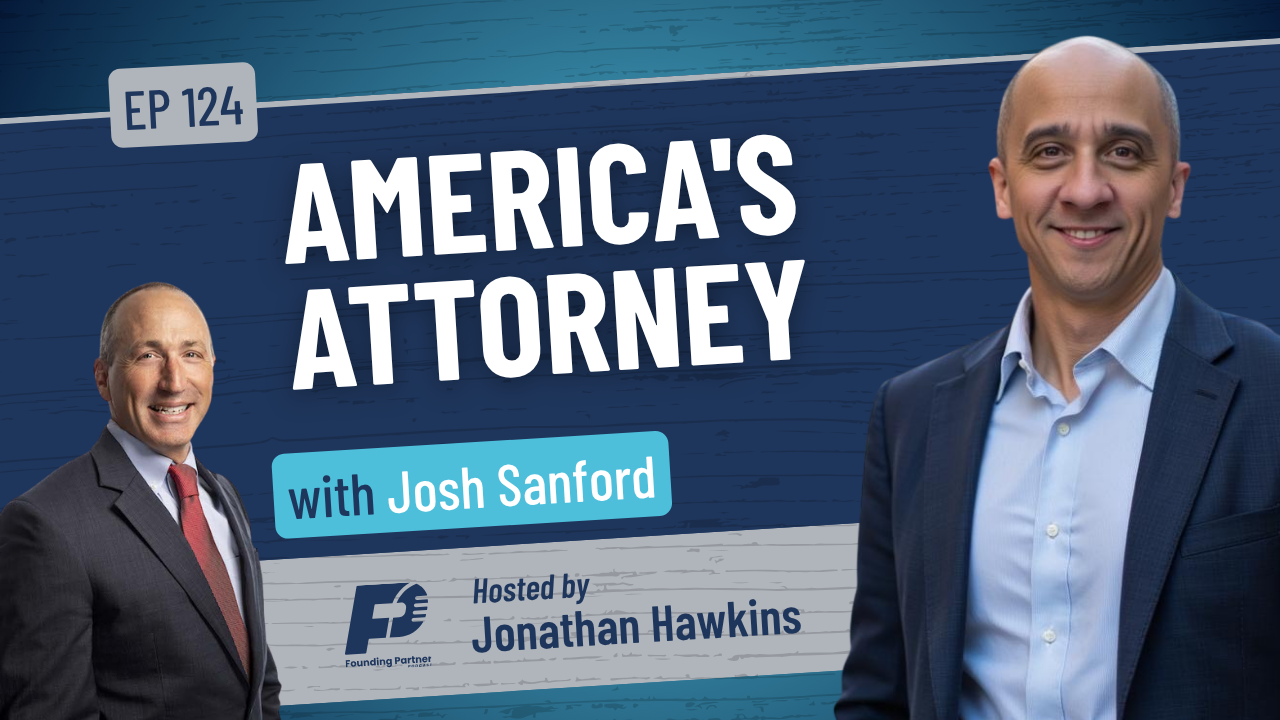
From Unhirable to Unstoppable
Josh Sanford didn’t follow the traditional path. In fact, he couldn’t.
“I was basically unhirable out of law school,” he said. So instead of waiting for an opportunity, he created one. He started his own firm out of necessity, not strategy.
That decision changed everything.
What began as survival turned into experimentation. Over time, that willingness to try became a defining trait. Not just building one firm, but multiple. Not just practicing law, but rethinking how it works.
And that thread runs through everything he does today.
The Power of New Rooms and New Thinking
For nearly 20 years, Josh described himself as “head down in my shop,” focused on practicing law, going to court, and doing the work.
Then something shifted.
He started attending conferences.
At first, it was about referrals. But it quickly became something deeper. Exposure. New ideas. New ways of thinking.
“I was thinking new thoughts… I was getting exposed to new ideas.”
That shift didn’t just change his business. It changed how he saw his future.
Because sometimes growth isn’t about working harder. It’s about stepping into rooms where different conversations are happening.
When the Market Changes, You Have to Change Faster
Josh built one of the largest wage and hour practices in the country. For years, it worked.
Until it didn’t.
A Supreme Court decision changed the landscape. Arbitration clauses became enforceable in ways that made class and collective actions harder to pursue.
Margins shrank. Cases became less viable.
And instead of holding on, he made a hard call.
“We decided… to shut the front door on that business and take no more clients.”
That moment defines the difference between reacting and leading.
He didn’t wait for things to get worse. He pivoted.
Building Systems That Let Lawyers Be Lawyers
One of the most practical insights from this conversation is how Josh approaches scale.
Not with hustle. With systems.
“We try to break things down into the smallest identifiable unit… and remove inefficiencies.”
The goal is simple. Let lawyers focus on judgment, not repetition.
That shift required a key decision. Hiring someone with a business mindset to run operations like a real company.
That one move transformed the firm.
More structure. Better workflows. More capacity.
And ultimately, more freedom.
Why Audience Is the New Insurance Policy
One of Josh’s strongest beliefs is that every lawyer should be building an audience.
Not for vanity. For protection.
“If you don’t know what the future is going to hold… there is one surefire thing you can do, which is to have the largest number of people who trust you.”
That audience becomes optionality.
It can lead to clients. Referrals. Opportunities you can’t predict yet.
But only if you start before you need it.
Because building trust takes time. And most people quit before it pays off.
The Future of Law Is Already Changing
One of the most thought-provoking parts of the conversation is Josh’s perspective on where the industry is headed.
Fewer accidents. Smarter cars. Rising acquisition costs.
The traditional volume-based personal injury model is under pressure.
Not collapsing overnight, but slowly eroding.
And the real risk is not seeing it coming.
“The cost of acquisition has already gone up… accidents are down.”
So what’s the move?
Adapt early. Reduce costs. Build skills. Build relationships. Build audience.
In other words, don’t wait.
Fall in Love With the Process
Throughout the conversation, one idea keeps coming back.
The process is the point.
Whether it’s building firms, creating content, or lifting weights, the outcome isn’t guaranteed.
But the work is.
“If you have to have a goal and arrive… I don’t even know why you’re practicing law.”
That mindset removes pressure. It replaces it with consistency.
And consistency is what creates results over time.
Closing Reflection
Josh Sanford’s story isn’t about doing more.
It’s about thinking differently.
He didn’t wait for the perfect plan. He didn’t wait for certainty. He didn’t wait for permission.
He built. He tested. He adapted.
And most importantly, he kept moving.
Because the future doesn’t belong to the most prepared.
It belongs to the ones willing to create it.
AND MORE TOPICS COVERED IN THE FULL INTERVIEW!!! You can check that out and subscribe to YouTube.
If you want to know more about Josh Sanford, you may reach out to him at:
- Website: https://eksm.com/
- Website: https://www.sanfordlawfirm.com/josh-sanford/
- YouTube: https://www.youtube.com/channel/UCyMHxf61yTwmNh_SXCpV7eQ
- LinkedIn: https://www.linkedin.com/in/josh-sanford-3b91b431
Connect with Jonathan Hawkins:
- Website: https://www.lawfirmgc.com/
- LinkedIn: https://www.linkedin.com/in/jonathan-hawkins-135147/
- Podcast: https://www.lawfirmgc.com/podcast
Jonathan Hawkins: [00:00:00] Alright, so, you know, I was lurking your, your LinkedIn a little bit. So you talked about the law conference circuit, and that’s where we first met a year or so ago.
But I think you spend a lot of time gonna these conferences. So tell me about that, your schedule and what you’re doing there
Josh Sanford: yeah. Well, let me back up and say if I wasn’t a co-founder of Lexamica, I would not have done all that traveling. That’s not why I started traveling. I started traveling to build referral relationships and but then what I realized was like the relationships that I was building, whether it created like a referrals for my firm back then or not, were just like, so valuable.
Like I was thinking new thoughts, I was getting exposed to new ideas. I was having just new opportunities to do business with people. And did, I’m kind of hooked on it, man. I worked a really long time head down in my shop doing my thing, going to court and not really thinking new thoughts and not really challenging myself for like 20 years of being a [00:01:00] lawyer.
And then I started going to conferences and I mean, you know, you could argue that there’s not like a causal relationship or whatever, but like I really feel like I just hearing what other people are doing and being challenged by the ways that other people are changing themselves and growing has helped make me imagine a future where I could do something different than what I’ve done my whole career.
So now I’m just kind of a serial law firm founder and I don’t know. I have these different projects and I don’t know. I love my work.
Jonathan Hawkins: I’m with you. I love the conferences. I have not done near as many as you have, but it’s, you know.
the
Josh Sanford: fine.
by the way.
Jonathan Hawkins: 1% of law firm owners and lawyers are going to these things. So the ones you’re mixing with are the ones that are doing a lot of negotiate where, you know, here in Atlanta even, you know, which is a big legal market.
You know, I hear all these things at a conference.
Welcome to the Founding [00:02:00] Partner Podcast. Join your host, Jonathan Hawkins, as we explore the fascinating stories of successful law firm founders. We’ll uncover their beginnings, triumph over challenges, and practice growth. Whether you aspire to launch your own firm, have an entrepreneurial spirit, or are just curious about the legal business, you’re in the right place.
Let’s dive in.
Jonathan Hawkins: Welcome to Founding Partner podcast. I’m your host, Jonathan Hawkins. This is a podcast where I get to interview founding attorneys and talk about all the cool shit they’re doing. And today’s guest, Josh Sanford. I’m not even sure how to introduce Josh ’cause he’s got multiple law firms, he’s got side businesses.
He’s got all sorts of cool stuff going on. So, all I’ll say is he is an attorney. From Little Rock, Arkansas and Josh, I’m gonna, you know, thanks for coming. I’m gonna kick it to you. You, how do you describe what you are, what you [00:03:00] do?
Josh Sanford: Did you say that you have to interview lawyers or you get to interview lawyers?
Jonathan Hawkins: I get to interview
Josh Sanford: Okay, good. All right. Today, it may feel like you have to I do a lot of different stuff, but everybody does. I don’t know. I feel like I I’m a guy that likes to be on teams and build teams and try new projects, and I think that the it’s like impossible to predict the future.
And so if you don’t know what’s coming, you should try to design the future the way that you want it to be and not just sit back and wait for it to happen. So that’s, that’s what I try to do.
Jonathan Hawkins: All right. Well, I like that. So let, let’s go through, so. Let’s go through your law firms first. So you’ve got, you got Sanford Law Firm, right?
Josh Sanford: Yeah, I do,
Jonathan Hawkins: me what, what that is and what, what you do there.
Josh Sanford: you want the backstory?
Jonathan Hawkins: Yeah,
Josh Sanford: I was basically unhirable out of law school in 2001. I did have a job offer, but it didn’t pan out. And I got like a temporary job and then I was like, man, I, I gotta, I gotta start a law firm. I gotta, I gotta have an income. So I was in my hometown, [00:04:00] Russellville, Arkansas, about an hour from Little Rock.
And you know, it wasn’t a shingle, it was like a regular sign, but I started a law firm and I was there for eight years. I hired a couple of lawyers as we grew and then in 2009 I opened a second office in Little Rock and I moved here to Little Rock and I had been doing a little bit of everything.
And then around 2009 I took my first ever FLSA case, which when I signed it up, I did it ’cause a friend told me we could work it together. I didn’t even know what it stood for. And I found out about overtime laws and, and minimum wage laws. Like I didn’t take that class. In law school, but like fast forward nine years and I grew the country’s largest wage in hour practice.
In fact, for four years we filed more wage in hour cases around the US than any other firm and grew a big team. And we were just, we were loving it for until 2022.
Jonathan Hawkins: You know, I wanna find out what happened in 2022,
Josh Sanford: Yeah, [00:05:00] you do. See, I did that to you. I put that in your head and now you’re like, well, wait, what? What happened?
Jonathan Hawkins: that. See, you’re good man. You’re good. So, before you though, so I have, I have, I have some friends that defend the wage, Jer. Yeah, defend the way Jer claims and, and they’re just like, man, they’re the scariest claims to defend.
And they were, they would tell me about these people out there that are making a killing and they’re probably talking about you. So, what happened in 2022?
Josh Sanford: Well, we, the deal is that we, we hit some big ones over the years and I really enjoyed it. Like, I, like I’m constitutionally in favor of. Lawyers standing up for the voiceless, for take, taking claims that don’t seem like they could go anywhere and like saying like, I’m gonna go to court.
I’m gonna use my skills and my strategy and do what the law allows me to do to help people. Man, we were, we were killing it. We were having a great old time, however. The US Supreme [00:06:00] Court came down with a decision in, I think January of 18, right as we were scaling up that said that you could embed an arbitration agreement inside an employee handbook and that that was binding.
And so the way for us to be profitable was to have collective actions, which is like the FLSA version of class actions and those started to just kind of disappear. And I think now the stats are something like 60% of all workers in the US have individual arbitration agreements are not subject to class or collective actions in their employment claims.
That really cut into our margins and we got to a point where the more cases we took, the more money we did not make. And so we decided in October of 2022 to shut the front door on that business and take no more clients for a while.
Jonathan Hawkins: Wow. Interesting. I, I thought employee handbooks were, were deemed not a contract. So how can you have
Josh Sanford: well, they are and if you, if they can show that you [00:07:00] received it and then you show up at work the next day and work, you’re deemed to have accepted it, at least in most jurisdictions. I mean, they’re subject to state law, construction. But yeah, it pretty much, it pretty much cut the legs out of our, of our practice.
Jonathan Hawkins: So what does Sanford Law Firm do now?
Josh Sanford: Sanford Law Firm still has a few cases. We’re trying to wind things down but what I did for about a year and a half was we had gotten really good at marketing and at finding the cases that we wanted. We just decided we didn’t want those cases anymore. And I got into the world of consumer class actions specifically data breaches.
And I spent about a year and a half generating data breach plaintiffs for some lawyers that I was friends with. And then my buddy Tommy Kherkher. Who is the K in EKSM came along and was like, dude, you’re doing this. Like we could start a firm around this. This is a great vertical. I’ve got a buddy named Jarrett Ellzey who would like to run the [00:08:00] cases.
And so we in September of 2024, August of 2024, started this new firm, EKSM and this is the crazy thing. Alright, we have filed basically one class action per day, not per business day, but per calendar day every day since we’ve been open. It’s absolutely as astounding. We have over 600 class action cases that we have filed, which is just like, to me is like crazy and I love it.
Super fun and it’s not even the most interesting thing that we’re doing, which is nuts.
Jonathan Hawkins: There you go again, man. What is the most interesting thing you’re doing?
Josh Sanford: See, I’m doing this for you. We have a docket of five cases against Nvidia. By dance, which is TikTok snap, which is Snapchat. Meta, which is Facebook and an AI company called Runway for violations of the Digital Millennium Copyright Act. And these cases are fascinating. They’re like kind of a once in a lifetime opportunity where these companies [00:09:00] have, according to the lawsuits, violated something called the Digital Millennium Copyright Act.
And they’re worth you know, their statutory damages are worth hundreds of billions of dollars. We’ll see about that. But they’re super fun. They’re like super high leverage. We’re getting to work on complicated legal issues with high dollar values and stand up for content creators. And that is a group of people who are close to my heart.
Jonathan Hawkins: So how do you, yeah. how do you finance against those behemoths on the other side? How do you finance those
Josh Sanford: Yeah, great question. The, the answer is a lot of times when, well, let me back up and say, when we were doing wage and hour, what I learned is that if you are good at the substantive law. There’s only so much that you really need to be concerned about for, from the lawyers and the budgets on the other side of your cases.
I bet you if we went through the Fortune 500 list, I probably sued 80 of ’em over the years. I thought it was a big deal early on when we would sue [00:10:00] big companies, and then it just became just like every day it’s just like nothing. Don’t care. It’s like not a big deal. If you know your stuff, you can go toe to toe with anybody.
And that’s what, that’s who we were then. That’s who we are now. And so, like from a strategy standpoint, it’s just like, like know what you’re doing. And, and it’s really not that intimidating. Now you have to hire experts. Fine. That takes money. That’s why God created banks. I think it was God. And then I think maybe the devil created interest.
I’m not really sure. But there are, you know, where there’s a will, there’s a way. And if you, if you have a, a right, that needs to be vindicated. And if you poke around and never give up, you can figure it.
Jonathan Hawkins: You fight the good fight. So how do you, how do you, there’s two things. How do you figure out the claims that you, this, this new little vertical that you’re gonna pursue? You don’t give us the, the secret sauce, but you, you sort of poke around and then you find this thing. And I know you’re really good at marketing and that we can dive into that too, but how do you find the new claim?
Josh Sanford: I am maybe the [00:11:00] luckiest lawyer in America because one of my law partners his job is that he watches Law 360 and Twitter and the news, and he just thinks, is there a claim here? Is there a claim here? Is there a claim here? He literally never is not thinking like, what’s a lawyer’s angle here? And so we’re just kind of always looking at new opportunities.
This, imagine this is a lawyer and that is his job. Like he, he doesn’t, he doesn’t have clients, he doesn’t have cases, he doesn’t have to do marketing, he doesn’t have to go to meetings. He’s just ideating. Based on what he sees in the news, that is the most absurd luxury that any firm could have. I mean, regardless of your size.
And for us to have that as at a small firm, it’s just like, it’s crazy. But that’s the way that we’re built and it works for us.
Jonathan Hawkins: So tell me about filing a class action every day.
Josh Sanford: So, yeah. So the first thing that you should think is this firm must be [00:12:00] addicted to systems and processes. And the answer is, well, yes, actually we are. We, we have tried to create inside of our firm, and this is not new at EKSM, we, we did this at Sanford back in the day. to break up the pieces of what it takes to manage a law firm and, and, and a particular piece of litigation into the like, smallest identifiable unit.
Figure out how to remove the inefficiencies, figure out what things get done over and over, and then to build systems and and machines that will create that repetitive work without grinding the humans to the ground. And so we’ve become pretty adept at that. And obviously to practice law takes judgment and to do it well requires like wisdom and carefulness.
What we’ve tried to do is create systems that allow the lawyers. To just work on wisdom and [00:13:00] carefulness and not repetitive tasks so that they can stay focused on like what it actually is that sets them as lawyers apart from you know, normal people who are nice and fun to be around.
Jonathan Hawkins: All right. I wanna dive into the systems things because I’m, I’m very curious. I’m in the middle of doing this now. How did you figure this out? Did you bring in help, especially when you’re busy practicing law? How do you find, how did you get there?
Josh Sanford: So, what happened with me was in 2018 I was playing basketball at the gym at lunch. And one of my buddies told me that he went on a sales call to a law firm to sell him some technology. And he said he didn’t meet with a lawyer there. He met with just like someone who had an MBA, you know, just like a business manager.
And I was like, huh, that’s really weird. And then I started thinking, you know, ’cause, I mean, I’m just in Little Rock. This is not like the hub of like big firms or anything like that. It’s just kind of, I mean, we were just a small town and I was like, man, what if you did hire someone? With a [00:14:00] business background to run the firm like a business, and then my wheels got turning and I found the perfect candidate, and I hired this guy and you’ve met him.
His name is Gabriel Stewarts. And like he, he took us from kind of this disorganized system list, process list law firm into like a scalable business where we could actually end up helping more people do more work faster with a better quality of life. ’cause literally like. It was like a triple win-win, win, whatever it was, like it’s best for everybody.
And and that allowed us to grow. Now, one of the ways that we grew was that we leaned very heavily into the area of referrals, specifically making relationships with PI firms to get their employment law referrals so that we could vet those leads for wage in our cases.
Jonathan Hawkins: And Gabriel that leads us maybe to your other business. You and Gabriel have the other business,
Josh Sanford: yeah. Gabriel and I are the
Jonathan Hawkins: Tell us all about what’s it called [00:15:00] and all.
Josh Sanford: Yeah. Gabriel and I are the co-founders of a software company called LexAmica L-E-X-A-M-I-C-A. I tried to spell it a couple days ago and I misspelled it. He’s the CEO, he is the capital F founder. I’m like the small c small f co-founder. I don’t work there.
The, he has a team of about 40 people and it is the largest and most successful software company that manages referrals between plaintiff’s firms. In the US and it’s, it’s an exciting business. It’s, it’s something that we got into kind of naturally because we wanted to figure out how to help those, basically, like discarded leads from these PI firms.
But then we realized like all these law firms, we all have CRMs or CMSs, whatever you call ’em, to manage internal cases, but there was nothing for that interstitial. Area between law firms. And so Gabriel conceived of this idea and we found an angel investor and launched it, and [00:16:00] it’s used by thousands of lawyers around the country every day.
And I’m glad to be a, a part of it.
Jonathan Hawkins: So how does it work? Like I, I, I’m a lawyer in you know, mobile Alabama, and I’m like, Hey, I want to, I want to get into this platform. What, what? Tell me how it
Josh Sanford: Yeah. So it, it functions it functions as a CRM for your referrals between other law firms, but more specifically it functions like a two-sided marketplace. So, let’s take there’s a big, there’s a big advertising firm in Alabama called Sheara, right? If Sheara is on the platform, they get leads.
They want some of them. Some of ’em they don’t want. Let’s say it’s not a geographical match or it’s not a case type match. they’re gonna be on File Vine or Lead Docket, and they’re gonna say, the, someone in intakes is gonna say, oh, we don’t, we don’t do this type of case. They’re gonna hit the refer button and that it’s, there’s an integration with Lika, and then we’re gonna use an algorithm to match it to the firm that is most likely to get the [00:17:00] best result.
For that specific lead, based on the facts of the lead. And so there’s, you know, let’s say a hundred larger firms that send leads out and there’s hundreds, several hundreds of firms who want to receive leads. And we’re just matchmaking and doing data tracking in real time and making sure there’s transparency and accountability and that people are getting paid.
Jonathan Hawkins: So you’re looking for both sides. You want people to join that have referrals, and then people that can receive referrals.
Josh Sanford: The people who shouldn’t do business with that company are people who are defense lawyers, basically, like e even family lawyers. Like, you know, the big PI shops, their phones ringing with family law claims just ’cause, you know, they’re top of mind. And so those referrals are out there. People are.
People are needing lawyers and we have space for, for good litigators to help the clients on the platform.
Jonathan Hawkins: I mean, hell, [00:18:00] you know, my firm, we, we represent lawyers and law firms. If you look at our website. That’s all we do. We do some other things too, but that’s all we do. If you look at the website, I get some weird ass calls. I don’t know why they call my firm, but it’s just weird stuff, just like you’re saying.
Josh Sanford: It, it is funny that, you know, your, your marketing or your message can be just so compelling to some people that they don’t even stop to say, does this really match my need? Or the, the flip side of the coin is you could be like the perfect message for someone, but there’s something about your, your marketing or your messaging that doesn’t click with them, and they’re not gonna call you even though you are the right lawyer to call.
It’s so fascinating. So, Lexamica sits there to play matchmaker and make sure that clients end up with the actual attorney that they need.
Jonathan Hawkins: So when was like, when was it founded?
Josh Sanford: that project went into like beta mode in in April of [00:19:00] 23 and came to market with paying customers in October of 23, so about two and a half years ago.
Jonathan Hawkins: So yeah, tell me the business model. So. It.
Josh Sanford: Okay, so it’s, it’s free on the litigation side. So let’s say you’re a lawyer who wants to do estate planning. You can go there and if you qualify and you, you get vetted and you can be on the platform, you don’t pay anything. But if you get a lead and you, you take a case, you owe a referral fee to the originating firm.
So we call them handlers and originators. I mean, obviously a firm can be both, right? You can, you can both handle cases and originate cases, but originators pay a monthly subscription to put their outbound leads, their referrals into our system. And the reason they do it is that they typically have enough volume that they are paying.
Either a full-time person or a lot of the time of one of their intakes team to manage their referral system, and they’re not doing it that [00:20:00] well because it’s hard to do that at scale if it’s not your only job. And also these firms are limited to their own network. You only know who you know. So the, like the tax on your time to find a workers’ comp attorney in Kansas.
If you are a lawyer’s lawyer in Georgia is like, it’s not even worth it for you. But if you have a plugin that you can trust to send that lead to the right lawyer, then it’s a lot easier.
Jonathan Hawkins: That’s cool. Alright, we got lots to cover ’cause you’re doing a lot of stuff, so, and we’ll circle back on some of these. So, so, yeah. So in, in addition to your two law firms, do you have any more than two? Is it just
Josh Sanford: Yeah, I, I actually I have four law firms that I’m running right now. Two of them exist in connection with YouTube channels. There’s a YouTube creator, which a lot of lawyers who watch your channel, they’re gonna have seen him [00:21:00] in their feed before. It’s a channel called Legal Eagle. The Legal Eagle Channel is think about 10 years old and was a full-time job for the creator there.
Devon Stone for the last eight years it’s legal entertainment. Channel high quality videos, really well researched scripts, lots of motion graphics, whatever. I met Devin at a conference in the fall of 22, and I was thinking about this audience that he has, which at the time was 2.5, 2.6 million subscribers, and thinking like, man, they, they surely have legal needs.
And, and then Gabriel and I are in the process of developing this referral management platform. if we took his audience and met their legal needs by mapping them to the best firms in the country, why that would be a great way to have a law firm. And so I pitched it to Devin. He was like, yeah, let’s, let’s do it.
And so that’s what we’ve been doing. We went live almost three years ago, [00:22:00] not quite three years ago. And we got thousands of clients. Matched with hundreds of law firms around the US and his, he continues to grow his channel. He has now almost 3.9 million subscribers. He’s actually hired other lawyers to make more videos on his channel so that he can just keep putting out that content.
And that’s been super fun. So that is one of them. The other law firm I have is very similar but on another creative’s channel. Her channel is called Legal Bites. The lawyer’s name is Alina Mazeika, and it is very similar to the Eagle Team where we’re using Lexamica to match the legal needs of her audience around the US with the best firms
Jonathan Hawkins: And these audiences, any kinda legal need could come. So it could be criminal
Josh Sanford: match it. We can help them. They’re not, it’s not like Devin is making a video called, like the three things to remember if you get in a car wreck is, it’s not that way at all. He is making [00:23:00] YouTube content. It’s like funny, it’s quick, it’s well edited. You know, it’s, it’s edutainment with a legal angle.
And so like the top of his funnel is as broad as you know, who wants to consume legal content on YouTube? Ah, and, and, and Alina is the same, different, you know, smaller audience, different audience. But yeah, it’s not, these people are not out there making content where they’re trying to get clients.
That’s, that’s not their thing. They’re, they’re trying to be educators and they’re succeeding at that. And the market is rewarding with them, with those eyeballs. And with those eyeballs comes the opportunity to match their legal needs to the best lawyers.
Jonathan Hawkins: So speaking of YouTube channels, you’ve got one of those two that that’s. Growing
Josh Sanford: I actually don’t even like to talk about my channel
Jonathan Hawkins: Is that the name?
Josh Sanford: yeah, I’m on, on YouTube. I’m called America’s Attorney. And dude, it take some kaons to name your channel that [00:24:00] when you have one subscriber, which is your nephew. But that’s, that’s what we did. So my channel is still very, very small.
I have as of today, 71,200 and something subscribers, not that I’m counting. And let’s, I view that as very small and I
Jonathan Hawkins: big for a lawyer. That’s big for, that’s big for a lawyer though.
Josh Sanford: Yeah. Yeah. So if you don’t have a YouTube channel, that seems like large to you, and I, I get that, but like Devon has 3.9 million subscribers and I’m more handsome.
Wittier I don’t know. It’s, it’s, you know, maybe he just has more reps. Alina has almost 300,000 subscribers, and then one of my law partners, Tommy Ker at EK sm. He was one of the first lawyers on YouTube. In fact, he just kind of blew up on shorts when they were new and TikTok. And this guy, he has half a million subscribers at his channel attorney, Tom, on YouTube and like 900 [00:25:00] followers on Facebook.
And he doesn’t make a lot of content these days, but IWI met him at a conference in Atlanta in December of 21. And he was on a panel about social media and he was like, ah, everybody should have a YouTube channel. And I was like, yeah, everybody should have a YouTube channel. So I went home and started one.
I had no idea what I was doing, but we developed a friendship through that, which ended up growing into a law firm together. And he introduced me to Devin. And that’s just kind of spun off all of these this value creation and this new direction that I had not on my roadmap at all four and a half years ago when all that started.
Jonathan Hawkins: So let’s, let’s more about the YouTube. So you started this thing about four or five years ago.
Josh Sanford: Yeah, I went to this conference in December of 21. I said, okay, I’m gonna start doing YouTube. So I go home. I had just hired a marketing employee and I said, Hey, in addition to all this other stuff, you’re gonna become a YouTube editor. And she was like, okay, man. The videos were so bad. [00:26:00] Oh, they were so bad.
They’re private now. You can’t see ’em. But we, we kind of labored with no understanding of the algorithm or how to do YouTube for about 12 months. And then I took a class and I was like, oh, it’s actually like a system. You do it a certain way. And so we, we lean into that and we started to grow.
And I’ve had like fits and starts of growing and all that. In the last like nine months. I’ve have been great. I’ve gone from 35,000 subscribers to 71,000 subscribers. My average video views are up. And look, this, it’s been fun. It doesn’t generate like cases ’cause it takes so much volume of views to have that like a reliable.
Pipeline of cases, but I really enjoy the project and I do think that as media gets kind of more fractured or like you, you can go, you know, you can consume whatever kind of content you want. We’re, [00:27:00] we’re past the, the world of there being three TV stations or 20 TV stations. There’s just like whatever content you want.
And so I think it’s important for lawyers. To build an audience if they can and if they are immune from the pain of boredom where you are working and working and working and it’s not, and it’s not giving you any dividends and you can push through that and eventually get some results where I am.
Right now’s kind of the result of not really given up.
Jonathan Hawkins: So what’s your system? How many times a week or a month are you posting videos?
Josh Sanford: Yeah. Posting two long form videos. A week two o’clock central on Tuesday and Friday. We try to never, ever, ever miss, I mean, maybe like an ice storm. Even with my travel schedule, we’ll figure out how to edit something, even if it’s on the road or I’m not here in my studio. we, we didn’t, I’m not a big fan of shorts.
The reason that I want to make content is I wanna build a community of people who’s consuming a [00:28:00] certain type of content where we are kind of all on the same page and shorts. They don’t really do that for me. I don’t post on TikTok or Instagram. I’ve tried those things in the past. I don’t, they don’t really interest me.
We are now using some AI tools to cut up the long form videos and make shorts and that’s fine. I think we get. Extra views and maybe some audience building from that. But most people who watch shorts on the platform don’t watch longs, and most people who watch Longs don’t watch shorts. And so we are really focused on that long form content.
And it’s, it’s funny because, you know, my background is an employment lawyer and kind of a generalist before that. And now I’m a consumer class action lawyer, at least at EKSM. But, you know, my, my content is about bad interactions with cops. It’s like, fourth Amendment violations and and those, and like 1983 claims and that sort of thing.
And it’s something that just [00:29:00] regular people can relate to. People want to have a lawyer help them understand like, is this a valid interaction with a cop or is the cop inside the law or outside the law?
Real quick, if you haven’t gotten a copy yet, please check out my book, the Law Firm Lifecycle. It’s written for law firm owners and those who plan to be owners. In the book, I discuss various issues that come up as a law firm progresses through the stages of its growth from just before starting a firm to when it comes to an end.
The law firm lifecycle is available on Amazon. Now, back to the show.
Jonathan Hawkins: Okay, so YouTube. Why did you focus on those topics versus something else for the
Josh Sanford: you know, it’s not like a personal passion of mine. I’m not like a Antico guy. I, I am like, I am a pro freedom guy, like I really do. Like, I just feel like the less government we have, kind of the better, like the, we don’t exist to serve the government. We just exist to be free in our country.
so I don’t find the, the [00:30:00] content like, it kind of, it’s fine with me, but I’ll tell you what I do. Like, I do like the way that it gives me the opportunity to talk about what the rule of law means because I’m disgusted by power grabs. And I really enjoy the opportunity to talk about what it means to, like, for authority to operate inside of constraint that’s imposed by the will of the people.
And and you know, like it’s pretty irreverent. I have a good time. We, we have memes on there. I act like a clown wearing a sweatshirt. You know, I don’t know. It’s, I don’t take myself too seriously. I don’t think anybody else does either.
Jonathan Hawkins: So,
Josh Sanford: Yeah.
Jonathan Hawkins: all right, so you’re doing it. You, you said you’re doing it to build an audience. Is that your main spot where you’re building an audience or you, you said you’re not on really on any
Josh Sanford: Yeah, I mean, I post a little bit on LinkedIn but I’ve had a hard time finding a voice on LinkedIn. I don’t want to be a douche bag who like humble [00:31:00] brags on LinkedIn. And so, and I also don’t wanna like overshare, so I’m not really sure what to talk about. But I, you
Jonathan Hawkins: you’re a super duper duper lawyer, aren’t you?
Josh Sanford: pardon me.
Jonathan Hawkins: You’re a super duper duper lawyer. You can, you
Josh Sanford: Oh, yeah. But I, you know, I, I, I wanna have a B2B voice as well as that B2C voice. Yeah.
Jonathan Hawkins: So, yeah, so, you know, people talk about building an audience. But, and that’s great. You everybody should build an audience, but you gotta build the right audience. So, on YouTube, what’s the end game? What are you, what are you, you know, what are you doing without audience in the future? Sure.
Josh Sanford: Yeah, the answer for me is that there is no end game. The process is the goal. I love to say, Hey, I’ve got this play that I’m gonna run and I want to be good at it, and I wanna stick to it and just see what happens. I like, look, you, you can make some money off of it. Like it, [00:32:00] it probably in 2026, it will pay for itself.
Meaning that, you know, like what I pay my producer who co-owns the channel with me is not, it is not gonna be surpassed by what we bring in, but it’s not really about that for me. I like, I like to work man. I just like, I wanna have something to do and I like the idea that I am adding a little bit of.
Levity and entertainment to the world of like, the exposure of dirty cops on YouTube. I don’t know, Sue me,
Jonathan Hawkins: All right, so somebody’s out there, lawyer’s out there thinking about, Hey, everybody says YouTube’s the thing. I wanna start one. What advice do you have?
Josh Sanford: do not start without first getting the book called the YouTube. Ooh, what is it called? It’s by a guy named Darrell Eves, and it’s either called the YouTube project or YouTube map or something. Darrell Eves, [00:33:00] E-V-E-S-E-V-A-S-G. Wizz. You’re not getting anything outta me. You can waste a lot of reps if you don’t know what you’re doing at the beginning.
And here’s the thing. Your first videos are gonna be terrible. It doesn’t matter like how much prep and study and attention you have to it. You just be bad at it. You will just be bad. And I’m telling you, my first hundred videos, they’re just hot garbage man. Hot garbage. But it’s all just about, you’re just building, building, building, building.
And then the thing about the algorithm is that like it actually does work. If you’re consistent and you are improving, no matter how small, the algorithm will reward you if you don’t give up. And dude, I’m really not much of a quitter. That’s like my thing. That’s like my only thing. I don’t think I’m that smart, but I don’t quit.
Jonathan Hawkins: I like it. So you, you, you are a man of many talents. Let’s move on to the next thing. So you’ve got, you’ve got a podcast too. Now your podcast is a little [00:34:00] different than mine and, and others, I mean, yours you take your show on the road, right? Or do you, or do you do different things? Tell me
Josh Sanford: Yeah, so Tommy Kirker and I are traveling the country doing these podcast events basically once a month. It’s not like a specific day or whatever, it’s just like, try to schedule it when we can. We are coming to Atlanta on April 1st. That’s not a joke. See what I did there?
Jonathan Hawkins: I see it, it’s
Josh Sanford: yeah. Okay. So.
Jonathan Hawkins: gonna try to go, I haven’t signed up yet, but I, I’m gonna try to be there.
Josh Sanford: So we’d love to have you, we’d love to have any plaintiff’s lawyer in Atlanta. Is this thing, is this episode going up before April 1st?
Jonathan Hawkins: It will be after. It’ll be after. But I know a lot of, I know a lot of plaintiff SL here, so.
Josh Sanford: I’d love to send you a link and you can get people to come out. What, what we’re doing is we’re feeding and drinking people, and we’re having a discussion around the future of plaintiff law because.
There are several paths forward to basically the [00:35:00] end of large scale MVA dockets. One of them is regulation that requires sensors and bumpers that functionally prevent. M lots of accidents. The other one is automated driving and that, that is on rails right now. That project is, is live and is growing all the time.
And there’s this third thing that no one really wants to talk about and honestly, I don’t really know how to talk about it, but like if or when a GI is developed and is kind of like released on us. are gonna change, driving’s gonna change, everything’s gonna change. And so I, I just feel like, lawyers should right now be thinking about the future.
Like, what does my next act look like? Okay. I’m, I got go to marketing, I developed a docket of, of motor vehicle cases. But like what happens when you’re cost of acquisition per case goes up three x and the number of cases goes down to 2x. And there’s [00:36:00] no profit there. And I we’re trying to encourage these conversations among plaintiff’s lawyers to figure out like, what are you passionate about?
What are you good at? What does the future look like? You know, NBA dockets, they haven’t been around that long, right? Like there weren’t a lot of car wreck cases in the sixties, seventies. Started really in the eighties that people started advertising and like people started figuring out, Hey, I can, there’s insurance, I can make money here, and it’s not gonna be with us forever.
So we’re talking about that
Jonathan Hawkins: So you, you go to a different city, you bring in some guests. what’s the format? Do you, is the audience lobbying in questions? What? What are you doing?
Josh Sanford: booze talking. Those are three of my favorite things. Yeah, I mean, we try to do some, some audience participation, but like in Atlanta I’ll say in the past tense, because this is airing afterwards, we had Natanya Brooks. And Mike Werner. And these are, these are [00:37:00] lawyers who are at the top of their craft.
They aren’t reliant on heavy volume to figure out how to make a living and how to create jobs for people at their firms and how to do great work for plaintiffs. And so we, we just talked through like their vision for what it means to be a lawyer and how that might change for people. And we also can’t not talk about legal ai.
The, the whole podcast tour is sponsored by sio, which is one of the big three legal tech companies. And you know, they’re encouraging people to have a, a real honest conversation inside their own firms about like, what does it take for us to stay on top of best practices?
Jonathan Hawkins: We know it’s, I mean, a good trial lawyer is gonna be employed no matter what happens. But like you said, there’s, there are huge firms that are built on these volume, MBA, you know, platforms or whatever. And then there’s a whole ecosystem of. Of the vendors and the software that supports it, they’re, they’re gonna go by the wayside too.
What, what are they saying?[00:38:00]
Josh Sanford: I mean, I think there’s a lot of ostrich going on. Like people say, well, since we don’t know when this change is coming, we don’t have to talk about it, but here’s the reality. The cost of acquisition has already gone up nationally, depending on who you ask, like 25 to 50% over the last three years. Fatalities are down significant accidents are down.
There isn’t gonna be some like cliff that things drop off probably. It’s just gonna be this slow degradation of your ability to get cases matched with the profitability of those operations. You know, as a, as a function of that increased case cost acquisition and people are gonna, the lawyers are gonna look around eventually and say like, like, we’re doing these cases, but I’m not just not getting as many as I used to.
I’m spending even more money and I’m making less. And what am I really doing here?
Jonathan Hawkins: So what do they do?
Josh Sanford: Well,
Jonathan Hawkins: have you,
Josh Sanford: yeah, so I think right now a lot of lawyers are [00:39:00] saying. I’ve got to build an audience because if you don’t know what the future is going to hold for the types of cases that are out there, there is one surefire thing that you can do to protect your downside, which is to have the largest number of people who trust you, put their trust in you, and rely on you for information.
So go build an audience while you can while you’re not broke. Because that’s, then that’s an opportunity to help them no matter what the future of legal looks like. Maybe it’s just outbound referrals for you. Maybe it’s something else, I don’t know. But that audience is never going to not have value.
It’s always gonna have value. That’s number one. Number two. You gotta figure out a way now to use AI in your practice as efficiently and responsibly as you possibly can to bring down the cost of your operations. ’cause your marketing costs are going up if you are a volume shop. And you know, [00:40:00] there’s, there’s ways that people are doing that right now, but I think that what people really need to do long term is invest in themselves and their careers and their skills.
And instead of being reactive and taking what the market gives you or taking what’s left over that no one else has claimed, like, go figure out what you’re the best at and, and focus on that.
Jonathan Hawkins: So you’re doing YouTube audience building. What, what kind of advice do you give to others in terms, you say go build an audience. What does that mean? Where do they build it? How big does it need to be in your view?
Josh Sanford: Yeah, well, there’s no, there’s no such thing as big enough, right? It’s like, how many, how many reps do you need to do in the gym? One more rep. That’s it. It doesn’t, whatever the number is, it’s just one more rep. And, and honestly, if you are the type of person who like has to have a goal and you’re gonna work towards this, and then you think you’re going to arrive, I don’t even know why you’re practicing law, because the, the practice of law is [00:41:00] all about the process, right?
It’s all about like it improving the way that you help clients over and over and over. And and that sort of iterative improvement type work is perfect for social media and it’s perfect for audience building. And I don’t know. It’s, it’s never been easier because the, the tech is, man, they’ve made it idiot proof.
I mean, look at me, I’m doing it.
Jonathan Hawkins: I tell you, you know, I first wanted to do a podcast, I don’t know, 12 years ago, but back then. You know, it’s easy. It’s easy now. You just, it’s easy now back then, like what equipment, where do you do it? All that stuff. So I didn’t do it then.
Josh Sanford: Yeah. I just,
Jonathan Hawkins: So, all right, so we’ve talked about,
Josh Sanford: the hardest thing is starting right? And then like you start, and then you just kind of figure out a way to push through the boredom. Where you are committed to this thing that you’re doing, despite the fact that you’re not seeing results. I was actually listening to a, a podcast a couple of weeks ago, and the guy was saying that like, he’s done over a [00:42:00] thousand episodes and something like 90% of his listens or views or whatever have been on the last 10%, the most recent 10% of his channels.
So he just had this like. Hockey stick thing and you just kinda gotta grind. But I would say to anyone that’s listening, who’s a lawyer who wants to build an audience, don’t, don’t niche down on some nerdy topic that doesn’t have broad appeal unless you know that the people that you attract to that. Content are going to have those claims. So like if you’re a lawyer that represents lawyers having a podcast that only lawyers listens to, super smart. But if you’re a lawyer like I am, that represents just like regular consumers. If I had a podcast that only, or YouTube channel that only lawyers listen to, I’d never get any work out of it.
Jonathan Hawkins: Well, I’ll tell you the co consistency thing’s huge when I started this, it’s been. [00:43:00] Not quite two and a half years. I told myself I would do it every week for at least three years before I even made a judgment call. Because I mean, I don’t know if I’ve seen anything I’ve met. I get to meet cool people like you.
But you know, I’m not sure if you say, have you gotten any results? I don’t know if I could say I have, but you know.
Josh Sanford: Yeah, it’s really weird, isn’t it? When you’ve got this project and you have to commit to it for so long that you have to be in your own mind, like divorced from a particular outcome. Like you actually do have to believe in your own mission. Like you have to have this commitment and say, you know what?
Results will come in time or they won’t, but I’m gonna do this ’cause I said I would, I made this promise to myself.
Jonathan Hawkins: So you keep talking about the process. Are you a Arkansas fan or are you a Bama fan? You a Saban fan?
Josh Sanford: No, no, I mean, I’m an Arkansas guy. It’s really hard to be an Arkansas Razorback fan. Unless you really are like, you like to be two and 10 or three and nine or whatever. Basketball is great. When this episode airs, it [00:44:00] will be like a week or two since we beat Arizona. In the Sweet 16, which is supposed to happen in like four and a half hours. Man, everything is about the process. But we haven’t talked about this. The two things that I’m into when I’m not at work are golf and lifting weights, and there’s like nothing more process oriented than those. Two endeavors in terms of like what people can do in their free time, because it literally doesn’t produce a TA tangible permanent result that you can hold onto.
Like in golf, you have a shot to make you ma, you figure out what you’re gonna do and then you hit it and you’ve now created another problem and you have to go solve that problem. And you solve that problem, eventually the ball’s in the hole and you start over again and it never ends, and it can go well, or it can go poorly if you don’t enjoy the process of solving that problem.
It’s like a total waste of your time, and if you’re into it, it’s great. And weightlifting is pretty similar to me. It’s like, [00:45:00] well, okay, you lift these weights and then when you’re done, you put them down and guess what the weights are right where they started. Literally nothing happened, and then you’re still there.
But. You, you become the change that, that is driven by that work unless you quit, in which case you atrophy and everything that you did actually does result in nothing. And so it’s like, I don’t know. It’s, it’s either perfect or it’s insane. But there, that’s what I get into.
Jonathan Hawkins: Well, I don’t play golf. I’ve got some clubs I don’t play, but I do lift weights a lot and have for years, and I, and I’m with you. I, I like, I just like it. I mean it, you know, and, and you go there for months and you, especially if you’ve done it for a long time, you don’t see much change. I mean, when you first start, maybe boom, you see a lot of change, and then it’s just maybe you get one more rep or five more pounds or whatever.
But you just keep going like, like you said.
Josh Sanford: My middle child is 18 and when he turned 14 he, he was like, I’m gonna [00:46:00] start lifting weights. And he probably weighed like 125 pounds and he’s, you know, he is added like 50 pounds and he is just like pure muscle. It looks like crazy and I’m like. I was talking to him the other day, I was like, man, you know, four years of lifting weights and look how your body’s changed.
And I was like, you know, I’ve lifted weights the exact same amount of time that you have in that last four years, and I don’t look any different at all, but I’m fighting against old age. I’m not about progress, I’m just about just keeping steady. Yeah. Yeah.
Jonathan Hawkins: I tell people, you know, getting into, you know, I turned 50 here recently. it’s, you’re just gonna atrophy every year. So you gotta get as much. Muscle on you as possible. So then at the end, as it decays, you’ve just got more. So you, you know, so I tell people, you gotta get in there.
Josh Sanford: your, your podcast, are people listening or are people watching?
Jonathan Hawkins: I probably, most people listen, but they,
Josh Sanford: do you want me to take my shirt off?
Jonathan Hawkins: If [00:47:00] it gets views, baby, let’s do it.
Josh Sanford: That’s
Jonathan Hawkins: All right, so. Ah. All right. So I wanna move on to
Josh Sanford: are like,
Jonathan Hawkins: one more thing, and then we’ll tie it all together.
Josh Sanford: Yeah. Yeah. Go ahead.
Jonathan Hawkins: yeah. We’re, we’re moving on. We’re moving on guys. Alright, so, you know, I was lurking your, your LinkedIn a little bit. So you talked about the law conference circuit, and that’s where we first met a year or so ago.
But I think you spend a lot of time gonna these conferences. So tell me about that, your schedule and what you’re doing there
Josh Sanford: yeah. Well, let me back up and say if I wasn’t a co-founder of Lexamica, I would not have done all that traveling. That’s not why I started traveling. I started traveling to build referral relationships and but then what I realized was like the relationships that I was building, whether it created like a referrals for my firm back then or not, were just like, so valuable.
Like I was thinking new thoughts, I was getting exposed to new ideas. I was having just new opportunities to do business with people. And did, I’m kind of hooked on it, man. [00:48:00] I worked a really long time head down in my shop doing my thing, going to court and not really thinking new thoughts and not really challenging myself for like 20 years of being a lawyer.
And then I started going to conferences and I mean, you know, you could argue that there’s not like a causal relationship or whatever, but like I really feel like I just hearing what other people are doing and being challenged by the ways that other people are changing themselves and growing has helped make me imagine a future where I could do something different than what I’ve done my whole career.
So now I’m just kind of a serial law firm founder and I don’t know. I have these different projects and I don’t know. I love my work.
Jonathan Hawkins: I’m with you. I love the conferences. I have not done near as many as you have, but
Josh Sanford: just hearing what other people are doing and being challenged by the ways that other people [00:49:00] are changing themselves and growing has helped make me.
Imagine a future where I could do something different than what I’ve done my whole career. So now I’m like a, like, you know, I’m just kind of a serial law firm founder and I, I don’t know. I have these different projects and I don’t know. I love my, I love my work.
Jonathan Hawkins: I’m with you. I love the conferences. I have not done near as many as you have, but you know, it’s, you know, the
Josh Sanford: fine, by the way.
Jonathan Hawkins: 1%, of law firm owners and lawyers are going to these things. So the ones you’re mixing with are the ones that are doing a lot of negotiate where, you know, here in Atlanta even, you know, which is a big legal market.
You know, I hear all these things at a conference. I come back here and meet with lawyers and they’ve never heard of half of these things.
Josh Sanford: Yeah. And that’s a really good point. I will say that one of the reasons that we are doing our podcast as a tour. like going from city to city. We’re trying to meet [00:50:00] lawyers who aren’t gonna go travel to one of the big conferences. They’re not gonna go to MTMP or to Legal Week or you know, an NTL event or join the fireproof Mastermind or whatever.
But like, they still got stuff going on in their lives that I wanna know about.
Jonathan Hawkins: So how do you pick your cities on that?
Josh Sanford: Well, so far, well we, our first one was was in Houston, which is where Tommy lives, my co-host on it. And then we went to Chicago I guess ’cause it’s a big city and it’s beautiful there in February. And we chose Atlanta for the third spot because great guests to interview Brooks and Werner and I the fourth, we’re going to Scottsdale near the end of Arizona, I’m sorry, near the end of April.
And I’m not sure where we’re going after that, but just, we’re just going from city to city, trying to meet people.
Jonathan Hawkins: Well, I’ll tell you, the weather is great here now, but there’s pollen everywhere, so.
Josh Sanford: yeah, man.
Jonathan Hawkins: trade offs, but it’s gonna be nice. It’s gonna be nice. So,
Josh Sanford: I’m playing golf while I’m there.
Jonathan Hawkins: where are you [00:51:00] playing? You gonna swing over to Augusta? Playing Augusta National.
Josh Sanford: no, I wish I’m playing East Lake on the morning of the first and on the second. I can’t remember, but I’m going with some friends to a country club out there. Dude, I love golf. I love it so much. It’s so stupid. It’s such a colossal waste of time unless you are addicted to it and then it makes perfect sense.
Jonathan Hawkins: So how’d you get into it?
Josh Sanford: COVID happened and I wasn’t allowed to go to the gym and lift weights or play basketball with my younger friends, and I was like, well, I have to move my body or I’ll go insane. So I just, I guess, got into it. I’m like totally hooked. I mean, hooked.
Jonathan Hawkins: Nice. Nice. Yeah. People ask me if I play, I say, well, I got some clubs, but you know, maybe once a year I get out there.
Josh Sanford: Yeah.
Jonathan Hawkins: But anyway. Well, cool man. Anything else that you’re doing that we hadn’t talked about? Because I know you got a lot going on.
Josh Sanford: No. I mean, I feel like we pretty much covered it. Yeah, I think we’ve covered it.
Jonathan Hawkins: Okay, so, so then that, so we’re gonna do [00:52:00] sort of the, well, we’re not gonna talk about me, but I wanna talk about the unifying question here. So you, you got four law firms. You got you know, your tech thing, you got your YouTube channel, you got your podcast, you play golf five times a week. How do you have time to do it all?
And how do you balance, or what do you spend your time on other than golf?
Josh Sanford: Yeah. Well, man, I’ll tell you, I listen to a lot of music. I listen to a lot of podcasts. I guess I’m starting to listen to your podcast now. I’m not gonna listen to this episode. I can’t hear the sound of my own voice drives me crazy. I am like a frustrated athlete and my thing is that I just want to be on a team like my childhood, playing soccer, playing football, playing basketball was like so fun for me.
All I wanna do is build different teams. I want to take. People who have skills, who are committed to each other, put them in the best spot possible to create value. And so I just love being on these teams and trying to help coach ’em and manage ’em and be a player on them. [00:53:00] And I don’t need a weekend or a holiday or a vacation or anything like that.
Like I, I actually love my work.
Jonathan Hawkins: That’s awesome. So, last question. You know, again, you’ve done four firms, you’ve been all over. You’ve talked to all these lawyers. One piece of advice is build an audience. What other advice would you give to lawyers out there trying to build something?
Josh Sanford: Do not wait to see what happens in the future. Like you actually do have agency. You are so blessed to be in the situation that you are in. You were able to go to law school, you’re able to get licensed. You’re able to do this work to help people, and if you think that what you’re doing right now is what you don’t want to do forever, no one’s coming to save you.
No one’s coming to change your life. You can do it. You can think new thoughts, you can meet new people. You can design a future that looks nothing like the present. And every single thing that you’ve done that’s made you who you [00:54:00] are to get you to where you are today can support you into that new future.
And yet it can look totally different from what you’ve got going on right now. And that to me is the most exciting, energizing thing. I just want to like run towards whatever is next.
Jonathan Hawkins: We gotta end with that. That’s, that’s good stuff. So Josh if somebody out there wants to get in touch with you, where’s the best place where you gonna send them?
Josh Sanford: I mean, you can go to eksm.com, get my contact information. I’m on LinkedIn as Josh Sanford, obviously subscribe to my U YouTube channel and get my cop mockery content twice a week. But, you know, I’d love to help anybody out. I just, I, I, I feel like my entire career has been a never ending series of people being nice to me in ways that I don’t deserve.
And I, I, if you don’t deserve someone to be nice to you, gimme a call and gimme a chance and I’ll do it.
Jonathan Hawkins: Josh, it’s been fun, man, and I hope to see you here in a week.
Josh Sanford: Yeah. [00:55:00] I hope so.
Jonathan Hawkins: it’ll be a weeks ago.
Josh Sanford: Okay. Alright. Thanks a lot Jonathan.
OutroUpdatedWebsite-1: Thanks for listening to this episode of the founding partner podcast. Be sure to subscribe on Apple podcasts, Spotify, or wherever you get your podcasts to stay up to date on the latest episodes. You can also connect with Jonathan on LinkedIn and check out the show notes. With links to resources mentioned throughout our discussion by visiting www.lawfirmgc.com. We’ll see you next time for more origin stories and insights from successful law firm founders.